Episode #2: From Redundancy To Divisional Leader (with Shaun & Renee Goulding)
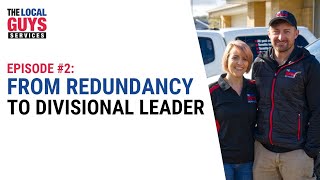
Shaun and Renee Goulding went from Shaun's redundancy at Holden to running the pest control division of The Local Guys franchise. They explain why they chose a service business, how they train new franchise partners, and their plan to expand nationally.
Questions this video answers
Since 2000 (about 23 years, as stated).
Married for 14 years.
14 years.
About eight or nine years ago (as Shaun states).
Seven years.
Chapters
Okay, no worries. So, Sean and Renee, welcome. So, yeah, so the reason why obviously we wanted to get you in today is to learn a little bit more about yourselves and what your role is at the local guys. So maybe we'll start off with that. Can you tell us what your role is at the local guys and what that sort of entails?
Yeah, no problem. So my role at the local guys is the pest control divisional.
Yeah.
So what that entails is obviously overseeing the pest control division, training the new guys that come on board, being there as that support for the guys that are in their business. Basically just making sure everything runs smoothly for them.
Yep, perfect. No worries. So Sean and Renee, you're obviously husband and wife. Yep. So partnership in this endeavor, which is great. So tell us a little bit about your guys. How long have you been together for and stuff like that. So we've got a bit background.
Yeah, no problem. So been together since high school.
Yep.
So the year 2000. So 23 years. Married for. Do you want to have a guess?
Married for 14 years.
14 years, yep. Yeah, that's out. Beautiful.
Yeah. Three young boys.
So. Yeah, yeah, beautiful. So. So if I understand you correctly, essentially your role at the local guys is to support new Franchi partners who are looking at joining or interested in joining the local guys in the pest control division and then to provide support to any franchise partners that have gone to to assist them in growing their business. That's basically how it works.
So they brand new into the industry. So very green. So it's my job basically to enrich them with my knowledge and ensure that they are living up to the local guy standards and basically performing, you know, good pest control work out there.
Yep, yep, perfect. No worries. And what about you, Renee? What's your role within all of this?
So my role is I get to have a good of a bit of a chat with, you know, potential people coming on board. You get to know them, get to talk to them about how we are, how we've started.
So you're that first point of call.
Yeah.
Someone. Yeah.
Interested, Definitely. Yeah. Just tell them our story and basically see how they go from there.
Yep, okay. No worries. Perfect. And could you maybe tell us maybe if you can start, Renee, and then we'll hear from you. Sean, what were you doing before you started this pest control journey? What was your former life like?
Hairdressing.
Yeah.
So clearly.
Perfect.
Always good for a chat.
Perfect. Perfect.
Love to chat.
Yeah, yeah. I couldn't think of a better way to get understanding of being able to chat with people.
That's it.
That's great.
No worries.
And what about you, Sean?
So basically straight out of high school, my first job was at Elizabeth Holden manufacturing facility.
Yep.
So being on the assembly line.
Yep.
Help building the Commodore and the crews.
And how long did you do that for?
I was there for 14 years.
Wow.
Until that went bust and forced to look for a new job.
Yep. So Holden's for those that don't know, is a huge employer here in South Australia. When did Holden's close up?
That'd have to be eight or nine years ago.
Yep. Yeah. Yeah. And how was that? I mean you've been there a long time. How did that sort of. Can you tell us a little bit about that experience at that time of your guys lives? And I understand, you know, pretty good money there. They looked after you pretty well. An ex Holden's guy myself quite as long as you, but I was there for a few years. So yeah. Can you tell us a little bit about that experience when that came up? No problem.
So yeah, obviously it was a little bit daunting in the beginning being told that you're going to lose your job.
Yeah.
Especially in something that as you said, is so well paid and comfortable. It was easy just to ride that wave for as long as you can.
Yeah.
But it really, it was a blessing in disguise for me because I was always looking for something else but didn't have the guts to get out there and do something.
Yeah.
And this sort of pulled the trigger for me. So yeah, I actually saw it in a different light that it was a good move for myself.
Okay, okay, so. So talk us through that. That time. So this announcements come out, how are you told?
A lot of it. You heard through the news rumors. We sort of knew that it was coming a long way out. It just gradually grew in numbers by how many they were going to let go at a time. It sort of, you know, there were three shifts there, then it was going to go down to 2 eventually 1. And we were pretty confident that we'd be staying on the one shift there. But then eventually that got.
Because they were running 24 hours there.
Yeah, 24 hours.
So it was what a day, an afternoon and a night shift, correct?
Yeah, yeah. So you know, a big operation. So. And you know, being an Australian icon like the Commodore, you didn't think that was ever going to die. So.
Yeah, it sort of did come.
As a bit of a shock. But yeah, like I said, it was something. It was a blessing in disguise for myself.
Yep, yep. So they tell you I Mean, you can see the writing on the wall a little bit. They're starting to reduce the night shift, starting to reduce the afternoon shift. And you know, you can see, all right, this is the writings on the wall. So what's the thought process for yourselves at that point? You're thinking, you gotta find something else, obviously. How did you come to the conclusion of, you know, do I wanna, like, why didn't you just go get another job? I guess is the question.
Well, basically, so we got given a redundancy package for leaving Holden.
Yep.
So we had a little bit of money, depending on how long you'd been there. So we had some money to spend or to bank. We had to decide what we're going to do with that. I could have quite easily just gone and got another job and maybe kept that money and put that towards the mortgage or something like that. But we had a discussion about it and I really didn't want to get back into another dead end job. I wanted to invest this money, I wanted to do something with it. So I saw it as an opportunity to invest in myself instead of taking the safe way out and just investing it back into a mortgage or something like that.
Yeah, so you said another dead end job. So is that how you sort of saw what you were doing at the time?
Yeah, pretty much. You didn't require any sort of prior skills or knowledge to become a worker in that type of industry. And there was ways that you could work up through the ranks, I suppose, but you would eventually get to a point where that would stop. You need extra education to get any further.
Yeah, yeah. So you sort of thought where, where you're at, kind of where it's going to be for, for the most people. Correct?
Yeah.
Yeah. Okay. So, so how, so how was that for you, Renee, at that time when you hear about this? Obviously Sean's bringing in a good chunk of the, the income for the business, for the family household. How do you process that?
Yeah, it, it is stressful at the start because you, you don't know what's going to happen. You don't know how quick he's going to be told. Right, see you later. You've got the tap on the shoulder. You're out first one. Yeah, so yeah, it was a little bit of a stress for a while there, but as soon as Sean looked at it that way in a positive way, I knew that he was going to make the right decision.
Yep.
And I think it was a good move for him because like you said, he was just stuck in a A mundane job, just doing the same thing day in, day out. Didn't really have any drive. So doing this for him.
So the conversation happens obviously at some point between the two of you and. And you're saying that you want to put your money into something where you can, you know, potentially grow something for yourself and, you know, have a. Have a crack at something else. Yeah. So then how does pest control come into that equation? You know, like there's a million different businesses, a million different franchises that you could look at doing. How did you come across, how did end up becoming pest control? Was the thing that was ticked enough boxes for you to move forward with that.
Yep.
So obviously I was looking for. Well, I decided that we were going to look into something that I could possibly work for myself and make a career working for myself. Instead of, you know, answering to a boss, I could become that boss. So that's the type of path that we went down. And then it was a matter of choosing the industry.
Yeah.
So what we looked into was. Well, actually plays a big part in this is the people that you know.
Yeah.
So the advice that you get from friends and family. Yep. So one of my uncles was actually a pest controller.
Yep.
We talked to him a little bit about pest control. Obviously yourself was in a service based industry. You told me the pros and cons about service based industries.
Yeah.
So basically I just went through the service based industries and sort of had a look at what industry I think would fit for myself.
Why? Service base.
Service base. For me, the big part about choosing that would be the repeat business, the low cost involved in running a business and high profit margins. But the number one thing is that service base is a repeat industry. So there's that cash revenue always coming in. If you do your job correctly, it should always be a revenue there.
So like now, for example, you've got a business where you've brought your brother into the business. Obviously yourself and Renee are in the business. And you know, I know that you've got a very successful business and we struggle to send work your way, let alone get stuff in because you're quite booked out. Yeah, yeah.
So exactly why I decided to get into it, you know, that repeat business. But then pest control, I decided down that avenue because it's something I looked at, is always going to be there. There's always going to be a need for pest control. It's not something that is going to be taken over by a robot.
Yeah.
It's going to be something that's been required. There will always Be pests. So people always have issue with pests. Yeah, that was a big part that.
Played it as well, I guess. One of the one true global services. This doesn't even matter what it is, you know, it has. Has to be done, I think even.
Exactly.
Yeah. No, it's. Yeah, that's fantastic. Okay, cool. So had some family members, had some friends that were kind of in the industry, pointed in the right direction. Service based seemed like. So it ticked a lot of boxes for you. So you then didn't know that industry at all. You've joined another franchise, one of the bigger pest control franchises around. How long were you with them for?
So I was there with them for seven years.
Yeah.
I can't say a bad word about my experience with them.
Yep.
They taught me all the knowledge that I needed to know and I bring into my business today. Yeah, yeah, yeah. It was, it was a really great experience. I enjoyed my time there.
Yeah. Great, great. Fantastic. Okay, so you know, seven years in and, you know, the business is pumping along and all the rest of it. So before we go any further, how did you find work, life balance, you know, or just life in general really? I suppose like coming from being at Holden's where I know you're on a production line, you're pumping out 300 plus vehicles a shift. Yep. You can't. You got to put your hand up to go to the toilet, literally. Because otherwise the vehicles just keep going past and. And no one's putting that part on or doing that part to it. How did that sort of differ from now? Being a small business owner and doing your own thing?
Obviously it's a lot different. You're your own boss, so you can pick and choose the days and the times that you work. What I really enjoy about it is that I'm able to make my life work around work and not the other way around. Previously, you know, you set times that you have to be at Holden. So therefore, if your knockoff time was past the school knockoff time, you didn't have the opportunity to go pick up the kids from school. Yeah, but now I don't. If I want to pick up the boys from school, I don't book in jobs around that time and ensure that I'm there for them.
I'm there for their sports days, parent teacher interviews.
Yeah. So I'm sure a lot of people, like, specifically people that, you know, listening to this podcast would want to know more about that because they might be doing some due diligence or doing whatever and seeing if it's the right fit for them. So what does a typical day look like in your household? How does it work? How does your typical day look like when you're at work, when you get home? All that sort of things just give us. So basically, warts and all, give us everything. Yeah.
We get up in the morning to get the boys ready for school. We get ready for work ourselves.
Yep.
We take the boys to school. We're able to take the boys to school. More often than not, we leave the house at the same time. So if Renee isn't able to do that, I'm more than capable of doing that also.
Yeah.
And then basically I get into my day, I make sure I've already had my day scheduled out, so I already know what time I'm going to finish. If boys have trainings on certain days, I'm ensure that I'm not working any later than I need to.
Yep.
And I just move that into the next day. That's what I love about it, is that flexibility. So, yeah, I can have that day look any way that I want.
Yeah.
So every day can be different. It works, as I said, it works around my life and not the other way around now.
Yeah, yeah. And. And what about weekends or any of that sort of things? Because I know you have sport commitments, so how does. Because pests can come at any time.
Yeah.
It could come at 3 o' clock in the morning or whatever. So how does your life work in with that, with that side of things?
Yeah. So honestly, I try not to work any weekends if possible.
Yeah.
On the rare occasion and emergencies, I can go and help out a client.
Yeah.
And I have done that in the past.
Yeah.
But more often than not a client will be able to. It's not an urgent matter that addressing there. And then they can wait till Monday.
Yeah.
Where I can get to it on Monday. I try not to work at all on the weekends. That's my family time.
Yep. No, that's, that's completely fair. And I know that where you're at in your business, you know, we've got other, like, I see it as a spectrum and we've got franchisees on different parts of that spectrum. And you're obviously quite an experienced and far down the path on the, on the spectrum. So you're, you're able to be at that point where you can kind of. You don't need to work weekends or other, other guys that are just coming in and you know that have just paid a bunch of money for the, the franchise and maybe a new Vehicle and all this sort of stuff they might want to collect. We've got some franchise partners here that just want everything they can possibly get.
And that also comes down to each and every individual. Some people like working on the weekends. Yeah, that's up to them. They can work on the weekend if they, like, run their business however they like.
And I guess that's the beautiful thing about the franchise over. You know, if you're an employee, if you. If they need that coverage over a Saturday and Sunday, you're on a rotating Saturday, Sunday shift. And it just is what it is. You try to work, basically. Yeah. So you get the benefits, but you also get the downside as well. So, you know, like, it's. It's whatever works in with your lifestyle. Correct. Yep. Okay, cool. No worries. So. So obviously now, like, what. What prompted you to make the transition over to the local guys? I guess you've got this business that's pumping along. You've been doing it for seven years, and then you've looked at transitioning out to join the local guys. Talk me through that thought process and how that was decided between yourself and Renee and. Yeah, yeah. Okay.
So in the initial stages, quite frankly, it was Jared that come to me that said, why don't you expand what you're doing? You've got the knowledge now to push even further.
Yep.
You've sort of gone down the same path yourself. You had a vision. Explain the vision to myself.
Yep.
Renee and I weighed up the options, whether that was right for us to go down that path.
Yeah.
And we agreed that it was time to expand, share knowledge.
Yep.
Help other people grow, basically.
Yeah, yeah, yeah. No, definitely. And how have you, like, because for me, that's one of my favorite parts about being in the role that I'm in now is, you know, you have these new franchise partners that come on board and they risk everything on you, like, under your back, basically. And they're like, yep, you know, I'm putting all my faith into you. And I've been a franchisee a couple of times before as well, so I know the exact feeling of doing it and just going, here's a bunch of money, and here's this. And here's. I'm quitting this job that might be paying whatever it's paying, and I've still got, you know, liabilities, and I've still got expenses, and I still might have a mortgage and all this other sort of stuff, and I've just got to trust. Trust the process. Exactly. Yeah.
It's a whole different Kind of emotions. It's exciting, it's. It's scary. It's everything mixed into one.
Yep. Yeah.
No, it's a good way. Yeah.
That's what makes you feel alive.
Yeah, yeah, yeah, yeah.
You just got to look at it that you can make anything work.
Yeah.
You've got it there, you've got the tools there, you've got support there.
Yep.
It can happen.
Yeah. Yeah. And I know, like, that's. Yeah, that's one of the most rewarding things on my end is, you know, we've seen like even one of your franchise partners comes to mind who's, you know, had a. A huge first month and just came in and was just, you know, basically just completely overwhelmed with emotion.
Yeah, yeah.
Just basically gave me the biggest bear.
Hug ever because he had. He had all those apprehensions in the start about taking the plunge and whether this risk was going to be worth it or not.
Yeah.
And after seeing results after that first month, he could not have been happier.
Yeah, yeah. And we're going to get him on. We're trying to get him on and we'll get him to tell us his story.
He's got a good story.
Yeah, yeah, yeah.
And I think, because we can actually relate to. To where they're coming from as well.
Yeah.
So we know what it's like to start out. We know the nerves and things like that. So I think people actually get that from us as well.
Yeah.
They understand that we're not just.
You're real people.
Yeah, exactly. Yeah, that's exactly right.
Yeah. Yeah. No, no, 100%. And I think that's. That comes through massively. I think if you're just this big corporation or this big, just pumping out franchisees like a machine.
Yeah.
It's. It comes through very quickly. So I think being just real people and we're all just trying to. Was it. High tide raises all boats. It's just about. That's the concept here, is we all sort of rise by the same sort of hard work together.
That's what I love about it is that family, team environment.
Yeah.
Where we're all in this together.
Yeah. Yeah. So tell me, what do you. What would you say to. What do you think makes the most successful franchise partners when they come on? Like, what's the sort of things that you're looking for when you're talking with people when they're still a franchise candidate and you can go, yeah, that one's going to be fantastic. Or that one's, you know, we're going to have to mold a bit and stuff like that. What are those sorts of things that sort of pop up in your guys eyes? That.
That's probably a really good one for you.
Yeah.
Talks to them.
Yeah, yeah.
I think people skills as well. How you talk on the phone. Yeah. You're not a fake person. Just. Yeah. I had one franchise partner that I was talking to and we were talking about football for most of the conversation as well.
Yeah.
And just that general chit chat and just to feel comfortable. I think that was great. Yeah, I love that. Just. Yeah, they didn't. Yeah, they didn't feel they had to answer with fake questions.
Yeah.
Just be who you are.
Yeah, yeah, yeah. No, absolutely.
Anybody that can hold a conversation come across as a friendly, honest type person, they're the ones that are gonna thrive. Because we can teach alone. Yeah, yeah, yeah, yeah.
And we can teach skills. We've got all we've got. We've just been recording for 4K HD training videos. We've got all that online. We've got access to you. You hold their hand through the onboarding process. All of our licensing and all that sort of process is all there. The ongoing support's there. It's just having someone that. Yeah, you can teach skills, you can't teach attitude. Yeah, 100% definitely agree. Completely agree. Okay, no worries.
So.
Now we're in multiple states already and we're growing rapidly. What do you think you enjoy most about the role?
About the role is dealing with different personalities. One of the things in the beginning that I was sick and tired of about Holden was the mundaneness of it. In this role, each and every day is different. There's a new task. There's always different problems to solve. So it's exactly that. It's that making feeling alive, basically.
Yep.
Not being stuck in a rut and helping people out. I love being able to. The new franchisees come to me with issues that they've come across and being able to help them through that.
So that leads me on to my next question. And what sort of support, like for someone who's coming from the outside looking in, how does that support look like? How do you provide support to people. Yeah. And to your franchise partners?
Well, so the number one thing would be being available. So whenever they run into an issue, all they've got to do is pick up the phone.
Yeah.
And I'll be there. If not right there, and then as quick as possible.
Yeah.
They will send me through text messages, pictures, whatever it is.
Yeah.
I'm there to help them out. That way.
Yeah.
So that's the first point. But the second point would be ongoing support would be like making contact with the franchisees on a regular basis.
Yep.
Just checking in, seeing how they're going. I understand what it's like to run a business, especially in those early days and how stressful it can be.
Yeah.
So even just somebody to be there to lend an ear to, to talk to. Yeah, I think that's, you know, if you were in, went out alone, you don't have that support. Yeah, that's what I'll. My role is to be there for them and help those through. Help them through those tough times.
Yep. Yeah. And I know Renee, you help a lot with the admin side of things and whether it's licensing. Yeah. All that sort of stuff. Well, so they've got sort of the technical side, which I think is more Sean's side and then your side for the back of house.
Yeah, definitely. And I'm the same. If they can't get hold of Sean, look, they can pick up the phone and give me a call if I don't have the answer. Obviously I'm not a technical side of things, but I will do my best to help them out and just provide my support from them as well. So they know that. Yeah. They can call either one of us and we're there for them.
Perfect. Perfect.
No worries.
So what do you think.
Your biggest achievement has been so far in this whole crazy journey to where you guys are now and where you're going with the business and all the rest of it? What do you think your biggest achievement is today?
Probably bringing on my first franchisee.
Yeah.
I didn't think that I'd ever play that role at all.
Yep.
Even when we agreed to come on board to step into this role, there's still that apprehension. It's just like beginning your own business all over again. Is that. There's that self doubt.
Yeah.
But then seeing that first person come through and be successful straight away, that's. Yeah, that's my biggest achievement, I'd say.
I remember first one that I spoke to more than anything.
I remember when Sean was training up the first couple of guys and I think we were talking on the phone.
Yeah.
And we were saying it's, you know, they're hanging off every word he's saying. Yeah. Because to Sean it doesn't seem like.
No, he.
That big of information.
Exactly.
It's. He's got this platform. Yeah.
Yeah. And I've always tried to push him to say, I believe that you can do it. You have to believe that you can do it. He was never a talker like myself, you know, I can talk to anybody.
Yeah.
But, yeah, watching those guys actually listen to him and take it all on board, I think he really felt that as well.
Yeah.
And it was nice to see him actually believe in himself.
And now it's just.
And now it's just second nature.
We've got new franchisees starting next week and it's just like business as usual.
Get him in front of the camera as always.
Yeah. No, it's nothing now, is it? No. That's great. All right, cool. So we're just finishing up now. I think the last two questions I've got is where do you see the pest control division heading over the next 10 years? Where can you see going to and. Yeah. What sort of things? Where do you see the direction of it? Yep.
So I guess what we were just talking about, my biggest achievement today is bringing on that first one. My next achievement would be to have one in every state.
Yeah.
We want to have the whole of Australia covered, basically. We want to be able to provide this service Australia wide.
Yep.
So that would be the next step for us.
Yep. I know national clients is one that works extremely well in the test and tag side of things. So I think that that's going to be a great milestone to be able to then provide that national service to a lot of clients.
We can get that national brand recognition that we can provide that service Australia wide. There's only going to benefit the franchisees that come on board and we all grow together completely.
Yeah, no, I think that's very, very, very true. Last one. What's your favorite pest to deal with?
My favorite.
Yeah.
Is there a favorite?
That's a given. Yeah.
My favorite. That's a good question. It's pretty hard. There's so much food, variety. There are my least favorite person to deal with, but I don't think I really have a favorite person.
No.
No.
Yeah. And I think that's the thing about pest control, isn't it? It's like, you know, we've talked about it a lot in the test and tag side of things because our job, we've got a few different services we offer. There's a bit of variety there. But. But pest control is, you know, how many different? How many different? I don't know. Yeah. How many is there?
We're just going through the videos earlier. I think there's at least 20 different services.
Yeah.
And we're still each and every one of those services. Can be different each and every day. Yeah, yeah, yeah.
It definitely keeps you on your toes, doesn't it?
Exactly. That's what I like about it. It's problem solving.
Yep.
So it keeps that mind ticking over, and you keep the mind young, I suppose.
Yep. Beautiful. All right, well, thanks very much for that, guys. I learned a few things, and I think that that was hopefully really valuable to. To a lot of people. So, yeah, very much appreciate putting these guys on the spot and bringing you in and having a chat.
Have Renee by herself next time, okay?
No, let's not.










