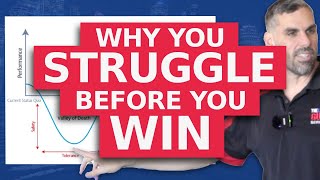
When you start a business or learn something new, you hit a dip first. The J Curve shows why: heavy investment and effort in years one and two produce little return, the Valley of Death where most people quit. Year three is usually when it flips. Daily small actions compound, and by year five or six you're stable. Buying extra franchises early is usually a mistake.
Chapters
Once you're over here, obviously it's happy days and all the rest of it, but you've got to be able to get through this patch here. This is like kind of the danger zone, right? So we've got to be really careful whilst we're in this zone. All right, so we're going to talk about a little thing called the J Curve. So the J curve is the cycle of any business. So very similar to a rocket being fired off. The rocket uses 50% of its fuel, only getting off the first few feet off the ground. However, as momentum starts to kick in, it gets easier and easier. We can see this analogy applied to any aspect of business, such as finances. It might be money coming in and money going out. It could be time and energy or resources. And it's important to be aware of the J curve because starting a business venture can overcome pitfalls such as the Valley of Death there, which I've called it the Valley of Death, which is an amazing name to call it, I think. But basically, let's look at this. As far as, like, money, for example, you guys just went through and you're down here somewhere, just spent a bunch of money out for the franchise and maybe a vehicle and all this sort of stuff, and you've had all this money going out and you haven't had any coming in yet, right? So that we're going through this process now of, like, learning and going through all this sort of stuff and getting it all right? And then as you kick off next week, then all of a sudden, you know, you get your first lead, and then all of a sudden, oh, it's a week later, or if I start to get paid, and then you're cruising along and you go over there. Once you're over here, obviously it's happy days and all the rest of it, but you've got to be able to get through this space here. This is like kind of the danger zone, right? So we've got to be really careful whilst we're in this zone. If you can also put this down to say, like, building something in energy or whatever. So the other one that I like to use is like, imagine, you know, has anyone tried to play an instrument before? Everyone had a go. You played bass, so you were successful. So you know how to play bass guitar. Okay. I was one of the ones that dropped off, right? So I've got two guitars at home. I got an acoustic guitar and I got an electric guitar. So you know exactly what I'm talking about. And these guys, whether it's Any new skill that you've tried to learn, new language, anything, right? Any new skill. You start off right here at the beginning, and it goes up a little bit because you get really excited. You get this guitar in your hand. You're like, oh, this is amazing. I'm going to learn all of these new skills and all this, like, I'm going to be, you know, on the AC dc, like, learning all this. It's going to be great. And then you realize that I've got to start with like, happy birthday or something silly like that. And I've got to do learn the F chord. Well, that's one's really difficult. And I've got to learn the C chord. Oh, that one's not too bad. And then D chord and all this stuff, and it's almost like being a child again. You've got to slowly get back. And what happens is the energy and all the rest of it starts to drop off. And you're going, this is not. This is hard work. This isn't fun, like. And what happens is you get into this area, into here, okay? And this is where most people tend to drop off. There's where most people go, this is just too hard. I'm just going to drop off. It's too much for me. And they either go off this way here and they just drop off, or if they just keep persistent at it, maybe 10 minutes a day, a little bit, little bit, little bit. And you keep pushing and you keep pushing. You get to this other side over here, which is beautiful. And then all of a sudden, you can pick up a bass guitar and you can just play songs and you can play all those things, and it's really, really cool. So you want to be mindful when you're in this area here with stick starting a new business or whatever. And what the thing is, you just got to trust the process and you just got to keep pushing and you just got to go a little bit more, a little bit more, a little bit more. And what you find is, as you get over here now, I've got franchise partners. We've got, you know, nearly 100 franchise partners. I've got guys and girls all the way along this spectrum, right? And it's so funny because we've got some guys that come into the office and they're over here, right? And they're making all this money and they've got all this momentum and it's so fantastic. And all the rest of it and all of the team in the office go, oh, he's so friendly. He's so happy. Happy and nice all the time. He's just doing a good mood all the time. And I go, yeah, you should have met him three years ago. He was as stressed out as anything or whatever because he was down here. And I've seen him go through the whole cycle. So that's my big part of my job and our job working together is to get everyone from this side to this side over here. So I think just being aware of that and when the emotions kick in and all the rest of it and you're feeling it so hard, all the rest of it, just know where you are on the J curve. I think it's just helpful to know that. And then all of a sudden you can start to go, right. It's just my emotions kicking up. I've just got to stay, keep going with the bass guitar, keep going with it. Because I know if I keep doing a little bit every single day and stacking up those everydays, all of a sudden I'm on this other side and great things are happening. So just an important one. I think that's, that's really helpful on there. I'll play a little video on the J curve that will just talk a little about a little bit about it. Well, here's an example here. So you can see here in you purchased the business, your car, you've set yourself up. It's expensive but it's worth it. You focus on building your business, taking on as many jobs as possible and building your client base, working hard on marketing your business during the quieter times. In year two, you keep building your business while enjoying the repeat clients from your first year. You continue marketing while your schedule starts to build up in year three. This is where things really start to kick in. In service based businesses. It tends to be year three things just go out of like sight. You enjoy your repeats from your first and second year and you continue building your business even more. Typically speaking, when people tick over from year two to year three is when I see this massive shift in them. It just like all of a sudden they're just like, I've made it. Like success is basically a foregone conclusion. Now like that is where I see everyone's shoulders drop and all of a sud they're just like, I'm out of the fire now. I'm now just like building off this battleship rather than this kayak. And the things are really good. So that's our job is to be gazelle intense in year one and year two to really get to that other side of it. Now, do some people get there quicker? Of course they do. It depends on the market, depends on this, it depends on their effort level and all the rest of it. But typically speaking, that's what I want to prepare you guys for is for that one to two years of that real strong build, knowing that in year three when things are really start to get like super enjoyable. And as I said, we've got guys that have ticked over to the fifth and sixth year, fifth year in the local guys and every time I talk to them now they've got a few staff members and stuff like that and they're just like, it's great, we love it. It's just. Couldn't be better. Yeah, yeah. So when people expand their business, for example. Yeah. They expand clients or they say, hey, I'm going to buy one more franchise there. Normally clients, normally I try and talk people out of buying additional franchises. You just don't need to, to be fair. I mean, I'd happily take your money, but I, I really don't think you need to. I think that you're, you'll, you will be able to build enough with the, the fr. The, the territory you've got and all the rest of it where the, the clients will just build and you'll be able to onboard staff with just the one territory.