05 - REAL PEOPLE, REAL ISSUES - "CHILDHOOD ABANDONMENT AND TRAUMA"
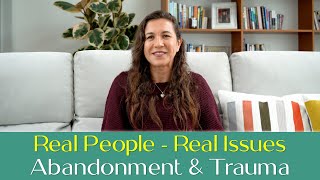
A recorded conversation (YouTube) between Dr. Karol Darsa, Psy.D., and an anonymous guest exploring the guest’s lifelong sensitivity to abandonment originating in early childhood. The guest describes being raised primarily by grandparents until age six-and-a-half, then returning to parents, and later experiencing intense grief reactions to adult relationship losses. Dr. Darsa frames the issues as relational/attachment trauma, explains implicit (body-stored) memories, and recommends body-based trauma work and addressing self‑abandonment alongside memory processing.
Chapters
Hi, I'm Dr. Carol Darca, author, trauma psychologist and founder of Reconnect Integrative Trauma Treatment center in Los Angeles. Welcome back. Today we're going to talk about a completely different topic. Until today, I've been talking about different topics that I've published in my book the Trauma Map. But today I have decided to do a mini series of real life people and talking about their different issues and to find out whether it's connected to trauma and really allow people to ask me specific questions. So if you're very interested in being a guest on the next videos, please first of all subscribe so you can get my videos and then you can contact me with my email address, Dr. Darsareconnect center.com you see it right here. And if you can email me, then I'll invite you to be my guest and you can be here and you can ask me any questions that you have about trauma and I can offer you some guidance. So I have my first guest today. This is all anonymous, so I will not be sharing her name. And this is actually an option for you as well. She's sitting right behind the camera and she's going to tell us a little bit about her life and her questions. And I'm hoping that you all will relate to what she's sharing. So microphone is yours.
Hi. Thank you for having me, first of all.
Thank you.
It's a pleasure to be with you here today. So I've had therapy for a few years with different therapists. And recently, first of all, I'm 50 years old, in my mid-40s, I discovered that I can't get any results. And after a few sessions with one of the therapists, I sort of realized that my issues were not actually connected to a betrayal, to a divorce, or to other problems that occurred in my mid-30s or maybe early-40s, but they're connected to some other major event and it dates way back to my infancy. I'm still trying to figure out if this is. If, yeah, if this is a trauma or not. But I want to tell you briefly about it so you can tell me if this needs to be treated as a trauma or if it's just some other problem that can be solved with basic therapy.
Okay, so.
So when I was born, like as soon as I was born, I was the first grandchild of both sides of the family, my maternal grandparents and my paternal grandparents. And since I was the first, both sets of grandparents were literally obsessed with me and my grandma on my mom's side. I don't know how to say this, but literally hijacked me and I physically moved to her house. I was raised with incredible amount of love and compassion and I was spoiled to death. And my life as I knew it then was just perfect. I was not aware, since I was very, very young, I wasn't aware that I was missing my parents because I probably saw them every other day. They used to live very close to each other. But my infancy and my toddler years, of course I can't go back all the way back to infancy, but I remember three, four, five years when I was going to preschool. I remember leaving my grandparents home and then after school I was returning to their house. This continued until I was six and a half. And at that age I was supposed to start elementary school. And I was not literally, but let's say figuratively ripped away from those two people who loved me like crazy. And I went back to my parents house and I started living with them. And during the subsequent years I remember having like Friday night dinners with them.
With your grandparents?
With my grandparents, with my parents and my grandparents in my grandparents home, which I knew as my own place, place where I grew up. And of course after dinner my parents would try to take me back home.
And.
I remember being on the floor crying and never wanting to leave. 40, 50 years forward, I'm trying to understand if this has caused an abandonment issue, an abandonment trauma in my own life, or is this some other issue that can be treated in some other way. Because I went through a divorce, I went through some failed relationships and I always connected them to a divorce or to a betrayal or to this and that. But as I read, as I researched more, I think I'm starting to understand that this might be related to my very, very early years in life.
Right. You know, there's no specific formula that says, yes, this is trauma or this is not trauma. It completely depends on the person and the person's reaction and everything surrounding the event. So one of my first questions to you is, do you find yourself feeling sensitive to being abandoned or rejected by other people, including romantic partners or friends?
Yes.
Okay, that's a good answer based on your history. So if you didn't tell me your history and if I knew that you were sensitive to abandonment, that's probably what I would have asked you.
Extremely sensitive.
Okay. So that means that was a trauma for you. And this is an important thing to, for you to know because a lot of people think trauma has to do with some sort of a physical injury oriented stuff. But there's a really Something that we call relational trauma or attachment trauma. In your case, you had good attachment, but still being ripped away, even as an infant, from your mom. Because even though you may think as a mom, as an infant, I don't know, the separation from my mom, there's. It's not possible that you don't know. You know it because you are in her body growing up there. And then. So being taken away from your mom is. Could be one trauma, then taken away again from your grandma, could be the second trauma. And then subsequently, of course, I don't know the rest of your history, and it may not be relevant here, but if you are suffering now from that, my biggest suggestion would be that you go back into that memory and find a good, supportive therapist and to help you to process what has not been processed yet.
I think I found her.
One. One important thing is that because you were so young, a lot of the memories might not be explicit. They may be implicit, which means they're sitting inside of your brain or inside of your body. So it could be even sort of somatic reactions. So when you work through this issue in a different way, not just like, oh, yeah, I remember. Okay, I understand it's one thing, but to digest, to process, and to really have a healing with that memory and with your younger self is a completely different process that probably might have to happen.
Okay, I remember during my sessions with one of my therapists, she asked me. It was the first time, actually. She asked me to go back. And I said, back what? Like when I was 14, this happened to me with a boyfriend when I was 13. And she goes, no, no, no, no way back. And then I was really puzzled because I'm. I couldn't remember what's way back. Yes, she said, you will be able to retreat, retrieve. I'm sorry, your memories from your toddler years, from your infant's years. And I really sat down and thought long and hard, and for the life of me, I couldn't.
You can't cognitively. That's the reason why when I do trauma therapy, I use the body because the body remembers it. So the body has ways to actually access that information. So there's a whole protocol that one can follow. So it's. It's like when you get in touch with that sense of abandonment, and then you connect that sense of abandonment to how it feels in the body. And then we go into the body. So you're not trying to dig into your head, but you, in a way dig into your body. Then you may be able to come up with either the memory or the feeling of how it felt when you were that age, because there's been a sort of disconnect from that. And cognitively that makes sense because we don't develop a capacity to hold memory that young. This is the reason why we do it in a different way. So bypassing the thinking brain is basically how you eventually access that time. By the way, I need to add one more thing. It's not required that you remember in order to heal. It's about connecting to the feeling and finding a way to heal with that young part. So even if you don't remember anything else, but with what you just told me, now it's sufficient to work on it.
I remember in my teenage years, I used to see my girlfriends really being friends with their moms and really connecting with their moms and sharing girly stuff and doing girly shopping and this and that. And I always felt a little off or awkward that I didn't feel that closeness with my mom. So, of course, in my later years, when I discovered that this might be related to my infancy, I thought, there you go. I never formed that sort of maybe closeness with her when I was very little. And then I couldn't really connect with her in my later years, which, I mean, now that I'm 50, I'm very close with her. Like, we sort of recovered all a lot of stuff. We became really good friends and we care for each other. I never for once doubted that my parents, you know, love their love. I never thought that they abandoned me. They were very young, they like to travel, and they. They had a very busy social life. And I knew that. But still, like I said, when I look back right now, I'm thinking. And of course, based on the stuff that I've read in the last few years, I'm thinking that, yeah, maybe the problem stems from there.
Well, the first three years of your life is when you really find creating the deep bonding with your parents. So you had some bonding, right? But it's not in the same way because they were secondary. They were your secondary parents. How about your relationship with your grandma? Did you feel like you felt, even as an adult or as a teenager, closer to her?
I don't know how to put this. She was obsessed with me. It was beyond love. They loved me in a way that I cannot even explain. And I felt it so deep inside that I respected and loved her back more than I loved, you know, someone else in my life. Like, until she passed every Mother's Day, I used to call her first. Now that I was living, you know, like thousands of miles away from them. I called her first to wish her a happy Mother's Day. Then I called my mom, and her loss was a huge, huge trauma for me. I can't really use the word trauma now, now that I've read your book. Of course it's a big word. It has a lot of meaning. But, yeah, her loss had a huge impact on me, and it took me many years to come to terms with it. But I know I was loved unconditionally. I was spoiled unconditionally by both my grandparents and. Yeah. Age 50. And now we're talking about 50 years later.
Yeah. You know, another interesting idea comes to my mind because we're very much focused on sort of seeing the relationships outside. Right. Because this was a relationship. So I was abandoned. And now I'm sensitive to other people's abandonment. But there's another way to look at that, and that's something where you can do, because you can never control someone else abandoning you. Right. They can. That's how people are. And you see this in my book a lot, too, about sort of the self abandonment. Because if you are abandoned in some way, even though you had love, so yours is even a little bit more tricky than a sort of a traditional abandonment where you really were left by your parents. You are not, but you still felt that. But you can continue to heal that even if you don't do memory work by looking at how you are abandoning yourself. Because if you continue to abandon yourself, you may actually perpetuate yourself more and perpetuate the past trauma on an ongoing basis. So you may ask, how do I do that?
How do I do that?
You look at different ways. Do I abandon myself verbally, Meaning, how do I talk to myself? Is one form of looking at abandonment. Do I abandon myself emotionally? Which means, do I validate my emotions? Do I judge them? Do I accept them?
What?
Or am I getting angry when I have feelings? Because that's another form of abandonment. Do I abandon myself physically? Meaning, do I take care of my health? Do I exercise? Do I eat well? Do I take care of myself? Do I shower? You know, so these could be different forms of self abandonment. That when you heal those and you really pay attention to how your relationship with yourself is, believe it or not, even if you never really go back into the past, you may be able to heal at least 50% of the past abandonment trauma. But you have to be very particularly interested in looking at the subtleties of self abandonment. Because I Gave you the bigger examples, but they're sort of subtle ways of like, dissociation. Being out of your body is a form of self abandonment. Like if your thoughts are. If you're constant thinking, the. Say you're in a relationship and you're constantly thinking about the person instead of about yourself, that's the form of self abandonment. So these are some ways that a person can develop an awareness and heal the abandonment issue. Tell me a little bit more about how it shows up in your adulthood. You said you're very sensitive, so how does this show? Like, how do you react? What do you do with it? Or what kind of people do you attract into your life?
Problem? Well, it manifests itself, I think, in like, major ways in case of an abandonment. Not abandonment, let's call it breakup. You know, in later years in my relationships, let's say in my 40s, any sort of abandonment, whether it be betrayal or just, you know, this is not going to work out, or any other excuse valid or invalid. I literally show physical symptoms of illness. This is. This starts with severe depressive state. Okay, not leaving the house. I'm not a smoker, but I start chain smoking for a few weeks in a row until I literally get sick.
Sick.
I. I don't know if it's punishing myself or not. I. I can't really tell. But I try to tell myself that, you know what, you've been through this before and it hurts in the beginning, and then you get used to it and come next year, you won't be able. You won't even be thinking about this. This man or this relationship. So I try.
So you're consoling yourself.
Constant. There's constant consoling, but the first, I should say few days or maybe a few weeks following breakup. I am literally grieving like, as if I've lost a parent or someone that I love incredibly much.
And do you hear your own words when you say as if I lost a parent?
I think I just said it for the first time in my life.
There's always a reason why somebody says a certain word. It's never an accident. So with that, you can go in deeper into what is that really? How does that really feel, losing a parent? And then you get, if you can get in touch with that feeling, it.
Tells you so much of, I have lost a parent. But to be honest with you, I mean, this is, I think, the first time I'm sharing this. But we sort of prepare ourselves to losing our parents because one day.
Right, but you're telling me this as an adult. You're talking about losing a parent as an adult. But when you react to a loss of a romantic relationship, you are not in that moment saying that as an adult. That loss that you just referred to was not an adult saying, I, I. It's as if I lost a parent. There's like a deeper pain that's connected with that.
Yes. And I don't like that pain.
Exactly. And because you don't like that pain, you do everything to avoid it. And as long as you try to avoid it, the pain will show up in a different way until you become ready to face the earlier pain. Because there's definitely an earlier pain that's surfing it surfacing here.
Thank you. That's very helpful. So I think we'll continue seeing each other again off camera. Thank you very much for your time.
You're welcome. I want to thank my guest again. If you're relating to some of what we shared here, please feel free to contact me at my email drdarseconnectcenter.com this was a real example. This was not prescripted or anything. I just sat down and I said, just feel free to share everything with me, whatever is coming forward. And, and I'm very sure a lot of you are going to relate to the sense of abandonment that my guest was sharing. So remember, trauma equals disconnect. Healing equals reconnect. Please stay connected. Sa.
More from Dr.



58 - HOW DOES TRAUMA AFFECT CHILDREN - IT MIGHT BE MORE THAN YOU THINK - HOW TO SEE SIGNS
57 - GAMING ADDICTION AMONG ADOLESCENTS - WHAT ARE THE SIGNS AND HOW TO DEAL WITH IT AS A PARENT?

55 - OCD - WHAT IS OBSESSIVE COMPULSIVE DISORDER? WHAT ARE THE SYMPTOMS? HOW TO DEAL WITH IT?

54 - ARE YOU NERVOUS ABOUT YOUR FAMILY GATHERING FOR THE HOLIDAYS? I HAVE SOME TIPS FOR SURVIVAL :)

53 - DO YOU HAVE A HARD TIME KEEPING YOUR NEW YEAR RESOLUTIONS? THIS EPISODE CAN HELP