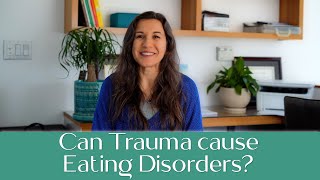
Dr. Carol Darza (trauma psychologist, founder of Reconnect Trauma Treatment Center) explains how trauma can underlie a wide spectrum of food problems—from emotional eating to clinical eating disorders (anorexia, bulimia, overeating). She describes psychological mechanisms linking trauma to eating issues: using food to gain control when control was stolen in childhood; soothing/nurturance learned via food; using weight as a perceived barrier after physical or sexual abuse; and body-disconnection (avoiding fullness to avoid feeling the body). Darza defines anorexia (obsessive refusal to eat, severe underweight, high health risk) and bulimia (bingeing with purging, often normal weight), gives case examples, stresses that eating disorders affect all genders and socioeconomic groups, and recommends seeking specialist treatment. For milder emotional eating she recommends awareness and a delay/distraction technique (start with a 1-minute pause, gradually increasing) and refers viewers to Reconnect Trauma Treatment Center and her book The Trauma Map.
Chapters
Foreign hi, I'm Dr. Carol Darza, author, trauma psychologist and founder of Reconnect Trauma Treatment center in Los Angeles. Today we're going to talk about a different part of trauma issues. So it's food and, or eating disorders and trauma. Well, food issues can really be a whole spectrum from just simple, as simple as emotional eating, which most people suffer from, to going all the way to eating disorders such as bulimia, anorexia or overeating. Right. So we're going to talk about how it's related to trauma and then some, some tools, hopefully that will help you. So a lot of people do not see the connection between how traumatic incidences can trigger food oriented issues because they think the trauma has to happen sort of one to one, meaning you have to have had a trauma around food and therefore you develop an eating disorder. But it does not work like this at all. So let's think of some examples. One very common thing underneath of a lot of eating disorders is actually a sense of growing up in a family where the child has no control or sort of has parents that were very over controlling. And over controlling could look like abuse, right? Physical control, which is physical abuse, could be sexual abuse. But it could be also an environment where there's a lot of strictness where a person does not have a right to really be themselves. And they're constantly told what to do and how to be or how to feel. So this lack of control that a child has growing up can eventually develop into a sense of wanting over control in areas of life. And when a child cannot control their lives, such as, I don't get to decide whether I'm hit or not. I don't get to decide where I live, I don't get to decide anything about my life. Guess what area a child can control? The bodily functions. So they, of course it's an unconscious process, right? So they can say something like, well then I am the only one who can decide what comes into my mouth, what goes into my stomach and what does not. So a child having a sense of control then eventually can make that person feel more powerful. So that becomes a habit as a child. That's sort of one aspect. Another aspect is really the soothing. I'm going to also talk about the cultural thing because in culture we actually encourage a lot of the soothing via the food. So we'll say stuff like, okay, let's celebrate, let's bring the dessert, or I'm not feeling good, let's eat this. So the brain starts making connections between the feeling at what you and what you're eating. So if a person finds some sort of a comfort in a food, or in fact gets nurturance via food, because they might have had parents who didn't show love or affection, but they prepared food, which could be also an affection, then that person learns to soothe their feeling via food. And guess what happens when they're grown up? Then of course, they can start really connecting. I'm not feeling good. I'm stressed today. How am I going to feel good? Okay, I'm going to eat something. Before I go into detailed explanation and examples of anorexia and bulimia, I'd like to read you guys the definition of what each of them means. So let's start with anorexia. It's an emotional disorder characterized by an obsessive desire to lose weight by refusing to eat. So this is not just when, oh, I don't feel like eating, I'm trying to lose weight. This isn't obsessive oriented eating disorder where the person is so preoccupied with their, with their appearance that they really do not eat at all and they are almost all the time underweight. So there's a tremendous amount of health risk and it could actually lead to death. And it has done that many times, unfortunately, in the history of humankind. And the difference with bulimia is, in the bulimia, there's also an excessive worry, of course, about one's own weight, but the intake is greater and instead of restricting the food, it's more about throwing up or purging the food. The purging can happen via exercises, via throwing up, or via diet pills and, and such. So, and, and most of the times bulimic people are within the normal range of weight. So that's the main difference between them. And again, I said there's a spectrum, right? So I'm talking about in general, food issues. But then if you go into more severe eating disorders such as bulimia or anorexia, or again, overeating, then you are probably looking into more severe patterns of issues that were not handled in use. So one of them could be a physical abuse. If the child is physically abused and there is no safety, they can find some sense of safety with eating. This is an unconscious process. Again, where when a person eats a lot and actually puts in almost like layers and layers of fat and weight into their bodies, there's an unconscious process that makes a person feel safe, as if there's sort of like a barrier around the body that nobody can get to. The same thing often happens among sexual Abuse survivors that I've. That I've worked with, some of them actually have done this consciously. They have told me I put on weight on purpose because I did not want to look pretty anymore. Or I felt sort of too exposed when I was skinny and too vulnerable. And as I put the weight on, I felt more protected. So you might be relating to some of these things that I'm sharing. Those are very common. Again, either conscious or unconscious ways the trauma shows up related to eating disorder. Well, with the. So this is when a person puts on more weight, but it could show up also in being too overly worried about weight issues and wanting to look good, or being obsessed with being skinny. And particularly with anorexia, we see that this, in fact, it's never enough how skinny the person is never enough. So they have to be even more and more. Well, when they eat certain food or when they eat food in general, there's a sense of fullness that they feel. Right, because that's why we eat. We're hungry, we eat. And they don't like that sense of fullness. That's. I'm talking about anorexia right now. They don't like that sense of fullness because it makes them feel their body and it makes them feel present in the moment, which is really opposite of how they want to feel. What happens with anorexia, regarding the body connection is that the person now doesn't want to eat, not only because they're really, you know, of course, obsessed with their looks, but it triggers trauma in a very different way. So when a person eats and get a sense of fullness, they start feeling their stomach or they start feeling their body, which is, of course, we have to feel their body. Right, our bodies. But a person who suffered such a trauma may be really averse to eating because exactly that reason, they do not want to feel their body. They do not want to feel the sense of fullness because the fullness could also feel a sense of sort of heaviness of emotions. And in order to get rid of these emotions and not to feel their body, they might have resorted to anorexia, which is, again, the not having much of an intake of food in the body. Let's talk about some examples of what kind of trauma could be underlying an eating disorder. Over my 22 years of trauma psychologist, what I have seen is really a variety. So sexual abuse can definitely eventually result into eating disorder. Again, in order to deal with the feelings that are coming up, a person might eat them away or completely shut down and cannot eat Right. Or they do not want to feel their bodies. As I was saying, physical abuse could be another one. Attachment related abuse, which is relational trauma with having grown up in a neglected family or uncared family or absent parents. Could be a way to just, okay, I don't have my family, I don't have no one. I'm alone, but I have my foot as a friend. Could be another way. And yes, sometimes there are direct trauma and cause kind of thing that can happen. I have one client, I'd like to share this example with you guys that she was, she grew up with a very physically abusive parent. And no matter what she did, the father would always find sort of a way to punish her in a very unusual and very strong way. And in one situation, for instance, if she didn't do what she was supposed to do, she was forced to overeat. And if she threw up, she'd had to go back to eat more. So as you can imagine, she eventually did develop an eating disorder where she had a lot of aversion to certain food. So these are some of the common reasons why a person could develop eating disorder. So I talk about the trauma with that because contrary to the popular belief, it's not just about because the person wants to look good. It has a lot to do with what, how they were raised. And by the way, it happens not only in women, a lot of men suffer from eating disorder as well. So it's very important for us to know that. And it happens across any cultural and socioeconomic status. They do not find any correlation with that. Yet there's a lot of correlation with trauma. If you suffer with an eating disorder, please seek professional help. This is not something you can do on your own. You really need someone who specializes in eating disorder. There are therapists and there are also centers where if you need to have more intense treatments such as a residential program or an outpatient intensive program, there are a lot of great places, especially within this country, that I highly recommend. But if you are struggling with more sort of emotional eating and not really an eating disorder, there are things that you can do. One is awareness. Just really find the connection with your eating habit and your emotional status. Is there a certain time of the day that you are eating more or less right? Is there certain incidents or certain people that trigger different kind of eating behaviors in you? You can watch that. As long as you have an awareness, you have a chance to just really create a change. If you have a habit of jumping into food when you feel dysregulated or when you're upset about something, one simple technique is actually to put in time between the desire to eat and the actual eating. So let's say I got angry at someone and my automatic habit is to go to the refrigerator and take one minute in the beginning, just one minute, just stay aware, notice the feeling and say, okay, is it really hunger? Check in with your stomach, Is it really emotional eating or is it anger eating? You know, a lot of things can happen and then when you notice that, then make a decision. If you still want to go ahead and eat it because the emotion is too big for you to deal with, that's fine to begin with, but maybe that, that one minute, that awareness can help you to just really take back your hand out of the refrigerator and into something else, right? Reach out for, to a friend, go for a nice walk, maybe exercise, put on a song and dance in the in your home, or just read a book, watch movie. There's a lot of way that you can use positive distractions and eventually what you will want to do is you, you increase that 1 minute into 2 minute, 3 minute, 4 minute, and then you'll develop much more capacity to tolerate your feelings this way. As I mentioned, if you need professional help at Reconnect Trauma Treatment center, we can help you with healing on your trauma. We actually have specialists that are nutritionist and eating disorder specialists that help help you while you're doing your trauma work. If you are not from Los Angeles and if you want to know more about trauma also, please feel free, of course, to get my book, the trauma map, or the audiobook and you can listen and get good tools from there. Thank you for watching. Please remember, trauma equals disconnect and healing equals reconnect. Stay connected, Sam.