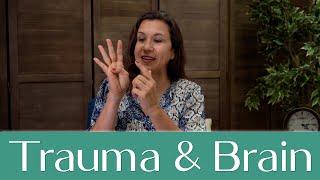
Dr. Karol Darsa (Psy.D.), founder of Reconnect Trauma Treatment Center, presents a brief, practical explanation of how trauma affects the brain using a simplified three-part model (reptilian brain, limbic system, frontal cortex) and a hand-model analogy. She explains that during trauma the rational frontal cortex becomes "hijacked," leaving the limbic/emotional brain to drive fight/flight/freeze responses; chronic trauma can bias the brain toward limbic-dominant functioning. Darsa uses clinical vignettes and neuroimaging claims to illustrate these changes and emphasizes "bottom-up" body-oriented interventions (mindfulness, yoga, breathing, movement, body-centered psychotherapy) to calm the nervous system and restore integration. She references experts (Daniel Siegel, Peter Levine, Bessel van der Kolk) and closes with the message: trauma = disconnect; healing = reconnect.
Chapters
Hi, I'm Dr. Carol Darca, author, psychologist and founder of Reconnect Trauma Treatment center in Los Angeles. Do you know how your brain functions after trauma? In order to be able to talk about this, I need to first explain to you how brain functions. I'm going to talk about in 1976 when Dr. Maclean Paul McLean talked about three distinct parts of a brain. And although it's an outdated sort of formula and explanation, but it really explains well how you react following a trauma. This model is really a simplified explanation, of course, but I like to keep things simple. Simple. So we have three different parts of our brain. The first one is called reptilian brain. This is literally comes from the word reptile because that's very animalistic, very instinctual reactions. And that's where our brain is responsible for these responses. So it's like the survival functions, heart rate, fight or flight response, body temperature and body sensations. So when something happens and when we react a animalistic way, it's not something we think about, it just really happens organically. Well, for instance, if you try to hold your breath, the reptilian brain actually gets activated and doesn't allow you not to breathe. So it's a good function, right? So you can continue to breathe that way. So it's a survival. But what's really important in order to understand how trauma affects your brain is to really understand the other two parts, which is the emotional brain, otherwise known as limbic system, or the rational brain, otherwise known as the frontal cortex. I'm going to show you also in my hand, how we can really locate them in the brain. So it really makes much more sense. So the limbic system. So let's imagine that our hand is our brain and this is actually the reptilian brain right here. This is our limbic system. So the limbic system is where the emotions lie, Right. So basically all your reactions to stressors, traumas, upsetting things, all, all of them are here. And also the somatic reactions. So when you are in danger and how the body reacts to it is all stored in the limbic system and that therefore creating our emotions. Now then we have, we're going to do it like that because you'll see, you understand the reason of it. Then we have the frontal cortex. So this is the, the front part of our brain and again, otherwise known as the rational brain. So this is where your cognitive capacity, when you're thinking, you're trying to rationalize things, you're trying to make a decision about jobs or relationships, you are using this brain so all the language, everything day to day functioning. Now, here's what happens when we actually have trauma. Our rational brain gets hijacked, which means we're not really able to use it that much. So it's almost like a lid. It opens. I did not come up with this theory. I'm going to tell you in a minute about that. But it's like a lid. It gets opened. And what gets activated is your limbic brain, so your emotional system. So again, everything comes to the surface in front of a stressor or a trauma. Why is that important to understand? Because have you ever been in a situation where you found yourself reacting so strongly and then you said, oh my God. It was like, I couldn't use my logic, I was acting so irrationally. Yes, probably because you triggered a past trauma or you triggered an unresolved stressor from before, which is again, the lid gets flipped and you are not functioning from this anymore, and you are functioning from there. This is actually what happens in the moment of trauma. So if you are threatened for any violent or abusive situation, because we need to act very fast, we do not have that capacity to access our brain. So our body really goes into an automatic response. Fight, flight, or freeze response is sort of how we call it. So I highly recommend you to watch Daniel Siegel's explanation about the hand model. You can find it on YouTube. But I just was able to give you a brief explanation about that. This is a very good way to explain to kids when they get into highly activated states of why they're behaving that way. And if you expect your child or any other child in that emotional brain state to be rational, you'll be really wasting your time because they don't have that capacity in that moment when all their feelings are activated. So what can we do and how does that affect us on a general sense? Right, so let's see. In fact, let me give you this good example, because I had a client who had a black belt in martial arts, and in the midst of a violent situation, when she was threatened, she didn't think of using her martial arts skills. So what happened? Right, it got open. So can't access the thinking brain. So she's just in her emotions. Unfortunately, she shut down later on when she was blaming herself, saying, how come I couldn't use what I know? Logically, this explanation really helped her not to feel guilty. So you often will look back into the past and wonder why you reacted the way you reacted. But just again, understanding how the brain is hijacked in that Moment by the overwhelming emotions and takes you out of the capacity to think rational, hopefully will give you a relief, which is one of my always ultimate goals because I really feel, feel sad when people blame themselves for things that it was out of their control. Understanding the three parts of the brain is also important. How your brain actually changes following a traumatic incident, especially if you had chronic trauma in your childhood. So what happens is the brain almost gets used to functioning from the limbic system, from the emotional system, much more. And it's much more prone to get actually constantly hijacked. So even now when you are not in a current danger, but you have maybe sort of a little bit of remembrance of something that happened in the past, you could find yourself again back into that open, right? Just overwhelmed by the emotions and not really knowing what to do. So this hijack is it first originally happens in the moment of trauma, but you can find yourself regularly functioning from that place. So we in therapy try to teach models to people that help to balance the thinking brain and the emotional brain once again. But here is the contrary really to the popular belief that by thinking, by talking to yourself like okay, just stay calm and, or don't take it personally or it's in the past why it's not working right, because what's happening is in that moment you're only talking to your rational brain, which is already hijacked. But no one's really talking to the emotional brain which is actually where all the emotions and the upset and the trauma is stored. This is the reason why we use a lot of body oriented modalities when we try to help people. So the mindfulness, yoga, breathing techniques, all of that is what's called a bottom up approach. So you're not trying to target or help the person from their head or from their thoughts, but you're really trying to help them from actually from the bottom, meaning make them feel their body. So when you're activated, instead of talking to yourself or talking, trying to be rational with yourself, doing a physical body oriented movement, you would find much more effective for your nervous system or for your brain to calm down again. Believe it or not, doing some physical movement like yoga, breathing, walking could, or dancing, one of my favorites, could actually have your rational brain come back online again because that's what you want. You want both of them to be in conjunction, working together as a collaborative partnership rather than just working from emotional or just from your brain and really disregarding your emotional self. So I have a good example of a client who was very judgmental with Herself, her. Teresa, she was, she had severe traumas as a child and as an adult. She was a successful businesswoman, had two kids and just couldn't understand why she was still having nightmares and hyper vigilant reactions and was in panic all the time. Right. So, well, coincidentally she also has two kids who were on the autistic spectrum. And when she talked about the kids, I asked her, how are you feeling towards them? She said, well, I understand them. I'm very, actually very patient person. I'm really surprised myself, but I really take care of them. And I asked if she ever blames the kids for behaving in a way that's very probably emotionally dysregulating, Right. And she said no. I said, how come? She said, because their brain functions in a different way. That's why. Sometimes they react that way or they act the way that they do. And so I asked her the following. Have you ever considered that your brain also functions differently because of the chronic trauma you had as a child? And that's when she really went into a shock of no, I've never thought of it. I thought I should be strong enough and I should be able to overcome anything, but never thought that trauma might have altered my brain chemistry. And this is when we started our work of really helping her become much more compassionate with herself and utilizing her body to calm her nervous system down and bring herself back together. Do you know that brain scans of trauma survivors actually are quite different than the brain scans of people who've never had trauma? So there are some studies of brain imaging with people with ptsd, post traumatic stress disorder, and they so that the pictures really show impairment in function of different areas of the brain. If you want to know more about brain development and how it's related to trauma, I recommend that you follow the experts in those. My favorites are Dan Siegel, Peter Levine and Bessel Van der Kolk. So you'll find really great information on site with their books and their articles about that. I hope that this video was helpful for you just to understand yourself and reducing the blame that that you might have placed on yourself years ago. I think understanding what trauma really does to a person is very important if you're dealing with a trauma. If you're wondering what you can do about the changes that your brain has encountered, I definitely recommend a few practices for you. One being mindfulness, especially if you're focusing on more mindfulness, stress management, which really helps for you to exercise your brain. Some forms of meditations are good and of course psychotherapy, where it's much more body oriented practices. Then you can learn to alter the chemistry in your body and in your brain. And remember, trauma equals disconnect. Healing equals reconnect. Stay connected, Sam.