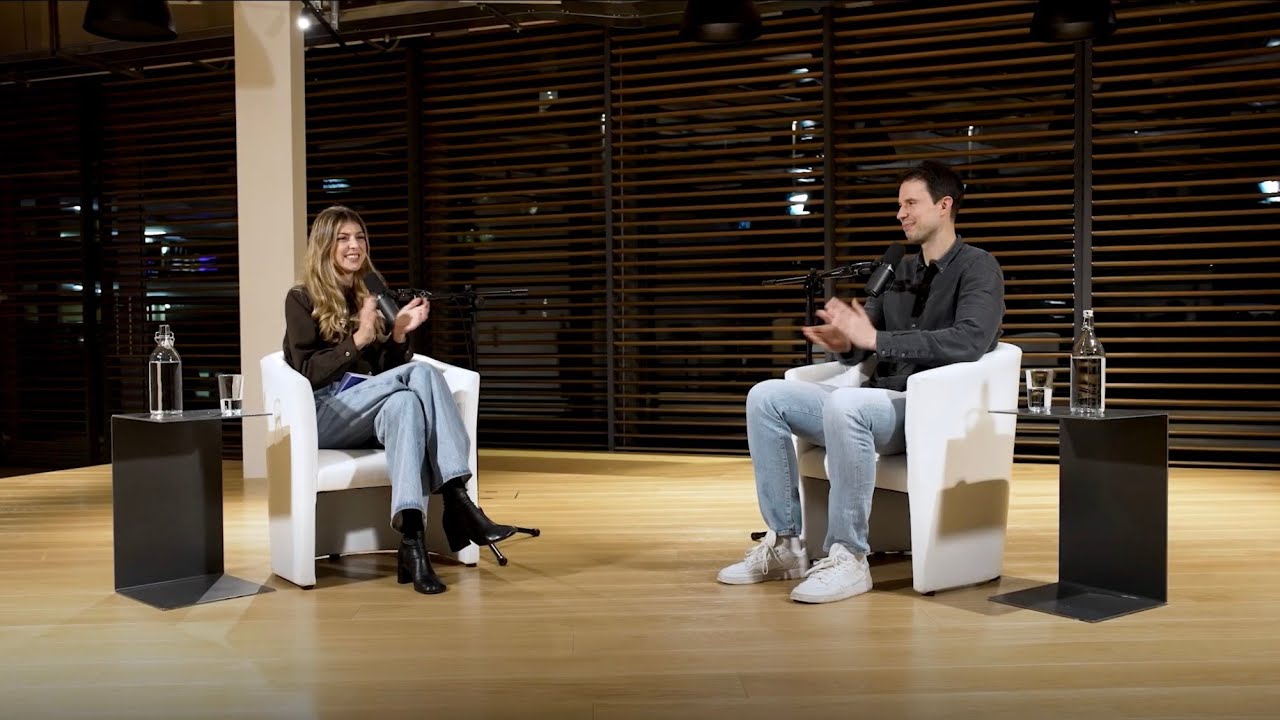
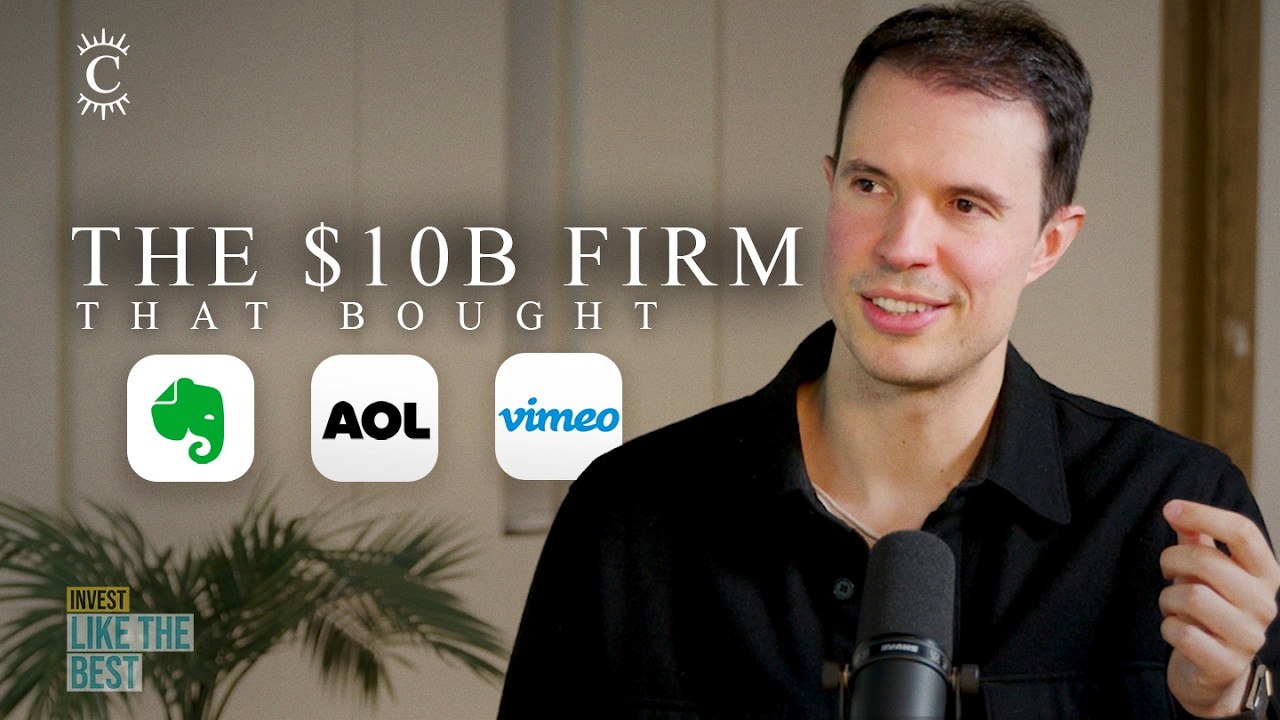
A chat with Luca Ferrari During Bending Spoons’ IPO 📈
Luca Ferrari, CEO of Bending Spoons, discusses the company's Nasdaq IPO day and its strategy of buying and improving software companies rather than building one product. He emphasizes hiring top talent as paramount, names Evernote and AOL as major acquisitions, and identifies AI and complacency as the company's biggest opportunity and threat.
Chapters
We're trying to build a generational company. We're trying to win the World Cup, not simply say, oh, it's great, we qualified. You are here. I really thought that, let's say, IQ was 80% of the game. And now I think it's still important. It has to be high enough. But once it's high enough, almost all that matters is how badly you wanna be great. Betting on growing primarily through acquisitions, where everybody was telling us, you gotta focus on one product and try to grow that organically. You have no idea how many times I've heard that. And then pretty much every single company that I've seen that, they have done much worse than we have. It's very difficult, at least in business, to find something that works. I think 99% of the time you'll be better off maximizing that than questioning every little thing that could in theory be better.
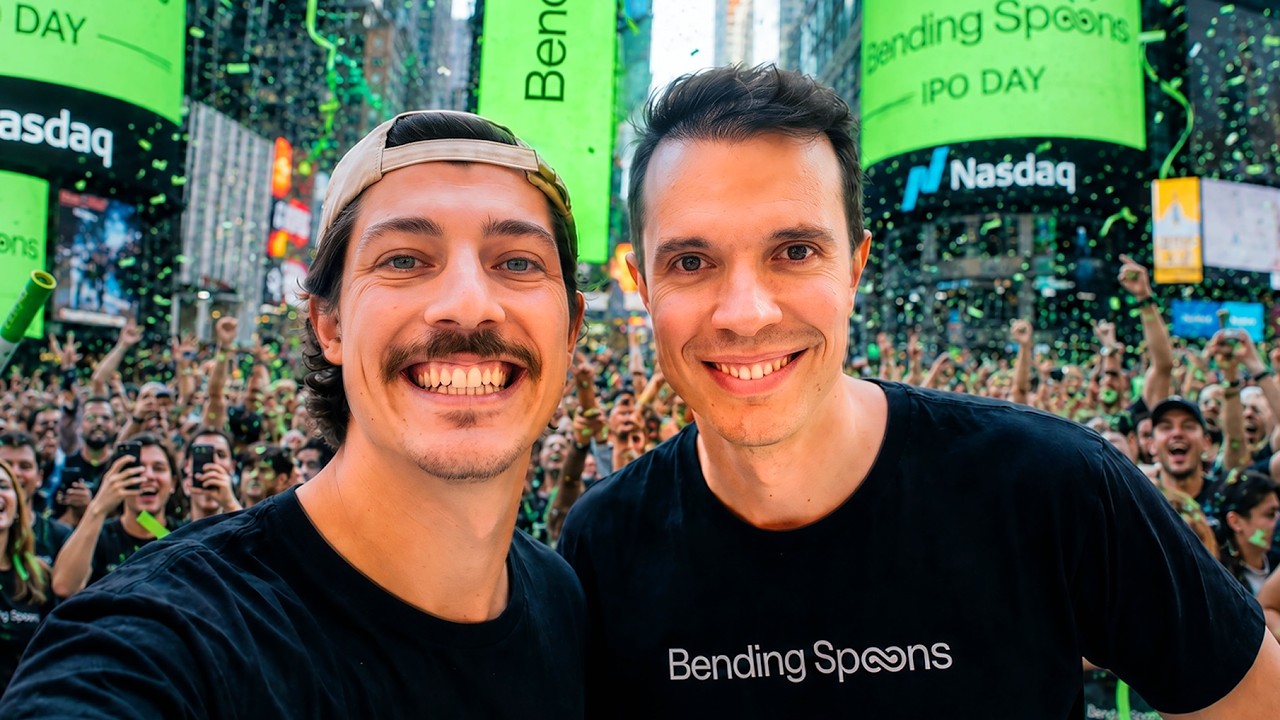
I was at Bending Spoons IPO, and I wanted to give you a quick recap while everything is still fresh. I am working on a proper mini-documentary about the whole experience, but there was no way I could wait before sharing what it was like. I'm not gonna explain from scratch who Bending Spoons is or what they do. I've already made at least 3 videos about But the short version is that they buy software companies, make them better, and they don't sell those companies. In the last 10 years, they created a very strong platform made by their own technology and amazing people. They went from $0 to $1 billion in revenue in just 10 years, and they closed their first day of trading on NASDAQ already close to $30 billion of market capitalization. 2 weeks before the IPO, they decided to fly the entire company from Milan to New York on a charter flight, so everyone in the company could be there for the listing. And somehow they let me tag along. The people at Nasdaq told us they never seen anything like it.
You are the reason that Nasdaq exists.
But honestly, that's a classic bending spoons move. They put the team first. Every employee can choose to take part of their compensation in stock, and this IPO created a lot of millionaires and even some multimillionaires. So let's begin. Bus from Milan to the airport, check-in for the flight, 8 hours in the sky, hotel right in Times Square, 3 hours of sleep. And then I was ready to follow the CEO Luca Ferrari around for the whole day. First stop, 7 AM in the morning, CNBC. Then over to the Nasdaq to meet the Spooners, catch up with everyone and sit through a bunch of meetings. And after a series of speeches and some really cool team moments, it was finally time to ring the bell. Co-founder Matteo Danieli gave an incredible speech.
Spooners, this moment is yours, enjoy it!
And then the celebration officially kicked off. Times Square was completely covered with Bending Spoons billboards. And after that, I followed Luca to JPMorgan to watch the stock's first trade. Then it was back to Nasdaq for a long series of interviews with the press, from Bloomberg to TBPM. When the day was finally over, it was time to celebrate. Bending Spoons rented out for the night the entire Edge observation deck for an insane party.
Welcome to the Olympics! After all our efforts, We've finally earned our place.
Luca gave a speech that got everyone fired up. It was honestly one of the most incredible days of my life. Like I said, I'm putting together a full mini-documentary about the whole experience, but today I just wanted to share the conversation I had with Luca. After watching him do interview after interview, I wanted to ask him the question nobody else was asking.
Or would you consider an acceptable scenario in 5 years from now?
5 years. I think now that we're a publicly traded company, I'm not allowed to make specific predictions. But I will say we hope to keep doing what we have historically, but a lot more and a lot better of it. So, you know, in 5 years we have to have acquired a lot more companies and much bigger companies. And hopefully that will drive a lot of growth. Hopefully we can be an even better place to work, attract even more outstanding people. I think there's a lot to do there. And we're very excited about using AI to reinvent how a business should be run. Automation, better products, more efficient monetization. I think we're only scratching the surface in that regard. We're investing heavily. So, in 5 years it should be much, much better if we've done our job correctly.
What are the top 3 KPIs that you always check?
I'm mostly focused on the quality of our team, so I review applications, I review every single profile we consider extending an offer to. I believe we have a strategy that works and is likely to keep working, and that the main determinant of whether we can do well is if we can keep hiring great people and they work well together. So, it's really where I focus most of my time. I look at all the numbers, I'm pretty obsessive about it, but it's not as important. And then, of course, I mean, I review financials, revenue, profits.
Is there any quantitative way To measure the quality of the team?
We do. We run assessments internally at least once a year, and we try to make those as scientifically sound as possible. We look at that, and over time we try to check whether the average quality of the talent is maintained or improved. And it seems it has historically. But it's, you know, humans are not entirely measurable. We are, you know, wonderful and complicated. But, you know, that's our best proxy to get a sense of whether we're trending in the right direction.
How much do you think is the quality of the person the baseline that you get? And how much do you think is how much you can help that person grow thanks to also motivation, learnings, everything?
It's difficult to quantify, but I will say the latter is absolutely massive. I think a good culture, a good environment is such that everybody plays above their level. It's like in sports where there are some teams where everybody looks like a champion when they're in that team, and then they, they transfer to another team and they're not as good. And then, you know, it's because the environment, the coach, the strategy, the motivation, team play is such that everybody looks better than they are. So, we try to hire the best people we can because you're always going to be better off with better talent, but then be that system where everybody punches above their weight.
What's the biggest opportunity for the years to come? But also the biggest threat?
I mean, AI is certainly a huge opportunity for us. I think it will change everything. And it's not going to happen by itself, certainly not in the next 5 or 6 years. It'll take a lot of efforts to take advantage of that. So, we're investing heavily in that area. I think, you know, big risks, there's always complacency as you feel you're a little bit successful, then you may become arrogant and then you're dead, literally. So that's one. Scale can dilute the quality of a culture. We are adding roughly 30% to our team size each year. And obviously, I would say I think it's mostly an opportunity, but it would be imprudent not to recognize that every time something changes quickly, you can also lose because the rules of the game are changing. It's certainly also a risk, let's put it that way.
So you just made a bunch of interviews with the press.
And some of them, they were looking for weaknesses in the business. What did you tell them?
I think, I mean, like all businesses, plenty of weaknesses. I would say one is we, when we acquire companies, we rethink them often from the ground up, really try to change a lot of things, parts of the team, the technology, user experience, monetization. That takes a lot of time, a lot of effort, and that places a— it's a bottleneck to growth. And as you go after bigger companies or more complex larger teams, more customers, it becomes increasingly challenging. I think another one is because our growth is primarily driven by acquisitions. On the one hand, I think the ceiling is much higher if you can acquire a vast array of companies. In theory, you can grow— I mean, I wouldn't say infinitely, but a lot more.
Mm-hmm.
However, it's a lot less predictable. There could be a period of time where you find good deals, maybe valuations are a little bit lower, and you grow tremendously. And then maybe there is a period of time where Valuations are really high, you don't find as many opportunities. So that probably will make our growth very choppy. And I think many investors like smoothness, predictability. So that will be challenging for people psychologically to ride those waves.
Yeah, it makes sense. Like, once there is a big opportunity, you buy a bunch of companies and then maybe you don't do that for a while if the price is too high. In these 13 years of business, What are the most important things you learned?
One of the lessons we've learned is that complicated things are rarely effective or successful. You need simplicity. In most cases, the best things, whether again they're solutions to problems, ideas, can be reduced to relatively simple principles. And I find that some of the most successful people, they are very good at identifying the few things that matter and really focusing on getting those couple of things right with, with, with simple, elegant solutions as opposed to covering every corner case. But as I observe, it's very difficult to implement. We humans have a tendency toward complication. By the way, it's the same way we got to, to the crazy complex regulations we have today. I'm sure that every time someone was adding a new law, they really thought it was a good thing.
Mm-hmm.
But then we were failing to, to account for the increasing level of complexity and the glue that, that Adds to the system. I'm sure that a lot of laws, if if they didn't exist, basically nothing would happen. You may maybe occasionally some smaller issues, but we would be all more agile because there is there are fewer fewer rules. You know, people generally are well-intentioned, and they add because they think they're incrementally solving minor problems on the margins, and then it's impossible.
Benespois is a simple organization.
I believe we are. We try to be as simple as as as as possible. We're willing to accept. not covering certain corner cases if it means we can keep things a lot simpler. We have determined that it's much better to, once we hire very good people, entrusting them with a lot of responsibility. We could probably prevent some mistakes and embarrassments if we put in place more controls and processes. But I think the net effect of that would be extremely detrimental by reducing speed, sense of ownership. So it's tempting to say, oh, we had this little fuck up here had we had a process. But there is a cost to solving that concrete problem.
It's less of a cost to just keep the mistake sometimes.
Exactly.
So simplicity is one thing. Other things you learn or principles you go by?
I firmly believe now, when I started trying to build companies, by this point roughly 15 years ago, at the time I really thought that, let's say, IQ was 80% of the game. And now I think it's still important. It has to be high enough. But once it's high enough, almost all that matters is how badly you want to be great. The Rafa Nadal ingredient. You got to be good enough talent-wise or you just don't have— but then at a certain level, it's much better to have—
Obsession.
More obsession, more desire to learn, improve, refine, expand. That will drive you to great heights, or at least improve the chances that you do. And being a little bit smarter but not as hungry You're not going to succeed. And I think it's very similar with academics.
What about sources? So all these learnings, you learned them by mistakes. Any books, mentors, inspirations that you had during the journey?
Yeah, I mean, I read a lot of books. It's unusual to find, I think, like a very specific lesson you take away. But I believe that absorbing a lot of interesting information, and it has to be deliberate, you have to think about it over time, stimulating the brain with the mind with a lot of information, process it, think it through, it really makes your machinery a little bit better. And then you will connect the dots in real life. You try to surround yourself with really good people, ideally better than you are. Read a lot. I like books, but I think any source of high-quality information. Try to be active, like challenge, question, think about it. And then constantly analyze your life. What's happening? Why?
How often do you analyze your life?
Do you have a process for it? Yeah, I try to. I set objectives for each decade, and then I set objectives for the year and for the for every 2 weeks. But also, the things I do every, every day, at the end of the day, I try to ask myself, have I done the best I could with the cards I was dealt? Or could I have done better? And I just spent 5 minutes, that doesn't have to be a massive amount of time, trying to identify 1 or 2 things I could have done better. And then I promised myself to improve. It's, you know, small things, but over time they add up. And again, it goes back to that level of obsession. Some people are hungry, but a lot of people are not that determined. If you have that extra level of desire to be great at what you do, you have a good chance of standing out, I think.
Is there anything you would consider to suggest to read, like a must?
If someone is looking to be a great investor or a business person, I'd say 7 Powers by Hamilton Helmer. Probably the best book on competitive advantages I've ever read. It's a great lens through which you analyze businesses, but also your own business ideas. Also, in general, the stories of people who have been successful because they were good and not lucky. There's plenty of those. There's a great book called The Outsider. Outsiders that talks about some of the best people who created fortunes through capital allocation. The most famous person who's mentioned there is Warren Buffett, but there's a long list of other people who are not as well known but arguably just as successful. And you can come up with some ideas or be inspired in some ways. You— I love reading multiple biographies of Benjamin Franklin. I think a great guy. Back then, you know, even the great guys were awful in some ways, but creative, did incredible things in science, in business, imaginative. If in your mind you can create a model of that person that can guide you toward achieving better outcomes.
Of course.
For example, Elon Musk was very controversial, but I think nobody would question that he's willing to do what other people disagree with if he thinks that's the right thing to do. That can help you Give you that extra confidence. So creating these avatars of people who inspire you for different reasons—you don't have to love the entire person, just that one aspect—and you can pull them out of your memory depending on what problem you have.
Some people have it for Luca Ferrari. Well, I always think you wouldn't approve of what I'm doing. You know, when I when I lose my focus on things, he wouldn't approve.
If I can be helpful, you know, feel free to abuse of my. Yeah.
You mentioned times where you were convinced. of something and other people thought you were wrong and you ended up right?
Oh, I mean, to be clear, I've been wrong many times, but we have also been right repeatedly when people disagreed. I remember when we— Benny's Poons, we started it in Denmark and we moved it to Italy soon thereafter, I think about a year after we started it. And almost everybody we talked to told us, why are you building a company, a technology company, in Italy? It's difficult to know how we would have done have stayed in Denmark or maybe established our headquarters in the States. I mean, who knows? But I'm pretty convinced that it's been helpful for us. We found a lot of people who didn't have as many great opportunities and decided to embrace the ambition of the project. Or betting on growing primarily through acquisitions, where everybody was telling us, you gotta focus on one product and try to grow that organically. You have no idea how many times I've heard that. And then pretty much every single company that I've seen do that, they have done much worse than we have. That's been obviously a very good move. Another one people have told us for as long as I can remember, you need to hire experienced people. And we have continued to bet primarily on inexperienced but highly motivated, brilliant people and giving them the coaching and plenty of space to show— to prove that they deserve a lot of responsibility. We have not regretted it. So, look, I think if you do what everybody else does, you're probably not going to do super poorly. But if you want to hope to do incredibly well, you have to take a position at least on something that's contrarian. Either because you're lucky or you're good, you may be right and then do super well. But it's the only path. If you look at anyone who has succeeded in a massive way, almost always they had a few positions where they went against the grain and they were right. Because in a competitive market, if you emulate what everybody else is doing, probably at best you'll be mediocre. It's just a fact.
Right. And what about any mistakes? Especially something that you look back and really wish, I could go back in time and do that differently?
Many things. I'd say one was we were being quite successful with our current strategy: acquire and improve and reinvest. We had been successful with that for years, pretty much from the beginning until, you know, maybe the first 5 or 6 years. But at the time we were at a much smaller scale. We were acquiring basically small apps. We were going to saturate that market because, you know, we needed bigger acquisitions and there weren't any that were so simple. And we weren't confident that we would be able to do the same with more structured companies, with real investment, with professional executive teams. And so for a while, I'd say maybe a couple of years, we slowed down our core strategy that had worked so well. to try alternative venues to see whether we could find an alternative strategy that would work. We've launched a couple of products from scratch. None of that worked all that well. And then we ended up— we still continued with the core strategy, just a little bit more slowly.
Mm-hmm.
And then we did buy a bigger company than Evernote, and it went just as well, extremely well. And then we were like, okay, we were fools in not trusting our abilities and slowing down something that was working to look for something better. And ever since, we've been 100% focused on the core strategy. So I think there the lesson is it's very difficult, at least in business, to find something that works. I think 99% of the time you'll be better off maximizing that than questioning every little thing that could in theory be better.
Would you say Evernote changed a little bit the way you approached the business?
Yeah, the challenge there was it was the first time we acquired a relatively large organization, 340 people. They had a professional management team, they had some of the world's best investors, Sequoia Capital, a much bigger customer base. It was a whole new game. A lot of what had worked for us turned out to work really well, bringing in high talent density and entrepreneurial approach, scientific approach to improving the product and improving monetization, investing in the product. But also we had to develop a playbook for how do you resize an organization It's, it's pretty— it was pretty scary for us. You know, the idea of facing, for example, a substantial layoff. You don't want to hurt people. I think we've gotten better now. It's never going to be— it's always going to be painful. But I think we've gotten a lot better at doing it in a way that's less painful, more efficient. So that part started being developed with Evernote, for instance. More recently with AOL, it's— there's roughly $200 million in advertising revenue on AOL. We have done a lot of advertising revenue, but I wouldn't say it's a core expertise. We have spent the last 6 months investing heavily in becoming experts in programmatic advertising. We have developed some interesting technology there. I think we're just at the very beginning of that journey, but it's a whole new set of skills and tech we're developing. With Brightcove, the first time we acquired a large sales force. You have now account managers who talk to their customers, pick up the phone. So, that was also a bit of a shock and a very nice challenge and again, there too we started by being pretty bad and then getting better with time.
You're a person that operates by principles. What do you think are the top 3 or 5 principles you go by?
One important thing is to never do anything unless you have determined the objective. Spend a good amount of time clarifying exactly where you want to get. It could be a big thing, like again, plan for a decade. Where do we want to be in 10 years? Or literally, you know, For tonight. It seems basic, and lots of people just go with the flow. They— and those decisions tend to be kind of random, frankly. So that's one. Another one is try to listen with humility, but at the same time, never outsource thinking. Like, you want to make your own decisions using your own head. It's an important skill to develop. A lot of the good things in life come from going against the grain, not just out of spite, but because you did your homework and you concluded you may have, you may have an insight there. We mentioned radical simplicity. Very important. Do less, do better. Remove pieces, processes. The simpler it is, the more likely you are to do really well, especially if you're good at removing the components that are not really central. Give credit to people. I think the ego is evil and good. It can drive you to great things. The need to prove that you're good, for example, you could say that's a form of ego, right? Equally, though, if you seek the spotlight, for example, it can be demotivating for the people around you. I think it's important to master the ego, recognize where it can help you, and unleash it. It's— if you, if you tend to be competitive, again, that's an ego thing, really, because why, why, why would we want to win? Like, often there's no reason for it, but some people feel compelled to win. I'm one of those people. If you, if you have that and you can channel it, it can be a great force to your advantage. But if your ego is, I want to appear, I want to be the person, well, that's likely to hurt you in the long run.
In terms of goals, having a clear goal, it's good, you said.
Yeah.
When we met for the first time, I asked you for a goal and you said, I'm aiming to have the best and the biggest organization that I can, the best place for our employees and the greatest company I can build. Is still that the goal or where you want to be in 20 years?
I will say this. Yes, it's, you know, broadly speaking, that's the goal.
You kind of reached it. That's why I'm asking.
No, I don't think we have. I don't think so. The hope we have, the dream we have is that in 30 years, when people look at the past and they're trying to establish what companies completely reset the bar, invented new ways, were the hallmark of excellence, I think you may think about like maybe 10 companies, something like that. We're not in that list yet, not even close. So I think we've done a lot. I would be disingenuous in not acknowledging that, but our ambition is much greater. We're trying to build a generational company that truly people are like, wow. I mean, go and read about Bentin Spoons for 20, 30 years. They just, you know, they were breaking records and unreal performance and the type of talent they attracted, trained, all the positive externalities that create great entrepreneurs, you know, great products, incredible financial performance. Yeah, of course we are completely different companies, but that sort of institution. Yeah. And so I look, I don't know that we will succeed. I really don't. But that's the type of competition we're playing. We're trying to win the World Cup, not simply say, oh, it's great, we qualified, we were there. Exactly. Again, it's— don't take this as we absolutely know we could fail. It's not a matter of being Arrogant. It's more like it's fun to aim really high. It makes life more exciting, I think.
You see yourself working with the same intensity for the long run?
Life happens. It's hard to be certain. I mean, I've been working roughly as hard at this point for close to 20 years, maybe 16, 17 years. So I'm not exactly— it's not exactly—
Before Ben& Spoons, you were working as hard as Ben& Spoons? Yeah, maybe even harder.
Too hard, to the point that I was— after I graduated, the first 3 years I was— initially I spent 1 year working as a consultant to pay for the startup. We were using my salary to pay for rent and food, and in parallel on the startup. And then as I resigned from McKinsey full-time for 3 years on this first startup, which was a failure, I was probably working substantially harder, too hard, to the point that I don't think my brain was functioning at the optimal level. So, I've been working pretty much as hard as I could for the past, yeah, roughly 16, 17 years. I'm pretty confident I can go on for quite a while, but I don't know if, you know, who knows how I'll feel in 10 years. But I'm certainly not anywhere near done.
I think you gave up something during the journey, probably.
For sure. I mean, for example, family. I mean, no doubt I love my wife enormously, and I don't spend as much time with her as I would love to. It's something we have discussed, we largely agreed on, but it's not ideal. It's a compromise. I have a daughter, she is 10 months old. I'm trying to be there, but obviously I'm not there as much as a dad who's working 9 to 5. I work out, I read a lot, but, you know, there's a parallel universe where I do more of that. So everything in life is a trade-off. At the end of the day, there's only 24 hours in a day. I don't know that I'm making the right prioritization, but it's the best I know of.
You're not looking for a successor yet, that's the thing.
No, very far from it. Look, I mean, I'm happy to step aside if we feel we have someone who can do what I do better. I just want the company to do well, really. I would be very happy to—
Yeah, wipe the floor.
To have any— for real. And those who work with me, I think they would tell you that that's true.
We were speaking about that behind the cameras. Like, everybody should do what they're meant to do in the company. If someone is really meant to do the CEO, he's gonna do that.
Exactly. We have a history of having, you know, some of my co-founders, they are still working full-time. They took a step back because we felt another Spooner was better positioned to do their role. So, it's the same for me, but as far as I'm willing to, I'm basically still 100% committed, and I don't see this changing in the next several years, at least.
Is your job going to change now that the company IPO'd in any way, your day-to-day work?
Who knows? I suspect, despite— I prefer to do more, like, actual work, help solve problems and build things, but I suspect I'll be spending a little bit more time talking externally. Because now, you know, before you had essentially your key stakeholders were your team members, and there's only so many, and then a relatively small number of investors. And now you have a distributed group of investors. Their immediate reactions and opinion can influence your trajectory. And so we will have to talk to them more than I had to in the past. We'll try to keep that to a minimum, but I suspect that's going to be the case.
How many reports do you have right now? Do you speak with a lot of people inside?
So technically, I think I have 15 to 20 direct reports. I normally— I talk to each, with a few exceptions, I talk to each at least once every 2 weeks. The last 6 months as we're working on the IPO, I've canceled probably 75% of these meetings. I told them that this would happen. Hopefully I can go back to doing the meetings from next week. Yeah, maybe too many reports. I don't think I'm— I've been extremely helpful to too many of them.
Drawing a pie chart, how much work is focusing on learning, focusing on problems, so alone work, and how much is going to be external communication and internal communication?
The last few years, I would say that probably at least 50% of my time has been doing essentially individual work, helping solve problems. I'd like to think it's going to be the same going forward because I think that's how I can contribute the most. I haven't invested historically, I haven't invested a whole lot of time in external communications, not even 5% for sure. I think on average I might have done 3 interviews in a year or something, and I'll probably do more in the future, but I hope it's still a very small fraction of my time. Internal communication, it's huge. especially as the team scales. You can't assume people know things any longer. You can't assume people— we try to create a trust-based organization where people, their default is to think that everybody means well. But still, if someone is always suspicious and you want to be as transparent and as proactive in sharing facts as possible. So we, you know, we try to post on Slack frequently. We write memos and just really be completely candid about what's going on, what we're trying to accomplish. And again, the bigger the company, the more you have to do that. So that's a pretty substantial amount of time. And then just Trying to support my colleagues, listening to them, giving some advice if I can, taking some work off their shoulders if I can. It's not that fancy, to be honest, but you try to make yourself useful.
Thank you very much.
Thank you, sir.
More from Luca


Inside Bending Spoons: Finding Talent, Leveraging AI & Driving Operational Excellence | Luca Ferrari

Bending Spoons Cofounder & CEO Luca Ferrari on the company's buy-and-hold strategy