Inside Bending Spoons: Finding Talent, Leveraging AI & Driving Operational Excellence | Luca Ferrari

Luca Ferrari, CEO of Bending Spoons, explains how the company runs acquired businesses like Evernote with tiny teams of 20 people by hiring obsessively from 800,000 annual applications and building AI tools like the design assistant Diagram. The firm generates hundreds of millions in revenue with minimal headcount through talent concentration, internal automation, and disciplined acquisition strategy.
Chapters
So we're going to start this episode in the locked-in stance because we've just been talking off camera, and I was like, goddamn it, we need to start recording immediately. I didn't even want to think to start here, but you noticed the AppLovin mug, and then you're like, oh, Furugi, and then you laughed. What do you think of Adam Furugi?
Well, he's great. I mean, uniquely focused, ruthless, and I mean it in a positive way when there is a goal. Goes for it. Very rational, effective. I mean, 10 out of 10 on that in those areas, I think.
So when I published the episode that I did with him, I think I titled it like the best founder no one's ever heard of because at the time he was running like, I don't know, like $150 billion market cap company with like 400 employees and they were printing like $6 billion in cash. And he kind of lays out exactly like his— we were talking about fanaticism before we started recording. It's like he's just fanatical. It's like success of his company goes before almost anything. No, it does go before almost anything in his life. He's just completely obsessed and committed, you know, to essentially like excellence. I think you share that trait with them. So we had lunch together probably 6 months ago. I talked to you right after. I was like, man, you got to do the show because I know a lot of founders. I don't know any other founders that think like you. One of the things that you said that I think everything else, that all the other ideas flow from this, is that you want to be the best in the world at what you do, even if that's not possible. Can you talk a little bit more about that?
I've always been kind of polarized in my interests. I either choose to do something and then I'll try to max that out, try to be the best or part of the best team, or I will try not to do it at all. Or if it really has to be done, then I'll literally try to kind of just check the boxes for minimum commitment. All sorts of rewards. emotional and material are at extremes. I think I have a close to 10 out of 10 relationship with my wife. I think to me that's worth 100 times more than having an adequate relationship with my wife. Same with my job and my colleagues trying to build the best company there ever was. And we understand that's aspirational and likely nearly impossible, but I think— If we get close to that accomplishment, the rewards, the fulfillment, the satisfaction, the learning along the way, financial rewards will be just exponentially greater than just doing well enough. And so I think you have limited time and energy. You want to find one or very few pursuits where to try to go all out and everything else, keep it eliminated if you can, or keep it at a bare minimum.
So you just said you're trying to build the best company there ever was.
Yeah, just again, aspirationally. Don't take it— it's not meant to be arrogant. I know we have a very slim chance, but just, you know, waking up in the morning and thinking we're not building a nice church, we're trying to build the greatest cathedral that anybody has ever built. That's a lot more exciting to me. Gets you further. It's more fun, energizing. Better people will want to work with you. And I think one of the big ways in which life is interesting is surrounding yourself with amazing people, better people than than you are, if possible.
Do your co-founders feel the same way?
I mean, you'd have to ask them. I think we probably, for the most part, I'd say, yeah.
But is this something that you guys repeat to each other, like, throughout the company? You're trying to build the best company ever?
We're not big on founders. I know this is maybe ironic to say, you know, given your podcast, but we try to eliminate the idea of founder from this company as much as possible. We think it distracts people from the company. The company is the center. And whether you're a founder or you joined a little bit later, All that matters is your contribution, your trajectory. The people at the company, those at least I know the best and with whom I work the closest, regardless of whether they're founders, I think broadly they share this ambition. So yes, but it's not necessarily a founder thing. It's more of a values thing.
The way I've been describing you to other founders is like, it's almost like Luca is like the Galápagos Island of like entrepreneurship, right? Because if I'm not mistaken, When we were talking, you're like, well, I don't really listen to podcasts. I didn't read books. I didn't study other entrepreneurs. You've kind of evolved the way you build your company, like completely independent of anything going on around you.
Yeah, I think part of that is, I don't know how much the audience knows about Danish Films, but we started in Copenhagen, Denmark, quickly thereafter moved it to Milan, Italy. These are not exactly, especially Milan, not exactly, and certainly not at the time over a decade ago, a center of entrepreneurial pursuit and an ecosystem where you've, you know, you turn left and right and you have all these other startups or advisors and whatnot. So, and of course we were absolute nobodies. So it's not that we could pick up the phone and call Jeff Bezos, right? So we just had to figure things out on our own. We were trying to build, aspirationally speaking, the best company in the world. If you emulate what most people are doing, you're pretty much guaranteed to you know, at best be mediocre, mediocre plus, maybe you execute a little bit better. But if you want to try to be the best of the best, you need to take some risks and rethink things. And so we figured, okay, let's try to experiment, invent, think from first principles, and we will make more mistakes. It will take longer than if we copied some of the tried and tested approaches, but we should be able to find at least a few insights, a few new ways that will set us apart. And I think being more isolated geographically has probably played to our advantage. In that regard, so that we weren't under the influence of of of the mantras that everybody you know in the big startup hubs over time was was preaching.
Let's give a little bit of background of Bending Spoons. You had a startup before Bending Spoons that failed, right?
Yeah.
Okay. What did you learn from that failure, and then what lessons did you learn from that that helped you start Bending Spoons then?
Yeah. So that was called Evertail. We were It went on from 2010 to 2013. We were using AI to write diaries automatically. So you would install an app and then it would collect data and figure out what you'd done, where you had gone and whatnot. It was actually pretty cool, but never managed to make it scale. Commercial failure. Some of the most crucial lessons were, one, the importance of talent. So we had a very small team at peak, maybe 12 people, but we saw that the contribution of the best person we had on the team relative to, like, say, the medium person, forget about the bottom, but was easily 10 times as great, like literally worlds apart. So that taught us, okay, the range of productivity, at least in our field in digital technology, is massive. So the value of having on board that sort of individual is gigantic. And also, That person who was performing at the peak in that group was actually one of the least experienced people. And so that showed us, okay, maybe experience, you know, certainly valuable, but not as critical as people sometimes tell you it is. If you have someone who's really smart and really cares, often they'll be able to deliver as much value, if not a lot more value, than someone with a lot more experience.
Let's give a concrete example. So I'm just gonna pull the notes. When we were having lunch, I was like, oh, this is too good. And I started just texting you on WhatsApp. I'm like, and I think at the bottom I say like, these are notes for when you do the show, even though this was like 8 months ago or whenever it was. And you mentioned that you're like, hey, you said something interesting. You're like, I'd rather hire young graduates. Let's talk about the Evernote story in one second. You said most executives are overvalued or overrated in your opinion. I'd rather hire young graduates. Graduates find someone good and then saturate their capacity. Can you give examples of how you've done this?
Why talent, let's say, over experience? I think there are a few reasons for that. Number one, most of the things we do, and I mean broadly, in most industries, probably certainly in the technology industry, are not rocket science. They do not require immense amounts of notional knowledge and repeated extensive track records. They require actually a good brain and a desire to do well, to achieve first and foremost. And also our field technologically, but also in terms of customer expectations, evolves very quickly. So experience gets stale relatively fast.
Wait, before you go on, sorry, I'm going to interrupt you. Explain more about customer expectations evolve rapidly in your field.
Yeah, I think I'm not sure how it works if you sell salt, but when it comes to selling technical tools, what people consider excellent today, or an intuitive interface, or effective monetization, are very different from what things looked like 10 or 15 years ago. Completely different. I mean, I'm sure at least people in the audience who are at least 35 years old will remember what software looked like in the early 2000s. And by today's standards, that's primitive and almost unacceptably bad, and people would never use it or buy it. And the ways you build that software— and by the way, that's just the, say, customer-facing layer. But then behind the scenes, how— and this is only something that probably people can understand if they've built software before or work with AI— the way you efficiently wrote software in 2010 bears very little resemblance to how you do that today in 2026. Whatever people learned back then, yes, some of it will will port. I'm sure, you know, you are more mature emotionally, you know how to work with others and whatnot. But a lot of that experience, basically, you can throw it away. The value of accumulating many years of experience is not as great, I believe, as some people think it is. And additionally, not all experience is created equal. You can actually get worse through experience. If you're exposed to low standards, for example, of performance, you'll normalize those over time, and you'll actually be a less capable team member than someone who has never been exposed to any standards. And maybe naturally is inclined to believe idealistically perhaps that the bar should be held higher. Or if you've been working for a long time in an organization where the way to progress and succeed is by pleasing others and doing what they tell you to do, even though you don't necessarily think it's optimal for the organization, call it politics. I don't know that that experience will make you a lot more capable necessarily if you, for example, join a company like Venispons where I'd like to think we're a radical meritocracy and We try to be rational in deciding and do what's right for the company. So for all these reasons, experience can be extremely valuable, but it's not necessarily extremely valuable. But talent, meaning a good brain and a massive eagerness to excel, grow, make an impact, those never fail to be valuable. And so in a competitive labor market where you can't have everything at the same time, you need to prioritize. We tend to favor talent also because experience, we can give it to you. We just have to be a little bit patient to make sure we expose you to good challenges. Surround you with amazing colleagues, you'll accumulate experience very quickly. First principles, really, and based on those anecdotes and observations during the first company I co-founded, but also at Benny's Spoons in the early days, we repeatedly saw that that thesis was supported by facts. And so we kept investing in, first of all, attracting excellent talent and then creating ideally the perfect conditions for that talent to flourish very, very quickly. Because of course, you need to establish your structure and operations to get the most out of the human capital you have. I would build a company differently if I had to work with inferior talent than we do, because we believe we have amazing colleagues.
Well, say more about that. So how did you build the company?
Yeah, so for example, I think if you have— and maybe there's nothing you can do about it— if you have mediocre talent, then I think the appeal of process and procedures becomes greater. Checks, rules, because you need to guide more. You can't count on people to problem solve autonomously as well. You can't count on them coming to work with fire in their belly as much. You know, process and procedures, sometimes we say they are terrible, but honestly, they can be, you know, the lesser evil if you're in that situation. If you are lucky enough or good enough, for whatever reason, to have a very strong team, then I think, generally speaking, you want to have as few rules as possible. It's not that process and procedures are always bad. There are cases where you want to have some of those, but to the extent possible, get rid of them and give people massive leeway to express and develop their talent. Makes them feel trusted so that they will bring the best of themselves to work, and that will be good for everybody. They get to do better work, they get to learn a lot faster, their careers can be turbocharged. But again, that only works if you have a very good team. I suppose it's probably similar with sports. I would imagine that how you coach, and I'm going to the extreme, I'm not saying Benny Sprunges is bad, but if you were coaching the Team USA dream team with Jordan and Barkley and those guys, you would do it a certain way that would be different the way you would optimally coach a team of kind of modest talents. You can probably win with both. It's a lot easier to win with Jordan, but certainly you're not going to tell your more modest talents, okay, go and figure it out. You will try to give them a system that's a lot more guiding. So we try to approximate as much as possible, like the dream team aspirationally, and then leave a lot of space for those people to live up to expectations.
I want to tell you about the presenting sponsor of this podcast, Ramp. I have been reading a lot about SpaceX lately. SpaceX is one of the most valuable businesses in the world, and one of the main themes in the history of SpaceX is constantly attacking and questioning your cost. Ramp helps many of the most innovative businesses in the world do exactly that. The median company running on Ramp cuts their expenses by 5%. And one thing SpaceX has demonstrated is that a religious dedication to controlling costs can help actually increase revenue because you can pursue opportunities you couldn't otherwise. And we see that in the Ramp data too. The median company running on Ramp also grows their revenue by 16%. So when you're running your business on Ramp and your competitors are not, you have a massive competitive advantage that compounds over time. Ramp is the only platform designed to make your finance team faster and happier. Many of the top founders and CEOs I know run their business on Ramp. I run my business on Ramp, and you should too. Go to ramp.com to learn how they can help your business save time, save money, and grow revenue. That is ramp.com. Okay, but go back. How do you identify talent when that talent doesn't have experience? How have you done that?
I think you can think about life in general as, when it comes to people and accomplishments, as you control certain inputs, you know, how much you work, what you do when you work, for example, to make it super simple. And then there's a bunch of elements you don't control, call them boundary conditions, sometimes knowable, sometimes unknowable, sometimes fixed, sometimes shifting, and the combination of those ingredients leads to outputs or results, or call it what you will. Outputs, results are fairly easily observable. Sometimes there is a gigantic amount of inputs that go into achieving a certain output, and those inputs go into it for a long period of time, whereas the output can be very simple. The company achieved a certain amount of revenue, whatever. You won a certain tournament, no matter the field. And so it's a lot easier to just look at the results, the outputs. It's the convenient, sometimes lazy way. But life typically in most pursuits, most endeavors is so complicated. The amount of inputs, the amount of people contributing different inputs, the amount of variables you don't control, those boundary conditions are such that if you just look at the outputs, sometimes you get a massively distorted picture of what the person contributed. A lot of it could be luck. A lot of it could be actual human performance, but not by that individual, someone else who just, you failed to know was involved. Maybe it wasn't as front-facing. Now, the more extensive someone's track record is, the more results likely correlate with actual talent. Take an investor. You can get lucky 1 year, 2 years, 4 years, but unlikely 30 years. I don't think anybody would question that Warren Buffett is almost certainly insanely good at investing. You can never prove it definitively. He could have been lucky for decades, but that's astronomically unlikely, right? But if you find any hedge fund who delivered 50% performance in any given year, it could easily be they got lucky with 2 stock picks. Maybe they were, those were terrible ideas. Maybe they picked them for the wrong reasons, but, you know, whatever, the boundary conditions changed and they made a lot of money. So when you pick someone who's very experienced, decades of work, probably you can get away with just looking at the results, maybe some reference calls, very likely you'll get a reasonably accurate assessment. But if you have to pick someone who hasn't even graduated yet, or maybe has been in the workforce for a year or two, then you don't have the luxury of using this, like the sample is too small.
Exactly.
And so you need to find different ways. And something we do is making extensive use of testing. So we develop tests that people go through that we have found over time proxy pretty well their, say, mental capacity and faculties, for example. We have over time developed, we've really built a science out of studying people's track records, including academic records and personal projects and similar things, whereby in Samos application, we identify over 100 different signals. And through those, we predict their long-term potential. It's not entirely dissimilar from what a stock trader who's algorithmically oriented would do. You know, the more quantitative hedge funds, they would identify and test hundreds or even thousands of signals. Many of these are only very marginally predictive, but in aggregate, they make you predictive enough that you can succeed because you're just better than others. And so we have all these signals, some of which are completely obvious. Someone's GPA tells you something. Higher GPA is better than lower GPA. It doesn't prove anything. It's not definitive, but it's a good sign. Some are more subtle and we keep working and investing scientifically in identifying and measuring these signals. So over time, I think we have developed a competitive advantage in finding people who, despite their minimal track record, are very likely to excel.
Okay, so this is one of the notes that we talked about at lunch, and this is one of the things I text you where you essentially said you need a lot of other companies, kind of like they don't really— not many companies have brilliant people in HR. And you're like, no, you actually need brilliant people in HR. You said that you've— you can make hiring a science, that you had at the time a team of like 50. And you actually, these are engineers. These are not typically people that you find, right? And then you say you compare 1 to several years of performance, the signals from their CV, which is what you just described, or these 100 signals, signals rather, and that you've centralized hiring and firing. And I guess these are, you call them talent managers, and they're in charge of both entries and exits. The hiring and firing is centralized for all the companies that you own.
Yeah, it's very unusual. And by the way, the signals are not just from the CV, but they could be from email exchanges with our recruiting team, from the tasks we ask a candidate to go through, anything really. Anything qualifies as a signal and we just care that it's predictive. It doesn't have to be something that, let's say, intuitively immediately makes sense as long as we can prove it's likely not a statistical fluke but actually—
Give me an example of that. I'm a little confused.
Well, I mean, for example, one of the qualities that we value in people is because what we do is such a team sport, you need to be somewhat collaborative. You don't have to be the nicest person in the world, but If you are arrogant or dismissive of others or just an asshole, that doesn't work typically unless you're a freaking genius. We might accept it occasionally, but almost nobody is. So for most people, you need to be nice enough. And we find though that when they're interviewing even assholes, especially because these are smart assholes because they've already passed the more cognitive-oriented test, they're generally quite nice. 'Cause they know that if they come across as super arrogant, they're not gonna get an offer. We found that whether the interviewer felt that the interviewee was open to criticism and reasonably pleasant to talk to wasn't a good predictor of whether they were actually collaborative on the job. So we have a role, call it like a, it's almost like customer support. People who help you with more of the logistics of your application process of scheduling interviews or, so it's more of a support role. Which clearly does not come across as in any way connected to the final assessment, how people interact with those is a lot more predictive of how they actually are as human beings. And so we found that people who were curt and sometimes, of course, even disrespectful occasionally, that's rare, ultimately that predicted poor behavior in a social context much better than how they interacted in an interview. Again, one of hundreds signals in and of itself is not definitive, but it helps form an accurate picture at the end of the day. And that would be for collaboration, but then we would have others for hardworking attitude, whether you are creative, whether you're logical in your thinking, perseverant, the important things that identifying what's important is not rocket science. You could imagine what's important to performance. The difficult part is spotting it through these kind of subtle signals.
And the interesting part is that you just said, how many companies do you own right now?
We've bought, um, a little over 50 businesses over time.
But you could see, like, if you own 50 businesses, like, there's multiple different ways. You're kind of like a conglomerate, you know? Like, the hiring could be pushed down to the actual individual company level, and you're like, no, no, this is so important.
In, in the talk I had, we had— That matters.
I, I was gonna say maybe the most important. So you just said it's almost all that matters, so it is the most important. So I'm going to centralize this. Are you also then The decentralization allows you to kind of take the insights that you learn from one of the 50 and disperse it to the other ones. Is that what happens?
I firmly believe that in business entrepreneurship, the number one thing is call it strategy, meaning what we're trying to do, how and why do we think it's going to work? That is, if you have a terrible strategy, you can have the best team, you're not going to go anywhere. But once you have a strategy that makes sense, the team is almost all that matters. I'd say the team and the culture, which is like the rules of how we engage with one another, it's basically almost all that matters. And so I don't think there is overinvesting in creating a great team within Vision. We try to be generous in our time and resources when it comes to that. So why centralizing hiring and parting ways with people? I think there are plenty of good reasons for it. One is that Team managers. By the way, most companies, it's say you run a team of 10 people, most companies you'd be deciding, maybe there's a budget, like, you know, you can hire 2 people, but once that's in place, you'd be deciding who gets hired. Probably HR will screen CVs and send you, and maybe pre-interview a bunch of people and send you maybe 5 candidates, and then you pick the one you prefer. End of story. We think that system is bad. For a few reasons. First of all, hiring managers, meaning that person who runs the team, have almost all the wrong incentives in hiring. For instance, they probably don't want to work late or on the weekends. They feel they need help, so they will try to fill the position as quickly as possible. I'm sure they will not hire someone who they think is a net negative for the team, but as long as they find someone who they think can get the job done somehow, they'll probably get that person. Obviously, as a farsighted, ambitious organization, you don't want to have— you don't want to hire the first person who's adequate. You want to hire someone who can be amazing over time. So first, bad incentive. The second problem, and it's connected to that, is if you are running the team, probably most people, although they would be willing to coach, If it comes down to it, they would much rather hire someone who's already fully mature and competent. So they, again, they can either do other stuff or work less. If you leave it to a hiring manager to decide, they'll favor very experienced candidates over green, immature, but potentially much, over time, much better contributors.
I like that you identified the incentive misalignment, right, that you find in typical companies. What's the incentive structure for your hiring managers in your company then?
Well, there's none, just trust. So they don't have any bonuses, any variable pay. We just tell them we trust them to build the best organizations they possibly can, and then that's it. And we find that if we hire people who are intrinsically motivated and who like the project and you work with them and you're deserving of their friendship and admiration, then they will do their very best to achieve the common goals. In fact, we find that setting highly specific concrete objectives to which career progression or pay are tied almost invariably leads to bad outcomes or inferior outcomes, meaning maybe people will occasionally try a little bit harder in the short term, but then there's all sorts of deviations from what would be optimal holistically for the company, and that's instead optimal for specifically checking the boxes of that particular incentive system you created. And so we just tell them, we trust you, to create the best teams you can. So hire well, part ways with— hopefully we don't need to part ways with a lot of people, but when it's necessary, please do that. Let's talk if you need help, let's discuss, but ultimately it's as simple as that. And by the way, it shouldn't come as a shock. I mean, most of us, I think, when we worked in projects where we thought we were doing incredibly well and everybody was pushing in the same direction, how frequently were there super mechanistic KPIs with our pay tied to it? I've never seen it. I mean, generally in startups, for example, yes, there's a broader idea. If we do really well, maybe our equity will be worth more, but it's highly indirect and ambiguous and when and how much. People work hard and try their best because, you know, they feel a sense of ownership. They like working with one another. They care about the project. So we try to recreate that same setup. We give them full trust in leading hiring. And by the way, because this is centralized, They also have a much bigger sample and much better information, both in terms of what's available out there and what works and what doesn't. Again, if you're a hiring manager in a team of 10, it's probably bigger than most teams. At best, you're gonna hire 3 people a year. I don't know, I'm just making it up, something like that. It's not a huge sample to learn from and you're not focused on it. So you're not gonna wake up in the morning thinking, how can I be a better interviewer? Obviously, it's not your core problem. For our centralized talent team, that's all they do. So there is no professional pride other than we're good at this. They do it at scale, so they have massive sample size and they get to see what kind of talent we can attract across all different, let's say, roles and positions. Therefore, they're much better positioned to understand whether someone is the right hire for a particular role because they've seen what come in time across the board. And so they're better positioned to know, okay, if we wait a little bit longer, just statistically speaking, more likely, or are we not likely to find someone who can be even better? So they have all sorts of advantages in terms of their focus, the informational sample that supports their decision-making, and also this efficiency that they are basically, yes, they're hiring for a particular role, But nothing prevents them from picking from other pipelines potentially and swapping as needed. Again, maybe someone applied as a product manager, but they see that they could actually be amazing as a growth manager. They can easily make the swap because they are looking at the entire thing, not just that particular area.
I really love your insight. It's like, well, if you're running the team and you feel the pain, you might just take the first candidate that comes along. But your whole thing is like, we know our strategy works, so now we're just going to spend all of our time on talent. The conclusion you just shared here reminds me of Brad Jacobs, who was on this show last year. He says he has a great maxim where he's like, an empty seat is less damaging than a poor fit.
Oh yeah.
He's just like, I'll leave the position empty. Like, it's going to be painful, but it's going to be not— it's going to be way worse than if we hire the wrong person and he'll just leave it indefinitely till they find the right person. It's very similar to what you're saying.
Yeah, completely. And look, I think in general, having sharp job descriptions is bad. You want to have a there is a blob of work that needs to be done and different things are differently important, urgent. And if you have a team where people don't feel siloed, they're just responsible for the company success. Again, just like a startup. If you're failing to hire someone who's supposed to take care of like a little part of this blob of potential work, it's not that that blob is ignored if it's really important. Someone will basically— Take it. Postpone something that's a little bit less important to take care of it, right? And so I always say, I generally talk to new hires, uh, we have sessions where we discuss some of our cultural principles and other things. And one of the things I sometimes say is that we all have the same job at Ben& Spruce, all of us, starting with me, and that's helping the company succeed. On a daily basis, it's helpful to say you're a software engineer, I'm a product manager, just to— so we don't step on each other's toes too much. But essentially Everybody's job is the same. Do whatever is needed to help the company succeed. And so I'm not worried about a seat being empty because I don't think the concept of seat even exists really. We'll just adapt and take over and complete the work that needs completion. And we'll just not do some other work at the end of the day. Very little work in a company, especially a digital business, is strictly necessary. Almost all of it is elective. optional. It's just a matter of what's high priority and lower priority.
Say more about this.
Well, I mean, almost everything you do, you could also not be doing, almost all of it. And so winning starts with doing what's ROI positive, which is only a small portion actually of the complete universe of possible projects and tasks. And then doing things in order of priority. So from say highest ROI, I mean, the risk of being a little bit simplistic and your resources will be limited. I think most companies do things that are ROI negative. You know, if there is 100 things they could be doing, but only 10 are ROI positive, many companies are doing 40 things. Hopefully, at least they do the 10 that are ROI positive too. In some cases, tragically, they're not doing some of the ROI positive things despite doing so many other things.
Wait, so why do you think they're doing this? Is this a lack of talent, an issue of focus, not understanding prioritization? Like, what's going on there?
Oh, I mean, all sorts of reasons.
For the companies you buy, because obviously you're buying Things that are— there's a brand that's well known, there's a customer, there's a product there. But in almost, I think, every single example, you've massively improved everything you've purchased. So what are like the most common mistakes that people previously under previous management were making?
A lot of the reasons for those opportunities not being seized, frankly, lay outside of their control. Some of it is perverse incentives. If you're running a business on a standalone basis, especially for a public company, but also private companies, ultimately they're aiming to go public. So it's kind of the same. You'll be judged on what I often— you'll be judged on what I would, let's say, consider ultimately secondary, if not even vanity metrics, rather than, let's say, value creation through cash generation. For instance, If you are running a business where most of the revenue comes from subscriptions, and you know maybe that the optimal price is a higher price, like in every, pretty much with any product in a free market, if you raise prices, you're gonna have fewer customers, which can be fine. Maybe you have 30% fewer customers, but each ultimately contributes twice as much, you're better off, right?
Yeah.
However, often the markets will punish you dramatically if you do that, because when they see that the number of subscribers has gone down, even if revenue has gone up, they will not like it. And we could debate why that's the case. It's an interesting discussion. But if you're a management team, ultimately, in that particular context, you will have to heed the opinion or expectations of the market, and you will not do that pricing change, even if you know that it's going to be positive. However, if a company, a business is run within the broader benchmarks where none of the businesses, let's say, ends with itself, but it's a piece of a broader puzzle, a source of cash for further deployment and growth, then it's much easier to make those otherwise unpopular decisions. And even investors would potentially support them because they're not focused any longer on, I want, say, Evernote to have as many subscribers as possible. Yeah, well, all else being equal, I want to have more subscribers, but I would rather have an Evernote that generates more revenue, more cash flow so that it's more attractive to the bigger managed funds and we can go after bigger acquisitions and thrive. So there are incentives and this is one example. Another one is talent. Sometimes businesses, when they have matured and everybody understands and sees they're somewhat saturated their opportunity, maybe they're growing 15%, maybe they're flat, but they're not doubling every year or something. Often they have long stopped attracting some of the most hungry ambitious talent. And so these executive teams have access to perfectly valid talent, but maybe not, again, standout talent.
And wait a minute. So I think it just clicked on one of the unexpected benefits of what you're doing. It's like you buy AOL and I'm working on AOL. I don't think I'm working for AOL. I think I'm working for Bending Spoons.
Exactly. So consulting, like the big strategy consulting companies, McKinsey, BCG, Bain.
Did you have a—
you got hired there? I got hired because we had— so in parallel with the startup we were talking about.
Tell the story. We're going to go back on Betty Sue. This is a hilarious story, dude.
So I have a background in engineering physics and with 2 friends of mine, also engineers, we had this idea of building that company, that AI self-writing diary I was describing earlier, Evertale. But we had no money.
All of us coming from countryside in the northeast of Italy, You come from, like, a town of, what, 900 people or something like that?
At least at the time. Yeah, I'm sure you're on 1,000.
I don't think anybody in your family went to college. I think your parents cut hair.
Yes.
Right. Okay.
Although they are retired now. But yes, they used to.
Maybe some of those billions you got in your pockets are helping them retire.
Well, it's all virtual. I haven't sold a lot of stuff. So anyway, we wanted to build that startup, but we had no money. And It wasn't, at least we thought it wouldn't be easy to raise seed capital either. And maybe it's easier or it was easier and certainly is easier in the States. It wasn't for us. And so we figured, how do we do this? And so the 3 of us, very good friends at the time and even more so today because we've gone through so much over the following 15+ years, we figured, okay, all of us look for a job and whoever gets the most lucrative offer, accepts it and pays for rent and food for the other 2. The other 2 would work on a prototype and basically the startup until we can convince someone to give us some money so whoever is working can quit and we can all focus on the startup. We all looked for a job and, well, frankly, one of us was doing a PhD already, so that was our backup plan, but not a super lucrative job so that we were hoping to do better than that. And I happened to get an offer from McKinsey. for a consulting job as a strategy consultant. And so that was the best offer we got. And I remember I was terrified because I'm close to incapable of lying or being opaque. I always want to be honest and transparent, but that's why I decided I would tell the partner from McKinsey who extended an offer to me that yes, I was going to work there if they wanted me. my 100%, but the plan was as soon as possible for me to quit, to go do the startup. And I was so convinced that they would withdraw the offer, you know, because who wants to hire someone who was kind of as a— who's not planning to stay.
Who's saying, I'll be here for a little bit and I'm trying to leave as fast as possible.
Exactly. Incredibly, that partner was enthusiastic about the project and said, yeah, it's great, you know, Well, we want to have you here. So very grateful, very inspired, worked very hard, as hard as I could. I was working on the startup in the, you know, basically during the night, but not like when people say during the night, I mean from 7 PM to 9 PM. I mean like from midnight to 2 in the morning and then on the weekends. And then I remember after the One year at McKinsey, I had my, I don't know, 3 weeks of vacation or something like that. I spent them to work full-time on the startup. Anyway, about a year later, we managed to raise about half a million dollars. And so I quit. I mean, I finished the project another 2, 3 months and then I left. So yes, that's my stint in consulting. And I think I saw something there that I think has some similarities to Ben& Jerry's at the time. Most of the people who applied to work at McKinsey, and I'm pretty sure it was the same for BCG, Bain, these other consultancies, were very excited to be working there. They got some of the best graduates, at least from business, maybe not as much from engineering. But then you would end up serving telcos, banks, insurance companies to which you would never have sent your CV. And I think bended spoons is kind of similar for software engineers, product designers, product managers. I believe we got some exceptionally good talent, especially students, new graduates, for reasons we can discuss, but talent density is one of them, career opportunities. And then you end up working on AOL or, you know, again, Evernote. Some of these businesses, these people wouldn't have applied if the whole prospect had been to work there for 5 years or 10 years. But they are incredibly excited, and rightfully so, to spend, say, 12 months or 18 months on AI, rebuilding the technological foundation, rethinking the customer experience monetization. That's a very interesting challenge because you get to change a lot of stuff on a very large user and customer base. So you get the best of a startup and a big corp. From the big corp, you get, we're working on big user and customer bases. We're not trying to find product market fit. We have a lot of resources. But from a startup, You have a tiny team, lots of responsibility, and we're actually making big changes. So we're not refining a button or trying to add the next 0.5% in revenue. We're trying to rebuild almost from the ground up in many cases. And so going back to what are some of these executive teams from the acquired companies getting wrong? Well, they're actually often doing well, but they can only work with the teams that realistically they can attract. And we are often able to bring in a lot of fresh talent with the new perspectives and some excellent skills. And so it's a lot easier to rethink and rebuild these companies when you have access to this talent pool.
One of my biggest partners is Ramp, and I'm really close with the founders there. And I was happy to be with them the night— Eric and Kareem. But I was with Kareem the night that one of their main competitors, who they didn't even view as a competitor anymore, but everybody else did, Brax, got acquired. And Kareem said something interesting. He's like, oh, you know, it's like, oh, how do you think about this? He's just like, well, you know, people thought there was like a war between Ramp and Brex. He didn't. And he's like, well, if there was a war, it's definitely over now. And I go, why? He goes, best talent's not going to go to Virginia and go work for Capital One. He's like, we're going to keep getting better talent. And even if that, like, in that gap between, you know, the talent that we have and the talent that they're going to attract there, it's just like, it's like you play that out year 1, year 2, year 3, 5 years from now, it's like It's over. It's all about people. It's very similar to what you're saying.
Yeah, I don't know their industry well, but it sounds plausible. I tend to agree with that.
Deal is how the best founders turn the world into their talent pool. I've been studying how history's greatest founders operate for a decade, and one thing they all have in common is they understand that recruiting and hiring the very best talent is your most important priority. A players recognize other A players, which is why top companies like Ramp, Shopify, ElevenLabs, Uber and DoorDash all use Deal. Many of the top founders I know have personally invested in Deal after using their product, and what they discovered is that Deal is the best company in the world at building infrastructure for global hiring. Deal will help your business hire, pay, and manage any worker anywhere in the world so you can retain the best talent anywhere and spend the rest of your time focusing on what you do best— delivering value to your customers. The founder of ElevenLabs has a great description of the value Deal can give your company. He said, we built ElevenLabs to break down language and communication barriers. With Deal enabling us to hire and support exceptional talent anywhere, we can accelerate our innovation and bring more voices, stories, and ideas to every corner of the world. Deal is trusted by over 40,000 businesses. Learn how they can help your business today by going to deal.com/senra. That is deal.com/senra. I want to go back to this idea of saturating their capacity because it's still one of the most interesting things you told me when we had lunch. So can you give an example? Okay, you talked about it's better to have no habits than bad habits. So I'm going to find graduates, or in some cases, people that haven't even graduated yet. They might start as an intern or very entry-level at Benting Spoons, and then you're like, oh, we identified this talented person. And what do you mean by saturating their capacity? Give concrete examples of how you've done this.
Yeah, everybody at the company, certainly the people who have shown promise, They should have way more on their plate than feels even remotely comfortable. And the reason why you should do that is manifold. The first reason is every time you choose what to work on, whether you do it consciously or unconsciously, you're prioritizing a set of work items, each with its own return attached. Again, you may be unaware of potential returns or very deliberate, but either way, that's what's happening. The bigger the universe of, let's say, work items that you can prioritize from, mathematically, the higher the returns on your time you'll deliver. Let's say you have 10 possible tasks. If I add, and each with a certain, let's say, ROI attached. If I add the 11th, it's impossible, assuming that you select well, it's impossible that adding an 11th task will lower the ROI of what you choose, to do because you still have the other 10. So if this is lower ROI than the others, you're still going to do the others. But it's possible that it happens to be the highest ROI of all. And so you end up doing something more valuable. So the more work you give people, the better the opportunity for them to create value. Now, that's especially true if they choose well. And therefore, it's very important to work with people who are smart. And it's very important for managers, for leads, Probably the number one thing they can do, or certainly one of the most important things they can do, and we try to coach them in this regard, is to help their reports select well. So that's the most important thing. The other very important thing that you accomplish when you give people a lot more work than feels comfortable is you're really forcing them to come to terms with the immensity of the possible. We find that sometimes people, as they grow and the aperture for them professionally expands, they get overwhelmed. Oh, there's too much to do. We need more people, for example, on the team. And I think that's generally a terrible way of looking at life or the world. Generally speaking, there's always a lot more you could be doing than than you can do in terms of your capacity. It's just that some people don't realize it. It's not that if you're a student and you're done studying for an exam, there's nothing else you can do. There's plenty you could do. You could launch a startup, you could take a second degree on the side. It's just that you may not be sufficiently proactive and imaginative to figure it out. And so as people jump in a job and if you give them just, you know, relatively short task list so that they'll be done within their 8 hours and there's nothing on their mind. That initially feels easy and comfortable, but you're failing to train them at a massively important skill, which is handling that immensity of the possible. And once you become really good at being comfortable with having 100 times more things you could be doing than you can actually do, that's an insane superpower to have because it enables you again to— to handle a vast array of possibilities and surgically select those with insanely high returns. And it's something you can only do if you're not thoroughly overwhelmed. So is it better to have someone become overwhelmed by that immensity once they're 10 years in and they're running a 100-person organization and $1 billion in revenue? Or is it better to test them at that and coach them at that? I wouldn't say on day 1, but maybe day 7 and for the first year so that First of all, you only promote to that higher level of responsibility people who have proven that they can do that. And if they actually can do that, they begin benefiting from it much earlier, even if their scope is more limited. But you need to completely eradicate the concept of, I'm only good at my job if I exhaust my checklist, my task list. There's no such thing. You're always going to have, at least at Danish Blooms, but I think, again, life, if you look through the veil is like that anyway. You're just unconscious about this sometimes. You really want to be able to handle that enormous amount of possibilities and surgically identify those that have insanely attractive returns and then be laser-focused on those and disregard everything else.
Is this related to what you were saying earlier where you're like, listen, they're not going to be— AOL, if it was a standalone brand, they're not going to get the talent that we are going to get at Benting Spoons. We can have a massive impact because they have a huge customer base, but then we can treat it like a startup. But then you said something about like, if they can work on this for 10 to 12 to 18 months, so then you rotate teams throughout the different companies. Is that part of saturating their capacity? It was like, okay, this opportunity on this business, this person is really talented, but there's no other ways to utilize that talent to a higher degree here. So let's move them to another team. Am I understanding that correctly?
Or no, no, no, that you do. There's very— there are— yes, we do rotate people all the time. There are very good reasons for that. Part is, I think at some point when you've looked at the same thing for a long time, you stop having good ideas. So it's good to get new people in to maybe take a fresh look. Part of it is we just find that if people keep working with the same people, you risk developing subcultures. And we are highly opinionated on what the optimal culture looks like. We want it to be uniform across the company. And if someone comes up with a better idea, that's awesome, but then it has to be spread across the company. We don't want to have subcultures. And so you want to move people and mix and match so that they don't get used to a different way of working, at least on the important aspects. Another one is that they get to learn more. So that goes back to what you were discussing. It's slightly different from having an immense set of possible tasks. There is an element of diversity there. You need new challenges and diverse challenges to keep honing your craft and finding new ways of growing. So that helps too. And it keeps also enthusiasm levels higher because humans tend to get bored. And so we want to try new things to stay motivated. And last but not least, as we keep acquiring new things as an organization, the universe of the things we could be doing expands with new acquisitions. And often working on those new things yields the highest expected returns. And so regrettably, we have to remove resources from businesses that would still have plenty of opportunity in them. But relatively speaking, it's better to work on a new business. So for all these reasons, we do rotate people all the time. And I think it's been quite successful for us to do it that way.
You just said you have very strong and you're highly opinionated on the culture that you should have. Do you want to share some of those opinions?
The main quality we look for in people, we call it extreme ownership. We try to work with people who care tremendously about being the best in the world at what they do, about bringing value to the team.
Hold on. Did you get that from Jocko's book?
Actually, the name, yes. The concept is not exactly the same. There are similarities, but I thought the terminology extreme ownership was so immediately evocative of what you look for that I said, okay, we need to use that for sure.
Obviously, you know, I only read biographies and history, but I don't read business books. But I always tell people, it's like, that's one of the few business books I'd actually recommend reading. You can read it in a weekend. And yeah, it's very direct. It's just like Jocko is. And I've met him in real life.
He's the exact same person. Yes.
So Extreme Ownership.
Yeah, Extreme Ownership. Again, I think we define it a little bit differently.
So how do you define it then?
Extreme Ownership is caring in your belly tremendously about being the best at what you do, about helping the team and the company succeed. It's a matter of priority and intensity priority. And we want to work with people who feel that way about their work at ManageBulls. We'd rather not work with someone who's really, really smart, very competent, but for whom doing well here would only be priority number 3 or 4. We have seen it time and again. We've had people who were probably close to genius-level IQ fail here because ultimately they saw their job as a way to earn a living, to make ends meet rather than actually transcending apparent limitations and winning and being amazing at what they do. Okay, hold on.
You just got done saying, hey, we're gonna centralize hiring. We have a bunch of engineers. You need to have brilliant people in HR. We went through this very unique way that you think about this, right? But how do you screen for that? How do you screen for being successful here and helping this company be successful? Is that one of their top priorities? Maybe the top priority in their life?
I mean, it's never gonna be— we understand Obviously, if you have a family, that will be number one. But if you start telling me after my family, then there's being a great gamer at night plus—
Yeah, people aren't going to apply for a job and say that. So like, what are the actual things that you're—
Yeah, so I think there's, first of all, you try to, I mean, I don't want to give too much away, but let's say—
All right, if it's a proprietary job.
No, no, no, no, no, no, no. But I would say, first of all, you want to see if there is a capacity to express extreme ownership. There's a bunch of people, well, I suppose every human being in theory has it. But I find there are a lot of people, they don't seem to be, at least not inclined to developing extreme ownership or for almost anything. So they just struggle to care tremendously about things in life. And there's no moral judgment, but I'm just saying, I want to be a part of a team that has a real chance of redefining what's possible and succeeding at a really high level. Of course, that type of profile is not going to be highly appealing. I don't think I'm saying anything shocking here. So you look for signs. In someone's past of that extreme ownership at work. Maybe they were fully focused on their studies. Okay. Did they do incredibly well at least? Maybe they did a lot of work next to studying because maybe they didn't have the financial means or they wanted to learn a craft. Maybe they were into open source. Did they— is their contribution extremely dismal? Or is there something just in terms of it looks like they put in a lot of effort, maybe they didn't have a breakthrough, but you can tell through the sheer volume of contributions that they really cared. Did they launch a startup? Was it because it's cool? 4 months, it didn't work out too bad, or they ground at it for 3 years and it was incredibly unsuccessful, but you can tell they wouldn't let up. Something that shows they are capable of putting their passion into something.
So in your S-1, I think you reference Singleton. Henry Singleton and Tom Murphy.
Yeah.
I just read, I did another episode on my other podcast, Founders, on Singleton. And what was remarkable is Singleton made a very early investment in Apple, right? And then he wound up joining the board. And he was asked by his partner, he's just like, well, there's a million companies, not a million, but there's a bunch of companies trying to make the personal computer. Like, why'd you choose Apple? Like, how you pick the best one of the bunch and there's a bunch of them. And he said 2 things. One, he thought that people were going to be intimidated because they'd never dealt with. There was no such thing as a personal computer. These things could be intimidated, less likely to be intimidated by a computer called Apple. But more important than that, he's like, the founders of Apple had— he goes, there's a lot of these founders that I met for other computer companies that they wanted to start a computer company, but if it didn't work out, they'd be okay. He goes, the founders of Apple had to make it work. They had nothing else. There was no way that Steve Jobs was going to give up. And the idea that Singleton being the genius that he was, identified that in a 19 or 20-year-old Steve Jobs is incredible.
I think sometimes, of course, one of the greatest entrepreneurs, right, to ever do it. And I think a lot of people focus on the eye for detail. Certainly, certainly had that. The perception of what consumers would want, certainly good at it. I think maybe that wasn't even like his main thing, but I believe what we would call extreme ownership in his case just is We'll probably call it differently, but I think deep down it will be the same thing. Just he cared so badly about seeing Apple succeed the way he thought it should, like by building those amazing products. And when you want something so badly, you're not guaranteed to win, obviously, but it just sets you apart.
Because there's a million or a thousand different little decisions you're going to have to make, and you're just going to pay attention and care more about every single little decision. I've mentioned this quote so many times on these conversations that we get to have with these founders on the show. But I think Josh Kushner just— it's one of my favorite quotes I've ever heard. And Josh's point was just like, if you have to pick the person that is the smartest or the person that has the most experience or the person that wants it more, you always pick the person that wants it more.
Oh yeah.
I think that's kind of what you're getting with extreme ownership.
Completely. Look, what we found is that there is a level of, let's call it intelligence, broadly speaking, not just purely, let's say, logical, analytical, but that's necessary. At least in our endeavors. But after you pass a certain threshold, which is admittedly a fairly high threshold, but we're not talking about, again, genius level, then it's almost all about how badly you want it. Do you really want to be amazing? I was talking about this with, again, some new joiners yesterday or the day before. I brought up the example of Rafa Nadal in tennis. I think I've said this before. Most experts I've talked to believe he wasn't even probably a top 50 talent in his generation, but went down as one of the 3 best for sure. Some say the best or second best to ever do it. And where he really stood out was that extreme ownership. He just woke up in the morning and he was like, I'm gonna be the best tennis player I can possibly be. I'll give it my all, 100%.
And did you read his autobiography? It's called Rafa.
I haven't.
You should. I think you'd be interested because it's like a lot of people don't know, The amount of injuries that he had when he was younger. He shouldn't have even been able to play at all, much less be one of the best to ever do it.
Unbelievable. Absolutely. Like what I said to those new joiners, I told them, I don't believe there is almost any chance you will fail to have an amazing career, at least at Bennispoons, probably almost anywhere, certainly at Bennispoons where we try to be extremely meritocratic. If you really bring it, like if you are an Extreme Owner, I would bet there's less than a 1% chance you fail to have an amazing career because We know you're smart. We tested that. We're unlikely, unless you cheated somehow, unlikely to be wrong. You have the, you know, you've studied what you needed to study. So you have some of the foundations. It's almost all about, do you come to work to be amazing, to be better today than you were yesterday, to see your team be better, to see the company take a step in the right direction? Or do you come to work basically waiting for the day to be over? You know, like, of course, you're going to try to be okay at it, but you don't really care too much as long as you're You have a job and you earn your money. And if you're part of the former group, you'll do extremely well for sure. So that's really a key cultural tenet for us. We select for it, we try to foster it. We will much rather have a smaller team of people who feel that way than vice versa. And by the way, it's contagious. So if you have a high density of people who feel like that, highly accountable, proactive, because if you're an extreme owner, so you care tremendously. You're going to be entrepreneurial because you'll be paranoid about things that could go wrong and enthusiastic about new ideas and how you can improve things. If I ask you to do something, you will not forget, you'll get it done. More so, you'll even come back and do more things than I expected you to, and that will be incredibly exciting for me. And I don't want to show you that I can be just as good. So it's just, there is an escalation of positive reinforcement that you accomplish if there is a high density of that feeling within the team. And as soon as you dilute that, the people who feel that either leave or lose it. You can't have an extreme owner. Like Steve Jobs famously was looking for A-players, and I think he was looking for people who had that desire, that drive to do something amazing, even before looking for people who were brilliant. Obviously, you want to have both if you can, but you can never have, I think, a high-performance team where more than a small fraction of people lack extreme ownership. So that's really number one. And then there's many other things that are important, but secondary to this.
What are some of the things that are also important?
Yeah, one thing that we call relentless simplification. We believe that most things don't matter. Most things do more harm than good. However, humans have a tendency to add the complexity do things and do those things that destroy value. So if you leave an organization, almost any environment, let's say, unattended, and you don't provide guidance in this regard, it will tend to become more complicated. People will be adding parts. And when I say parts, I mean, it could be expanding a team, it could be adding a step to a process, adding an entire new process. If it's a product, adding a feature to the product. New rules. I'm making a general point, but it applies to almost any human endeavor. People will tend to add pieces, very rarely remove pieces. And with every piece that you're adding to this ensemble, this system, you're not adding complexity linearly because you're not just adding the piece, you're also adding interdependencies, interconnections with some and sometimes all of the other pieces. If you go from 3 to 4 pieces, they're not only getting, you know, the system is not getting, say, 33% more complicated, it's maybe getting 40% more complicated or 50%, depending on, again, the connections and how these new connections impact the other connections. Most human organizations, if you don't make a conscious effort to achieve simplicity, so avoiding this increasing complexity and value-destroying complexity will go down that path. And that's how we got to our modern society with all the bureaucracy and complicated regulation. A lot of it, or almost all of it, probably when it was introduced, it was meant to be a good thing. And maybe in a vacuum it was, but then people failed to account for the cost of these interconnections and frictions. And so we have this value or this principle whereby we ask everyone who works here to, first of all, every time someone is suggesting that we should be adding complexity, The burden of proof is on those making that suggestion. The people who support the thesis that we shouldn't be adding that complexity don't need to prove it. They're done. They just have to raise a flag and say, I don't think we should. So the burden of proof is on those who want to add complexity, which helps reduce the addition of complexity dramatically. And the complexity you add tends to be, hopefully, more often than not, good complexity because you have to prove it. And so hopefully, if you're intellectually honest, That should be a good idea. Then the other part of relentless simplification is that we want people to be on the lookout for existing complexity and suggest that we should be removing it. Understanding how we operate and the biases that accompany us throughout our lives is very important. Charlie Munger famously studied biases, and I think knowing your weaknesses or likely weaknesses is 50% of avoiding them or overcoming them. So, knowing that we as humans tend to have this This thing called consistency bias, but also inertia bias. I mean, I've heard it, you know, slightly different things called with slightly different names. So essentially, we tend to assume the status quo is fine, and we focus on deltas that happen, new things that are added or changes. We stop seeing, we become blind to our surroundings as they stay the same day after day. And so we ask our colleagues and all of us to make a conscious effort to question what's already there. And the longer it's been there, the more we should be questioning whether it's still a net positive so we can look for things we can get rid of.
Have you paid attention to how Elon talks about this at all?
Maybe, maybe not.
Okay. I mean, it's one of the things that he probably repeats the most. Obviously, he has that famous like 4-part algorithm that he applies to every company he does. But there's like emails from him, and I think he might even have tweeted this. It's just like, go ultra hardcore on deletion. He is obsessed with exactly what you're saying. You call it relentless simplification.
Simplification.
His is just like, he wants to delete, delete, delete, delete as much as possible. Simplify, simplify, simplify. We had Toby Luque on the podcast a few months ago, and he said something that was very interesting. He's like, well, in technology, the world belongs to the fast. It's to these teams that actually can get ahead by reduction. He's like, very few teams understand the skill and the genius of getting ahead by reducing. And the illustration of his point, which he did beautifully, he's like, well, you know, the modern-day Picasso would be the picture of the Raptor engine that SpaceX designed, where it's like, you see the first one.
It got super simple.
Yeah, it's got all kinds of weird shit and wires coming out of there. And then the second version's a little less, and then the third one's just like beautiful. And I actually posted the clip like 2 days ago of Toby saying this on the podcast, and then I just quote treated it with the picture of the Raptor, and then somebody asked, For Elon's explanation, he goes into and responds to like how he thinks about this process, but he's completely obsessed with the going ultra hardcore on simplification, on deletion.
It is a superpower, super, super powerful. Um, because yes, it breeds speed, scalability also, besides, which is a slightly different thing.
But even you just nailed it. It's like he even goes into like, well, if I have, uh, like the, the, the comp— the complexity is nonlinear. Like you just said, if I have 100 parts in this engine compared to if I have 5, like what does the supply chain look What does the manufacturing look like? What is repairing it, figuring out what actually went wrong? There's just a million other things that get more complicated with more complexity.
So it's both people don't focus on simplification for some reason. I think it's really probably there are anthropologic reasons, there are certainly societal reasons, but people do not focus on simplification unless again, they're unusual radical lateral thinkers like Elon or you teach them. But when they do, the second problem, they tend to be incremental in it. But often, by far the biggest wins in terms of simplification is complete removal. For example, I mean, you just said Elon is a master at that. In our context, I remember we were banging our heads against the wall a decade ago, approximately, with job titles. So we, like pretty much every company we had, we were very small, but still enough people that job titles were a thing. So you wanted to maybe have a senior this, staff that or director. And we were trying to develop definitions who should be a director. You know, like you need to, if that exists, if it's a thing, you probably need to define it, you know. So spending time trying to define it. And then you assign someone that title, whether senior engineer, and then the other guy who's not senior engineer is disappointed. It's like, why is she senior engineer and not senior engineer? Well, because of this or that. So you need to have that conversation. And then it's emotional draining. It takes time. So at some point, We were looking for ways to streamline it and simplify it. And someone said, why do we even have titles? What's the benefit of titles? And someone else is like, well, you need titles. Everybody has titles. And why do people have titles? Let's really try to dig deep into the root cause. Because I agree. I mean, everybody said probably there's some benefit. I mean, let's not be arrogant. There's probably some benefit. What's that benefit? And we ultimately determined that the benefit was that people really needed titles for, let's say, bragging rights. It feels good to be able to show progress in one's career, and they're useful if you need to find a new job to be able to very conveniently and efficiently convey a level of experience or capability you have achieved. And so we were like, okay, but all we're saying here is probably true, but also not something that the company needs to be involved with, right? And so we just got rid of titles and we told people, you can pick your title, for your CV, LinkedIn, whatever. We don't need to know. We don't want to know. We don't need to approve it. We don't want to see it. Just don't embarrass us. Like, you know, don't— you're a new hire. Don't say you're the CTO because then people will question our integrity as a company. But as long as it's broadly reasonable, we're good. We have never reintroduced them again. We don't have any titles. I mean, the person runs product, which technically would be called a CPO. We have an algorithm. It's just product management lead. As simple as that. It's completely automated. And it is—
What do you mean it's completely automated?
The organization is based on algorithmic rules so that if you have direct reports and if these reports are product managers, automatically this tool will call you product management lead. But whether you have 2 or 200, you're a product management lead. So there's no discussion. We don't need to agree whether you are or aren't. There's no senior, junior, director, VP. And I just made the example of the, let's say, topmost leader in product for us. It just has the same quote unquote job title as a person leading one person. And if he needs to do something with his LinkedIn, he could put whatever he wants up there. And we never have to have this discussion. So we never look back. We probably saved easily hundreds, if not thousands of person hours in terms of defining terms and and having emotionally draining discussions with people. Never had a problem. Not a single instance of someone complaining that we didn't formally assign to them a title ever, ever out of at this point many hundreds, actually multiple thousands of people. So that's an example of something that everybody does a certain way that if you are trying to simplify incrementally, maybe you achieve a little bit of uplift, maybe 5%. But if you get rid of it completely, it's liberating. It's a 10x improvement potentially or whatever the baseline you want to However you want to measure it. And often, often, not always, but often you find these opportunities on a product. Get rid of an entire part of the product. 2% of people use it. It's adding complexity to codebase, bugs, issues. And sure, someone will be disappointed, but the 98% of people who don't use it, you can serve them so much better that one year down the line, you'll be 2x as well off. Just do that. Don't slowly transition out a million migrations, headaches, issues.
I found one of my all-time favorite quotes when I was reading the book Zero to One. The quote says, the single most powerful pattern I have noticed is that successful people find value in unexpected places, and they do this by thinking about business from first principles instead of formulas. That is exactly what AppLovin has done with their advertising platform. AppLovin connects you with over a billion potential new customers inside mobile games. AppLovin allows you to capture undivided attention. AppLovin ads are full-screen video ads that are watched for an average of 35 seconds. That is retention that blows other ad platforms out of the water. And you can launch on AppLovin in minutes. You set the goal and AppLovin achieves it. There's no complex setup, no expertise needed, and AppLovin scales quickly. They can put your ads in front of over a billion Other businesses have seen immediate results, have scaled to hundreds of thousands of dollars of spend per day, and increased their revenue by millions. So you want to get started quickly before all of your competitors are on AppLovin. And you can do that by going to applovin.com. That's applovin.com. Before we go back to these other cultural tenets of you, tell me about this like automated system you just described that's like running the company in the background. What is this?
Yeah, I mean, I wouldn't say it runs the company in the background, but we are pretty fanatical about technology in general. Again, I personally was involved with AI in 2010, which at the time nobody— I mean, it looked weird because it wasn't a thing really. Today, obviously, if you're not building a startup with AI, people look at you like, what the heck are you doing? Of course you should be building a startup in AI. We carried with us this passion for using technology and cutting edge. Tools to be more productive, more effective. And so we have invested pretty heavily at Bene Splints over this point, over a decade to develop. Basically, you could look at it as an operating system. At this point, over 50 proprietary tools that run almost everything that we do, or at least supported through automation. And then we buy companies and it's almost like installing them on this operating system. And a lot of The operations are subsequently run homogeneously, consistently, and very efficiently through it. For example, we have one system to manage payments. We have one system to run A/B tests. We have one system to predict user lifetime value. We have one system for recruiting and talent predictions. We have one system to orchestrate the many AI models we use internally to run our operations. So we always use the ideal one in terms of cost, quality. We have one system to authorize different colleagues to have access to different systems. So let's say credentials management, one system for data aggregation and processing, and the list goes on and on and we keep refining them. And we have kind of an open source community internally whereby we have platform teams who own these different tools and make them better by the day. But then each of our businesses, as they use them, they find ways that they come up short. They can add features, fix bugs, and as they improve them, these improvements are propagated and automatically made available to the entire portfolio of businesses. So adding businesses actually makes us better as a whole, not just because we're adding some revenue, but because we are adding another entry point for innovation, improvement ideas on this kind of operating system. And it's been a boon for us. It's hard to estimate exactly how much much in terms of efficiency effect it's added, but it's certainly transformative, I'd say.
So adding more businesses is better for you, but then is that not in conflict with— I think you're now, for your acquisitions, you want to do fewer and bigger?
Yeah, I mean, it's— there's a trade-off, obviously, the, the, like in almost everything in life. Fewer bigger acquisitions is better for us to the extent that It means we can focus our limited operational capacity onto those transformations and getting those right. We have seen that in terms of time and effort, it doesn't take a lot more time to transform a company that's bigger in terms of revenue than a company that's smaller.
So same amount of time invested.
Roughly speaking, Evernote in 2023, early '23, we had a team, a task force of spooners, these people from the core team we've been talking about, probably 50 people who joined Evernote and really drove that transformation, rewriting the codebase, re-architecting the cloud infrastructure, rethinking monetization, reorganizing the company and all that. And that was a business generating a little less than $100 million in revenue.
At the time you acquired it?
Yeah, at the time we acquired it. And then in the first half of this year, we did, broadly speaking, the same thing with Vimeo with roughly the same number of people, 50 to 60. But Vimeo, is roughly $400 million in revenue, so approximately 4 times as large. And the team originally was over 1,000 people. Evernote was a little over 300 people. So 3 to 4x the scale, whether you want to look at revenue or headcount, roughly the same number of Spooners introduced into the business to change it.
That's incredible.
Part of that is, I believe intrinsically, the complexity of transforming a business doesn't scale linearly with the revenue of that business. Partly is, in the meantime, we have gotten a lot better for example, expanded and improved that operating system. So we're getting more productive. But so because of that, we prefer to acquire relatively few businesses and make sure each counts. So it has to be larger and larger as we scale as a company. Currently, we're roughly $3 billion in run rate revenue. So the business that moves the needle for us today needs to be a lot bigger than when we acquired Evernote. In terms purely of that operating system of technologies, we do benefit from more diversification because The more teams we have who adopt these technologies, the more likely we are to find ways that could be made better, innovated on.
So how do you reconcile the two?
We tend to prioritize the former because I think bigger businesses—
Because you developed this operating system over how many years? Decade and a half?
Yeah, we started 13 years ago. Obviously, when we kicked off the project, 5 people, we didn't have the luxury of investing in R&D in our technology. I think we started in earnest with significant investments maybe 10 years ago, something like that.
And has anybody, I don't think you would do this, but has anybody tried to come and buy these tools from you?
First of all, we like to keep them for ourselves because they're a competitive advantage. Also, you can't do everything in life. You need to, talking about prioritization and focus, and we just decided that we use these tools for our own benefit to run this business as well as we can. Also, I don't think they would be all that appreciated by the broader market for a couple of reasons. Number one, They tend to be very, very advanced. Most people out there who run a digital business, they actually don't want, maybe they think they do, but they don't want the most sophisticated A/B testing platform. Overwhelming. They're not obsessive about A/B testing. They want something that's a little bit more approachable. So they wouldn't actually necessarily take full advantage of the real, there are solutions out there on the market that are more mass market, a little bit more intuitive, easier that I would recommend to them rather than our own, which is again meant for or high level of sophistication. And lastly, a lot of these technologies are doubly powerful because they're fully natively integrated with one another. They're all built to function together. And so it's very difficult for a business out there to choose to adopt 50 different things. They're not going to scrap everything they're doing. And so a lot of the value fades away if I'm only giving you one thing. So I don't even think that the business opportunity would be all that great to market this stuff.
I've heard people that I don't think pay attention to Benting Spoons, they're like, oh, this is just like another like PE play. And I was like, that's, I don't think that's it at all. Can you, so let's, I think, walk through one of the acquisitions, right? You mentioned earlier, I don't know if this is a term you put on it, but like, you know, when you're starting a company, you're, it's kind of, you have to like luck your way into product market fit. You don't want to do that. You want to buy, you know, a working product. So let's take Evernote, for example. I was an Evernote customer for, I don't know, 8 years. So like, what did you see in Evernote? What was the state of the business? And then what happened after the fact, I guess?
By the way, I think people who compare venture funds to private equity, yeah, they maybe have a simplistic, superficial view of the world and they're like, okay, they acquire companies and, you know, they've raised prices. Okay. Like, okay. But then, you know, Google acquires companies, of course, acquired hundreds of companies and has raised prices hundreds of times. So it's a little bit of a pretty limited set of criteria to compare. I'll give you like the highlights on a high level and then I'll translate to the very specifics of Evernote or any business you want me to talk about. First major difference, we're not a fund. We don't buy to sell. We have never sold a material business. We buy to hold and operate forever. The second very big difference is that our interventions in the business are very, very deep. Again, I'll be very clear as I describe Evernote, but we transform them sometimes beyond recognition. I'd like to think for the better. That's what we try to do here. And the third aspect is we integrate these businesses very, very deeply into a shared platform, including the technological operating system we were discussing, but also this core team of, we call them spooners, who run the businesses, a lot of the R&D, marketing. We move them around fluidly across businesses. And none of this bears any resemblance to what private equity does because those are funds they buy to sell after, say, 5 years. They generally intervene, yeah, maybe on some costs or price, but I've never seen a private equity reinvent a product or rebuild the org or rebuild the technological infrastructure. And they generally don't integrate the businesses together under a shared platform because they don't have the platform. And even if they did, they need to sell them piecemeal. So if you integrate them, you can't sell them, or at least it would be much more difficult to sell them. So we are almost as different as it gets. Other than we acquire stuff for a living. So that's for sure in common. Now Evernote specifically, so what we saw in it, well, Evernote in its history has been used by a quarter of a billion people.
How many?
A quarter of a billion people. Extensive reach and usage ultimately build a brand. Naturally there's that plus the experience needs to be good, which often was, especially for the first many years. But it's certainly, it's a brand that almost everybody has heard of, is familiar with, often is perceived positively, sometimes not as much, but certainly not negatively. More sometimes as, well, it's something from the past. It's probably not that relevant, but nobody has a negative association with Evernote, or very few people. So a very well-known, powerful brand, a pretty sizable user and customer base, several million active users and customers at the time of acquisition and to this day. And we believe that a substantial opportunity for improvement across the board. I'll describe the improvements in a moment. And lastly, something we always seek in acquisitions is predictability. We like to buy stuff where we have a good sense of where it's going at least 5 years out, at least under management once it's installed into our platform. And in that case, a few factors enabled us to predict its future. One, the user and customer base was highly tenured. On average, I think a paying customer had been on the platform using Evernote for 5 to 10 years. I don't remember exactly, but a extremely long period of time. Most of the revenue was from subscriptions, which we tend to be able to predict in terms of their future performance better than more volatile revenue streams like advertising. Most of the value lay with the existing users and customers as opposed to hypothetical new users and customers we'd have to acquire out there. And we find that it's much easier to bet on existing customer bases than new acquisition, because new acquisition of users and customers tends to be much more volatile with the changes in competition, advertising dynamics, in terms of advertising for acquiring customers. So we liked the whole package. We thought the price was Do you disclose what you bought it for? Well, it can be seen directionally from our financial statements. It was about $200 million, give or take. Say the number again. $200 million.
$200, okay.
More or less.
About, okay.
$203, something like that.
So wait, they were doing $100 million in revenue, right?
A little less, like $90.
$90. And were they making any money or no?
I would say roughly breakeven.
Okay.
Roughly breakeven, slightly profitable.
And it's doing what now?
So we don't disclose profits by individual business, but I would say it's very profitable. You can see our overall profitability as a group, adjusted operating income margin, we're at around 54-55%. Individual businesses tend to be more profitable, especially if you've owned them for more than a couple of years.
So hold on, before you go on in there. So like an Evernote case, right? You drastically increased the profitability based on these rough numbers.
Also revenue. Revenue went up.
Well, that's what I was going to ask. Does the revenue also have to go up or you were just fine if you just make it—
We try to improve revenue and improve cost. Sometimes we're successful on both fronts. Generally, I would say sometimes more on one than the other, but on Evernote, we both increased revenue and reduced cost.
Explain the difference of what you were doing compared to they were doing whatever, $90 million and not making any money or breaking even? So what is the difference between how you were running the business and how they were?
We made a lot of changes. We rebuilt the org vastly. So it was roughly 350 team members. We made it substantially smaller. I think a year, a year and a half after the acquisition closed, we were more around 50 to 60 team members.
Hold on. So when you acquired it, they had 350 people working on the product or the company?
Approximately.
Okay. And you're cutting that down to, let's say, 50 to 60. This is what we were talking about before we started recording, which I think is really important. And this is why I like Adam from AppLovin too, because, you know, his whole thing is like the, the, if you factor in either his cash flow to employee ratio or market cap to employee ratio, it's like, you gotta like That's a very interesting metric where his whole thing is like, I'm doing this with 400 employees. You mentioned previously, it's like to see what can be done and how efficient a business could be run. It's very similar to like, it's a good example for other entrepreneurs in the same way that like other runners didn't crack 4-minute mile, for example, until somebody did it. And then once they see somebody did it, then you just see it happen all the time.
Yeah.
So why could you do this with, let's say, 300 people less than they could have?
I think there are different factors. One is the access to talent. We've been able to build an employer brand, a company where some of the best people want to work. We got 800,000 job applications last year. We hired fewer than 300 people. And if you're running Evernote, even if you're Steve Jobs—
800,000 people are not applying to Evernote.
Yeah, exactly. And it's not anyone's fault. I mean, that executive team was doing the best they could with the resources they reasonably had available. So we have good fortune to be able to take advantage of an arbitrage in access to talent. We also have a massive advantage in that each of these businesses matters to us, but it's not everything. And so we can take risks. For example, if you're running Evernote, And that's all you do. It's a standalone company. And you make the change I just described in terms of headcount. If something goes wrong, you're out of a job, as, say, a CEO, and realistically, you're done because that will be the blemish on your CV that you can never clear pretty much. It's not that we want something to go wrong if, say, Evernote is part of the Ben& Jerry's Foods, but we can make bets that are The expected outcome is highly appealing, but maybe they're a little bit more risky and so not so appealing if that's all you do with your life. The upside of, again, it's almost like insurance. On average, we get it right and it's a great value. Occasionally, maybe we make a mistake that would be painful if that business was run as a standalone company. But net-net, we do so much better and we learn so much faster and the good lessons we learn From a business, we can port them and apply them as relevant to all other businesses. 3, we had access to that technological platform. Talent levels, the ability to take some risks that would be uncomfortable for that management team given their boundary conditions. 3, that technological platform I discussed, it just enables us to do so much more with fewer people. But if you're running Evernote standalone, you're not going to have have resources to develop those technologies. Also, you don't have the, the business case because we can amortize those investments over all of our businesses, and increasingly more businesses is required, and it's difficult to justify if all you do is Evernote. And then again, those perverse incentives, uh, I mentioned earlier whereby if you're judged by Evernote and Evernote alone, making a change that would, for example, result in a smaller number of monthly active users subscribers will get you so much hell, even though it's maybe the right thing to do for the business. We could make some of those unpopular decisions more easily and take full advantage because the business has been thriving relative to the previous trajectory and financially and in terms of customers. So these are some of the big reasons. But yeah, the changes were sweeping. I mean, the org, we rebuilt it, I mentioned, It was a lot smaller. And by the way, today Evernote, we run it with about 20 people.
What?
Yes, because in the meantime, you keep improving. So I'll describe the improvements we made, but some are fundamental improvements in the underlying technology codebase that enable the team to do more with fewer resources because everything gets a little bit cleaner and more maintainable and manageable. Part of it is our operating system of technologies has gotten so much better in the following 2, 3 years that we're so much more productive, especially with AI. We have had some close to breakthroughs in productivity.
Can you talk about that?
Yeah, sure.
Everybody's interested in this right now. There's a bunch of founders that have already been on the show that are coming back on, and we're just going to do like an hour of how literally they're redesigning their entire organizations with AI.
Yeah, we've been using AI pretty aggressively for as long as I can remember. Certainly in 2018, I'd to say we're using it to predict user lifetime, basically to inform our A/B testing. But I would say over the past 2 years, especially with very rapid progress in LLMs, we've been able to have some major breakthroughs in various areas, especially software engineering and data analysis and product design. I'll give you a couple of examples. So for design, we recently actually deployed a tool we built in-house called Diagram. Whether you're a designer or product manager or growth manager, you go to this tool. It looks a little bit like Claude Design, just broadly speaking, but it's specialized in our particular context and fully integrated with everything else at Bento Spoons. And you can just tell the tool to pull up screens for the app you're working on. So it's Evernote for the relevant features, and then you guide it as it It produces new versions of those interfaces. And it will do so by automatically following the design guidelines that the, say, the head designer for that tool has laid out in some documents somewhere. You don't have to know where they are, like the tool knows. So you just tell it what you need and they'll give you work that the head designer would typically approve. It will automatically look into the code base to know how the different interfaces interact functionally. So it will make proposals that make sense from that point of view. And then once you're happy with your proposal, develop the code for you and then the, say, lead engineer will be able to review and approve it if it's fine. And then automatically, because it's integrated with our A/B testing system, you'll have a new segment where you're going to test that new, say, onboarding flow or whatever. If you had the skills before, you were a product designer, now you can do it sometimes in maybe 1% of the time. In many cases, it's actually a better result because it's so precise and just humans, we tend to miss things. But interestingly, It enables doing design work for people before couldn't, like product managers, software engineers, growth managers. So now a lot of the inefficiencies that stem from, I'm a product manager, I have an idea, I want to test something, but I need to wait for the product designer to be available. Then I need to explain to them what I have in mind. I failed to explain it properly. I get 3 days later, I get work back and it's not what I meant. I need to explain. The inefficiencies stemming from this exchange of information. We humans are insanely inefficient at exchanging information. We're quite efficient at absorbing information, but when we have to articulate ideas, language is very, very— it's better than not having language, but it's very inefficient. And more so when it's with another human with whom the iteration cycle will be slow because they may not be able to do the task immediately, Even if they do, it will take them time. But with the machine, we can tell it, it'll do it right away, and it will take them a fraction of the time. So you can actually iterate very quickly. So overall, you get to the result in a tiny fraction of the time. But interestingly, you can do it even if you can't design. So this overall makes our teams a lot more efficient. This is an example. Another example is something we called Alt Spooner. It stands for alter ego or alternative spooner. And it's basically an agent that lives in Slack. We use Slack for communications that has by design the very same access you do as an individual in the company. So it has access to the same tools to the same degree. So if you have full access, partial access, it mimics you. It's meant to be you basically, but artificial. And you can instruct it to do pretty much anything you could do. It could do some things it will do better, some things it the worst. So we have Evernote, we have a channel on Slack where we can report feedback on things we think could be improved, bugs or new features. And I was there to provide input on something. I was just using the tool and it failed at something and I wanted to relay that. And I saw live one of the best uses of Alt Spooner by one of my colleagues. She runs Evernote and she wrote, you know, in this channel she tagged Alt Spooner and said, I noticed this bug, Could you please go to Moros, which is, again, back to the integration of our tools, it's our customer support tool that collects feedback from users, to check whether it's just I got unlucky or if it's a widespread phenomenon or issue, and then report back so we know how to prioritize it. And separately, can you look into the codebase for root causes for this issue, and if you can find them, propose a fix, and then ping Marco, who's lead engineer for that particular product, so that he can review the code and push it to production if it's fine. And so she, the general manager for Evernote, in maybe 3 minutes, essentially identified and fixed a bug, something that would've taken—
If this is human-to-human coordination, weeks maybe.
Forever. Exactly. There are many more examples. I mean, I had to I wanted to know the trajectory of monthly active users on Meetup, not one of our properties, recently for an analysis I was doing. And generally, I would have to ask a data analyst and they'd be busy. I would either interrupt them or they would get back to me a couple days later. It would take them presumably a couple hours to give me that. I actually interacted with my old Spooner, Went back and forth asking for further cuts. Okay, just show me just for the US, just for users on iPhone, just on— and I got all the answers, all the graphs in a few minutes. Perfect.
Done. I need to go back to this because you just blew my mind. So I know you're not telling us exact numbers, but Evernote's doing probably a couple hundred million or thereabouts in revenue.
Let's say more than 100, less than 200.
Okay, so there you go. That's the range of revenue. It is profitable. And you just gave a hint of what the operating profit percentage might look like, right? And you're doing this with 20 people.
Yes, that's right.
Yeah.
Plus the help, slightly unquantifiable help of that platform that keeps pumping out technological improvements, you know, like those automatically benefit everybody. So it's, you know, you can allocate it by dollars in revenue, whatever. But yes, People wake up in the morning and fix bugs forever, not launch features, optimize monetization. That's about 20 people right now.
Okay. So this kind of efficiency, are you seeing that in the rest of the businesses that you own as well?
Yeah, for the most part. I think that not all functions are equally—
Are you optimizing for that?
No, I mean, we just try to make each business as successful as possible. It's not like we want to have the smallest number of people that we can. I mean, if more people create more value for customers and for Ben Jerry's, we would, assuming we can hire enough fast enough, we would certainly deploy them. Sometimes we have situations where we would want to have more people, we just don't have them. So, okay, that's a separate issue, but we don't aim to minimize the number at all, just to run these businesses as well as possible. And we often find that some of these businesses, when you take them back to startup mode, so they had been large, slightly bureaucratic, sometimes political organizations for a while, things tend to grind to a halt. It's difficult to be entrepreneurial, enthusiastic, move fast, work on what matters. If we bring them back to a much smaller size, much higher talent density, we get rid of a lot of red tape. Then even though the team is smaller, or perhaps precisely because the team is smaller, product development and optimization of monetization pick up again. And Evernote is a good example. If you look at the— it's difficult to precisely quantify innovation, but if you look at the timeline of, say, product improvements, features, before we acquired it in the, say, 2, 3 years before and after, it's night and day. I feel very comfortable saying it's at least 3 times as fast under almost any frame of measurement, despite the team being much smaller. But it's really, I think despite is the wrong word. In many ways, it's because it's a lot smaller. And so these people are, again, startups. Instagram was built by, I suppose, I don't know, like 10 people. I'm not sure, something like that. WhatsApp— I think it was like 12 when they got acquired from— There is climate-proof that small teams of very capable people with extreme ownership who really care can outwork and outproduce vast organizations where either not enough people care or they do, but there are so many feet to step onto and so many hurdles to overcome to get stuff done that they fail to do so. And it's not, I mean, nobody wants that to be the case. It's more like frog in the boiling water kind of phenomenon where you keep adding teams and processes and rules, and then at some point it's very difficult to care and it's very difficult to get stuff done.
This is what I meant about, like, it goes back to how I've been describing it to other founders, that it's just like this Galápagos island of entrepreneurship. Because I know you mentioned being influenced by Henry Singleton, for example, and he would do this too. He was like, over and over again he says, hey, I think at one time he owned 130 different businesses and 129 of them were profitable. But he wanted to break business units into the smallest possible parts. Difference was between you and him, you like breaking things down to smaller parts, less people, more efficient. But he didn't. He essentially kept the business units separate.
Yeah.
Where you're actually studying them all and then using insights and spreading across your entire organization. It's very similar to like what Mark Leonard did with Constellation. Is there anybody else that you've been influenced by or that you take like an idea or two from?
Frankly, not a lot. Going back to what we were discussing earlier, that we were growing up as a business in no man's land, way in Italy, and purposefully chose to stay a little bit isolated to try to, at the risk of reinventing the wheel, also coming up with some real powerful innovations. So not so much. I'd say maybe Netflix. I think I don't really know Netflix from the inside. I don't know anyone works there, but their famous deck, cultural deck, and there have been a couple of books that have been written about it. I think some of those ideas that you want to beat complexity with talent, not process, and keep rules to a minimum, I think some of that rubbed off on us. But other than that, I think we've tried to be quite autonomous in coming up with our own ideas.
Do you describe Bending Spoons as a conglomerate or no?
I mean, it's a conglomerate to the extent that—
But do you actually use that word?
No, I've never used it. It doesn't bother me, but I think it's more, at least in my mind, a conglomerate is a set of relatively distinct and separate parts. In our case, we try to make everything as homogeneous and integrated as possible, as I described.
So Berkshire and Teledyne would be much more conglomerate than Benetton?
Yeah, exactly. And I think what Singleton and Buffett did well, well, better than almost anybody in history, It's quite different from what I think we've been doing really well. They were, and in the case of Buffett, it still is, exceptional at selecting, at picking companies, management teams that should be worth more than the market was valuing them. I wouldn't say either, certainly not Berkshire, I think by their own admission, most people wouldn't consider them exceptional operators. They generally in fact, would avoid buying businesses where they thought a lot had to be fixed. They didn't like that. They liked business.
For the people listening to this, they haven't studied Singleton. You can just go back. I just did an episode on him on my other podcast. It's remarkable how many ideas that we've heard from Buffett and Munger that Singleton discovered like 20 years before them. And they both— yeah, Buffett and Munger would both say it's like, like, we— these are— this is where we got these ideas from.
If I have to think about all the people who did exceptional things in business and investing, If I had to take their achievement and assuming we can quantify it and divide it by their level of popularity or just not meaning they are liked or disliked, but how well known they are, he would be at the top of the rank. Like, he's been one of the most successful investors and business people ever by any measure. And yet very few people know him actually. I think if you ask 100 people, even in business, like 95 will not know who he was.
One of the things that Buffett and Singleton had in common is they essentially primarily saw their job as they were the ones to allocate capital. Like their main talent was capital allocation, right? And Singleton, I think you might have said this and I could be wrong, but this is what I'm going to ask you. It's like, well, after he started acquiring, he stopped acquiring companies, right? He bought like 160 in 10 years, something like that. I forgot the number, exact number. And then he's like, oh, now we're going to reverse course. We're not going to— he didn't make another acquisition, material acquisition for the rest of his career. And then he just focused on capital allocation, improving the business units he had, and then just discovering like, where's the best dollar I could spend? And is it improving operation of this company? Is it buying another company? And then he discovered it was actually buying back his own shares.
Yeah.
So I think I heard you say before that out of all the investment opportunities you see in the future, it might be buying back Bending Spoons shares.
Yeah, not imminently. I think we see a runway right now allocating capital toward acquisitions is as being, and I expect to continue being, way too— like returns, I think, will be way too appealing for that not to be the priority. But I think if you ask me, in the very long run, that could be an appealing way of creating shareholder value. I think what Singleton did incredibly well, it was acutely aware of the circumstances and boundary conditions and very creative and made fully rational decisions. So for a decade or more even, the market was affording his stock a good multiple and he was aggregating a lot of businesses he was buying at a lower multiple. And he was on top of that exploiting the arbitrage, was also very astute at selecting those businesses. He kind of double-dipped a business that was undervalued regardless, like people didn't see the potential in the medium to long term. And add to that the fact that that business would then join a conglomerate with a higher multiple. So double value creation. And then later the market changed its preferences, as the markets often do, so you've got to stay open-minded about it, and started appreciating more vertical businesses. And so he worked on improving those businesses and spinning them off so they could be maximally appreciated. So he was never opinionated on how this should be done. It I believe, I've never met him, of course, but I believe that looked at investing and running a business as a puzzle and tried to find the best solution. He was also a great engineer. He could have been one of the best engineers had he wanted to pursue that, and almost a grandmaster in chess, I believe, or at least—
He could play chess blindfolded. There's a story in, I think, the episode I just did where he's playing with his back turned and he goes, hold on, you told me the wrong move 3 moves ago. I mean, he's He's obviously genius-level IQ. Charlie Munger's on record saying he was the smartest single human he ever met in his entire life. And imagine all the people that Munger met in his entire life. Singleton took Teledyne public almost immediately. Did you know when you started bending spoons and you're like, okay, we're not going to stick with one company, we're going to keep acquiring? You started having— you did really small acquisitions, they were successful, you kept on that path. Was the plan for you and your co-founders like, this is going to be a public company one day?
I would say when we talked about public versus private. I think more often than not, we thought this would at some point be a public company. There are advantages and disadvantages in being a public company. I'd say for most companies, the advantages are greater than the disadvantages. And for a company like Benny's Poons that requires capital to grow fast, I think the advantages are way too large. I mean, it's not really a discussion that it should be public. But yes, it's not all roses. Obviously, there are new pressures and Incentives and noise that you'd be better off without, for sure.
How long it lasts when, okay, we know we're gonna go public to you actually went public?
We like to make decisions as late as possible. I think that procrastination is awesome if it doesn't come from laziness, because if you postpone decisions, you often have more information when you actually get to make them.
Singleton said something like this where he's like, if you don't make a decision, in many cases it results Yeah. So it removes the need to make a decision.
It's a slightly different thing. It's another reason why it's a subset of what I said, meaning, so there are some decisions that there is the only advantage of making them now is that you can forget about them. So there's something to say about that. And I think if the decision is not particularly important, sometimes the moment you bring it up, just make it so that, you know, you can free up your RAM, time to tackle other tasks. But if the decision is so critical as to whether you should be a public company or not, or whether you want to buy a company or another, generally speaking, you're better off delaying it as much as possible. Or at least there's almost no cost to delaying it other than the slight discomfort that, you know, it's still on your shelf. You still need to make it. And there are advantages, or at least, no, I mean, worst case scenario, you'll be just as well off when you eventually make it as you were early. But often you have more information. Maybe Maybe as you were just saying, the boundary conditions shift and you just don't need to make it any longer because it's irrelevant. Or maybe you would've made a decision one way, but then as the world changes or you learn something else that you had failed to spot earlier, you end up with a different option. And so with the IPO, we decided relatively early, probably something like first half of 2025, that we would want to prepare to go public in the near to medium term. And so probably late '25, mid-'26, late '26, but we would delay the decision as to whether actually to pull the trigger to as late as possible in the process. So we knew that we were probably going to be a public company at some point. I'd say certainly by late '25, no doubt about it. But we didn't know if we would go public necessarily in early July '26. We just said, okay, let's get ready. And then we'll see. I think the definitive decision of, okay, we will go public as soon as possible, definitively we made that decision in the spring of '26.
Earlier you said that assuming that the first thing a company has to do is have a strategy, assuming that strategy is good, then the most important thing is talent acquisition. How do you articulate the strategy of Bending Spoons?
Well, basically we want to achieve the maximum level of operational excellence, which means getting the most out of a business possible by any means necessary, both in our case structural means such as integrating everything on the same platform so that we eliminate all redundancies and we can achieve all sorts of scale advantages and network advantages, and by sheer investment in talent and technology, by any means possible, we want to achieve the greatest advantage as an operator. And once you have that, meaning you are— a business is better off with you than with almost anybody else. Once you have that for a sufficiently large number of businesses, then you're almost guaranteed to be able to compound capital very efficiently through acquisitions. Because by definition, by definition, mathematically, you'll be— if a business is better off with you than with everybody else, if there is— if there are enough of those out there, you should be the best, you know, the highest bid there when it's on sale. And the seller should still get excellent returns from their sale and you get excellent returns. So we probably focus 99% of our resources and efforts in being the best operator, building up that platform, unlocking as much of these structural advantages as we possibly can, and remarkably little actually in the acquisition side of things. We are very deliberate, highly sophisticated, but But once we have a powerful platform and, and these structural advantages, then it actually gets pretty easy to deliver very high returns through acquisitions. It's not that we see necessarily things in businesses that nobody else saw. It's just that we know those businesses are going to do so much better with us than with almost anybody else. So we can offer more.
And that operational excellence allows you to bid higher as well. I think, I think you said like you're pretty sure that you bid maybe 50% higher than the next highest bid on like Evernote, for example.
Yeah. I mean, I don't know. I cannot never know for absolutely sure because you don't, you know, obviously the sell side only tells you so much, but I'm pretty confident that our offer was way, way higher than this, which by the way, in hindsight, we should have negotiated better. But—
No, but we talked about this at lunch. I think you have a very unique— let's talk about this now. Like, you had a very unique approach to negotiation. I'm pretty sure you explicitly said you don't want to come in as how most people do. It's like, let me just put a really low number right now, and then you say a higher one, and then we go back and forth and back and forth and back and forth.
I think in time you want to be known as a— I want to say generous, because obviously nobody buys a company as generosity, but you want to come across or establish a reputation as someone who's trying to You know, get the last penny out of a negotiation. You want to help the seller get good value from the transaction, but at the same time, you want to be known as pretty firm. Like I put a number that I think is absolutely fair and highly competitive on the table. I probably think I could have gotten lower, but again, I'm not trying to get all the value out of this transaction at all. I wanted to get a lot of the value, but at the same time, I'm not going to be available for. A lot of back and forth.
Do you tell them that upfront? Generally, no.
If they ask us, sure, but hopefully they do their research. I can only think of one case in recent memory, which is actually quite recent, where we ended up raising our offer substantially because— and, but the reason is— so in that case, we were asked, forced really by the seller to put a number on the table before we had the data we needed. And so between not even participating or risking having to change it a lot later, we said, okay, look, we don't know a whole lot. Based on what we know, we think we'd be happy to do this between X and Y. And then later, as we progressed into the sales process and we got more data and we finally could form a somewhat complete opinion, we found that we could offer a lot more.
Yeah.
And so we increased that offer substantially. But it's really rare.
You increased the offer on your own or they said that's way too low?
You know, I don't actually remember exactly how it played out.
How would you do that today?
Probably a mix of the two.
How would you do that today? I would imagine if you think it's a nice—
I think I would, frankly, I think I would do it similarly because we just didn't have the data and the data wouldn't be forthcoming unless we put a number on the table. I don't— we're not trying to prove a point and be dogmatic and say we only put the number on the table if we have absolute certainty. So we said, look, we are not highly confident in this number because we don't have a lot of data, but this is not—
Okay, so let's say in a different example, you have the numbers that you need, you put the number out. Is that number pretty firm?
Yeah, generally, yes. I don't think we increased it almost ever by more than 5 or 10%.
So did you ever hear about the way Buffett bid for Clayton Homes?
No, I don't think so.
The founder of Clayton Homes wrote an autobiography. I can't remember what it's called, but I think his name's Jim Clayton and his son was handling negotiations because he had stepped down and his son is CEO. And so his son goes to Buffett, he is like, yeah, we'd, they were debating on like price per share. He is like, the board would entertain an offer at $17. And Buffett goes, $12.50 bid. And then the guy comes back, he is like, all right, we talked it over. We'll take $15. Buffett goes, $12.50. He goes, all right, went back, we're going to do $14. And he goes, $12.50 is my final offer. And then his closer was, I can assure you if every capital market in the world closed tomorrow, and when he's like, you can still rely on this offer. And they're like, we'll take $12.50.
I will not name names, but we have had one or two situations a little bit like that. And look, I think it's easier to do, because we're so confident— I don't believe to this day that we have ever been outbid. I don't remember a single case, at least not in the last 5 years, in which we put forth an offer and then the seller sold to someone else. We've had cases where they chose not to sell. Uh, maybe they thought it was too— I suppose they thought the offer was too low, but we have never seen that business being sold to someone else. And that— and we have been able to deliver the extremely high returns we have while winning essentially all winnable sales processes because of that massive advantage as an operator where we can deliver such an improved performance vis-à-vis private equities primarily and most other people. When you have that ability to basically bid higher than— I mean, I can't say everybody else every single time, of course there will be exceptions, but almost everybody else almost every time, then you can be confident in your offer. And we've seen that sometimes we put forth the offer and the sales party thought they could get more and they choose not to engage further. And then maybe we hear back from them, say 9 months later or 6 months later, and then they're willing to transact at that price because they needed to convince themselves that actually that's what you can get. It's harder to do if you think your offer is weak, then you need to be much more persuasive and try to get it done before people shop it around. But in our case, we always say, do you want to shop it around? Often people try to look for exclusives They're like, okay, this is my offer, but unless I get exclusivity within 5 days or the offer is gone, because they know that their best chance is to win on timing. Like, I'm here now. They know the offer is not that great. In our case, when we're asked, we almost always say, look, if you want to, we encourage you to go and shop it around. Because in fact, once you convince yourself that this is the best offer, it'll be easier for us too. Like, it'll be a lot smoother from— we'll sign faster, we'll close more easily. Like, we want it to be fully satisfied that this is the best value for you and your shareholders that you can get. So that's been, generally speaking, our approach.
So I think from the outside, I would ask like, how much of your business is run by numbers? Remember the discussion we had on jiu-jitsu and MMA?
Vaguely.
Okay.
Which part?
You mentioned, you named some people that you were fans of in the sport of jiu-jitsu and MMA. And then you said the way— Yeah, we talked about it earlier.
We discussed it.
But then you said one of the weirdest shit anybody's ever said to me in my life. And you're like, oh, by the way, I don't know what they look like.
Oh, yeah, yeah, yeah.
And I'm like, how can you be a fan?
Now I remember. Yes, yeah, yeah.
How can you be a fan of a sport and not know what the person looks like?
I wouldn't say I'm a fan of the sport, but I knew something about the sport. I'm a little bit of a geek for stats, numbers. And so, yeah. Same for for a lot of sports. Like, for example, CrossFit. I don't practice CrossFit. I barely ever. I've probably seen.
You don't watch the sports.
No, but I study the data that comes off the sport.
That's what I'm trying to get to.
I would tell you that Miss Toomey, she's the greatest CrossFitter of all time. She probably won like eight CrossFit Games. She only missed once when she was pregnant, I think a couple years ago, and then she came back and won again. So.
I don't know.
I just love to the stats, but you don't know what she looks like.
If she's walking down the street, would you?
No, I don't think I've ever seen her. If I've seen her, maybe as I was Googling, I guessed the picture.
But so help help me understand this. So like this part of you, which is one of the most memorable things you've ever said to me, right? Where you have like this, you had a bunch of knowledge about these people. Like so clearly you retain these these numbers. Are you running your business the same way?
I would say, am I? I'm a strong believer in logic, rationality. I think logic and rationality properly defined are perfect. They're always good for you. I'm skeptical about numbers actually, meaning numbers can be very dangerous because they are an approximation of reality. And if you take numbers at face value, if you're not sufficiently skeptical and inquisitive, you risk being misguided. Numbers are wonderful and very useful, but they need to be handled with care. What we try to preach at Benningtons is there's never a decision that you have to make where being logical and rational isn't the optimal strategy, ever. No matter how quantifiable or unquantifiable the matter at hand is, you're going to be as logical and as rational as you can. Whether you should be data-driven, Let's see. I mean, some things are very clearly well-informed by numbers. Other things are probably, it's useful to bring numbers to the table, but they don't tell you everything. Some things are somewhat dangerous. For example, today we generate well over $4 million in revenue per Spooner. So we—
$4 million per revenue per employee?
Yeah, per core team employee. So technically, we pay some of the highest compensation in the markets where we operate because we want to work with some of the best people. And that's not the main thing, but we want to make sure it doesn't become a thing. We want them to feel that they're highly valued and so that we focus on the things that are actually more exciting and motivating than the extra dollar. So pay needs to be high enough that Nobody forgets about it, but it's not front and center, let's say. Having said that, as is only natural, we don't want to waste money on compensation if it doesn't bring better talent, right? I think I'm not saying anything shocking here. And so I remember having this discussion with some of my colleagues whether we should raise salaries or pay in general. And I was firmly of the opinion that we should. And we have, by the way, and we will further in the future. And someone suggested that we run an experiment, and that was we would put out there job descriptions with the higher salary number than we would typically pay at the company and see whether that would get us more applications, better applications, more conversion rates. I was in favor of running that experiment because had we seen major uplifts, that would have very strongly supported the view that we should be increasing salaries. But I told the team before we ran the experiment that I thought even if we didn't see any uplift, I would still be of the opinion that we should raise salaries. And the reason why I believe so is that I think that the people who click on a job ad and actually then decide what to do is actually a fraction of the people that could be clicking on that ad. And by the way, a lot of those people will have already decided whether they're inclined to apply or they're just curious. And if you look at conversion from a piece of information you're changing, so late in the funnel essentially, and running an experiment that's going to last 2 months, you're going to fail to observe all the compounding effects of you establishing a reputation as an extremely high-paying company. Those will never show up immediately. You need people to spread the word at universities, in workplaces. You need to start showing up in the job boards as there are websites comparing. That will take many months at a minimum, probably Probably multiple years. The same way as today, Ben& Jerry's is generally regarded as one of the highest talent density, best places to go work. It's not something we achieved overnight. It's a slow investment in that. And by the way, the test showed modest uplifts, but not enough in and of itself to justify maybe paying people 20% more. So I cannot definitively prove that we were right in ultimately increasing compensation a lot, but I believe we were. If you base your decisions on numbers alone or primarily on numbers in every case, you're very likely to miss out on a lot of opportunity. So I'm sure Steve Jobs would have said that numbers were occasionally interesting to him, but definitely not the guiding deciding factor in many of the best decisions they made at Apple. So we try to make the maximum possible use of numbers, but with skepticism and context. But logic and rationality, they never fail you. They're the best thing.
Luca, man, out of all the founders I talked to, you're one of the least predictable people that I have conversations with. I really appreciate you exist. I love what you're doing at Bent Experience, and I hope we have multiple conversations in the future. Thanks for taking the time, man.
Thank you, David.
I hope you enjoyed this episode. Please remember to subscribe wherever you're listening and leave a review and make sure you listen to my other podcast, Founders. For almost a decade, I've obsessively read over 400 biographies of history's greatest entrepreneurs, searching for ideas that you can use in your work. Most of the guests you hear on this show first found me through Founders.
More from Luca

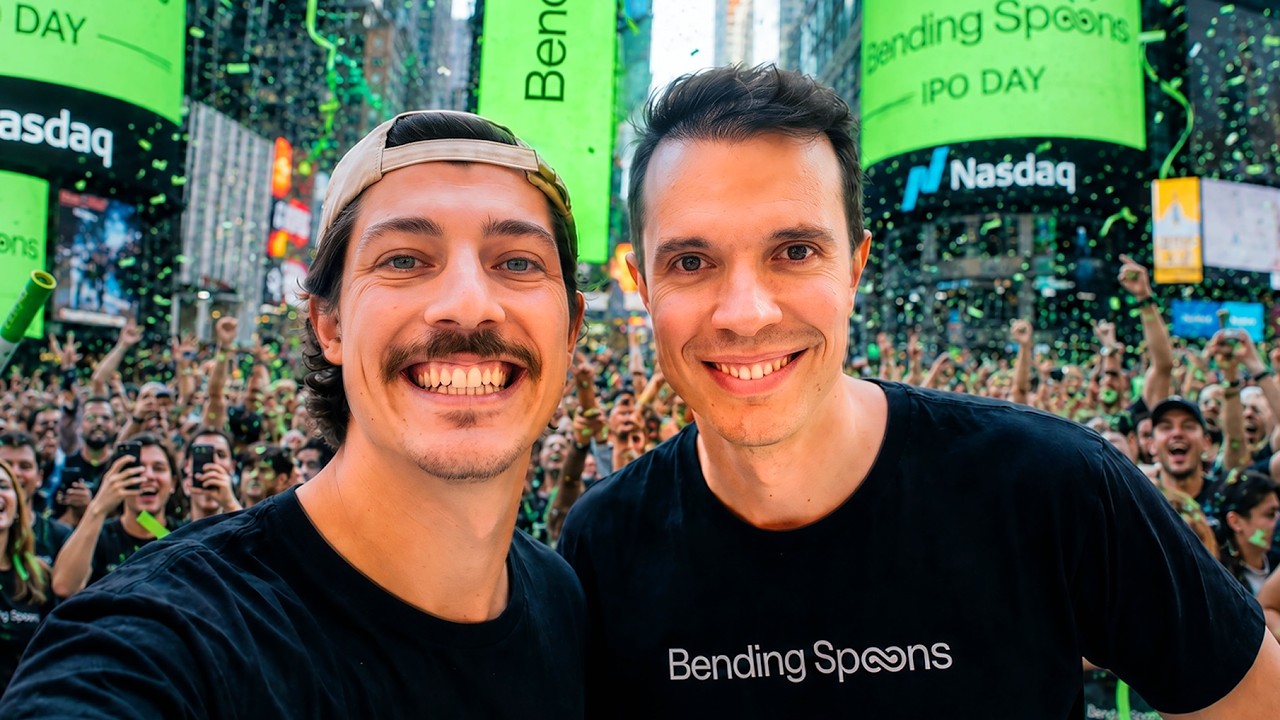

Bending Spoons Cofounder & CEO Luca Ferrari on the company's buy-and-hold strategy