Luca Ferrari, CEO of Bending Spoons, explains how the company acquires digital businesses like AOL and Vimeo, then integrates them onto a shared platform built on 50+ proprietary technologies. The firm never sells acquisitions and raised $1.6 billion in its IPO at $29 per share, jumping nearly 40% on day one.
Chapters
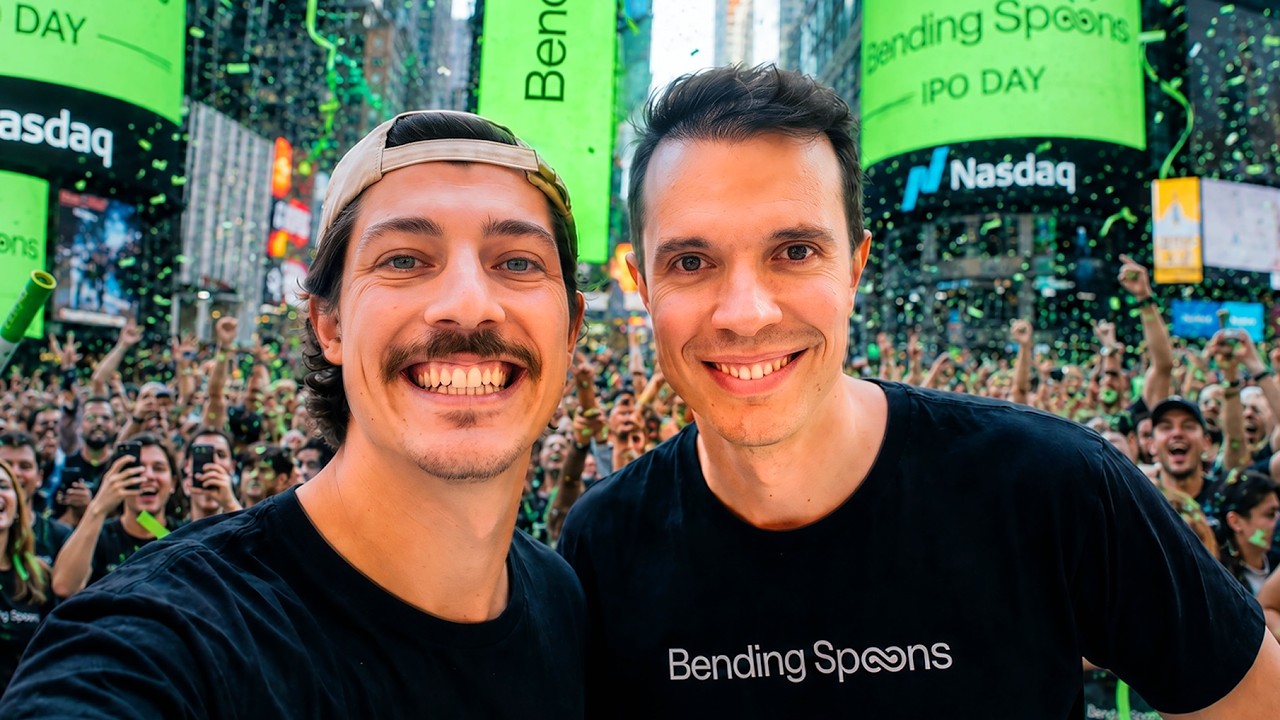
Now, some viewers may remember this iconic sound of the 1990s and early 2000s. Listen. I remember it all too well. That's the AOL dial-up, the sound of a computer connecting to the internet. Yes, over a phone line. At its peak, AOL offered millions of subscribers access to news, weather, games, and of course email. I can assure you, it was transformational. And as the web evolved, AOL shifted toward digital content and advertising. And last year, it was bought by Bending Spoons, an Italian tech company. Now, Bending Spoons acquires and revamps digital businesses like AOL, Vimeo, and WeTransfer. It rang the opening bell at the NASDAQ to celebrate its IPO. They look pretty happy people. Shares rose nearly Nearly 40% on the first day of trading. That's incredible. You'll see there that the shares were actually offered at $29. Bending Spoons says it's raised more than $1.6 billion through the IPO. It's going public at a time when AI is raising questions about the future of software companies. Luca Ferrari is the co-founder and CEO of Bending Spoons. Congratulations, Luca. Seems like quite a day. But I have to say, you've been at this for more than a decade now. Can you explain your concept and how you expect to grow your company going forward?
Thank you for having me. Yeah, of course. Happy to do that. So we, we've spent the last 13 years building a platform of really talented people, mostly engineers, designers, product managers, a culture of high performance and an approach to running businesses that's highly scientific. Over 50 proprietary technologies that help us do better work, more work with fewer resources, and lots of data from A/B tests across product monetization and marketing. And then we take this platform, buy digital businesses where we see a lot of unexpressed potential, and we integrate these businesses into this platform very deeply and try to almost unsee the status quo of these businesses and trying to come up with the most successful version of them we're capable of, then roll up our sleeves and rebuild everything that can be made better. We have rewritten code bases, re-architected cloud infrastructures, we re-accelerated innovation, rebuilt organizations sometimes from the ground up, changed monetization. And if we do it right, that improves retention, earnings, and in time we compound by investing in more acquisitions. And we never sell. We've never sold a significant business. Again, it's all integrated in the same platform, and the idea is to keep these companies forever, potentially.
And that's what I find so intriguing about your model. I am wondering, though, going forward, okay, you don't sell, you don't sell now. Sometimes selling even to competitors in certain spaces is more lucrative to shareholders. Right. And you are now a publicly traded company.
Yeah, I think you're right. But sometimes it's not really our choice. The level of integration we pursue is unusually high. I'm not aware of any other serial acquirer that does anything comparable to what we do. So the All of these companies, once they're integrated, they're running on the same technological layer. There is a core team that's shared with people fluidly moving across all of these businesses. So it's not that easy to then sell them off. I think you can't ever have it all. We choose to maximize efficiency and the quality of these companies and the products we own. But then it's not something that is easily disposed of like, say, at Private Tech we do. Would. So we'd rather take our long-term view and the higher level of effectiveness and efficiency, even if it means basically giving up the opportunity of selling these businesses down the line.
And we'll see if shareholders agree with that going forward. I am curious about the concept of launching an IPO right now. We're used to the ones on a massive scale because we've heard so much about them, especially in the AI space. So I'm wondering why your IPO and why now? You, I'm sure, could have raised more money in the private markets as well?
Yeah, look, I mean, we didn't— we have never tried to time the market or anything like that. We— I wouldn't be able to, certainly. We determined late last year, we determined we'd better be— we'd be better off as a public company. Better access to debt, which is an important fuel for, you know, for us, for our growth, and better access to equity, which we haven't used almost at all historically. But it's good to have the option. to use it tactically if an opportunity presents itself. We decided that in November or December, and then it takes a long time to work toward an IPO. I think we actually got it done pretty quickly, 6 or 7 months. And so you don't really know what kind of environment you're going to find yourself in by the time you go public. And in all honesty, I don't really care. Ultimately, myself and I think most of my colleagues who are doing this for the next 20 or You know, ten or twenty years. We'd rather have a good market than a bad market, but ultimately, you know, we're optimizing for the long run.
I will have to leave it there, but quickly, can you tell me bending spoons? Where does that come from?
The name?
Yeah.
Oh yeah, yeah. Okay. So well, it's one of my co-founders, Matteo. I think he's a fan of the movie *The Matrix*, and in that movie there is a. Yeah, yeah, there is a boy at some point that bends spoons with his mind, and we kind of liked the name because it captures— like, it's a metaphor for the power of the mind and determination, practice, dedication. And we just felt these were principles or values that, you know, we find inspiring. And so we— plus, you know, it's a little bit silly as a name, and it's good not to take yourself too seriously, I feel, in life.
Right.
So why not?
Luca, I'm glad I asked. Auguri. We will see you again, especially now that a lot of your results will be public. Appreciate it. Thanks so much.