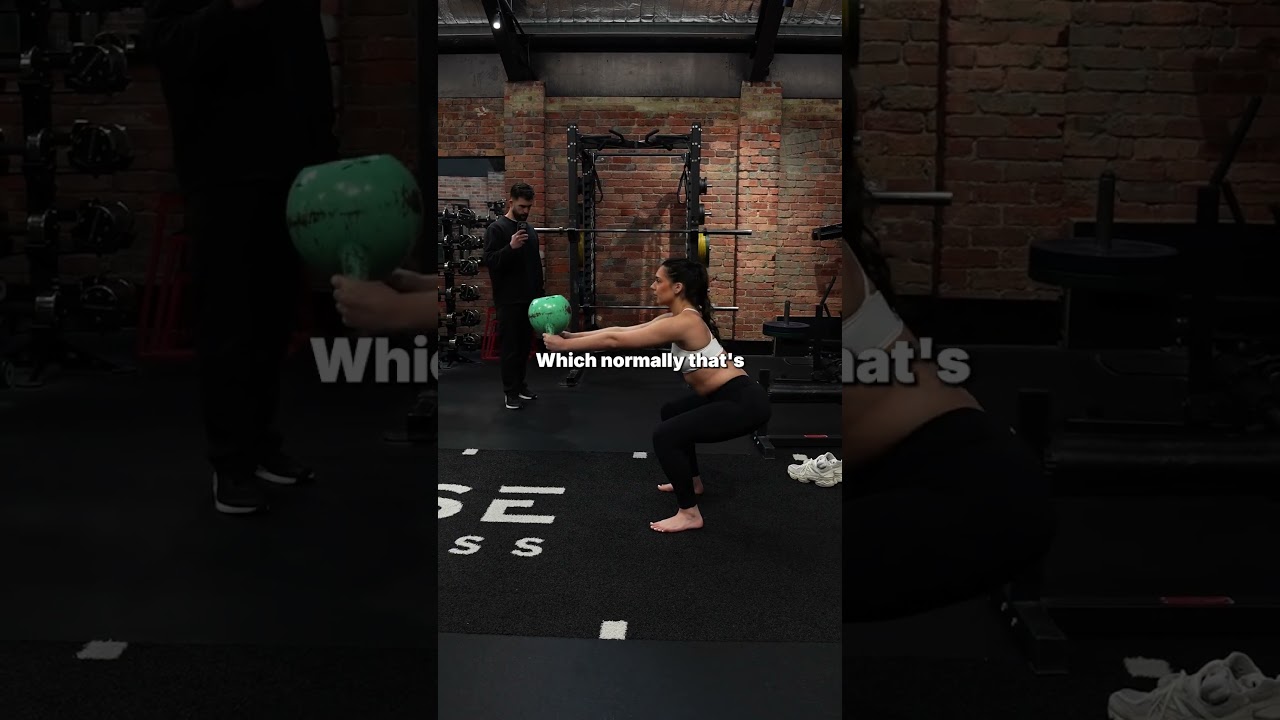
Mark Ottobre corrects a lifter's deadlift form, showing how a bar positioned too far forward can translate 100 kg into 200-400 kg of stress on the L4-L5 vertebrae. He walks through foot placement, lat engagement via a "point to the floor" cue, keeping the bar close to the shins, and maintaining a rigid spine throughout the lift.
Chapters
Let's just tell him as it is. Yep, go. I'm going to show you as well. What is it, good or bad? Bad. It is bad. Why is it bad? Multiple reasons. So he's rocking forward immediately, and the bar isn't in his center of mass at all, and he's using a lot of lower back and not a lot of hips, and the bar continues to come outside of his center of mass. Let's start with your shoes. Can you take them off for me, good sir? What I'm going to get you to do on your setup is I want you to point to the floor as hard as you can.
With my arms? Yes, with your arms. There you go. That's pointing to the floor as hard as you can.
So the other thing I want you to do, let's draw a line straight down from your shoulder, right? That's where you're gonna grab the bar. Foot position needs to be inside, 'cause I don't want you to be here when you're lifting, okay? Hips inside, point to the floor as hard as you can. If your feet need to go closer, and then I want you to pick it up, okay? Now bring that bar in, okay. 1, All right, great. That's it. So it was better in the sense of where your feet were and where your hand position was better, but what was worse was the bar is way outside your center of mass. In this position, what I want you to do is bring your arms up. If I put some pressure here, what do you feel? What's flexing? My lower back. Correct, pressure in your lower back. Let's just say we have 100 kilos here. If we pull out from there, that 100 kilos leverage-wise at your spine is no longer 100 kilos. It's more like 200, 300, 400 kilos, right? But it's all now through your L4, L5, right? Even if we do that even for like a split second with enough weight in our hand, we're going to seize up and hurt our lower back. It is your job to make sure that that bar stays as close to your shins and your body as possible. That's why at the start I get you to point to the floor as hard as you can, cuz when we point to the floor as hard as we can, we bring in our lats. What we want to stabilize with that is we want to stabilize the spine. The lats are going to help do that. So we've got 3 cues here. Your feet have changed, you're You're going to point to the floor as hard as you can on sit-up, and you're going to bring that into your body as hard as you can. Bring it into— that's much better. How'd that feel?
Yeah, more stable, better.
So one of the cues now, before you lift, what I want you to do is stick that sternum up and pull all the weight back into your feet. So see where I am here, right? What you're doing is you're getting into that position. That's the end position. Point, point, point, point, point. Keep that. That's it. Pull it into your center. Pull it into your center. So much better. But sternum up. The biggest red flag out of everything that I saw him do was he releases the lumbar at the bottom. Hold there. That's one. You're gonna pick it up, hold it a centimeter off the floor. There you go, there you go. Stand up. Good. Still not perfect at the top, but much better.