12 Years of Agency Lessons in 21 Minutes
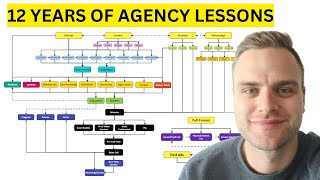
Matthew Larson (founder of A Thousand X Leads) presents "12 Years of Agency Lessons in 21 Minutes," a concise talk drawing on his experience founding agencies since age 16. He outlines 12 practical lessons for agency operators covering client retention (no client stays forever), revenue realities (no guaranteed MRR), operational habits (time-blocking, reminders and verification, treat yourself as a training company), key metrics (LTV vs. CAC), client acquisition strategies (ads, content, outreach, partnerships; use intro offers then upsell), diversified revenue (digital products, courses, affiliate/referral income), and creator-driven conversion channels (YouTube and newsletters). The talk closes with a note that sustained, multi-year consistency matters most.
Chapters
Welcome to 12 years of agency Lessons. My name is Matthew Larson. If you've never watched one of my videos before, and I am the founder of A Thousand X leads. I am 28 years old right now and I started my first agency when I was 16. So if we do the math there, 28 minus 16 is 12 years of lessons. All of the agencies have been a bit different, I would say, but an agency is an agency. You are selling a service to someone for money. At the end of the day, the first agency I ever had that this first successful agency ever had was a Facebook ad agency. Second one was an Amazon ad agency and then a conversion rate optimization agency. So they are different in terms of, you know, what is needed to succeed in terms of the actual service, but they're all serving e commerce brands. So I guess you could say in some ways they are very similar. So what I've done today is try to make it very easy to watch, easy to read. It's just have 12 lessons laid out. I just did that for one for every year. And hopefully this could either, you know, save you a lot of time, help you avoid mistakes, make you more money, you know, give you a reality check, or all of the above. So I'm gonna get into it right now. The first one is that no clients stay forever. You hear a lot of nonsense from, in my opinion, people who are delusional where they say their average CL stays with them for years, that might happen once or twice. But to say that your average client does that and to actually genuinely believe that and not be lying, just being that unaware, is something that isn't gonna lead to problems for you down the road. You always need to get more clients because no client stays forever. And you need to get more clients as well, because if your clients know that you, you know, it's kind of like they have all the power. If you can't get any clients and they know that and you're not growing, they're going to ask more of you. You're going to be more needy and more desperate and that's going to turn them off even more. And don't be naive about this and actually think that, you know, your clients wouldn't fire you the next day if you stopped getting results. It doesn't matter what you did for them in the past. And it's completely fair and completely valid. I'm not saying it's not, but you really need to, you know, get an actual some data on the average length of clients. So if you do Facebook ads like I Did my first agency, you know, I believe back then it was like 8.3 months is, or 8.2 months. It kind of is in my brain for some reason, even though that was many years ago at this point. And if you know that, then you, and you know that you charge, you know, 7,000 per month, that means each client is worth 8.2 times 7,000 to you. What did that be? 57,400. And then you take your 40% margins or whatever and say this is how much profit. And then you just go from there. But to just arbitrarily say that your average client lasts X amount of months or X amount of years is going to get you into trouble. And it's going to be part of another lesson later on in this list. The second one is there's no such thing as MRR. You might be charging 7,000amonth or 3,000amonth or something of that nature, but you have to earn it every single month. There's absolutely nothing that is guaranteed. And even if you have a contract and let's say you're charging people $5,000 per month with a three month commitment, people don't pay all the time. And if they don't pay, like what realistically are you gonna do? Are you gonna sue them for $5,000 per month? Probably not. Most collections agencies, you know, aren't going to bother with this kind of thing. So if they don't pay you, you know, not much you can do about it. That's the truth of it. The lesson with this is because you have to earn it every single month, you know, and if people don't pay, you never assume or to get too comfortable. And that's probably going to lead to some stress and, you know, heightened anxiety if you're an anxious person. But it is the truth. And to not understand that and be in the agency world is going to set you up for failure. Basically, lesson number three is that time blocking is the only way to get work done that actually moves the business forward. You hear that a lot where they say you got to work on the business, not in the business, you have to do both. But definitely you need to be working on the business. And if you have just a ton of meetings and you know, you're just changing tasks and you have a 30 minute here, a 15 minute there, an hour there, all the time, you're not actually ever going to make any progress on your agency. And I've seen that in my 12 years, like I made a tremendous amount of progress. At the risk of Bragging. But I've seen a lot of people who start at the same time as me who are still making, you know, their agency still does 30k per month, which is, you know, not trying to minimize that or anything. But if you've been doing it for 12 years and you're still making 30k per month because you don't actually get anything done, might be a little time might be a call for some self reflection. Most people don't get anything done at all because of the stuff I do. You need to be working on the business daily for five hours in my opinion. So if you really want to succeed, like you're going to have to pay the price of it. Waking up at 6:00am, getting five hours of work done before 11, 12:00am or 11:00am or 12:00pm and then you have, you know, 12:00pm to 5:00pm or more to do calls, to do meetings with your team. You need to block off that calendar and you need to get your work done. So hour one, you get your content done. Hour two, you make some new ads. Hour three, you respond to all your cold emails and messages. Hour four and you get the point. If you don't do this, you're just going to be up the hamster wheel or on the treadmill. You're going to be running very hard but not actually going anywhere. And that's just the reality of it. Lesson number four is related to lesson number one. If we go back where my average client stays with me for years, there's two very important metrics. And then a combination of these metrics is probably the most important metric that you're going to have to have with your agency. It's lifetime value and customer acquisition cost. And putting the two together as a ratio, your ltv. If we go back to that first example where I said 57,400 times 40% margin, let's go 50% margin because it's easier to calculate. So would that be 28,700? Hopefully let's hope so or so I just did some bad math. If you know you have a $28,700 LTV and your customer acquisition cost was $3,000, that's going to be a nine point something. LTV. LTV to CAC. The problem is that most people don't know either of these numbers. And when you don't know either of these numbers, you don't know how much you actually have to pay to get a new customer. You don't know how much each is worth and you don't know how those two Things interact. The number one thing like if all you did with your business was tried to increase lifetime value and decrease customer acquisition cost, you'd have a pretty successful business. It's all of the other crap that is not these two things that you know, prevent people from growing. And of course you have to do all of that other crap. But eventually you want to hire and systemize and, or delegate and, or just delete stuff so that you as the owner can only focus on your LTV and decreasing CAC and how those work together. When people say stuff like it's not how hard you work, it's or how hard you row, it's what, like what boat you get in, they're talking about your opportunity. There's a lot of agencies and a lot of pricing and a lot of stuff where you know, you simply cannot get a 10 to 1 LTV to CAC ratio. If you do something like email marketing and you charge $2500 a month and people stay for four months or something like that, $10,000 and you, after you take your margins out, that's maybe you might have 3,000, $4,000 left. When you're trying to get clients at scale with ads with, you know, all that kind of stuff, it's just not possible to get your customer acquisition costs low enough to where you would have a 10 to 1 LTV to CAC ratio if you had, you know, if your cus. If you were a premium agency and you charged $20,000 a month and you basically kept them for a year, that's $240,000 and you had 50% margin and your, you know, LTV in that case was $120,000 of profit and you were able to get a customer for twelve hundred dollars. Like that's a hundred to one. That's an insane opportunity. And it is possible with an agency. So don't let anybody tell you that's not true. It's just a matter of for most agencies it is not possible and they have a $1 LTV to CAC ratio or like a 1 or a 3 or a 5 and just not good enough to really grow a big agency. So if you find yourself in this situation, you either have to like fix your pricing, have some kind of upsell or value ladder, or just do a better job so there's less churn or you have to get better at ads, cold emails, content, all that kind of stuff to decrease your customer acquisition cost. Or most realistically you need to do all of those things. So number five is you Want to view yourself as a training company. You know, you say like, I'm in the business of I'm in the email business or I'm in the ad business. Now you're in the training business. And I think that this is an idea from a book called the One Thing or the Big Thing by Gary Keller. It's from one book I read where he was. He's the founder of Keller Williams Real Estate, if you know what that is. If you're American, probably only Americans, and maybe some Canadians might know what that is. But the idea is that when you're selling services, which an agency is selling services, labor is always going to be the biggest obstacle or constraint. You know, a lot of, and I've seen this and I've experienced it myself, a lot of the client work was great when you were doing it personally or you had a small team, but once you get to 50, 100, 150 employees or. And I've never got past that before, but I can only imagine, like how, you know, if you are one of these big tech Companies that have 200,000 employees, for example, you need a way to systematically onboard, hire and train employees and get them up to speed because you need to be able to replicate yourself at least to 70% effectiveness or 80% maybe, probably will never be a hundred percent. But without the ability to do this, without the systems to do this, like, you're not really going to get past a certain point. And I know that when I was doing it, I didn't understand this at one of my agencies and I was just basically hiring and hoping for the best. And you get a pretty bad reputation when you do that because the client work and the client results are just terrible. And then it makes getting customers even harder. And all of that kind of stuff makes churn go through the roof, makes your LTV go down. And it's just not something that you're going to want to be doing. So view yourself and aim and set the goal to be, not be the beat. You don't want to be the best email marketer, for example. You want to be the best email marketing trainer ever. And in this case, you're not selling training, you're just training your own employees. It's a great way to think about it, not just for an agency, but for everything. Lesson number six is you only really need to get lucky once. And that's the case with your ad funnels, your cold email scripts, your offers, your partnerships, absolutely everything. It doesn't matter if you failed 100 times before figuring it out. It doesn't matter if you made 5,000 ad creatives and they all failed, or 5,000 landing pages and they all failed, or you wrote 5,000 cold email scripts and they all filled. You just need to get one that works. And one that works will help you make all your money back and much, much more. And it's very, very heartening to think of it that way, that you only need to get lucky once. You don't need to, you know, get it right every single time. Because just the one time you get it right is going to get that 1,000 times, 10,000 times reward in terms of your ROI. Lesson number seven is that each client acquisition method makes the others more effective. Never listen to someone who says that you need to focus on one client acquisition method and master it. Whether that be like cold email or cold calls or, you know, posting on LinkedIn or posting on Twitter or ads or anything like that. All of them are valid. If you went to Google and you searched in how do I get clients? You probably see 50,000 results and all of them work. It's just a matter of, you know, how much do they work for you, and if they're not working for you, it's because you're not doing it right. You don't know something that you need to know you want to have at least. And these are the main buckets of course, ads, content, outreach, and partnerships. Pretty much every client acquisition method can be categorized under one of those four things, and the effectiveness of each is multiplied when you add another one. So if you were doing cold emails, and that was it, the second you start running ads and you start posting content and people see that and follow you on YouTube or LinkedIn or download something from your paid ads, you know, they become much more likely to reply to your outreach and to your cold emails in the future. Another situation, if you were running ads and they clicked on your Instagram profile and it was just blank, that would not be as good as if they clicked on your Instagram profile and it had a bunch of useful content on it, for example. So there's a lot of combinations of how these work together, but you want to have all four, because it's not a matter of, like, if each of them is worth 2, it's not 2 plus 2 plus 2 plus 2. It's more like 2 times 2 times 2 times 2 or 2 to the factor of 2, and then times 2 to the factor to the power of 2 again. And then, you know what I mean? Very, very important to understand this Number eight is reminders and verifying are the two most important parts of any operations or systems. So most people will only focus on their SOPs, like standard operating procedures, their processes, their systems. You might have those, like that's everyone is going to have those at a certain point, but it doesn't matter if you have them. You might tell people to do something, but you need to remind them without the reminders in an automated fashion. Whether those be slack workflows or text reminders or email reminders or whatever, you're not really going to get most of the value of these systems. A lot of people will open it once and then never open it again. You need to tell them, you need to tell them again. And then you need to have someone verify that it's doing or that it is incomplete. And then you have to have another person to verify that that person verified that it's complete. And you might think, wow, that is like redundant or that's symptom or that's kind of indicates the operations aren't that good. If you think that you probably never managed a bunch of employees before and had a huge operation system and that's fine, I'm not judging you for it. But when you really want to get to a high level, this is how it works. SOPs and processes aren't good enough. You need to remind them constantly. You need to have someone checking that it is done and then you need to check that that person checked that it was done. And it's called a basic chain of command. It's just one of those things. Business war, you know, anything. Lesson number nine, you want to start with an intro offer and then upsell into recurring clients because that's going to get you 10 times more business than you would have otherwise. It is hard to get clients and there's no doubt or question about that. When people try to make it sound easy, it's hard to get even one client. And you're kind of doing a disservice to people. Like if you post about it, oh my God, I got so easy to get clients. It's definitely hard. It's business. If it was easy, everybody would be rich as hell, right? But it's a lot easier to get clients. If you have a nice intro offer that's cheaper, that's lower risk, lower commitment, so they can try you out, if that makes sense, then you prove yourself, you get your foot in the door, and once you do prove yourself and get a result, it's going to be 10 times easier to upsell them. To your main service that you would like to sell them all along than it was if you just went for it right away. Lesson number 10 is only having a recurring service is the number one reason most agencies don't scale. It's very risky, very unstable to only have your main recurring service. And the reason for that is each client. If you had 10 clients and two of them leave and they're all equal in this hypothetical, that's 20% of your revenue and even more percentage of your profit. Another one reason is like 99% of people who come into your funnel through ads, through content, through outreach are never going to be qualified to buy from you. Your main service, it's just too expensive. They don't need it. They do it themselves. Not a good fit, whatever. So if you only have your main service, you're not monetizing 99% of the target audience. So you can do that with digital products, with affiliate links, with referral fees, courses, programs, and these things are a great source of revenue, but minus payment processing fees and maybe some software, they're 100% margin. So it's like you can double your revenue with these things, but it's more like you can five to ten times your profit. And it's just a very important part of an agency that 99% of people don't do it all. Lesson number 11 is that YouTube videos and newsletters are the two best ways to convert client. To convert leads into clients. You're gonna close 10 to 20 times more clients if you have these. And I know that sounds fake, but try it for a year and you'll see. YouTube videos are like spending time with you one on one. If a thousand people watch the video that you're watching now, I didn't have to hop on Zoom and basically go through these 12 lessons with them one by one. I made the video once and everyone can see it, but it's basically the same thing as if I was doing that. And newsletters are an intimate pathway to your brain that can. And this intimate relationship pathway simply can't be replicated with any other types of content. Newsletters are the only audience that you truly own that doesn't rely on a platform or an algorithm. And it's the only audience that you can reach, you know, right away, whenever you want, on demand. If you have 10,000 people on your list and you send a newsletter, all 10,000 of those people are going to see it in their inbox. They might not open it, they might not read it, but they're still going to see your name, your company name, they are still going to think of you. Whereas you post something on Instagram, for example, it's going to show it to like 1% of your followers at the start. And if it does well, it might show it to a little more more, just not the same thing. So YouTube videos and newsletters, three to five times per week at a minimum are going to get you 10 to 20 times more clients. And that does sound fake or not realistic, but it is. And if you don't believe it's realistic, probably haven't done it before. Lesson number 12 is that most people don't succeed because they're just not that good. You know, personally, their habits, their, you know, skills, et cetera. And their service just isn't good. And deep down, most people know their service sucks. And because of this, they're not confident enough to go hard promoting it. And they don't get leads because of that. If your service truly was great, you would be like, obligated to sell it to as many people as possible. And the reason most people don't do that is because deep down they know they can't get results. And the problem with this is that there is no easy answer or fix to this problem. It's just one of those things that you have to get better over time and hone your skills. And there's nothing that I could do or anyone else could do to teach you, in my opinion, to provide a great service. It's accumulation of your skills, your experience, like your thoughts, your actual execution. It's just one of those things. And this is probably the number one reason people don't succeed because their stuff isn't good. The last one, it's going to be a bonus one. And it's that anyone can do something for a little while, whether that's grow your business or get great results. You know, it's easy to do that for a week or a month or, you know, a few months, but it's not impressive until you do it for years straight. And anyone can do it for a little while. Talk to me, talk to other people, start bragging about it when you've done it for years. And that's the truth of it. It's not impressive until you do it for years in a row. And that is my true thought on the matter. So if you thought this was a helpful video, I guess, like, comment and subscribe, comment on what you want me to make videos on in the future and I'll see you in the next one.
More from Matthew







Everything I Would Change About This Ecom Email Marketing Agency (3 HOUR LIVE AUDIT)

Everything I Would Change About This Meta Ads Training Business (3 HOUR LIVE AUDIT)


