Everything I Would Change About This Ecom Email Marketing Agency (3 HOUR LIVE AUDIT)

In this three‑hour live audit, Matthew Larsen (joined by Philip Moldovanu) systematically evaluates the e‑commerce email marketing agency Social Scout. The audit begins with a deep dive into the agency’s paid ads, highlighting inconsistencies in claimed Klaviyo account numbers and suggesting concrete creative tweaks (testimonials, subtitles, stronger hooks, and visual pop‑ups) to boost ad performance. Larsen then moves to the agency’s overall content strategy, outlining a unified, multi‑platform system where each channel (Instagram, Facebook, LinkedIn, YouTube, Twitter) serves a specific role in moving the ideal customer profile (ICP) from cold awareness to a paid client. He assesses each platform’s branding, profile completeness, posting frequency, and content quality, applying the “7‑11‑4” rule (7 hours, 11 touchpoints, 4 platforms) as a benchmark. The review covers Instagram (profile layout, highlights, pinned posts), Facebook (profile picture, CTA alignment, posting cadence), LinkedIn (headline, featured links, lack of posts), and YouTube (thumbnail consistency, video packaging, long‑form content gaps). Larsen also audits activation points such as newsletters, webinars, community, and other lead‑magnets, finding most missing. Finally, he examines the agency’s search‑engine presence for both the founder and the company, noting control of first‑page results but limited professional content. The session concludes with a concise “top‑5 action plan” that includes fixing ad proof points, aligning guarantees, enriching landing pages, standardizing branding across platforms, and establishing consistent, high‑value content on all channels.
Chapters
So I was on Instagram scrolling a little bit, not doom scrolling, just scrolling a little bit in a controlled, measured fashion. And I don't know about you guys, but I just get nonstop ads for e-commerce email marketing agencies. And that's fine. I get there's a lot of them, but it's also very bizarre because I don't have an e-commerce brand. This has been a problem for me for months, years even. I just can't get away from these ads. So today I decided to basically pick one of them and do a full 3-hour live audit on their offer. So today's extremely lucky participant is a business called Social Scout Email Marketing, and that's what we're going to put under the microscope today. I don't know this person. I just saw their ads in my Instagram feed earlier today and decided to select them. I'm very passionate about this topic, and I love to do these audits because lead generation is probably the most important part of any service business. Every single problem in a service business, both B2B and B2C, can be solved by generating more leads. Simple as that. If you have a high churn rate, you're probably going to lose all your clients soon enough. You're going to need more leads. If you have low margins and pricing power, it's going 'Cause you don't have enough demand, you can do that by getting more leads. If you have a low close rate, you're just gonna need more leads to get clients 'cause your sales team is so bad and needs practice, right? If your team is bad and you keep messing up, it's 'cause you can't afford to hire A-players and you need more leads. If you have nightmare clients that you just can't get rid of, it's 'cause you don't have enough leads. And then if you just have low cash flow, obviously you need more clients, you need more sales, you need more leads. And we could probably go on and on and on about this, But we won't. The system that we're going to take a look at today and see how Social Scout fits into is one of here. So if we go into it and we draw a little bit, we have at the top, we have our 4 ways to get customers, our paid ads, our content, our outreach, and our partnerships. Those drive traffic from the top of the funnel to our middle of the funnel where they opt in or they apply and they start getting nurtured by our email flows and other stuff. Eventually they will try to fill out an application and they'll be either qualified or unqualified. If they are qualified, they'll have a chance to book a call. They'll see our VSL, they'll see our proof, and they'll get a pre-call flow and they'll kind of go in there. So that's basically how a marketing system works. Again, like today we are only looking at the publicly available assets. There's nothing that I'm going to reveal in this video. In this audit that you can't just go find yourself in 5 seconds. So obviously that comes with a few things. We can't see their outreach. That doesn't really make sense. We can't see their partnerships. We're not going to wait around for their email flows because those take very, very, you know, so long to receive. We're not really going to communicate with their appointment setter and we can't really see, you know, their sales process. So what does that leave us? That leaves us a few things. We're going to take a look at their paid ads. We're going to take a look at their content. We're going to take a look at kind of the industry, the ICP, the offer, the messaging, the big idea, that kind of stuff. Then we're going to take a look at their funnel, and then we are going to take a look at their search results and that kind of stuff to see what happens when you search them up. So with that being said, let's go through a little disclaimer here. Like I said, I am auditing this business using only publicly available information. I'm doing this purely for educational content. I'm not looking to roast or offend anyone. I have no motive or incentive behind doing this. 99% of the time in these audits, I don't even know the person. I just picked them because I saw their ad or content in my Instagram feed. And every audit on this channel follows the same checklist. All of the framework used are mine, and these are based on my own opinion only. I record all of these in one day, in one go. With basically no preparation beyond gathering the necessary links and probably looking at it for 1 to 2 minutes so I know that it's actually worth auditing. So this audit is also designed to be completed within a reasonable amount of time. If I'd sat here for 25 or 50 or 100 hours or I talked to them, my conclusions might change. But other than that, if you've never watched one of my videos before, you don't know who I am, my name is Matthew Larsen. I'm I'm 30 years old. I live in Dubai, and I spent basically 12 years in the lead generation and service business. During that time, I've been a part of 4 exits, 3 agencies, and 1 newsletter. At the company that I'm currently part in, we basically book about 60 B2B calls per day for ourselves and generate about 13,000 B2C leads per day for our clients. So I do view myself as something of an expert in this subject, and I also analyze about 300 businesses per month. Basically using this very same audit that we're going to do in this checklist. So again, I'm not going to read it off to you, but there are things that we will cover and we won't cover. We're going to be covering all of the public-facing assets, and there's going to be a lot of times where we can't see things or we don't really know their true intentions. And we're also going to be jumping between these things back and forth a lot of the time because nothing can be viewed in like true isolation. Context, nuance really matters here. And then before we get started, one of the requirements of becoming an adult, which most people never do, is learning the difference between in spite of and because of, right? My grandma lived to 98 years old just in spite of smoking a pack of cigarettes a day, not because she smoked a pack of cigarettes a day, right? And throughout this audit, We will learn, look through things that are surely working and probably profitable, even though they are not technically ideal in my opinion. So for example, you know, we often see people in these audits probably doing millions of dollars that I would guess in sales, but they have a terrible sales page or a terrible VSL. They are not doing millions in sales because of this terrible sales page. They're doing it in spite of the sales page. And if they fix their sales page in this example, they would make even more money. So it's very important to keep this in mind in the audit. So the first thing we need to do for Social Scout is we need to answer a few questions about the business, and we're going to be doing a best guess because we only have public info. We don't know their true intentions, but in most cases, I think it will be obvious. So I basically compiled a bunch of links here just to make sure that we have everything and it's worth auditing. But the first thing we got to do is basically jump through their stuff, and I have it all open in my tabs here. You can't see it, I don't believe, but I'm going to jump all through it and just get a full picture of the business. So this is their website here, and I'm going to change the view on my screen. So Elite Ecom— Elite Email Marketing for Ambitious Brands. That makes it pretty clear that it's e-commerce. We scaled 300 brands. Very nice scroll here. We have, um, the founder here. His name is Philip. Basically, they serve as your in-house team for email marketing. Some designs. Klaviyo. Got some screenshots. Got some testimonials. Got some of their designs. About us. So looks like there's 2 of them, Philip and Connor. They got some FAQs. So that's their main website. We're not really going to spend too much time on the main website because we're really going to focus on their ad funnel. This is the landing page or the sales page that their ads are going to. This is the application form. This is the call book page. It's loading, but it looks like a normal Calendly, I assure you. This is their thank you page. This is their ad library. This is the Instagram. This is the YouTube, Facebook, and basically the LinkedIn. So I very much we can definitely say straight off the bat that this is e-commerce, right? I don't think there's any real question about that. It's e-commerce. The ICP, you know, this is again where. Someone's intended ICP and their ICP that they end up creating all this stuff for, and the ones that messaging and resonates with, sometimes different. So basically the offer is in-house, you know, email marketing team that matched the ad I saw. So basically they're going to come in and presumably do all of your stuff, but we're going to talk about that later. The price— I did find the price on here. It in my check and it was starting at $3,500 per month. And that's important for us to know. Sometimes we can find the price, sometimes we can't. And their ICP, basically, like if we had to guess, right? So they're going to be your in-house marketer for this, right? So what does that imply? That implies they don't have an in-house marketing team. Most brands, you know, not all, but most Definitely in the 8-figure range are going to have someone in-house on average, not all the time. Basically, the second thing is they have to be successful enough to have and to be able to afford this. So like that kind of takes out a lot of the bottom-level stores. And then we can kind of— and this is where I say, you know, their intention versus you know, what actually shows up, right? Because we contractually guarantee $50K to $300K in monthly email revenue within 60 days. Like, I don't know if this is the intention or not, but to me, this really excludes big email marketing stores just with the messaging. Someone who's doing, you know, $10 million a year, or even a little bit more, they're doing $2-3 million a month. Is not going to want this, right? That's— they're going to be definitely like, where's the rest of my revenue, right? That's a very low amount. So it's just one of those things. So I'm going to say just by looking at, regardless of what their intentions are, they probably are, you know, e-com email stores, you know, $500K to $5 million per year range. Like, we'll see what, if we can learn more as we're going, but to me, like, that is what it is. So we're basically going to be looking at the strategy before we look at the execution. So basically gonna do the, the industry, the ICP, the offer, the big idea, and then the messaging. Like, these are all separate things in theory, technically, but they work together and they're just like so hopelessly intertwined that We cannot properly evaluate one without understanding all of them and how they work together. So once we do that, which will take some time, we'll then audit the execution. So the funnel, the paid ads, the content, the search results, and therefore— so the funnel and the ads and the content are of course downstream from the strategy. So we're not going to be able to judge if these are good or bad before we get a good grasp on these. So the first thing we're going to look at is the industry. And the industry is the larger market you serve. So in this case, it's basically e-commerce. And basically, before we evaluate anything the business has created, we need to determine whether e-commerce brands like the industry can support a large and profitable business. So we're going to score it across a lot of different things. As far as industry goes, basically In my opinion, your industry is even more important than your offer. Everyone always talks about offer, offer, offer, and in my opinion, yes, of course, like that is either the second or third most important thing, but your industry is going to really limit your offer. And let me give you an example. Let's say you do lead generation for, you know, businesses, right? If you did lead generation via paid ads for wealth managers versus dog walkers, the exact same team, the exact same deliverables, the exact same, you know, SOPs, the exact same everything, like that's the same offer. Who do you think is going to pay you more, right? Who do you think is going to be a better client? And that's what I mean. So we need to really nail the industry. And one of the things that I don't like, I'm going to get into it, is that ecommerce, as well as stuff like SaaS, as well as stuff like SMBs, as well as stuff like You know, a lot of this stuff, they're not really— they're industries, but they're not really industries in the way that something like roofing is an industry, or something like med spas is an industry, or something like, you know, MSPs are certain. Like, what I mean by that is you could do e-commerce. Like, let's just say you have a paid ad agency for, for ecommerce brands, right? A lot of ecommerce brands don't have a single thing in common with each other other than the fact that they like use Shopify, maybe some similar tech stack. An ecommerce store selling clothing versus furniture versus protein powder versus freeze-dried candy have very little in common with each other. And the reason that is an issue is that you don't really necessarily get necessarily get compounding learnings that can be applied from customer to customer. If I have a roofer in Los Angeles and I just, oh, I make the best ad campaign for him ever, I can just go get another roofing customer in San Francisco and San Diego and Las Vegas and Atlanta and Miami and basically copy and paste the exact same everything, change the logo, and I can expect the same results. It's not really the case in e-commerce. So the things that make up a great industry are basically the economics of your customer. Like your LTV matters a lot, right? It's all you hear, you know, offer LTV, offer LTV. But the average LTV of your customers' customers inside the industry you're serving can matter even more. If we go back to that wealth manager example, you get a wealth manager client that could be $50K+ a year, you get that dog walker, a client that probably going to be a few hundred dollars at best. So strong industries have high customer LTV, they are easy to reach, they have a large market, they have significant pain, they have spending power, and they have a positive market direction. And a lot of these can be good, and we're going to score this industry, but one fatal weakness can really ruin it. Like, if everything else is good but you just can't get in touch with anybody, it's not necessarily the best thing. Right? And a great business inside a terrible industry is always going to face an uphill battle, and a better industry makes everything else easier. So the same skill, the same team, the same offer can produce radically different results when applied to a better industry. Back to our dog walker and wealth manager example. So basically, we are going to audit this industry, and it is e-commerce in general. So for criteria 1, their customer LTV, this is kind of a funny one that isn't really fair because, you know, a lot of e-commerce stores are going to sell products, you know, $50, $100 ticket, sometimes less. So if we were to basically judge this on this particular scale in the same way that we would judge, you know, any other service business or any other niche, basically it's not really fair and it's going to basically make an unrealistic thing. So what we're going to do is we're going to apply context and nuance to this, and we're going to basically think of like how much extra revenue could he make realistically on average, you know, for a clump of customers, for example, right? So I'm going to give this a 3, basically 3 out of 5. It definitely is not the worst industry, But it's definitely not the best for customer LTV. The reason I'm giving it a 3 out of 5 and considering it in the $5,000 to $19,999 range is because he can affect so many customers, right? Like if he's sending emails, like one email can be worth like all of that much. So it's just not really fair if you kind of think about it like that, but we're going to do it as a 3 out of 5 here. The next is, are ecommerce stores easy to reach? So basically, we're going to decide 1 point if they can be reached through paid ads, through content, through outreach, through partnerships. And then we're going to give an extra point if there are not serious gatekeepers blocking the decision. So like a lot of industries, they'll have a secretary, they'll have, you know, it's not that easy to get to the person in charge, like a doctor is very, you could export a list of doctors, but they're with patients all day and you're just going to get blocked by their secretary, right? That's an example. So you definitely can get e-commerce stores paid ads and content. You definitely can build an accurate prospect list. You definitely can get them with partners. But to me, it's not like that e-commerce store owners like probably have a secretary as common, but they just are so easy to reach that going to consider the fact that like the direct access is, you know, they get spammed so much by email, they get spammed so much by paid ads, there's so much content that we are going to take away 1 point even though you can get, you can reach them through all of these things. We're going to take away 1 point because they get so much spam, and I think that's fair for this. As far as the market size goes, basically how many e-commerce stores are there going to be In his ICP, right? Like there's, I can't remember, but there's something like, I think there's several, like high hundreds of thousands of Shopify stores, maybe even more than a million active ones. But to me, like I looked at his ads, they're running in the United States only. He's presumably, you know, looking at someone $500K to $5 million per year. I have experience in this industry. I sold 3 agencies in this. And I know for a fact that if you export a cold email list with 3+— 3 to 25 employees on Shopify in the United States, you get 112,000 people. So this is a clear 5 out of 5 for market size. As far as significant pain goes, right? Like in the context of email marketing, 5 would be legally required or you're losing money every day. You know, e-commerce email marketing is not legally required in the same way that, you know, auto insurance would be. You can't drive a car without auto insurance. It's not like— this is, to me, is between a strong 4 and a 5. It's definitely not optional if you actually want to succeed. You know, people have budget for this. You know, they can't really wait, but you're not necessarily losing money every day, like actually losing. You're more like not getting the money every day. You're getting extra. I would like consider losing money every day, like your, you know, sales team doesn't have any calls, for example, versus this, your store is still functioning, but you're not making enough money like you should. The next is spending power, right? Go back to that wealth manager versus dog walker example. So let's see, how long can the average qualified customer pay for the offer without needing an immediate result? You know, it's definitely not a 1. Anybody who would buy this doesn't need to finance email marketing. I don't think they need like a quick result, but a lot of the people in that thing, you're in that like ICP range, that $500K to $5 million per year. It's not like they're gonna pay for e-commerce marketing and get zero results for 12 months. To me, like, this is a 3 out of 5. E-commerce brands maybe once upon a time would have a 5 out of 5 spending power, but their margins get squeezed every year by, you know, essentially increasing ad costs and more competition. So I would give it a 3. Market direction— is the industry growing or remaining stable? So I'm gonna go on my phone here, I'm gonna just look this up. It's a complicated one because we're just gonna use how much is it growing. So how many— I'm gonna search how many new Shopify stores per year growth percentage. We're just gonna use that for now. Simple enough.
Okay.
This is a great time for my phone not to load. So it is growing by more than 10% per year. It says it's 17% per year is what I see. I'm not going to audit those results, but this is a 5 out of 5. So 5, 8, 12, 17. 21, 24. So like the maximum score is 30, and if we go into our score, it's going to be firmly in the good category, barely over the neutral, but in the good basically. So the thing is that, you know, there's no real 1 out of 5 here. Like A good example is, you know, doctors have a high LTV. There's a lot of doctors. They are somewhat easy to reach, you know, like probably 3 or 4 out of 5. They have spending power, you know, the medical field, a number of people are doing is growing, but they just like most doctors, good ones anyway, are already like packed to the brim, right? Like this, getting customers, if you're doing lead gen for doctors, is basically completely optional. They get enough referrals where they don't need it. So everything else is kind of strong, one thing can really sink it. So I would say like this is, you know, between high, you know, between solid, neutral, and weak good as far as score. Essentially, like, e-commerce is not a real industry in the way we would like it to be. But, you know, it is what it is. And then we're basically going to give him, you know, we are in there. We're not targeting beginner Shopify stores. So we're going to give it a 4 out of 5. The next thing is the ICP. And a lot of people will just like kind of just consider the ICP in the industry the same thing. And they'll just call it a niche or a niche. Not really a good idea in my opinion, because although they're very, very closely related, they're not exactly the same thing. And niche will— if you just like conflate them, it will really make you miss a few steps here. So the ICP is the specific buyer inside the larger industry. So if you're selling to these e-commerce stores, so ICP, as we're going to go over, is probably going to be the founder of those e-commerce stores, basically. So 2 businesses can essentially serve the same industry while targeting completely different levels of customers, right? So an example of that, if I was doing roofing lead generation, and I was doing it for, you know, a single someone who just basically it's him doing all the roofs, maybe has a couple of people in his one crew versus a multi-state roofing company.
Yeah.
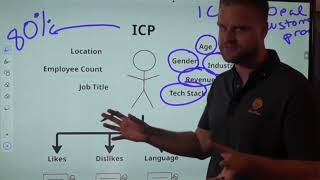
Who is going to be a better client? And this really matters. It's a specific level of buyer in that industry. And we really need to basically identify this ICP properly because the offer, the messaging, the funnel, the ads, the content should be built for this person. This is an extreme point of weakness in a lot of marketing where they usually, well, almost always accidentally, I don't know why you would do it on purpose, they accidentally create a generic ICP. Create messaging, they create ads, they create a funnel, they create an offer, they create content for basically the wrong level of customer, and then they just attract, you know, a bunch of broke leads and they get frustrated. So basically, the same industry can be good or bad depending on the ICP you target. A good ICP has significant pain, spending power, authority, and is easy to reach. And your ICP should basically describe about 80% of your customers, right? About 80% are going to fit into this ICP. Like, there's always going to be exceptions, but 80%. When we find these 80% of our customers in our ICP, our goal is to basically build a shared list of characteristics, both literally and then a shared list of problems, circumstances, and desired outcomes they have. And this is why we have to separate industry from ICP. Once we do that, you know, everything else downstream should be based on and appeal to directly this ICP. It's also very important to know that in most businesses, you generally scale your business by scaling the ICP, basically just getting higher and higher level people, not by just, you know, blasting out 1,000 low-level clients. Funnily enough, in this audit, e-commerce email marketing is kind of one of those where you just blast out 1,000 low-level clients. But if you were doing that roofing lead generation that I talked about earlier, you don't just get 1,000 solo owner-operator roofers. Eventually you want to scale up to the big multi-state companies. You have 5 clients instead of 1,000, and they buy more and they're more reasonable type thing. So for the action steps, we basically want to try to see if we can narrow down this ICP by characteristics. You know, this is going to be literally useful because we're going to see like this in ad targeting and cold email list building, but it will also help us evaluate the messaging. And remember, this should be the average customers. It's going to be, you know, different on either ends of the extreme. But so I would say that gender is probably not applicable. There's going to be tons of You know, men and women, e-commerce, $500K to $5 million per year. He is only running his ads as far as I can see in the USA. Tech stack, Shopify and Klaviyo, looks like very important. Homeowner status is relevant sometimes, not here. Same thing with marital status, same thing with household income. Net worth, interests, probably not. So basically we're looking for 2 to 5 characteristics. So age, like to me, like most of your people are going to be 25 to 44 in this. Of course there might be younger people, there might be older people, but younger typically don't have an e-commerce store at the same rate, or the younger people are much more into doing it in-house in my opinion. And over 45, they still might do it, but It's just, it's kind of like a tech-heavy business where you don't really see that many people over 45 doing this. Again, like, they could and there's nothing stopping them, but on average, we're going to talk about here. We're definitely going to be dealing with the founder or the owner at these levels. I don't think at these levels they're going to have a CMO or a head of growth that we would be dealing with. And something that I think would be really cool Is we want to see, in my opinion, we want to probably do the 3 to 25 employee range. E-commerce is a unique and funny, like, business type for this, because if you just don't do your manufacturing and you don't do your fulfillment and you just like kind of outsource your customer support, like a lot of people, you could have like a $100 million a year e-commerce store with like 3 employees. So it's kind of weird, right? But on average, like, we don't want to do either 1 or 2 in the sense that, you know, like, if a lot of people who have 1 employee count is going to be like, it's going to be a dead store. If they have 2, that's usually could be 2 co-founders. So if they have 3, usually they're going to be a good fit. And then we go to 25. This to me is only valuable as a proxy for outreach, which we're not going to target and we're not going to evaluate. But if he was going to do like export a cold email list, it would be this. So let's see if we can get these shared characteristics. So age 25 to 44, Shopify plus Klaviyo. They're going to be the founder. They're going to be the USA. What else do we have? $500K to $5 million per year. So like, this is valuable, right? We have this stuff here, and because we have this now, we can basically, in a following step, we can visualize this person, we can research them, we can get inside their head and say like, what are the different problems they're having? What are different circumstances they find themselves in? And what are the outcomes they desire? We really have to be able to visualize this. first and have these shared characteristics if we want to craft kind of the perfect messaging downstream of this. So if we're going to do this in notes, I don't have any real notes on this. Like, makes sense to me. And basically, as far as the ICP goes here, like, everything is, you know, it's hard to rate yet because we don't know his messaging and stuff, but Like, it looks good based on like what we've seen on his site. You know, we're going to be your in-house email marketer, we contractually do it, costs about $3,500. Like, that looks to me like he has executed everything for this ICP properly at first glance. But let's see, the next thing is going to be the offer, and that is obviously what we're asking people to buy. So an offer really is only good or bad in the context of the ICP and the industry, and it should solve something that they already care about, should create obvious value, and we should be able to fulfill it repeatedly and profitably. And a great offer is going to make everything easier, and a weak offer form— like, basically forces the funnel to compensate. Like, you're gonna have to be more dialed in your funnel the weaker your offer is. So basically, the offer should feel specifically built for that ICP. It should be built around existing demand that people already, you know, understand, wants, and pays for something like this. It should solve a painful, urgent, or expensive problem, preferably one that's legally required, but that's not usually the case. Just by looking at it, you should immediately understand what you're buying and what you're going to receive. The value of the offer increases basically with the desired result and how likely they think they're going to achieve it. And basically it decreases in value with time, effort, sacrifice, and risk, just like Alex Hormozi's value formula, right? So when we basically have our offer, we need to understand that this fulfillment should basically be standardized, repeatable, and profitable. We don't want to be necessarily doing full custom work for everybody. Of course, every client's different and we have to actually do our job, but we don't just want to be, you know, doing different deliverables for every single client all the time. We want to have a standardized process that's repeatable, that can be measured, improved over time for quality, improved over time as far as efficiency. The costs come down over time. These team basically is trained on the same thing over and over. And it becomes more profitable, right? So we need to understand that the offer strength determines, you know, how difficult the rest of this entire audit is going to be. If you have a 5 out of 5 offer, that basically does 80% of the work and the funnel only needs to do remaining 20%. Of course, these are round numbers. There's no way that you could possibly measure it, but directionally it's very correct. So if you had a 5 out of 5 offer, The offer does 80, the funnel does 20. If you have a 4 out of 5, the funnel does 60, or the offer does 60, the funnel does 40. If you have a 3 out of 5, the offer does 40, the funnel does 60, and all the way down. If you had a 1 out of 5 offer, basically the funnel— the offer does nothing and the funnel does everything. So, you know, you can sell whatever you want, you can make your offer however you want it, but you just gotta know that you gotta be super, super dialed in if you don't have a great offer. And we're gonna see how this goes in the rest of the audit. So let's go through a checklist, like basically the things that we're gonna do. We're gonna kind of do the same thing that we did for the industry. Is the offer built for cold traffic? Does it solve a problem people must address? Does it create obvious value? Do you, you know, based on the proof and stuff, have a high perceived likelihood of succeeding? Is there a clear result or deliverable? Does it deliver value quickly? Does it require minimal customer effort and sacrifice? Based on our best knowledge, does it cover acquisition and fulfillment costs? Is it standardized and repeatable? Does it have a risk reversal? Will it remain relevant for at least 5 years? And does it naturally lead to the main offer if applicable? So the first one, basically, does the offer make sense to someone who doesn't already know like and trust you? Basically, will it work on ads and in outreach? A lot of offers, especially bad ones, you know, they work with content, they work with referrals because there's a high degree of built-in trust already, right? They should not need to consume 10 hours of content or be introduced by their best friend in order to understand what you sell and why they should want it. So let's just see here. Is the offer confusing even after we explain it? So what is the offer? We contractually guarantee $50K to $300K in monthly email revenue within 60 days. We turn email into your strongest sales channel without spamming discounts, diluting your brand, or outsourcing the work to freelancers. Let's see what he says in his ads here. We step in and run your entire Klaviyo account from strategy to execution, optimize it daily. Minimum 20% lift in e-commerce revenue built from scaling 300+ brands, flows, campaigns, A/B testing, constant reporting, fully managed. If we don't perform, you don't pay. Simple. To me, like, in this ad, I'm just going to click it to prove that this goes to this page. So I find it extremely suboptimal for a few reasons. The first is, you know, in here it says 20% lift guaranteed. Here it says $50K to $300K.
Guaranteed.
Here it says 60 days. It doesn't say anything in the ad. So I would say very big point of failure with one saying 20% and one saying 300, uh, or $50,000 to $300,000. To me, like, the ad does a good job of saying what he does. So he plans, designs, and sends 3 to 4 high-converting emails To your list every week, he rebuilds all your flows and optimizes the account. Sure, fair enough, right? So to me, like it is understandable, but the breakpoint and it nearly has nothing. Well, it kind of has something to do with offer, but it's more the execution saying fifty k to three hundred k here and twenty percent there. You know, we can't be a five if it's that. But for the ICP, if they don't have an e-commerce email marketer, the offer is clear to me on the ad, like very clear on the ad. Let's see some other ads. It's not true with all of the ads, to be honest, and it's definitely not true if you just look at the landing page. If you Watch the VSL.
In the last 12 months alone, we've generated $50 million for our clients through email marketing. Let me repeat that: $50 million for some of your favorite household e-commerce brands like Body Glove, The Kind, Dr. Brandt Skincare, Bicycle Warehouse, and many more. In this video, I'm going to show you our entire email blueprint and exactly how we're going to implement the same system into your brand so you can start generating 30 to 40% Total revenue through email alone, just like every single one of our clients already does. And as proof, there are over 20 different sit-down video interviews that I've done with my clients and hundreds of messages from our happy customers raving about their experience with us. I encourage you to check—
To me, like, in combination with, you know, This off like that. And then I'm like 38 seconds into the thing. Like, I still don't understand, like, know what the offer is. And taking into account, like, not in some ads it's proper, in some ads it's not. Like, I'm gonna give this a 3 out of 5. I would love to give it a 4 or 5 out of 5, but we can't. So basically, as far as dream outcome or something people must buy, Like, people care about ecommerce marketing. It's definitely not a 1. It's not a nice to have. It is a real and valuable problem. I don't think they can usually wait. To me, like, this is between a 4 and a 5. Like, it is an important and expensive problem for people who actually need this stuff. I would hardly— I would like, if you've gotten to the point where you don't need your ecommerce, like you need an in-house Klaviyo email marketer, you've probably put it off a lot of the time. So it's definitely not urgent to the person. So like, this is a strong 4 in my opinion. As far as value, like, you're going to get more money from email marketing. So it's definitely not— it's definitely not a no or obvious. It's definitely not vague or minor improvement. You're going to basically get more than one Improvement because you're beginning to get flows and campaigns and deliverability. I would love to say that this is a 5, but he doesn't really explain too much even in the first 1 minute of looking around as to all the different benefits. It's more like, I'm going to— in the one, in the one video he did, in the other ones and on the landing page in the VSL, you're a minute in and you don't see it. So this is gonna be a 4 out of 5 to me. Perceived likelihood of achievement. So overwhelming proof from customers at the same ICP, strong relevant proof. Like, to me, he's doing a pretty good job here without watching the VSL. Like, let's go and see here. So 300+ ecommerce brands. Let's look at it on mobile as if I was Kind of going through it. So he has Trustpilot. It's a little hard for you to see that, isn't it? So it's basically no Trustpilot up top here, but on mobile, which is a bit weird. So 300+ e-commerce brands. He says that he has all these clients, but we didn't see that in the first— or we saw these 3 in the first few minutes, few seconds. 300 brands. So here's the proof that we're looking to see, and I love how he basically has a snippet. A lot of people will just put this there, and like there's no thumbnail, there's no snippet, and no one's actually going to watch it. They just want to know it exists. He's like, these things are kind of like having a passport, right? No one actually is going to investigate your passport. They just want to see that it exists because it implies something. So what is that? One, two, three, four. 5, 6, 7, 8. I'd love to see these named here if he can. I love this is proof of work. Like, proof of work is an actual type of proof, right? A lot of people don't include proof of work. Sometimes it's hard in industry depending on what it is, but it's a good amount of proof. It's not overwhelming. It's not an infinite scroll. And I feel like he Has a lot. Feel like he could probably get more proof if he has 300 clients. One, two, three, four, five, six, seven, eight, nine. It's good, but it's not an overwhelming amount of proof. As far as perceived likelihood of achievement, like, let's— we're gonna basically— he's gonna show us here how many things or how it's going to work. Okay, that's what I'm looking for. I'm looking for the pillars here. So it looks like he has some pillars without watching the whole thing. It's a clear mechanism and it looks like— and I love what he did here. I love when you put like the— when you have the big FAQs or objections and you put them in your VSL like that. It's a very, very good job. Looks like to me that this is a clear 4. It can't be a 5 because he doesn't have an infinite scroll of And to me, like, it should be some like one-page case studies, and we're gonna go over that later. A clear result and deliverable. So this is a funny one. If you can't control the entire result, you're gonna need to do a deliverable, but he can. So it promises a specific measurable result or deliverable, deliverable in a clear timeline. So let's take a look at that. So like the only thing that I don't like, you contractually guarantee $50K to $300K in monthly email revenue within 60 days. So that is a clear result. The only thing I don't like, well, some of the things I don't like, 2 things. The first is in his ads, which looks like a primary traffic source for him. He says minimum 20% lift. Like, I don't like that at all. And then I also don't like this range. He could solve it by putting 20% lift, but this range makes a lot of people hesitate. Like, okay, what is it? Like, if I pay you $3,500 a month, which, you know, is the price, and I get $50K, I'm gonna be very upset. You know, if I get $300K, that's probably a good offer, right? And I would probably Almost certainly this is based on your revenue and your email revenue, and that's on a case-by-case basis. And that's fine. We know that like there is context and nuance, but I don't know that like looking at it. Remember, I'm just someone who clicked from paid ads. I vaguely care. I'm vaguely interested. So like with that, keep with that in mind, like to me this is a 4 out of 5. For time to first value, like how quickly does the customer receive their first meaningful result or benefit? And this is not really the complete results, right? It's the first moment they receive something value. So their offer says 60 days, right? That's their stated offer and their stated timeline. Like for example, he could in the first week do the email flows. Like, maybe he does that, who knows, right? He could, like, day one set up some stronger deliverability infrastructure. Like, he very well could do that. But to me, like, unless I watch 100% of the VSL, unless I, you know, read the page, I don't really see anything that indicates anything to me less than 60. And remember, the perception is just as important, or if not like the same as, you know, more important than reality. So like, he could very well do this. And if he does do this, then my score would be wrong. And he should put that on his landing page. Like, you get in the first 24 hours, you can expect this, you know. So whether he does that or not, kind of irrelevant because looking at it, I don't see that. Maybe if I watch the entire VSL, but we can't rely on someone watching our entire VSL. So if it's in there, maybe. If it's not, I really like this offer in terms of customer effort and sacrifice. He like does it all for you. Like, to me, you know, they, they create minimal onboarding and very little additional work. This is a clear between a 4 and a 5 for me. So very little additional work. Like, they probably only approve emails, right? So I'm gonna say this is a 5 out of 5. Very good there. And I think you could make this time to first value very valuable by saying within 24 hours, like, just giving a timeline and like really bringing attention to that value. So we know that this price is $3,500, right? So the price is $3,500. What I mean by this is that when you're acquiring customers, if your offer, the price of your offer covers the cost of your payment processing fees, your software, your labor, and your advertising, in this case, that would be breaking even. So let's just, we got to make some assumptions. So gross margins, 80% gross profit. What is that? Math is hard, and I don't want to. So what is 80% of 3,500? So then cost per call, show rate, CAC. Let's do some math here. We love math, don't we? So I'm kind of embarrassed. I should know that's $2,800. So cost per call, reasonably speaking, qualified call $400. Show rate, reasonably speaking, 60%. Close rate, reasonably speaking, 20%. So that would make the customer acquisition cost, if we're doing math here, So basically 400 divided by 0.6 divided by 0.2 is 3,333. But it's a month, right? But it's not really what we're talking about here. Like we're talking about the first month's payment. So on the back end, this might really work, but not really here. So costs $4,000. So basically this covers only the, you know, it approximately breaks even. Like if he has a lower cost per call than $400, which I'd be skeptical of, it would break even. Doesn't cover only a small percentage of the cost. Like as a percentage, if this is true, that is $3,500 divided by $4,333. I would say that this is going to be a 3. It approximately breaks even. What you can do where you get so much of the cash is when you have your offer, your front-end cash collected covers the cost of the acquisition and fulfillment, you know, times 2, because then you can go and get the next customer while paying someone to fulfill it at the same time. So you're just basically stacking infinite cash flow. For this, it's going to be a 3. Definitely covers about 80% cost covered. And remember, this is public information. I don't have access to his statistics. But to me, like these are going to be generous, or very fair stats. Is the offer standardized and repeatable? So like every time you fulfill the offer, what you— your processes, your proof, your speed, your margins, results should improve. Like, to me, it's obviously different for every brand is the problem with e-commerce. So it can't be a 5. It doesn't look completely custom. Like he's going to be doing the same things. It's mostly custom with a few repeatable parts. And no, like the core is repeatable. To me, this is between a 3 and a 4. Like the substantial customization to me, like you have to do an exact design. You have to know the exact stuff for the brand. You have to know the exact copy. Like this is a 3 because there is substantial customization. But the core is repeatable—the flows, the campaigns, you know, whatever optimizing the account means. So, as far as the risk reversal goes, like let's go to his guarantee part. I would put the guarantee on the page too because you can't rely on someone watching your entire VSL. But So during the first month of our partnership, if you're not happy for literally any reason whatsoever, you get your entire investment returned to you, no questions asked. Like, Jesus, like we should put this here. Like, who cares about the whatever the contractual 20% lift or $50K to $30K? Like, no problem, any reason. But again, like This now guarantee is different from this versus the 20% in the ads. So like, as someone who barely cares, right, putting in my shoes as someone who owns an e-commerce brand and clicking it on from ads, like, very incongruent and very— like, is a reason to me to not get on the call.
No reason not to opt in.
I don't know, like, to me, coming into the account that there's 3 different guarantees from ad to VSL to landing page, and the fact that you still have to give access to their Klaviyo account, they still have to review stuff even if they get a refund. I'm gonna give this a 4 out of 5. Is email marketing going to be relevant in 5 years? No need to spend much time on that. It's a clear 5 out of 5. And to me, like, this offer is kind of like the main offer. So this question is really going to be like when you have an intro offer. Like, we can't have an intro offer that's paid ads based when we sell SEO services, right? For this, this is the main offer, so we're going to do that. So in this case, it's going to be 55 out of 55. So let's count it up because we Not applicable. 5, 9, 12, 15, 20, 22, 26, 30, 34, 38, 41. And I would definitely agree, acceptable but difficult to scale. It's like a perfect way to describe it. So to me, for the offer, 3 guarantees with the best one tucked away 90% through a VSL, which statistically people are not going to see. Need to make clear they will get value within 24 hours, 7 days, et cetera, like on a timeline thing. Because he might very well— like, if I just see 60 days and then I see the first month for the other guarantee, either way, 30 to 60 days. I'm very confused at this point, but also like we could get the value faster. What was another one? I would probably say elaborate more written about exactly what you do. You cannot rely On people watching a VSL. So meaningful things are in place to me and executed, but there's several meaningful gaps. So we're going to give that a 3 out of 5. So next one is the big idea, and the big idea is the single belief that hangs above the entire business in terms of marketing. It should change how the ICP understands its problem and make the offer feel like the logical solution. So we need to determine whether the business has a clear big idea and whether its offers, messaging, ads, content, and funnels consistently enforce it. So basically, like, there should be a real problem, belief, circumstance, or desired outcome experienced by the ICP. Like, this is not a slogan or a headline. And then the big idea should reframe the problem, why the old way doesn't work, and why your approach makes sense. Should be based around one core big idea and have problem stories, examples, and angles, but they should all reinforce it. Without this, if you don't have a big idea, your basically your ads, your content, your funnels, your sales process—it all feels very like lifeless, right? Doesn't really have that punch. Nothing really sticks. And the terms of compounding repetition over the long term, basically. You reinforce that same belief until the market associates that belief with you. And basically, if you have the big idea and you constantly repeat it in your marketing, your marketing compounds instead of just going to zero, right? For most people without a big idea, their marketing just kind of goes to zero if they turn off their ads or they stop doing their outreach. If you had a big idea, you still get that effect over time. So big idea, usually, like, I like to go with the framework from a book called Made to Stick. It's simple, it's unexpected, it's concrete, it's credible, it's emotional, and has stories. An elite big idea will have most or all of these and tie it directly to the offer. And basically, like, over the months, over years, etc., like, you will have an insane marketing plan. So the ICP can understand it and believe it in one sentence. Basically, it challenges an existing assumption or introduces a surprise opportunity. It uses specific people, problems, outcomes, numbers, examples instead of vague language. The claims are supported by proof, demonstrations, case studies, or firsthand experience. The idea connects something to the ICP that connects to something that the ICP genuinely wants, fears, or cares about. And the idea is demonstrated through founder stories, customer transformations, and real examples. So an elite big idea, basically Shelby Sapp right now is a very good example. Like her big idea is that women can create financial, can create financial time and location freedom through sales. It's simple, unexpected, and concrete. You know, you can make real money from anywhere starting a business without starting a business, building an audience, or finding leads. Her story, her client's story, all that kind of stuff. And basically everything that she does reinforces her own, you know, she's sales for women in the mind of the market. You know, whether all of her claims are true, Or whether, you know, this whole idea is likely, like that's separate. The big idea is extremely clear and sticky. And essentially, like, I really haven't seen anything of a big idea from this person right now. So let's go through the audit. Like, can the big idea immediately be understood or repeated in one sentence? Like, really, I don't see anything that we could even think of as a big idea. Right? Like, you know, my big idea that I started at the start of this is that every problem in your business can be solved by generating more leads. And I have a lead gen offer. I sell leads, right? I have an agency. Shelby Saps sells for women, right? You know, without like brainstorming for a long time, you know, I would basically for a big idea for this, which we don't have, you know, Like, look at your watch. Every single second is the, you know, basically the CPMs, the ad costs are going up. You need to be more and more efficient. You know, e-commerce, email marketing, your welcome flow helps you convert these customers and get more. Like, I don't really see any of that. It's just like why this is a no-brainer offer. It seems very like we're the best in the game. I would say like there's basically no big idea. To be honest, like 1 out of 5. To be honest, this is just 1 out of 5 for everything. We're not really going to review it, which is kind of a shame. I think like we're gonna go over the top 5 recommendations and this will be definitely number 1. We have to have a big idea or our marketing has no teeth or it will never stick. This is basically just a direct offer. Your big idea, like, it's not even enough to have it in your ad or in your content. It should be on your ads, your content, your headline, your VSL, all through the sales process, all your email flows, over and over and over. And I just don't think there is a big idea, so the checks really don't matter. So like, we'd like to see something like this. We don't really see anything, to be honest. Like, we do not see a big idea. Perhaps something about ad costs rising, and every day you wait, you are losing revenue, new customers via welcome flow, and repeat revenue. Like, one thing, 40% of your Cost should be attributed to your Klaviyo or your email marketing. Like, that's, that's not really a big idea. He says that— I saw it a couple times, but also every e-commerce email marketing company says that. Like, it's not unique to him. It's kind of like an industry standard. It's not likely to be durable or ownable. It's not reinforced. It's not— well, it is logical. It's not emotional. Like the emotional part, like if you don't take action, you know, every— like every day that you delay, your brand is less and less likely to succeed because ad costs are always rising, competition, and you need to get the most out of it. Like that's probably what I would go on. It has to be in one line, but something like that. So let's go now to the messaging part of things. This is separate from the Big idea. These are like all of these sub ideas, right? The big idea is the big idea. These are the problems, the circumstances, the desired outcomes, the questions, the objections, all of that in the way that the ICP describes it. So basically, your messaging is so important because it it determines who's going to click, who's going to respond, who's going to book a call more than targeting ever will. Like the algorithms are so good in paid ads. The creative determines the targeting, and in content, like, the actual topic determines the targeting. So basically, we want to see the business's core message and then find its different messaging angles, and we're going to really get in depth with this one. So messaging, like many things, is only good or bad in relation to the ICP. Like, that's why we have to basically view all of this stuff as one thing. The best way to do it is to research like sales calls, applications, reviews, testimonials, comments, supports to find the exact way that your ICP describes their problems, circumstances, and desired outcomes. Like when we have this, like we want to basically find multiple different angles that resonate with our target audience, right? Basically, you know, paid ads, what are the different angles? Like you don't have time, or what are the different angles? Ad costs are always rising. you know, not ad fatigue, like so many different angles, and we all want it to be very congruent. So like an example of elite messaging, like for example, this would be for a roofing lead generation agency, and that ICP being like large multi-state roofing companies with many crews because they can buy a lot of leads. Like bad example here, you know, are you sick of the phone not ringing? You know, are you sick of that roofer down the street taking all your business? Struggling to get leads, right? Like, that might— that would attract the wrong ICP, right? That would attract a very low-level, like, owner-operator roofer. But if you did it at an elite level, you know, roofing companies, do you need more leads to fill your sales team's calendars, right? If they have a sales team, that implies they're a big roofing company who has to buy a lot of leads. Roofing companies, are you about to miss your quarterly revenue targets? You know, owner-operator doesn't have quarterly revenue targets. If they have them, they're big. Roofing companies, are you looking to diversify away your lead sources? Like, are you looking to diversify your lead source away from cold calling or whatever, whatever it is? You know, only large companies would even know what diversifying your lead source means, let alone like wanting to do it. So like, that's an example versus non-elite messaging. So basically, our end goal is to get about 4 ad angles that consistently work. And basically what I mean by that is like we need— not everybody responds to the same thing, right? So it's just a matter of like some people will respond in this case to like welcome flow stuff, some people will respond to campaign stuff, some people will respond to deliverability, some will respond to pop-ups. But let's see what he— let's see what he really is going for. So in this one, like this is more like an ad thing, so we're really going to get into these ads. When I was looking at this, he has 2 different offers. I chose to do this one, so we're gonna only do offers about the running your entire Klaviyo account. So like essentially that is the main funnel. Again, that's not really a big idea though. That is the main messaging, but that doesn't qualify as a big idea. So let's look at some of these. So he is Philip. He was gonna hire him as your in-house marketer. So let's see what— so hire me as your in-house marketer. I do the flows and campaigns 3 to 4 times per week. So he designs the sexiest emails in e-commerce. I guess LTV, profit, and email revenue are all up. What does this say? Paying for Klaviyo but email revenue still flat. Email revenue still flat. You'll make it go up. Let's delete some of this stuff. Overpaying. You're not keeping the list down. So your account is underperforming. You will turn into your biggest revenue driver. Scroll down. There we go. Now we're talking. It's kind of like a direct offer.
Why is my email revenue always so low?
I'll go, why is my email revenue so low?
My name is Philip, and four years ago in my college dorm room, I started an email SMS marketing agency working specifically with e-commerce brands. In that four years, we have grown into the fastest growing Klaviyo agency in the entire industry, and that is a fact. So if you're an e-commerce brand, I'm going to give you some background as to how we started in the first place.
Why we're growing, and I actually go like full founder story basically type thing. See, there's— so on the website it's $50K to $300K in 60 days. In this, it's full direct offer guarantee 20% in 30 days. Very, very confusing. 40% of brands' revenue while dumping— without dumping more into ads.
So this is one of our clients that we helped scale to Maine.
Case study.
If you hire me to run your Playbill account, I'm going to increase your customer lifetime value, increase your repeat purchase rate, and by default increase your brand's profit margin.
Increase what was that LTV? So he's got very good ad diversity here, and that's. Pretty important because not everybody responds to the same thing. Let's just do a couple more. We got to move on at some point. So let's see here. So run your entire Klaviyo account. Let's, uh, you know, you hire me as your in-house marketer, the sexiest emails, LTV, profit, revenue go up. Let's, uh, get basically get some of these out of here because they're just repeating. I think this is probably 10 different ones. So like, I— does their core messaging clearly identify the ICP, the problem, the desired outcome? I would say so, because if they have Klaviyo, they just know. Does the messaging appeal to the LTV level of ICP they want to attract? It, it does. Does it use the exact language the ICP uses? Probably. Does it accurately describe the problems, desired outcomes? Overpaying more money to not spend on ads? Definitely. Underperforming? Definitely. Sexy emails? I would say so. Yep. Does everything lead back to the same core offer? It does. I don't think it overcomes the major objections, so no. And they do use multiple angles, so pretty good. So we see the direct offer plus guarantee. We see more than we see. So we see This, this underperforming. Yeah, I would say that we see 4. Yeah, like, I think that he could do a better job of using the exact language that they use, especially in the context of this ICP who might not use some of these acronyms because they're probably a bit beginner. But yeah, it looks pretty good. So to me, like, I would get rid of a lot of those ads, like you on a Tuesday after hiring me. I think those are— those have no long-term no long-term value. They may be okay for a laugh and an on-average non-serious call. Get into the offer much quicker and do a better job of identifying the ICP. Like, are you a busy brand owner who doesn't have time for e-commerce, like email marketing? Do you run a brand? Are you a busy brand owner who doesn't have time? To me, like, this is a 4 out of 5. Nearly everything is in place and it's executed competently, but you could dive deeper into some of the angles and get into the offer faster and do the language that they use. So the next part is the funnel. And now we're like, basically we have the high-level stuff. Now we're applying the high level to actual tactics. So this is a big step. In the overall audit. So as we know, the funnel turns basically attention and traffic into booked sales calls. So we're first gonna kind of determine whether the business is using the correct funnel for the offer and whether every required part actually exists. And then we're gonna audit each part individually and determine whether the entire funnel feels like one continuous congruent conversation, which is very important. So like I said, a 5 out of 5 offer means that the offer does 80% and the funnel does 20%. Essentially, like what we have here was we rated it a 3 out of 5 offer. So basically the offer is going to be doing 40% and the funnel is going to be doing 60%. So quite frankly, like the funnel has to be dialed. He can't just ride his offer here. He has to be very good at every part of the way. So essentially, let's get to it. Like the— this is the first page of his funnel. So we need to provide immediate clarity about what the ICP is and the offer, especially if we don't do that good of in-depth job in our ads. Every page in the funnel. So we're going to look at the sales page, we're going to look at the application, we're going to look at the call booking, we're going to look at the thank you page, at least in this audit. Serves one purpose and should naturally move the prospect forward. We need to have congruency between the ICP, the problem, the promise, the offer, and the expectations, which we've kind of already done really poorly with the guarantee, 3 different guarantees. And then we want to have one continuous conversation. So basically, if we get like a lot of this stuff right, these small compounding improvements, if we can find a bunch, could lead to Very substantial results. So is this the right funnel for the offer? Absolutely. Book a call funnel selling something that already exists, already is understood. We don't really need something like a webinar or a community or DMs or a newsletter. The sales page does exist. The VSL does exist. The application does exist. The Calendly exists and the thank you page exists. So yes, the ads in my opinion do not match the sales page, assuming that these are all the same thing. Like 20% lift versus— like, this is a huge point of failure for me at least. And then the VSL, at least he doesn't get into it for quite some time. So I've already been left because I'd be so confused personally. We step in and run your— like, this should be the headline. And then we contractually guarantee a 20% lift, or that guarantee from the VSL. I think it's a very, very poor job, to be honest. So the ad does not match the sales page. The sales page does not match the VSL because one says you can get your money back within a month for any reason. The sales page says $50K to $300K within 60 days, and then the ad says 20%. Like, it's a very big mess in my opinion. And then it just says substantial ROI. Like, I would say no again.
Hey there, it's Philip. Thanks for booking a call with me and my team. Here's some more information on how the call will actually go. First off, here at Social Scout, we are not your typical email marketing agency.
Like, to hear again, like, they've already explained what he does in the ad on the landing page, should have there, and that you don't need to introduce yourself again, should get right to it. But we'll get to that after. So congruency is a huge, huge problem across this unless I'm seriously missing something. Which I don't think I am because as far as I'm concerned, everything goes here. 3 different guarantees, 3 different messages. I'm not going to watch 15-minute or 17-minute VSL as part of this audit, but you shouldn't have to watch the VSL for everything to be congruent. So the next thing is the sales page above the fold. Like, to me, like, this is a, like, a 2 out of 5 personally, but To me, like the sales page above the fold is the next section. And this, the above the fold is the first section that someone sees when they look at it. So if you're on your phone and you load a page, it's the first, like without scrolling up or down, that's the above the fold. And just by seeing that, we need to see the ICP, the offer, the promised result, and the next steps should also basically match the ad or the type of content that it brings it there. Right? So if we go to this here, and we do it on, um, mobile here. So it's, it's decent. Like, this is not a bad-looking ICP at all. Of course, the congruency is pretty poor, but we are not going to double fault for that. The thing that it's so important is that 70% of visitors, if you look at a heat map, will never scroll past this section. So we need everything to be clear immediately. We need to basically understand the ICP, the offer, and the next step, like, right away. We need that congruency. We need the visual hierarchy, and the rest of the page depends on it, right? Like, a visual hierarchy— like, if you just, like, look at the screen and you read this, like, that is kind of what we're trying to apply to what we're doing here. Let's see if I can do it like that. So you're going to read the headline first and then here, and then you're going to read the button and then you'll read the top essentially. So we contractually guarantee $50K to $300K in monthly email revenue within 60 days. We scale your email marketing without sending discounts, harming your brand, or outsourcing the work to freelancers. I would say that all things considered, Klaviyo partner email revenue Like you wouldn't— you would know who this is for. You would know it's for e-commerce brands, right? So if we go like, this is what an ideal ICP or an elite— an elite above the fold will look like. The page has the proper visual hierarchy. The brand at the top matches the brand from the name of the page and used in ads. The star rating is that subtle form of social proof. The ICP is really clearly called out here. The offer is clear and easily understood, and the result is in the headline. The subheadline will expand a little bit to show them like or help you understand like how you would get the offer promise in the headline, and the VSL and the button are both above the fold. So get your first client, five clients from paid ads, your money back. Okay, done with the program will turn you to an expert. Okay, agency. Okay, like that's how fast it happens in someone's mind, and we really need to make. This good first impression. So does the manner— does the banner match the branding used in the ad or Instagram? So he basically runs his Instagram from one page and then he runs his Facebook from others. So it does from Facebook, it looks like. So he runs one from Inbox Fill and one from this. So kind of, but it needs to be the same from all of them, in my opinion. Does the above-the-fold section follow the visual hierarchy? I would say these are a little bit big, but— and this should be a little bit higher and smaller, but yeah, more or less. Is there a clear ICP callout? There's not. There's no e-commerce brands. There's no e-commerce brands between X and Y. Monthly email. Is the headline congruent with the paid ad or content? Messaging? No, it's not. I do immediately do the understand the promise. I basically— we scale your e-commerce brand without setting discounts harming your brand. Those are objections. I don't really understand how they do it immediately. Does the subheadline describe? We scale, and it just kind of— it covers objections, but it doesn't really elaborate on how you're going to be doing it. Social proof above the fold? I would say so. Klaviyo partner and Trustpilot. There is a VSL. Does the VSL have a clear thumbnail? I would say no. Is the CTA button immediately visible? And yes, it does. So mixed results here. Like, if we're going to basically— which we're going to do basically for almost every part of the funnel— we are going to take a picture here and then we're going to compare side by side. So if we look at kind of the elite one versus this one, the visual— first of all, there's an ICP callout here. Klaviyo is like a half callout because only an ecommerce brand would use it. The ad traffic And the headline thing should probably be its own banner and it should say Inbox Phil or Social Scout and you should run it from the same with both, whichever one he wants to use, but it's fine. Like Trustpilot doesn't really say the rating. I would say that the headline should be bolder and on probably— well, it has to match the ads and the VSL for sure, but yeah. And then you can pull this up a bit. Like, that's just a side-by-side. So for me, like, need immediate ICP callout, need to refine the visual hierarchy. It's a hard word to spell sometimes when you're on the fly. Need to match headline plus VSL to the ad, or vice versa, whichever, whichever guarantee and offer we want to use. Then we should— yeah, I would say that's it. Like, subheadline should say more like how you get the result, as in you know, email flows, campaigns, et cetera, that will match the ad better too. So to me, this is like a 3 out of 5. Not everything is executed competently just by the fact that all of the offers are different. But so in this audit, we obviously separate the above the fold on the sales page from the rest of the sales page. So we did the above the fold and now the rest of the sales page should explain the offer. Answer the objections, increase the belief, show overwhelming proof, and get them to book a call, right? And it's very important that the page should be capable of selling the offer, even if the prospect never watches the VSL. This is another part, like if you really have strong video ads that explain your offer very well, you can get away with less on the sales page versus if you do a lot of, of these kind of like meme ads that he's doing. Or you get, or your ads are vague, or you just have like static image or overlay-based ads, you really gotta start doing more work on your VSL and sales page. So basically every section should be clear about why it's there. If it doesn't explain, prove, or sell the offer, you know, probably shouldn't be there. For your rest of the sales page, like we're not really looking for a universal structure. There's many ways to make a sales page and no single format is really better than the others. We're looking for it to be an appropriate length, right? The length of the should match the ICP, like the type of offer and all that stuff. So typically someone who wants a done-for-you service, you know, they want to save time. So the sales page should be much more direct and to the point versus you're selling a course or like a program to someone, they, you know, probably have a lot of self-limiting beliefs, a lot of skepticism, it needs to be longer. Same kind of thing applies Doubly when, you know, you're targeting someone rich versus someone poor, or very successful business owner versus not successful business owner or less successful. The more money or success someone has, the more valuable their time is. So you just really like get to the point, you know. So we really want to start basic, you know, VSL, how it works, timeline, FAQs. And then if that doesn't work, like we don't have a high consumption rate on our VSL, we don't have a high application or book rate, then we can expand it more and more. And everything should be very, very, you know, logical, easy to scan, that kind of stuff. And then once we've explained the offer and how it works, then we just try to basically make an overwhelming amount of proof. You know, it should be an endless scroll. And then you would just place another call to action button after, you know, certain amounts of proof or more belief are created. So let's see exactly what we have here. So the first is, do they have at least 3 different types of proof? So we have one proof, we have our logos, we have these testimonials or these video interviews, and then we have the screenshots. So I'd say yes, we do. They definitely have at least 10 customer logos. Do we see at least 10 written testimonials? Hmm, it'd be tough to, uh, you know, call these written testimonials. We're looking for more like the Trustpilot stuff, but these are the video testimonials and they have more than 5. As far as I can see, they don't have any case studies. Like, these are high— I would say before versus after revenue screenshots, but There's no name, like high AOV brand doesn't really do much. Is there an overwhelming amount of proof? I would say no. Is the proof easy to consume? Yeah, they did a great job of this, especially where they put the thumbnail and the like one-liner. Very good. Is there a written FAQ somewhere? Even there, like if you put the one-liner in here, it saves, especially on mobile. This is very dense and like scrollable. Um, or like you have to zoom in. So like I definitely like put a one-liner above these 2. Doesn't seem to be an FAQ written. Remember, we don't— we— page should do it without the VSL. And is there a how it works section? Not really. Like it's just we do everything, which I don't really like. Like, I'm sure he explains it in his VSL, but he really needs to above the fold there talk about we do the flows, the deliverability, the campaigns, all that kind of stuff. Like, he says it in some of his ads, so they would know in some of them, but not necessarily in his highest spending ads based on impressions if you sort there. So I would say it's very no. So rest of sales page, like, we need to be able to sell the offer. If someone doesn't consume a single second of the VSL, we need more types of proof such as case studies and the written testimonials. Like, I really don't— like, without watching the entire VSL, I really have no idea what I am getting or when I am getting it, like personally. But he has some of this stuff, so we're gonna give it 3 out of 5. Now we're gonna go into the VSL. The VSL, as we know, is a pre-recorded, basically one-sided sales call. A lot of the value in a VSL is just getting them to see and hear you. You're not just some Anonymous person on the internet, and remember, like we've already introduced ourselves in the ads. The headline, like the opening of the VSL, should immediately confirm the ICP, the problem, and the promised result. I said it on his thank you page one, but we don't need to get into it every single time. Like especially if we're using heavy video ads, they already know us, right? The VSL in this case, it's not congruent with the offer because we keep seeing a different guarantee on every step. And if your video ads already function like short VSLs, like we don't have to make this VSL as good. If your, if your ads don't typically do that, or if you even make use of any static image ads, we should probably put a lot of stuff on the VSL, but we really want, you know, we could make a great VSL by just saying how it works in like 5 seconds, answering the top 5 to 12 objections in a row and how important they are, and then showing nonstop proof. But we still need to be able to continue through the funnel without watching one second of the VSL. So like, this is what a great VSL looks like. At least this is a screenshot of a great VSL. It has subtitles that play below the chin on mute because a lot of the time people will watch a VSL on mute. Like, if I watch a VSL on mute, I don't have captions on here. Like, I have no idea what he's saying. It has a thumbnail. Because it's a split second. Like a lot of people aren't going to watch your VSL, but if you have a thumbnail that like, as they're scrolling, like piques some interest like this one, they might be more likely to watch it. The VSL, a person needs to look like they know what they're doing and be professional. You know, the, the hook or the first line of the VSL should match this. The proof should happen within 5 seconds and then the full offer should be explained within 15 seconds. And then you just go back and forth between objections and proof over and over. So does the VSL have a clear thumbnail? To me, unless I'm really missing something, it does not. Does the first line or hook congruent with the ad or the headline?
I'm Philip, co-founder of Social Scout Email Marketing. In the last 12 months alone, we've generated over $50 million for our e-commerce clients through email marketing. Let me repeat that.
No, we don't. Speaker's face immediately Appears audio sounds good. Are the ICP within clear within 1 second? Well, it's clear that he is, uh, the ICP and offer clear within the first second, especially if the ice— I would say no. So I would say like he says that he did $50 million. I would give that half points, but Judging by like the first line doesn't really call anyone out. Like it doesn't really show proof. You know, I've generated $500 billion in the last 12 months, right? Like if you're doing it, I would put for our e-commerce email clients and then pop them up like as you're doing it.
Let me repeat that. $50 million for some of your favorite household e-commerce brands.
Yes, exactly like that, except more of them and faster. So he kind of does another form of proof within 15 seconds. Like, we go back— is it actually shown on screen instead of merely claims? It's not. It does not have Subtitles. I would say he looks serious. Yeah, so that's good. Is the VSL appropriate length for the service and buyer? Done-for-you service, $500K to $5 million, probably a bit long, but I would say it's a bit long, to be honest. It looks like to me that there's a lot of FAQs and he probably does do all of them.
So frequently.
So I would say that's a good job. And then, can the prospect continue the funnel without watching the VSL? I would say no, to be honest. Like, if this VSL wasn't here, I didn't watch it. Why this is a no-brainer offer, I don't even know what the offer is. Like, well, I don't even know how it works, and the offer is quite different at every step.
We're seeing like an average of like 35 to 40% more revenue because of the campaigns that we closed.
So like side by side, what we'll see versus what we would like to see, right? Go back to the start. It's unflattering there. That's a little better. I don't want to like post them in a bad thing. So if you were like to see basically like I'd have a thumbnail calling out, you know, are you a busy e-com store owner right away, like, and have a thumbnail This logo looks very much like Telegram to me. I don't know. I thought it was like looked familiar somewhere. But for the notes, like get into the offer, get into and explain the actual parts of the offer. Like so it is fully explained as to what and how by 15 seconds. When you say the $50 million revenue, pop up the clients. Instead of the clients at 15 seconds, pop up the testimonial recordings instead and play the most important soundbite of each. So like, to me, like, I don't know, say some of these are at a meaningful level, but if you take into account the VSL and the sales page, I would have given it a 2, I think. The next is the call booking page, and there's 2 separate parts: the application, the calendar. We want to have the application so that unqualified people can't waste our sales team time. And as well, like, if you have unqualified people, that's going back to your Facebook pixel, which he's running ads from, and that will ruin your ad targeting. So we're going to do both of these separate because they have different jobs, but they are like one and the same thing. So like, like I said, we need to protect our calendar. We need at least 3 disqualifying questions on our Application. We all should have at least 3 sales questions that would help or be useful in a sales call. If the question like doesn't either, you know, qualify the prospect or give us valuable information for the sale, like remove it. And basically disqualified prospects should never be able to go on the calendar. As far as the calendar goes, like 72 hours in the future maximum. We want to provide as many available times so that we can book. Like if I'm right now, what is it? So it's 3:35 PM on August 25th as I'm recording this. Like how soon can I book it? Like, can I do it at 4:00 PM, for example? And then bonus points if we can have urgency that's actually real. So let's go into the application audit first. So we're at the first page. Right there. I absolutely hate the contact information at the first page. That is the highest friction possible step, and we're asking it to be in like the very first second, basically. Like, I really, really dislike that. We should always have yes and no questions if we can at the very start to build momentum. And then another one, what is your— I don't like the order of this at all. Like, this is the one that should be first. Are you an e-commerce brand looking for that? Oh, I messed up there. What is your monthly revenue? So e-commerce brand is qualifying one. So what is your revenue? I'll just say this, and then this is where I got the price from, and he says it up front, so that's a good qualification. So we see basically like we have at least 3 disqualifying questions. We don't have anything that provides useful information. I guess you could say every question is meant to do that. Let's see if— let's go back and say under, and then it says 3,500 and this is 33. So we like, we really need a consistency like audit here. It is short enough for people to complete, but it's really just an insanely bad order. Couldn't be more of a worse order. And then August 24th— I said August 25th, but August 24th, like, we can't book for 1, 2— like, I can't book for almost 3 full days here. I don't know what that's about. And then that's also more than 72 hours in the future. More than 72 hours in the future, you're, you're basically No-show rate just skyrockets. It's actually insane. So I can't book a call. There's no basically no time slots available. Like no. So for this, change the order of the application questions to basically. To make the easiest ones first. Huge friction before they are bought in right now. Add helpful questions for the sales team person, which I'm sure is him. Right now it is just financial questions and it makes you seem Like all you need to work— all like they need to work with you is money and nothing else, which is not a very good message to be sending. Not sure if it is always like this or a vacation right now, but I cannot book a call for nearly 72 hours. To me, this is a 2, generously. I don't really like that at all. I'd honestly say a 1 there, but I'm not gonna do that right now. So the next thing is going to be the thank you page. So this happens— we should be on the thank you page after they book a call, basically. So this is the thank you page. So you book a call on Calendly, you're redirected there. A lot of people just treat that as kind of like the end of the journey. So to speak. And that's not really like what you want, right? You want to be giving them next steps. You want to be prompting them to confirm the appointment. You want to prepare them for the conversation. You want them to get more information so they're more likely to show up and close. And this is like your final opportunity to preframe them before the call. So we want a few parts. We want a call confirmation. We want clear next steps. We want a prompt to accept the invitation. We want to explain what will happen on the call and what they need to prepare, if anything. Then we want to force-feed them relevant information, proof, answers, etc. So like, this is what an elite page would look like, and there's multiple steps. The white space here is just exaggerated for the screenshot purposes, but like, this is the above-the-fold section, right? The headline confirms the call is booked. They're prompted to watch the VSL. The VSL answers most of their questions, and then they're prompted to scroll down more. Then they're prompted to respond to an email or an SMS. You know, step 1, reply to this, exactly what it will look like. Then they're prompted to accept the invitation. You know, I, I know the sender accepted in Google because if they don't accept this invitation, there's pretty much a 0% chance they show. And then we should have other videos that go over the very, very important top 3, top 5 FAQs. It's always going to be bigger than other ones, and that will prevent them from not having to watch the big VSL to find it, and they could just kind of run to whatever one they want to. You're going to know these after maybe like 50, 100 sales calls. A lot of them will be common sense, um, just very, very, very important. So let's see, does the headline confirm the call? Kind of. Congrats on taking the next step to scaling your brand. Accept the calendar invite you were just sent via email. Watch this too below. So it's not, I would say, the absolute best thing I've ever seen, but he does do this kind of stuff. So let's put this in there. So if we look at them side by side, right, thumbnail, watch this first, way bigger headline I would say is needed. This is very, very small on mobile, and there's no real prompt for it. It does prompt them to watch the video below, so let's just say there is no date or time clearly displayed using UTMs. The process is kind of— is there a VSL? There is. Does the page need to explain what they need to prepare? Not really. It just gives them tutorials, and they should be on your newsletter anyway because you've booked a call and given you their email address. So I don't really— there's not much there. No, no, well, not good enough at least. No. No, no. So we don't see this. We don't see really any of that. There's another great example of it, probably an even better example. But we need to have video FAQ. We need to have a prompt with image for calendar or for invitation. We need way better visual hierarchy. We need to tell them how the call will go. We need to stack proof, which we basically do none of. Another 2 out of 5. So now let's get to the proof audit. We've checked, we've already scanned basically his proof, but now we're going to go into each proof in Quite a bit of detail. So when we talk about proof, it's not really a matter of you know it's not well it is but it's not necessarily just do they have proof or do they not right? It's also a matter about how much they have, how strong it is, and how relevant it is to the ICP. One person could have or I could have a thousand testimonials or I could have one video testimonial from Elon Musk saying that I'm the reason that he. made Tesla so successful, right? One would be much more powerful. So we're gonna look for a few different types of proof. Proof of work, we're gonna look for logos, screenshots, testimonials, video testimonials, case studies, and third-party reviews. And the strongest proof really contains like clear numerical results. And that should be— when you do this, you should be organized around the objections it destroys. Like, you know, I didn't want to— I was worried this like was going to be difficult for me. He has a bunch of screenshots how easy it was to set up type thing. So like we said, proof is a spectrum. Proof makes everything else easier. What we're trying to create is basically one endless scroll of proof that is very relevant to our ICP, different relevant to different forms and levels. In this case, basically we don't just want all of our proof to be like supplements, right? We want a very big mix. We want to prioritize numerical results versus just, oh, he was great to work with. And then third-party proof is much better than on your website, although video on your website is very good too. We want to have the strongest proof first, of course, and then we want to basically make it scannable. And if we can, we want to organize it around different objections, you know, price objection, type of objection, Time objection, that kind of stuff. And then like we can really, when we lay, when we lay it out like that, or if we lay it out like that, we can really just smash objections because here's the proof there. And then our basically proof is never finished, right? Should always be collecting more, screenshotting everything. I always have somebody in my company who's hired specifically to collect and post the proof. So here is what some elite proof works like. Because this is proof of work. So this is an example of an ad agency actually putting some of their ads on there, like showing what kind of work they do rather than relying solely on testimonials. Logo proof, of course, we want, you know, logo proof in general, lots of different logos, but the bigger or more recognizable the better. We want screenshot proof, like in its native form preferably, if it's in Slack or on Telegram or on text or an email. Makes it sound more believable than rewriting it. We want testimonials that link to third-party websites if we can, but are also just around different objections. We want video testimonials with a very nice, very clean thumbnail, very consistent too. And then we want case studies. So if I clicked one of these, it would just pop up into a one-pager that I could download as a PDF. Won't take me off the page or anything. Looks very, very good. And then we want third party, preferably on many different platforms. The more platforms you have, the more powerful it looks. And then we have— looks like I've messed up, so I'm going to pause the video and delete this duplicate. And I'm back. So now that I've deleted the duplicate, let's go through the proof audit. So I've seen many emails that they do. We already know that this exists. Uh, we could probably put it higher on the landing page. Like, this should be to me like a scrolling section, almost a logo section. We have the logos, of course. So we have customer logos. Do they have at least 25 of everything? 1, 2, 3, 4, 5, 6, 7, 8. Like, we would really like to see more of these personally. They don't have any case studies. It does not take that long to scroll their proof. So showers performance, I would say they definitely have at least 3 Different variations. And does their proof object at least 5 objections? What we're really using proof is to, you know, address objections, specific ones. And if we organize it like that, it's so much more powerful. And the reason why is like, you just, you could just dump it and that's fine, but people don't believe you because of usually like one, maybe two objections. So if you have it neatly organized where they can find it, you can just destroy the objection. Like, this is the objection, here's the answer, here's proof that proves this is legit. You can really smash it. I would say no, to be honest. If we go to their search results, I think we definitely have a lot of third-party proof. So that's beautiful, love that. And then as far as the case studies go, maybe if we go into their website we can find it. How do I get back to their website? But none on their landing page, which is— or their funnel, which is kind of what we're trying to do. So proof of work, let's screenshot that because we have that. Beautiful designs, like they should show them higher in my opinion. We definitely have proof of the logos. We have a ton of logos and they spin very good, which is nice. Oops, what have I done? To me, this is a much cleaner logo section and way to do it than the spinning one, but it's fine. Testimonial proof. Don't really know. We don't really have testimonial proof. Video testimonial proof. For sure. No case study and third-party reviews. This is where he really excels. It's beautiful. I swear to God, I go to Japan once and then Trustpilot says I'm in Japan for like years after. Oops, looks like the wrong screenshot there. Did I not do it right? Let's take a look at these side by side. So this looks great. I love that. He could probably— like, I love the fact that he has this thumbnail, but he could probably sneak more in there. Although the example does the same thing, see how it's very difficult? Like, I don't know how buttoned I would be to like zoom in. I should probably update this example. This looks a bit cleaner to me. Love how this looks. You should bring it higher in the page. So the revenue screenshots are basically meaningless. Unless you name the brand. Screenshots of like money, completely meaningless, especially with ChatGPT. You can just make them now, like you don't even need to be creative. So move the proof of work up higher, get at least 3 test or case studies they can download. Try and get the same people to review you on another site other than Trustpilot, such as clutch.co. I think that would look even stronger if he has multiple form— multiple sites where he's just stacked like that. Where was that? Like, if he had a second site in here, it'd be indisputable. But this is, uh, this is well done. I would say that he probably has a 4 out of 5 for this, between a 3 out of 5 and a 4 out of 5. But he has so many Trustpilot reviews that it makes me extremely excited that, you know, that's like a huge form of proof. So now let's get into the paid ads. The paid ads basically are the first step in the sales process, right? They are the traffic source. It goes traffic source, then it goes booking calls on the landing page and funnel. It goes getting them to show up to the call and then closing, right? The job of the paid ads is not to, you know, generate the cheapest possible clicks or leads. It's to attract qualified people who will book, show, close, and actually become customers. We want to evaluate the overall ad strategy. And then we're gonna audit their actual static and video ads individually here. Like you could say that like really the only thing that matters in your paid ads is not your click-through rate or your CPM or your cost per click or anything. It's, you know, how many customers and how much revenue you get. A $10 cost per click for the right people is better than a 50-cent cost per click with a bunch of unqualified people. And that's to do with your messaging. Right. We want to know that winning lead generation ads, you know, they don't need to look pretty. They're not the same as e-commerce ads where you kind of need to do that. The best thing to do in a paid ad for lead generation is, you know, a painful problem, circumstance, or outcome as the hook, get into the offer as fast as possible, as clearly as possible, and then just stack proof. And people probably need to see most times a bunch of your ads before they click. And that's why multiple messaging angles and then multiple, you know, ad creatives for the same message are important because they're going to need to see them a few times and then eventually they are going to click. It's kind of like a nurturing, but with your ads. That's why when you turn on your ad campaign for the first time ever, you have a much worse click-through rate and cost per click typically than After a week or two weeks even. We also want to mix static ads versus video because on Facebook they're slightly different placements too, so we can cover more things. Static ads basically almost always beat bad video ads, but good video ads crush everything. Good video ads are usually capable of having more spend. So if you use the video ads and you kind of just have like VSL type video ads where you explain it. Like, like we said in the VSL and the funnel part, a lot of the time those can pre-sell the product, right? And basically if you're just using static ads, your VSL and sales page have to do more work. Ads also become very less efficient as you scale because they're broader and broader audience. So to get the same result when you double your ad spend or you 10x your ad spend, you need to make your ads and your funnel combination that much more efficient over and over and over. We're going to take a look at the ads in the Meta ad library so we can see what ads are active. In theory, it shows you based on basically like it's sorted by impressions, sometimes reliable, sometimes not. And a lot of people will go into the Meta ads library and just like, oh my God, this ad has been on since, you know, May 21st. It must be working. Could be true. But every business, even if you're selling the same thing, is different. You have no idea what people's economics, ascension rate, conversion rate, everything are. So we can't really assume that we can just take someone's ad and and run with it. Well, you could try, I guess, but you shouldn't. So this is here is what an elite static image ad looks like. The ICP is clear at the top. The offer and ICP are immediately clear. So in this case, financial advisors will generate exclusive and qualified annuities leads and sync them directly to your CRM. To me, it's very difficult to incorporate. Proof in a way that's not like really forced inside a static image ad. So the proof should usually be prioritized on the landing page. And that's why, you know, the star rating above the logo spinning and then like getting into the proof in your VSL as fast as possible is very important, especially if you're doing static ads. And then I always typically will try to handle the top 3 objections. So for this case, like an objection is I don't know how to set up the tech. You know, how long is this going to take? And what about fake or dead leads, right? You could also a little pre-qualify your ICP. Like if I was going to say minimum $10,000, like that would probably get a different level of clicks or different market than $2,500, for example. But the objection handling is very good because objection handling properly preemptively also is like a status symbol or a symbol of proof. Because if you know these objections that Like you must be experienced, right? And then we have a video ad. This is a photo of a video ad. Of course, we'll just pretend it's a video and we'll take my word that it does all these things. But very simple format if you're going to do VSL type ads and you don't know what to do, you know, call out at the top result or, you know, whatever below, and then subtitles below the chin, and then the video plays. I also love to just do proof You know, one form of proof within 5 seconds, usually a popup of logos or a popup of a testimonial or something, and then everything fully explained within 15 seconds. And starting at 15 seconds, we just have like one after the other testimonials over and over and over. Do that for, you know, 30 to 60 seconds. And then after that, if you want to keep your video ad going, I usually just have like 60 seconds where I explain away different objections. Can do that in the VSL too. Makes a very, very good, efficient ad. So basically in regards to the paid ads audit, we're going to like first, like how many active ads do they have? So about 160 active ads. It's a very, very good amount. How many of them are static image compared to the videos? And I'm like, it's, it's tough because like this would almost to me be considered a static image ad, but technically it's a video, so we can't really count it. But that's like the point of a static image ad. But video ads versus static image ads get different placements. So we have one video or one static, two, yeah, two. I would say that he probably needs more statics, to be honest. There are at least four different genuine messaging angles when we did this earlier. Like I said, we have. bouncing back and forth. We don't need to go through all of their messaging ever again. They do have the direct offers and then they do have problem circumstances, outcomes, stuff like the, is your thing underperforming? Should be 40% of spend or 40% of revenue, that kind of stuff. To me, I would say that these do a good job for the exact ICP that it is. It could probably do even better by talking like you're a busy founder and stuff, but I think it's pretty good. And their longest ads— how long have they been running? Sort by most recent here instead. Oh, we're glitched out. So their most recent or their longest ads have been running since quite some time, May 21st, it looks like. So it's reasonable to suspect that this ad gets, you know, some spend. This ad has been working for a while. So very nice, very nice. They've been running for a while and we usually check that for the example, like How would you say if they're just starting today? It's kind of going to be weird.
What does a repeat order cost you compared to a new customer through email? Near zero compared to what Meta charges.
There we go. His recent ads are a bit better. So let's look at his top impressions ads.
If you use Klaviyo, you want better looking emails that make more money.
So let's take a screenshot of that. Let's get— what we'll do is we'll get the ads together in here. Oops, that's the wrong offer. My mistake. I'm gonna count this as a static image ad, to be honest, because it functions in the same way and he has a lack of static image ads, so. Try to zoom in on that one a bit. It's always difficult though. Let's try and do this one instead. So we'll go there, and then for the video ads I would consider this to be more like a video ad, even though it's kind of an overlay static image type ad the same way. Actually, no. Let's— let's take this one instead because I think some of those are pretty— This is going to be a video ad. We're just taking it by number of impressions, taking it at like face value in that respect that Facebook has done it properly because, you know, we have other ads in here, but we got to stop somewhere and basically like We probably should do the most impressions, right?
Why is my EBITDA revenue always so low?
Let's also— let's get the link here so that we can come back to them. Let's find one more.
My name is Philip, and 4 years ago in my college dorm room—
Don't really like to review that one.
Why does no one believe me when I tell them Email marketing should make up at least 50% of their ecommerce store's total. Why does—
Because we're gonna have to watch the video ads again. We don't have to get the link for the static image because we can just kind of see it just in case we get lost. Who hasn't got lost before? I know. So we have basically 4 image ads and we have 4 video ads. So let's take a look at what we can find. Let's Make it look nice and tight here. So let's start off here and let's just go through a little audit. So does this ad have enough contrast to stand out in the feed? To me, like, not really like this. I would say in the feed, if I was scrolling, these typically have a pretty good stop rate, but it's just kind of like, I don't think it stands out that much. It should be bigger. It should be more at the top. A lot of the time you can have the hook, like essentially the hi, I'm Philip here in red or something instead. The ICP is not clearly at the top. You have to basically read, you know, hi, I'm Philip, here's how my offer works. Like, who cares, right? Scroll. You hire me as your in-house marketer versus e-com brands. Here's how it works, right? Are the offer and desired result immediately clear? Not really. You have to Read all the way to down here. And remember, our visual hierarchy would probably read one at a time. Are the 3 biggest objections handled as simply as possible? Not really. Like, what would be the 3 objections? Like, you barely— like, you just have to approve. This'll be on brand. This'll be written in your voice, like nothing, nothing really. So this definitely stands out in the feed, in my opinion. I love that. Designing the sexiest emails in e-commerce. I, I would say that's much better. Are the offer and desired results immediately clear? I would say a half a point there. No objection handling, no CTA, et cetera. So if we go back to that one, it's kind of like a hybrid. There we go. And with that context, yes, it does. It's kind of more like a video ad, to be honest, but there we go. Sexiest ads in e-commerce. I would say it handles kind of one objection that my ads— we'll give them a point there. Not the best, but Does the ad stand out in the feed? To me, this doesn't. Paying for Klaviyo but your email revenue is still flat does a decent job, like, calling out the ICP. Hire me to manage your accounts, results guaranteed in writing. Sure, let's go to try and find these again because I put them in static image ads because to me they kind of are, but at the same time There might be some other stuff that we're missing on this one. That's an image ad actually, so there's nothing missing. But I would say no. I'll manage your Klaviyo account. So see, like, this is what I mean. Like, this stands out a bit more. They are going to read this first. I wouldn't say it's the best color, but sure. The ICP Klaviyo. Yep. If you don't like the results, fire me up. There we go. To me, like Personally speaking, the objections aren't handling or aren't talked about. No call to action. So now is video ads. So like, does the ad immediately stop the scroll? So let's go find this.
Why is my email revenue always so low?
I would say yes. I think that's a— I really like the combination of The color gradient, the music, and that. Why is my email revenue so low? I would say it'd be better if he said, why are my brand's email revenue so low? But the offer is not clear within the first second.
I pay for Klaviyo every single month, but it doesn't Do anything. That's how you feel whenever you look at your Klaviyo account. I wanna help you fix that. I've seen behind the curtain of over 300 different Klaviyo accounts.
So he says he's done over 300, or that's kind of like a half point, but it's— I've, I would probably do— I've seen over 300, like boom, boom, boom, and then have pop up, like clients pop up on the screen in rapid fire.
And I always see the same problems. You're probably running some old underperforming email flows that have been in the account for literal ages. You never test or optimize anything in the account, and you simply don't have a true expert running your Klaviyo account, extracting the most revenue from it. You're paying for Klaviyo every month, but you're just not getting the most out of it. We will become your email team for a fraction of the cost of a single in-house employee, and we'll guarantee we can get you a 20% lift.
Okay, like the offer takes 40+ seconds. We should have put— yeah, I don't— I would say that it probably does use the same language. Is there one clear CTA at the end? Yes, there is. Very good. This CTA usually should pop up even like on the middle of this or on the bottom of the screen and like a button shaking type thing, like just book a call. You don't even have to say it, but within 15 seconds, I'd say that this does immediately stop the scroll. I think that's pretty good.
Four billion dollar company, but they're still messing up a ton of best practices. Watch me fix their pop-up form and build them a new welcome email in thirty seconds. First things first, their pop-up form to collect emails is horrible. Can barely read this sentence because the white text is blending in with the background. They're actually giving me fifteen percent off, but I had no idea because the main heading doesn't even mention it. And most people are in a hurry; they're not reading the smaller fine print text.
See, so he clearly knows what to do on his own landing page because he's saying it here and. That they're doing a bad job when he's kind of doing the same thing on his own stuff.
Also, this consent text is unnecessary when collecting email. You only need it when asking for SMS. All it does is just add more clutter to the form. On top of that, they're literally just straight.
I'd say that when you get to a brand of that size, like compliance and not getting sued is more important than micro optimizations. But like I do not know. I don't think this is more like content, to be honest.
Their pop-up form and build them a new wealth email in 30 seconds. First things first, their pop-up form to collect emails is horrible. Can barely read this sentence because the white text is blending in with the background. They're actually giving me 15% off, but I had no idea because the main—
doesn't really demonstrate his skills until well in past we're doing. To be honest, none of that. So let's go to this one. It's more like content to me. Beautiful. Love that hook. I would say that it does— the ICP and the offer are clear based on that combination of hook plus the pop-up. It'd be even better if you just put e-com brands at the top, but I would say definitely.
Nobody's buying your product from an email that looks like this.
This is what a high converting— there we go. Like, that is a form of proof because it implies that he— I love that. See, like, this is some good shit, right? Like, so he clearly can do it properly. The offer is clear within 15 seconds. It shows more proof. Like, it's visual. So yes, like, he can do a good job if he— like, he did, right? So there we go. Like, he's capable of doing everything correctly. Which is great news for him. See, like, it's perfect. Like, this is a perfect ad. This is like 10 out of 10. Well, 9 out of 10, but we're gonna go 10 out of 10. So he can do it right if he wants to. He just needs to focus. Where was that last one? Does no one believe me?
Why does no one believe me when I tell them email marketing should make up at least 50% of their e-commerce stores?
50% is a bit excessive to me, but sure. I think it does a great job. I love that combination still. No, the offer are not immediately clear. That's a lot of the time when you have a script like this. They aren't clear, and then you got to edit it on the screen and overlay text, and you can take that off. Like, we need to make it clear. Don't think it shows proof within five seconds personally.
Total revenue, and then I look inside of their Klaviyo account, and it looks like their grandma set it up in 2014. Look, I've seen behind the curtain of over 100 different Klaviyo accounts, and there's a reason some of your favorite.
Well, on one ad it said like very, very inconsistent. One ad he says 300 Klaviyo accounts. This one he says 100. Maybe, and they're both like in the same timeframe. Like, I think this one is actually later published than the other one. Like, the inconsistency, really, I'm sure, like, he, he could probably get these to be 3, 4 times as good if he just did these changes. So let's go side by side.
Oops.
Let's do his best, basically. Now let's go find that proof because that was very well done. See, it's perfect. And then starting at 15 seconds, he could even Start putting in testimonials from his clients like that, but it's good. So if we see side by side, like if you're scrolling Instagram, boom, this one has contrasting colors immediately. If you're a financial advisor, you like start reading versus hi, I'm Philip. I don't care about Philip. Who is that? Keep scrolling. Here's my offer again. I don't even know Philip. Who cares? Here's, let's keep scrolling. And then this is very small, doesn't stand out at all. Like, and then here. So as far as this goes, like, I like his ad a lot. He could make it even better by like putting this, he doesn't even need to make it so formal at the top, but just e-com brands or something. E-com brands, hire me to be your email marketer. And then he needs the subtitles. Does he not have the subtitles? Yeah, he has the subtitles. I guess because he's swearing, he doesn't put it. But to me, I would put the subtitle in the hook. And then he's showing proof of work instead of the testimonials. But I think it's a great job nonetheless. So there's a lot here. There's a lot to unpack. You did an amazing job with one of the ads. You need to do more like that. The static image ads need to be completely redone and proper. The bones of them are okay, but the execution is not. You should pop up logos or screenshots of testimonials on screen whenever you say 300 or $100 or $50 million in Klaviyo accounts and revenue. Just their name and logo is fine. It will make your ad 10 times better. To me, like, he has some important pieces and it's except like some of them are executed at an acceptable level, but several gaps are missing. So the next is the content strategy. And we're gonna audit every platform, his Instagram, his LinkedIn, his YouTube, and his Facebook. Uh, maybe Twitter too, but we're going to, we need to see how they all like play together before we necessarily have to do it all individually, right? The goal with your content in B2B is not really, or not merely to accumulate views and followers. It's to create fans, build trust, to own a word in the ICP's mind. And then move them towards the offer. So every platform plays a specific role inside one unified content system. So basically for positioning, anyone who finds them on any platform should immediately understand who the content is for and what they sell. Like, you gotta like think that these people, you have like, like cold traffic, whether it's content, whether it's ads, whether it's whatever, like cold traffic, meaning they find out about you for the first time through content. Like they really, like people underestimate how little these people actually care. Like they're just scrolling their feed and you need to get them to understand immediately. For the branding, it should look consistent between platforms. To me, like he does a pretty good job of that on first glance. The 7-11-4 rule, basically this is, comes from a Google, it's called Zero Moment of Truth research study. And then there was someone else took it and wrote a book about it. Where, you know, to buy, people need to spend 7 hours with you across 11 different touchpoints and 4 different platforms. That's impossible to measure, but it is directionally correct. So we want to prioritize a mix of different platforms, frequent posts, and long-form content. The goal, if you actually want to make a lot of money, is to create fans, not followers. We don't— we want to basically create hardcore niche-specific business content, not surface-level garbage designed to get views. Every idea in your content should come from the problems, the circumstances, and the desired outcomes. Realistically, you do a very good job if you just chose a problem and then gave them a 5-step solution over and over again. For consistency, like, this is not just posting consistency, but consistency in the content. Like, we want— like, if you were to see this one, for example, and you were to, like, That's a bad example, but if you were to watch one content, like, and you solved problem number one, they should want to go to the next one because they have problem number 2. And if you bounce around or there's like low quality and some are better than others, it kind of ruins it. You want to make a series of bingeable content. The ultimate goal to me is to own a word in the mind of the ICP. Like he in this case would want to own email marketing. Someone thinks of e-commerce email marketing, they go to Philip or Social Scout email marketing. It's very tough niche to do that though, very competitive. The value test, like basically every post, like you want to ask yourself, even like this is free, this is content, but would I watch 5— would I pay $5 to watch this? And then all of the platforms should work together. So basically for an elite content strategy, you have one unified and consistent brand across every platform. Every topic comes from the ICP's problems, etc. 2 YouTube videos per week that are at least an hour long. Long-form YouTube is the core content that gets repurposed into newsletters, short-form carousels, image and written posts. The entire purpose of LinkedIn, Twitter, Instagram, Facebook, like the short content, whether it's post or video, is to get them to watch the long-form. You send a daily newsletter or 5 times per week newsletter. And then basically every piece of content passes the $5 test. So let's look at his stuff as a whole. Let's— we'll just look at YouTube, Instagram, Facebook, and Twitter. If I just— if I go here and we'll look at it on— we'll look at it on the mobile because that's going to be the majority. So is it immediately clear what he does? So I look here, yeah, I scaled e-com brands. This is a little small, but yes, email marketing, yes, yes. It's immediately clear. Is the branding consistent? Well, all of the COVID photos are different, and he uses Social Scout for his Facebook instead of his name, which I personally don't like. But it's not— the profile picture is consistent. Email marketing for e-commerce brands. Like Social Scout email marketing versus— you should put— change this into email marketing instead. Makes it even more clear in my opinion. Inbox Phil email marketing. I would say it's generally clear. Like it's not enough to say it's not clear. Do they post on every relevant platform? To me, it doesn't look like he posts on LinkedIn. Kind of August 10th or August 1st, 9 months. August first. Must be on vacation. Does he satisfy the 7-11-4 rule? Like most of the time, you know, the hardest part is getting the seven hours. So does he have ultra long form content? No, he does not. And like an oh kind of there, but nothing over an hour. And the reason like we say over an hour, let's just say. Let's just say you have 60 seconds of content, right? In a short-form post, either video or written. So like a LinkedIn post or a short-form video or whatever. If they consume 100% of that, that's 60 seconds spent with you, right? Whereas they consume an hour YouTube video, that is 3,600. Literally, you'd have to get them to watch 60 or consume 60 short-form posts versus one long YouTube video to get the same effect, and you'd have to do that 7 times. So it's just like, to get 7 hours on the short posts only, I'm really gonna have to get them to do like 700 and— or 420 pieces of content, which is very diff— very difficult. No, no. Let's take a look at Instagram because we're only going to review Instagram content very likely, because if they have the right ins— or if they have Most people don't post content on them, like different content on it, very much. So let's get out of here. Oh my god, a loading screen. So let's see if he posts hardcore business content. So pop-ups, see, like, this is content. He's running it as an ad. Like, this would be good to just put in his ad. Like, he has all the pieces, he just needs to put them together. I would say yes, it looks like hardcore business content to me. And yes. Is the content focused? So no, that ruins it. To me, like, these look so generic. I don't even know that they're carousels when I look at them. I think that's pretty bad. He does it sometimes, but I hate these cover photos. Like, horrible. Like, this is what it should look like. To me, it looks like he does do this without literally watching every second of every single thing. We want it to be consistent because then it's bingeable. Like I said, it also trains the algorithm so the algorithm knows that he posts email marketing content and that's it, and it serves them better. And think about it, if someone follows him or subscribes on YouTube And because they liked his e-commerce email video, and then he just starts posting like POV videos or day in the life or something like that, it ruins their expectations and they'll never come back. Let's look at a few for the $5 rule.
44% of total sales. Step 1, clean your list, suppress unengaged.
Like, he, he, he, this is a good example of someone who It must be like accidentally, cuz it's like he accidentally made almost a perfect ad. This is accidentally very per— well, I don't wanna like demean him or anything, but he's doing the right thing. Would have to kind of assume it's accidentally cuz it's not consistent, but he's, he has done like a perfect format on ads, perfect format on content.
Strategy is killing your brand.
So he could like just do it perfect all the time is what my point. So this is good news.
Discount only. Every 20% off blast trains customers to only wait for this.
I actually would probably say that in the most case, like, it does. And then, do every platform move it to the same offer? Yes, it does. Or does the platform? Yep. So looks good, kind of there. So he needs, you know, stop with those Instagram cover photos and just make them normal to indicate it is you talking in a, you know, UGC type, or I don't know, UGC, but you know what I mean. You need to post ultra long-form content somewhere, preferably on YouTube. You need to post on every platform. It can be the exact same content. It looks like you haven't posted since UGG. One on the short platforms and in 9 months on YouTube. I think this is going to be a 3 at most, between a 2 and a 3 in my opinion, but it's okay. So let's get into the Instagram. Instagram specifically is primarily used for discovery, frequent touchpoints, credibility, and daily trust. The profile should look like a landing page, similar above-the-fold special care as the landing page. So basically, we on Instagram, like the things we want to really utilize are the highlights and the pinned posts and the DM me for X feature, like DM me this word to receive Y. So an elite Instagram will look something like this. Let me see if I can So an elite Instagram will look something like this, right? You have the professional checkmark, you have a professional or a professional photo, a blue checkmark, a high follower count, very, very nice above-the-fold design. The highlights are branded and they have stuff like testimonials, results, FAQs, that kind of stuff. And then you have 3 Pinned posts with professional cover photos. If you have a lot, if you have some viral posts, like those can be good to pin them there. Or if you, you like can utilize these for your offers and testimonials and more information as well. Kind of all depends. If you don't have any like really viral posts, you might as well just do the second part. But if you have a viral post that you want people to see, cuz people obviously seem to like it if it's viral, you can post there. It's also a good form of social proof. So we are going to audit to the above the fold and then the 3 pinned posts first, and then we will audit the content after. So setup first and then the content. So if we see this and we look at it, if we look at here, DM me to scale your brand, like it should say DM me X to receive Y. You should put Philip Moldovanu, email, ecom, e-commerce, email marketing, in my opinion. I've scaled 600 brands. So again, inconsistency. We see a different number on the site, we hear a different number in the ads. It says 100 million, it said 50 million before. Like, it's just honestly killing me. Um, the highlights are there, and they're like— this highlights are typically kind of the right topics, but they should have a cover photo to look better. Has the blue check mark, has a good cover photo, so that's nice. So they do have a blue checkmark. Their profile picture is clean. I do immediately understand what it is, but it could be even better. The bio kind of under— kind of explains what they do. It just kind of— yeah, it does. Like, I don't want to be too big of a stickler. And are the highlights clearly organized? They kind of are. They're missing the COVID photo. Oops, I actually have a blocker on my phone so I can't see that. Okay, we're back. So kind of, but we should have a cover photo. The 3-pin post client interview is great, but we probably should— like, we could— client interview, oh, it's perfect, but he needs a better cover photo and these designs are not the best. So he has one client interview post. He probably should make a carousel with something else that he's done, and then a carousel, or like a carousel of his offer, and then a carousel of FAQs. But he kind of has— so like basically they're clearly organized. He does show the proof in one. They don't have cover images, but it's okay. So because the content on each platform seems pretty close at a minimum, We're going to only audit Instagram to save ourselves time. So basically, do they post content frequently enough to get repeated touchpoints? No, he's posted YouTube 9 months ago, and he's last posted on some of these things, it looks like a month ago. Does the content appear to be improving over time? This is somewhat subjective, but I would say definite yes based on just the quality. Okay, so let's put that as a yes. It does focus on the content stuff. It is— I think he does a good job here. He does a good job here. He does a good job here. And it does not, as far as I can see— let's see what his other links are. Well, kind of, but it's buried. It's— he really wants to— I guess you could say this post goes towards YouTube and this goes towards— so I would give them yes there. So let's get their 5 most recent posts. So we'll do this one first. And we'll do this one second. Is that the same one?
What was it?
What did I put there? Do I have amnesia already? See, he does a great job there of saying what it's for without having to do it. Like, that's perfect. Like a lot of the time you'll see people running content as an ad, right? But honestly, like, it has to be proper. That's not a good piece of content to run as an ad in my opinion. Who knows, maybe it's just printing money. Like, I have no idea. I would doubt it, though. Okay. Let's just save this because we got to do the 5 most recent posts. So let's— can I tell what the post is about before consuming it? Yes. Because he did a perfect job here of putting the topic. Same here. Would the ICP recognize it? I think so. Yes. Would I pay $5 to consume it? Let's see.
Your welcome email will actually lower your overall click-through rate on that email and lower the amount of people who actually use your discount code. The reason for that is because you're distracting them from the actual offer. You're giving people more ways to miss the discount code. You want the discount code to be the only thing that their eyes can focus on. It should be in a nice big box with a nice big button.
I would say that one passes. Very good. And kind of, yes, you would do— you would get rid of them. So very good. Pop-up mistakes. Yes, I would say so. Does it address a real problem? Yes. Would I pay $5 to consume it? Let's see.
One pop-up form mistake that's killing your email list. My team manages email and SMS for over 100 different 8 and 9-figure e-commerce brands. Here's what we see.
He has so much space above his head. Exactly. That's what I'm saying. So he does know; he's just not executing it for himself. Absolutely crushing.
First of all, we call it a mystery gift to build curiosity instead of just telling people what they get. The most important thing here is that we're asking a segmentation question: What is your number one skin concern? Is it puffy eyes, wrinkles, hyperpigmentation, etc.? This gamifies the form; it makes it more.
I would say yep. Yeah, you could do it. So let's go. Can I tell what the post is about before consuming it? I can. Would the ICP recognize it's for them? I would say, I would say potentially. Let's see if it addresses a real problem or concern.
$4 billion company, but they're still messing up.
I would say yes. I would say I would pay $5. Does it?
It when asking for SMS. All it does is just add more clutter to the form. On top of that, they're literally just straight up asking me for my email address like every single brand has been doing for years. It's the same empty box trying to get your information. People are used to it. When shoppers see that, they instantly know the drill and try to find the X button. In 2026, this is how you want your pop-up forms to look. They should be interactive and you should be collecting some sort of data on your shoppers so you can send them down specific paths. Yeah.
Very good. This one to me, like, very big problem. I have no idea that it's a carousel by looking at it. And even like the color scheme messes it up in the top right. And like he was saying in the one video that they're white on white text, and then he's kind of doing it right there. The brands that rely on Meta are the ones that scale. Uh, do I know what it's about? Not really. The ICP, I guess it does. No, I would not pay five dollars. No, no, no. That's a bad one. And then let's see this one.
You guys just on top of it, man.
I would not say that they know what it. Well, I do know what it is before I'm consuming it. I would not know that it's the ICP without context. You should put e-commerce brand interview or something at the top. And then no, no, and no. The reason that I don't really like these as posts, they're more like in the— should be like in the highlights there and in the pinned post is exactly that reason. I, let's say I watch this, I go here and now I just see this kind of stuff, not really making a bingeable series. So I don't really like that. So let's get some Instagram side-by-side comparisons. So let's take a look at— or let's take a screenshot of him first. See, he almost has all the right parts. He's just missed— like, to me, like, he almost does have all the right parts. He's just missing the COVID photos and the more pinned stuff. He has the pinned here, but it, it's like kind of— it looks a little vague. If he had a very nice cover photo, that'd be much better. Realistically, doing a pretty good job. So to me, like, you— your last 4-ish posts are perfect. Have the exact same format for all of them. Make sure you— your 3 pinned posts have cover photos and add 2 pinned posts, one for FAQs and one for offer, because you don't really have Too many viral posts. And then like some of those, some of those cover photos and carousels are absolutely shocking for design, visibility, etc. Just do the basic same cover photo as you are doing recently. I would say that he basically I would say that nearly like a lot of the stuff is like, especially his most recent stuff is executed properly. So I'm going to give that a 4 out of 5. So Facebook as a platform, for example, might not be the highest priority. A lot of people will think about that as like a boomer platform, but it cannot look bad or abandoned because unless you're excluding Facebook, which he's not in his ads, substantial percentage is going to be delivered through Facebook, and a lot of people will click the profile after seeing the ad, right? So we need to take a look at his page and see like, does this enforce his credibility or does it not? And the first thing, like, well, let's get into the principles first. Like, if you don't exclude it, you know, 33% or so of your Facebook spend is going to be on Meta. So we need immediate clarity. We can post the same content as Instagram, but everything else has to be in place. Like this is what an elite Facebook page will look like. It'll have the professional profile picture, the blue checkmark. It'll have the professional cover image. It's immediately clear based on their bio and even if their cover image and stuff is basically, you know, what they do. We need to link our Instagram here and then we need to have a call to action here, a call to action here, and a call to action here, or a link here at least. So let's take a look. Does Does he have a profile picture that looks professional and clear? Not really. To me, it looks like Telegram. This is, to me, unless I'm doing something very wrong, this is the page that he's running his ads from. So does the COVID profile match the branding used in the ads? No. Do I immediately know what the ICP is? Email marketing, e-commerce. Yeah, I would say so. Does the description explain what they do? Kind of. Does it have a blue verification checkmark? It does. Very nice. To me, I don't know why it would be on WhatsApp. It should be learn more. There's nothing— no clear call to action here. So no there. Do the CTAs work? So WhatsApp is a weird one. And it doesn't go to the funnel, so no. So that's the setup. Do they consistently post on the page? No, last one is since August. It is the same content as their Instagram, so it does stay focused. All the same things are going to be true. Does their Facebook promote their lead magnet or long form? It does not. And do— does it move to the same funnel? It does not. This is a very poor, very poor, especially when you're running ads from it. Again, like I looked everywhere and this is the page that links from his Facebook ads profile or Facebook ads library. So see, like very poor. I don't like that at all. I'm going to give this a 1 out of 5. It should be branded. The setup is rather a mess. The funnel CTAs go to homepage or WhatsApp. It should be the same name that you use on your Instagram ads. It's very confusing when it's different. So LinkedIn, this is the B2B prospects. A lot of people really like to kind of do it on LinkedIn and go through your stuff on LinkedIn. So it's kind of important. The same thing applies here. We don't need to go through the principles, but this is what an elite LinkedIn looks like, right? Cover photo at the top shows proof and makes it immediately clear. Profile picture description does a good job. And then the about section Goes over the results they get, and then immediately you're into the featured section. It's not necessarily above the fold, but you're immediately into it. So let's take a look at his setup. We go to our phone here. So Elite Email Marketing, very good. I like that. He does not have Like to me, I think it's a net negative that you keep putting former D1 athlete and I'm a graduate of XYZ University. I think it's cool and it's good, but we need to this to be a professional looking thing to me. So let's see. Does his profile picture look clear? Yes, yes, yes. Yes, I immediately understand. Does the headline e-commerce for email marketing brands? Yep. They look credible and credible and professional. There's no link here. We need to have that link there, like either message or link, and then there can be also a link there. So no, and then no, basically not. So his featured section, so there's to his website. There's to his live Klaviyo flow setup. That's pretty good. You should have that everywhere. And that's to his newsletter. So they have at least 3 featured items. 2 of them have professional cover. Well, one of them has professional cover photo, kind of. Do they show proof for a case study? No, no, yes. Here. Do all the featured links work? It looks like they do. So for his content, it doesn't look like he posts anything, so we're not really even going to do that on here. Let's take a picture of this here. So this is an example— he kind of has his profile set up well, but he doesn't really post or do anything on it. It's quite a shame. See, like if we compare the two, she has 20 million impressions. He's a graduate of George Washington University, right? She's helped 3,000 people. He's a D1 athlete or former D1 athlete. It's not like I'm diminishing it. I that's cool that he's a former D1 athlete. That's great, but. We're trying to make money here. Remove D1 athlete stuff and replace with actual business content. Start posting the same stuff on LinkedIn, please. Major pieces are missing. He doesn't post at all, so it can't be more than a 2. We're not gonna go over Twitter here just because I don't think we need to. And then that brings us to YouTube. So, so the next thing is YouTube. And to me, the most important, important thing to get someone to spend enough time with you to become a fan— so we really want our YouTube to like own a word or own a problem. They're like, if we think of email marketing in this case, we want to just like think immediately Philip Moldovanu. And it's very important that your email topics go in the same like line of thinking here. We're basically building a searchable library of literally every problem to deal with email marketing in this case. And we want to have at least 4 like course-style videos that rank in search and generate traffic forever, very long. We're going to prioritize information over the production quality here, but you should take your packaging quite seriously because every YouTube video succeeds or fails on the topic, then the packaging, and then the substance. And you kind of can break it down like that. An elite YouTube channel, basically the GOAT, Ed Lawrence. He actually has a course on how to make money on YouTube for B2B businesses, which I've taken, and it's pretty good. The COVID photo immediately makes it clear what the ICP is. This is good practice for literally every platform. The profile picture makes it clear what he does, and it's showing that he has YouTube banners here or YouTube plaques. The description immediately tells you what the offer and main result is, and then every topic looks the same. Every topic is the same, right? YouTube, YouTube, YouTube. So let's see how we line up in terms of the In terms of the audit here. So let's see, you know, like he could make this a lot bigger. Very, very hard to read. He should put email marketing if he's gonna do that anyway. We've generated over $25 million. Again, inconsistent, like so inconsistent across everything. So let's do our audit. Yes, it looks clear. It kind of like the COVID photo, scale your e-com brand profitably. To me, that doesn't really on its own, especially when it's so small. I don't think that's a good job, to be honest. Pure email and SMS. Yes. Are the thumbnails visually consistent? I suppose so. Does the entire channel look like it belongs to the same brand? No, the thumbnails are not visually consistent at all. I take that back. To me, like, if you look at some of the platforms— Yeah, I say so. Is the first line of every video clear? So he has no pinned comment. Yes, book a call with me. So that's clear. There's no pinned comment. I don't really like book a call with me as the thing for him, for example, but Like, this should go to the funnel or the offer, to be honest, not the website. But so, is the channel links clearly labeled? Yeah, sure they are. So do they post consistently? No. Does the content appear to be improving over time without just literally watching it? Let's watch a couple.
My name is Philip. Today we're going to be talking—
So no real hook, no real packaging. Honestly, it looks like it might be getting worse over time in terms of packaging. Do the videos include timestamps regularly? It's a small video. No. So yeah, like they have no ultra long-form courses or videos appearing in rank. It is focused enough to do one word in the market. Yes, it stays consistent with that. Pretty much everything else is no. So for his previous 4 most recent YouTube videos, let's do a little audit.
All right, welcome back.
So number 1, 9 months ago. And I know about packaging problems because I've had them myself for literally ever, and now I've only recently started paying more attention. So trust me, I know. Let's do one where he actually does it better. So does this topic solve a real problem? Yep. Klaviyo? Yep. Is it related to the offer? Probably. Could it rank in search? No, there's just no— I don't think so. Can I tell what it is about before watching? Not really. It's one Klaviyo setting, I guess you could say so. I say so. Does the topic make the thumbnail Obvious. I guess it kind of does. No, these are not. And not really. No. Let's watch this again just to be fair.
Want to launch a loyalty program? It's killing the amount of people that are getting added to your list, and it's losing you money on a daily basis. It's totally legal to turn off, and most people just don't know to turn it off. So, because I can't tell you how many accounts I've been in that literally are losing tens of thousands of dollars per month.
Like, he's kind of just rambling. Does the video deliver what the title and thumbnail has promised? Without watching it, I'm sure it does. Yes.
Yes.
Yes.
Yes.
And probably no. I'm not really going to audit the rest of these. I think we kind of get the point, but YouTube side-by-side comparison. We're just gonna be doing it the screenshot way then. So if you look at his versus ours, or the ideal versus what we see here, no thumbnails. This having that on 2 lines really pushes everything down. And you can't even read that. So like, you need to post on YouTube in general. You need actual thumbnails. Need to fix the COVID photo. Because he's not posting in so long, this is honestly going to be like a 3 out of 5. He was Maybe it'd be different. The next is going to be activation points, because a lot of people get stuck inside your funnel. You know, they might be interested, but they still need more trust or information or time or help before they're ready to— this happens in 2, before they even book a call, and then when they're ready to buy. So activation points give these people different ways to learn from you, spend time with you, speak with you, and experience a result before purchasing. So There's multiple activation points. An elite stack would look like you have a book, you have a podcast, you have a YouTube, a weekly webinar, a setter, a community, lead magnets, frameworks, and action steps. So like, do they have a newsletter? Yes, they said. Do they have a community? And let's go to their website for this. So do they have a community? I would say no. Do they have appointment setter? We're going to put an N/A for that one because we don't know. Do they host live webinars? No indication of that. No real indication of any of this. They don't— like, no real indication of that. So we see that they have a newsletter. I don't know how much it's taken on, but they don't really have anything to review. This is honestly 1 out of 5. You need to take this stuff more seriously. And if you have it, we definitely cannot find it or see it, obviously. And we are specifically looking for that. So think of the audience who is lukewarm. Let's go to his— the search results, because that's very, very important as well. Like, because a lot of people will see an ad or a piece of content and they'll do nothing, and then they'll just go to Google, search for the person or the company, right? This is very, very common, and that makes kind of like the first page of Google kind of like your second landing page. So we're going to audit both the person as well as the company. So both should be good. We want to control the first page as much as possible. Negative results damage our trust a lot, but having no results also kind of creates doubt too. So let's do the personal one, and I have that, I think I just clicked it, I think, or no, I have it here. So one problem here is this is, this seems like a personal Instagram, not the Instagram that he's running his things from, so it's going to be a bit different. His LinkedIn shows up, but mostly to me his YouTube shows up, kind of his actual Instagram shows up, but most of the time to me, like, there's very little to go off of here. That's most— it's like, it's mostly swimming pictures, right? Which is how he was a D1 athlete. But he kind of has a unique name where I think that he basically does control the first page. They do post content on their social profiles. He does not have a website under his own name. As far as I can see. As far as credible third party, it's mostly about swimming. So no, don't really see many any negatives for him. You go to his, you can't really go through the funnel because he doesn't do it on his Instagram. He does it on his Instagram kind of, but it's the second one. So I would say no. For the company, I think I had it here. So Social Scope, perfect. LinkedIn, perfect. Beautiful Trustpilot, beautiful Instagram. Um, Social Scope, he does control most of the first page. Perfect. Does the website contain useful information? Yes, it does. Very good. Does the company's social media profile show proof? If we go back to— because like it's kind of awkward to post on these things, but if you just post FAQ videos and you post proof, like that is a very, very good thing to do. No posts on LinkedIn. This Social Scout is a different company, so I take that back.
I would say no.
Do third credible third-party reviews? Yes, very much. And no, well, they can kind of go to the website. So your personal IG goes up before your business IG. Make personal IG private please, or non-indexing. A different Social Scout company Instagram shows up first, and then post, post testimonials and/or FAQs all over company pages. To me, like, this has got to be a 2 out of 5. Because when you take into account it's his personal IG shows up first and there's not that much about him, and then a different company shows up here and then there's nothing on the profiles. It's just one of those things. So for conclusion, because we're done now, we've basically evaluated every major part of the business. The goal is really, you know, not to hand them an overwhelming amount of stuff. So let's do the top 5 action steps. So top 5 action steps, you need to do a full audit of your entire business. You have 3 guarantees. You always claim that you do different amounts of Klaviyo revenue. This is not like 1 or 2 inconsistencies, it is huge. You need to get to the point in your ads with proof, the offer, and a second form of proof within 15 seconds and call out the ICP better. You need to put way more information on your landing pages so that they could reasonably continue through the funnel without Watching the VSL, you need to fix your above the folds a lot. You need to start or resume posting consistently on every platform and fix your branding a lot so it is consistent. So realistically, that's the full audit. That's what I would do if I was him. Thanks for watching, and I'll see you next time.
More from Matthew







Everything I Would Change About This Meta Ads Training Business (3 HOUR LIVE AUDIT)