56 minutes of the best agency training you'll ever find
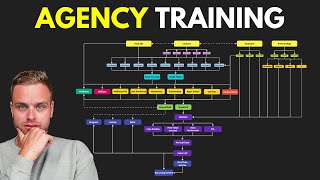
This 56-minute webinar by Matt explains how he scaled an agency from zero to nearly $1M MRR in under 12 months by building a complete client-acquisition funnel. He identifies four core constraints (leads, reliance on referrals, unqualified leads, and the founder’s skills/mindset), describes top/middle/bottom-of-funnel components (paid ads, content, outreach, partnerships → lead magnets/newsletters/webinars/groups → webinars/newsletters/communities/appointment setters), introduces lead-magnet design (VAR: Valuable, Actionable, Readable), discusses unique mechanisms and multi-offer funnels (info products, affiliate links, lower-priced offers to qualify/unqualify leads), and argues for assembling all pieces for scalable growth. The talk closes with a program pitch (1000x Leads, $5,000 one-time, 120-day implementation).
Chapters
Hey there, everybody, it's Matt here. So let's put in the chat if you can both hear me and see my screen, and then we'll get started very shortly here. Looks like to me that everyone says, okay, so I am just going to start this in about two to three minutes, just to give whoever isn't here a chance to go. But at its core, this webinar is going to show how I scaled my agency from basically just starting out at zero to just under 1 million mrr in under 12 months. And it's going to do that instead of me just listing what I did, you know, I did this and this and this, which has its place, but that's kind of boring. This webinar is going to really show you how you would overcome the top three problems that 99% of marketing agencies face. And these are, number one, not enough leads, which is easy enough to understand. Number two, all of the leads and clients come from networking and referrals, so, so no cold traffic. And then 3 of 99% of leads you do get are unqualified to work with you, whether that just be them personally or price or fit or whatever. And lastly, this webinar will come over the fourth and final piece, which is themselves. That's in my view, these three things plus themselves are the top four things that people face in terms of problems. So I hope everybody can see this. I can't really make the size of the writing bigger and still have it fit in one screen, but this is the marketing system, the marketing funnel that I used in my agency and that one that we teach in the 1000x leads program to really help you solve these three problems. I know it might look just like a mess looking at it right now, but this actually does solve not enough leads. All your leads coming from referrals and your leads being unqualified. So let's really dive into it. So we have the top three problems that most agencies face. Of course, we've just gone over that. And I really want to talk about why themselves kind of get in the way. Because I view the whole thing of building a marketing agency in three different parts. You have your offer, you have your funnel, which is what we have here, and then you have you. And you or yourself can be a big constraint if you don't have the systems, the habits, the mindset, the desire, the work ethic, the ability to focus, and so on. And this is important because you can think of these three things as the rungs of a ladder and your success as an agency. Is always only going to ever be at the level that all three ladders are at. So that's not a great way to explain it. What I mean here is, even if your offer and your Funnel are a 10 out of 10, if you your ability to focus, your skills, your habits, your knowledge is only a 2 out of 10, that means your entire agency is going to be a 2 out of 10 at best. This funnel works because it really uses and incorporates a lot of leverage. And I don't mean the type of leverage that you would use when you're buying, you know, meme coins or GameStop stock. I mean, four types of leverage that really let a business grow faster, bigger, and with less effort. Your media leverage, your capital leverage, your labor leverage, and your code leverage. And we're really going to talk about those things in a bit. So I won't go too far into them. And it's important because most of us have probably heard the quote from Archimedes, an ancient Greek philosopher, give me a lever long enough and a fulcrum to place it, and I will move the world. And this is really the case with your agency. Big agencies use these four types of leverage, and that's why they get so big. And it's very important to realize that the difference between the top 99.9% and the top 99.99% in terms of agencies is exponentially larger than the difference between the top 99.9% and the bottom 1%. There truly is an abyss between even the top 99.9 and 99.9% of agencies when you have this. They're just not the same thing in terms of revenue, profit, client acquisition, and so on. So let's go back to the actual funnel and I'll show you kind of how it works. So something that we all have to realize when we're doing this is there are four main ways to drop drive top of funnel traffic and get clients. And those are paid ads, content, outreach, and partnerships. You hear a lot of people say, and mostly they're going to be people trying to sell you something, that you should just pick one thing and really go all in on it and master it. And that's absolutely the wrong way to think of it. And the reason for this is because each of these methods, by incorporating it into your funnel, make the other ones more effective. For example, let's take two scenarios here. Who do you think would perform better? Someone who just sends cold emails to people and tries to get their business in terms of outreach, or someone who Sends cold emails. But people have seen their content, they follow them on social media. People have seen their ads, they might have downloaded a checklist or a guide or bought a product from them, or viewed their webinar like you're doing now. The difference between these two people and the results that you're going to get in terms of, let's say positive replies is 10 to 1, 20 to 1, 100 to 1. It's just two different realms and two different stratospheres, if you want to call it that. So we always have to make sure that we have all four of these client acquisition, top of funnel traffic drivers in place. We might be better at some than others, they might have varying degrees of effectiveness, but we always have to make sure that all of them are going to be a part of our funnel. So we can think of a funnel because a lot of us have probably heard the terms top of funnel, middle of funnel, and bottom of funnel. We can think of these pay, these paid ads, these content, these outreach and these partnerships as what drives top of funnel traffic. Your paid ads would be your Google Ads, your Facebook ads, your TikTok ads, Twitter, LinkedIn content, Instagram, Twitter, YouTube, TikTok, LinkedIn as well. Outreach would be your cold emails, your cold dms, your old school manual prospecting. And your partnerships would be white label referrals media joint venture. So referrals, kind of obvious white label would be if you, for those who don't know, would be something like a paid ad agency pays a landing page agency a set fee per month to make landing pages for their paid ad agencies clients white labeling the service. Hopefully that makes sense. I'm not going to go any deeper into that. And then media partnerships would be like, you know, you're doing, you know, a guest post on a blog, you're doing an interview on a podcast or YouTube channel. Anything where you're leveraging someone's audience to, you know, reach them is something to consider as a media partnership. So this funnel is not reliant on TR on fads or trends or what's hot or any new technology or methods. The this would work, you know, 100 years from now, just as it worked 100 years in the past, just as it works today. The only difference would be the tools and the technology that you would use to do this. Right? So I'm going to show you real examples of how I do this and how other people are doing this. So you're not just thinking that I'm just making this up because that's very important. To me, you go in a lot of these webinars, you buy a lot of these courses and the person teaching it doesn't actually do it. So it's very important that you know to me anyways that I show you how this works. So I want to start with the paid ads. And they're going to be four main types of paid ads. And this is going to make sense after as we go through the funnel. So in terms of. In its most basic form, there's four main types of ads. I have five here, but one of them is a type of. So we have a group funnel. So this really revolves around. You're running ads to an email and phone number, opt in and on the thank you page or automatically it'll redirect you to a group. Then you send sms, you send emails to get them in a group, let's just call it Facebook group for this example. And then in the group you're talking to them one on one, you're running retargeting ads, you're sending them email flows, you're posting content, you might even do a live workshop or something, all with the point of getting them to a sales call. A newsletter funnel, another type of funnel where you're running an ad, you are collecting their email address, you are sending them three to five newsletters per week over time to either book a call, get on a webinar or something. And that's how that one works. A webinar and a VSL funnel is kind of like the one that you are on right now. So surprise. You see an ad, you probably download a lead magnet, you get notifications and emails and SMS to sign up for a webinar and then the webinar introduces the product or offer. And then finally a paid product funnel. If you are a beginner and we got to take our egos out of it, if you are not currently generating 5, 10 even more clients per month through paid ads, you are a beginner. And convincing yourself or pretending otherwise is not going to hurt me, not going to hurt your competitors, not going to hurt anybody other than you. So a paid product funnel is where I always recommend people start because it's the easiest to understand whether the group, the newsletter, the VSL webinar funnels have a lot of nuance. A paid product funnel is easy to understand because it's much like selling an e commerce product where if you come from a drop shipping background or you've owned an e commerce store or you serve e commerce clients in your agency, it's a Lot easier to understand. So an ad would go to a product that ranges from 10 to $100. And that price range is basically what you want to do because after $100 people are not really just buying it then and there. You want to have an upsell funnel that gets the AOV to 100 plus dollars or more. And that's just simply to make sure you're covering the cost of your ad spend. You'd redirect to a thank you page where you make them aware of your high ticket offer. You have email flows, you have an appointment setter, you post content, you run retargeting ads and so on, and then you eventually upsell their product. So let's take a look at some of these funnels, shall we? To make you realize that these do happen in the real world. So I've pulled up a ton of different links here and this is an example of a group funnel. So let's just pretend we saw an ad, now we're in a group funnel. Taylor Welch, if you've ever heard of him. So I put my name, you know my, I don't want to really sign up for this because I'm gonna get blasted, but let's just go mattoogle.com and it redirects to a Facebook group where you join and he probably does everything that I said to you where he has all of that stuff and you essentially convert to his offer eventually. The next one I want to go over is a newsletter funnel. So here's an example of an agency called Pilothouse which is a very big they do creative for e commerce stores. They own DTC newsletter direct to consumer newsletter if you know what that is or you're subscribed to it. So basically they drive traffic to your this newsletter. They build credibility. They become the go to name if you're in DTC niche in your mind. And then when you open their newsletters, you know, they filter you by business email. If someone is seems like a good fit, they would probably contact you directly. And here is an example of, you know, a webinar funnel like the one you're on right now. Someone would see an ad whether that's how you got here or not. They would click sign up for the webinar and they would go and then you be on this webinar just like you are now essentially getting pitched a service. So those are the type of paid product funnels. A bonus one is the classic free plus shipping book funnel where you have a Facebook ad. I think probably everyone on here has Seen one of these at some point you get their book for, you know it's free, but you got to pay $9.99 for shipping. The important thing here is the fee covers the cost of both the shipping and the book. So it's essentially a wash. And then they're going to try to upsell you a hundred dollar AOV product which helps them break even on their ad spend in the exact same way it does with a paid product photo. Then you go to their thank you page, you get email flows, they become a great authority in your mind. And there's no better way to become an authority or to get someone to view you as an expert than them reading your book cover. To cover. The downside of this funnel is of course you have to have a book and that's obvious, but a great funnel if you manage it. And before we move on to the next thing, I want to just show you some type of paid product funnels and I have a few pulled up here. So here's one where the main service is, this lady named Amelia will go into your business if you use notion and build like custom systems templates, whatever you want to call it for you. So on the front end she's basically making pre made templates, selling them for $43 plus whatever upsells and a certain percentage of people are going to eventually convert to the main service. Another example Here is a $7 0 checklist by this conversion rate agency. So if you know what conversion rate optimization is, it's basically, you know, you make two versions of a page on your Shopify store or any website and you send 50% of the traffic to version A, the original and version B the one you made. And if hopefully version B will perform better in terms of conversion rate than version A and you'll make more money by implementing version B as your original from now on. So this checklist, there's however many, you know, tests that they say you should run and if you pay $7 for this, you like their tests, you might hire them to do it for you. The final one I'm going to show is this is an AI company that will make kind of the same thing as this Amelia girl will make. But using ChatGPT to make custom internal tools for your agency, their front end product, their paid product funnel centers around pre made bots that you can run and you see the quality, you see how it helps your business and you know, you might hire them for this custom work. So these are examples because it's very important to me that you see these working in the real world and it's not just me telling you or preaching without, you know, these things not existing. In terms of content, I think most people will know what Instagram, Twitter, YouTube, TikTok, LinkedIn content is going to look like. Same with outreach. You know, you get cold emails, you get cold DMs, et cetera. So I'm going to move on to what I would consider the middle of the funnel here, which would be your lead magnets. So a lead magnet, if you don't know, is something where you know, checklist guide, masterclass templates, swipe files where they put in their, usually their email, they're added to your list and you send them the value. Lead magnets are very important to convert, if you want to call it that, this top of funnel traffic into middle of funnel subscribers on your email list that know who you are and you can begin to market to them with email flows and so on. It's very, very crucial that we make not only multiple lead magnets, but also high quality lead magnets. And the two reasons for this are if we have, you know, one lead magnet. Let's go back. First, each of these lead magnets should solve a problem to do with your service. So I used to have a landing page agency, so let's think of the problems or the subcategories that have to do with landing pages. So you have in the overall context of a landing page, you have your site speed, you have your main headline, you have your hero image, you have your offer, you have social proof, you have just general copywriting and general images, you have how to read the data, you have how to do AB testing. So these are all different subcategories and problems and components that together make up a successful landing page. So I would make a lead magnet that follows a certain formula called the VAR formula for each. So essentially when you're creating a lead magnet, you want to think of it and run it by these three things. Number one, is it valuable? And the question to ask yourself is would you honestly pay $50 for this lead magnet even if you're giving it away for free? The same thing applies because when if you make a half ass lead magnet, someone downloads it and it sucks. It's not like they really mentally just oh, this sucks, whatever, they actually hate you. They this scenario of having a bad lead magnet that's they feel is a waste of time is worse than having no lead magnet at all. It's kind of like having a bad product. It's just not good. So we need to run it through the value test. Would we. And maybe we'll send to a couple of friends. Would they pay $50 for it? And hopefully you have some friends that will tell you the truth. Number two is actionable. So what it means here, is there an exact plan in this lead magnet that they can implement most of the value within 24 hours? Because we want them to follow our advice. When they're following our advice and overcoming these objections, they become one step closer to becoming our client. And then number three is readable. If your lead magnet is a wall of text and no one's going to read it, doesn't matter how much value and how actionable it is, they're not reading it. Might as well not even have downloaded it. So the way that we want to build our lead magnets is to have one idea and one image per slide. And I'm going to open one of my lead magnets here to prove to you that I actually practice what I preach here, because I'm going to probably sound like a broken record of that by the end of this. But as you can see, going through, every single slide has one idea and one image. And there's no exceptions to that. It just makes it so much more readable, so much more easier to consume. And again, if they don't read and consume your lead magnets, there's no point in even doing this. Let's go to an example here of why we want to create different lead magnets. So here is an example that has to do with starting a YouTube channel. There's a bunch of different problems. How do I set up my camera and lighting? How do I make good titles? How do I make good thumbnails? How do I do YouTube SEO? How do I come up with scripts? How do I come up with ideas? These are all examples of what I said before about the different categories. Instead of a landing page in the example I used previously, these become a YouTube channel. We'd want to create a separate lead magnet to solve all of those problems and to bring it full circle. We'd want to do that because not everybody in your target market is going to have the same problems. For example, in my landing page 1 from before, if we only have a site speed lead magnet, a certain percentage of the market is not going to have a site speed problem. They're either going to not even know that's a problem to begin with. They're going to know how to solve it. They're going to maybe have a web dev background so if I only have this one lead magnet, I'm missing all of that part of the target audience. I'm not capturing those leads. I'm just going to be having less leads in general. But the same people that have a. Don't have a problem with site speed might have a problem with headlines or copywriting or creating an offer. So that is why you'd want to do this. So I'm going to bring up the marker here and show you how this actually works in the real world and show you that it works with me. So starting at paid ads, I might have a campaign for each one of these. Right. So let's put the marker over here and let's go to each of these lead magnets. And just like this. So this would kind of signify you're going to all of the lead magnet landing pages. So here's. I pulled up six of my landing pages to just show you, you know, here's one, here's another, here's another, here's another, here's another, and here's another. So, and then here are the corresponding lead magnets. They're kind of large and slow down my computer quite a bit. So I'm not going to, you know, dive too deep into them here. I might actually exit out of these after I show you, but I just want to show you that this is actually how it is. So let's go back here. So I've created all these lead magnets to solve different problems related with the 1000x leads problem. You know, there's one for paid ads, there's one for content, there's one for outreach, there's one for partnerships, one for lead magnets, one for conversion mechanisms, which is this section that we'll go over after. One for your website, one for your offers and so on. For now, we can just take my word for it. But let's say they've hit one of these pages and they download the lead magnet. So I'm going to download this lead magnet for just for illustration sake. So now they've downloaded this lead magnet. Oops. Let's exit that out because there's sound. They've now hit my thank you page. Actually, let's open that up because that is the thank you page. They've now hit my thank you page and they're automatically added to all my email flows like this. Let's just go here. Let's finish this up as quick as can. So now they hit my thank you page and they're added to my email flows in my Case the one I'm doing here, the thank you page and the email flows promote the webinar that you're on right now. So that would be an example of going down to here and going down to here. And that is where we are in real time in this funnel because of course we practice what we preach. And here is an example of let's we've watched the webinar people are going to be either qualified or unqualified and that will be kind of a mix of your decision. And my goal is to identify who is which. The qualified people will go to my website, they will see my case studies free content testimonials and my vsl and they will book a call presumably. Right. But let's go back to the other ones because this is an example of a webinar funnel from before. But the same thing happens with a group funnel, with a newsletter funnel, with a paid product funnel. But let's just do a little example here. So let's say you're running paid ads in a group funnel. I'm just going to do it to one lead magnet just for the sake of time. They're going to your thank you page, they're going to your email flows, but now they are going to a community instead, where in the community, through all the tactics I set in here, you're going to determine whether they are qualified or unqualified. And that's how that works. It's the exact same thing with a newsletter funnel. Over time you are going to run ads to a lead magnet and I'm just going to do one here just for the sake of saving time. And your newsletter is going to be the tool to basically determine who is qualified versus unqualified. Now let's move, this is the middle of funnel process. But now these are examples of our conversion mechanisms. Our business bottom of our funnel here. So our webinar, our live workshops, our newsletter, our community and our appointment center. So if you don't know what an appointment setter is, that's usually an employee or a contractor, Sales, development reps, SDR is the same thing where they go through people who are leads, they contact them, phone them, email, SMS to try to get them to try to determine whether they are qualified or not. And if they are, book a call. If not, something else. Right. So the important thing to know and to understand is not only do these conversion mechanisms move them down the funnel, so to speak, get them to know, like and trust you more, help qualify them whether they're qualified or unqualified, but they also enrich your data. And what do I mean by this? So to sign up for a lead magnet, let's go to the right tab. To sign up for a lead magnet, you just capture their email address mostly and that's just to reduce friction as much as possible. You could do their name, email, website, revenue, phone number, where they live if you wanted to. But when you're running ads we want to get people on our list as cheap as possible and the more fields you have, the more friction the there will be. But it's important when you with your conversion mechanisms, when you give them group access or access to something better or access to your webinar, you, this is a great spot to, you know, get their name, get their email, get their phone number, get their website, not one and get their website and get their revenue. This is an example of enriching your data. So now instead of just guessing basically who is qualified and who's not, you're going to have their name, their phone number, their revenue, their website. So your appointment setter knows who to contact and who not to. Your appointment setter can't just contact your entire list via email. That would be very time consuming and not very effective. But now they have names, they have phone numbers, they have email, they have website, they have revenue. So they can really zero in better on who to contact and who not to to just do this entire thing more effectively. So one thing I want to talk about is a, what's going to be called here is a unique mechanism. So a unique mechanism, judging by the name is unique or something that only you could provide. So this is extremely, extremely effective and I'll show you what I mean here. So for example, this person here has a, the main product is a $15,000 basically mastermind for Shopify, for drop, shipping, etc. So your unique mechanism kind of is built from the back through reverse engineering. So let's just say, or let's just think of it this way, if someone is going to buy a $15,000 mastermind, what has to be true for them to buy it? So for example, if they don't have a Shopify store, they're not buying the Mastermind. If they don't believe that they can be successful, they're not buying the mastermind. If they don't see you as the mastermind owner, as someone who knows what they're talking about and is an expert, they're not buying it. If they can't afford it, obviously they're not buying it. So they have to make some Money ahead of time. If they don't have basic design, copywriting, sourcing image skills, they're not buying. If they don't know how the technology even works, they're not buying. And if they don't know how to run ads, they're not buying. So this is what I mean by reverse engineering. What are some things that have to be true to get them to buy? And if all of these things, and this is just an example I made, I don't know the inner workings of this person's business, they're not buying. There might be other ones. So what you'd want to do is you instead of, you know what we're doing here, instead of a checklist. Our unique mechanism in his case is he will build a store for you using AI. It's not going to be decent, but it's going to get you to take that first step. So this is an interesting business model because obviously to have a Shopify store, you have to have a Shopify account. So I've signed up for his. I would get his emails, texts, phone calls. I can choose what I want to do here. And obviously this is what I'm talking about. To get access to this store, you have to have a Shopify subscription. And we have his special bonus. And you'd be using his affiliate link and generating some serious affiliate revenue. And that's kind of a hack for this funnel. And you can tell this person has really got it going on. This is actually on the main Shopify website. He's probably their biggest affiliate. So you can really tell that this is effective. So the free store takes care of the reverse engineering part of now they have a Shopify store and you've done them a favor, they view you as an expert. If you actually signed up for this funnel, you would get blasted with emails promoting a $49 workshop that will teach you the basics of copywriting, design, running ads technology, and get them their first successes. So this is an example of how his offers his ads, his lead magnets, his unique mechanisms really knock out a bunch of objections automatically that make you become more likely to buy his main product. An example of this in the, you know, for an agency might be, you know, here's an email marketing offer. What are the main roadblocks that there's lots of agencies, they don't trust you. They have to do at least, let's say 30k a month. They think they can do it better themselves. They've had negative experiences of past contractors and so on. So you have to take a Bunch of steps to kind of get them across or kind of overcome these objections on yourself. So you might start at the top with a paid ad that goes to some kind of guide. Let me change the color of my marker here. Paid ad that goes to a guide. You know, now they get email flows and they're on the thank you page to your unique mechanism. And your unique mechanism, let me find the one I was just looking at is going to. You know, maybe we can build something in chat GPT using make.com that will write them six different email flows as an example. You know, if you're an E commerce, you'd have a welcome flow, a browse abandonment flow, abandoned cart flow, win back flow, post purchase flow, sunset flow, etc. And if you don't know what those are, these are just typical flows an E commerce store might have. You give them the written example using ChatGPT. Like you might have something like this and then you would say here's the result, here are the emails I wrote for you. They don't need to know that it's automatic. I will turn these into beautiful branded designed emails for you for one time fee of $2,500. Then you do a great job for this $2,500, they're very pleased with you. Now you upsell them into your typical main e commerce email marketing service for $3,500 a month to manage everything, send emails and so on. So one of my friends who's actually on this call right now made this as what I would consider to be a unique mechanism in this situation. So this is for an offer that sets up cold email infrastructure for people. So what are the things they need? They need domain names to buy because you'd never send cold email with your main domain because if it gets reported as spam, you know you are going to burn your domain and then you need scripts. These are by far the two main things that main objections that would get in the way of you selling someone a cold email setup. So you go through, you know, using ChatGPT, you know, fill in the blanks, fill in the form and it would send you something like this. So you know, here are your domain names that you should buy for cold email. You can choose whichever one here you can set them up all the DNS records that are necessary with a loom showing you how to do it. And then here are your scripts to try whether or not they try it. Some people might set it up on their own, some people, and if that's the case they could Use your affiliate links and you could start building affiliate revenue. But beyond the fact that would just impress someone who there's hundred cold email agencies out there that would just impress someone so much more who is in the market and who doesn't know which agency to go with than someone who's just saying, yep, pay me and then I will set it up for you with no real clear plan, no example, etc. And you can make this stuff very, very strong messing with it yourself. Don't get too caught up in the fact that it's chat, GBT or an AI. If you hit the prompts properly, you feed it examples, it will make a good result. So that is an example of the unique mechanism. Unique mechanism serves the same purpose as these conversion mechanisms. Are they qualified or not? And go on. So as we know, or as we went so far, three are main problems. Not enough leads. Doing what I've gone up to this point will generate more leads and it will do so from cold traffic. But what about the third problem? All of these leads are unqualified. And well, it is true that in any given target market, only about 3% of people are looking for a solution to their problem at any given time, actively looking. And of these 3%, only about 2 of those 3% are going to spend maybe 100, $200 to solve this problem, where that leaves 1% who would actually be a good fit for your main recurring service. So the importance and the reason why this is relevant is because if we only have our main recurring service, we are essentially excluding 99% of the market. And with this 1%, that doesn't mean 1% of the market is going to buy from you. The majority of those don't even know you exist. And of the ones that do, they have options. Lots of people provide your service, right? So let's solve this problem and we're going to go to this problem right here. So we have different options. I said in this example, you know, with our paid ads, with our lead magnets, we should be filling them with affiliate links. In my last agency, landing page agency, like I suggested, my paid product was 100 free webflow or not free. 100 webflow landing page templates for a hundred dollars. Good value. Something you build once and then you can sell over and over forever. I was doing 7k per day at my peak on ad spend to this offer and doing it 100% profitably. So if I'm selling landing page templates for a hundred dollars and it costs me less than $100 to acquire a customer through Facebook ads. Let's say I can essentially scale this offer up as much as I want. So let's just say $7,000 per day ad spend and $70 CPA, that's essentially 100 new paying customers per day. Into my funnel, these people have a credit card. They, I have all their name and contact information. They indicated that they are willing to spend money to solve their problem by buying this. And of course I also had they're using webflow, so if they don't have a webflow account, they use my affiliate link. So not only was I spending 7k a day profitably in info product revenue, I was also building affiliate revenue mrr through my affiliate links and I eventually got about 115k mrr for 12 months in affiliate revenue. Very, very important to realize here that these are very profitable when you're doing info products and you're doing affiliate very high margins that act as another revenue stream for your business that makes it more stable. But let's go back to the subject of are they qualified or unqualified? This judgment is going to be different for every business, right? Every business is going to have different criteria. But we can essentially solve this problem here by having different offers that address different types of people and levels of the market. So you see a lot of the time where this is the average marketing plan. A lot of people, they have content, maybe on Twitter that goes to the recurring service, that's the only option. Or they have SEO, goes to their website, buy their recurring service, that's their only option. They send cold emails, they do their recurring service, that's their only option. Or a lot of the time, you know, they just are sitting there waiting for referrals and that's their only option. So you can kind of think of this, you know, this is the Chad funnel and this is the beta funnel, the sad funnel that this is 99% of people. You hear stupid stuff about how agencies don't scale. It's not a good business model when their entire funnel looks like something like this. If you want to scale, you want money, you got to have a chad funnel. And trust me, the money printer will just be on 24 7. So what does that mean in this context? An example for you, you know, if they are unqualified, you might have a, you know, use Charge $5,000 for Facebook ad management. They can't afford that. They're unqualified. You might have a thousand dollar course that will teach them to do it themselves. That is an example of revenue that you can capture that you simply didn't get before. If this course doesn't exist, you cannot capture that part of the market. Perhaps that's even too expensive for them. You just send them away to the same info products you sell in your ads. Maybe they don't want to do it yourself. Course they might have a little bit more money than that. Maybe you essentially have a program that teaches them kind of like a coaching program or let's say they want someone to do it for them. They don't want a course. They don't want a program that teaches them they want someone. Maybe you send them to someone you know who does the same service but they are willing to do it for cheaper and, and you collect a referral fee. This is an example of one of the biggest problems. One of the three problems is people get mad. They don't when they get generate leads with paid ads or content because they say these are all junk, they're not qualified. And that would be true. They would not necessarily be incorrect. But the problem isn't in the fact that they are not qualified. The problem is the fact they have nowhere else to send them to monetize them. If you're running ads and you know they're not a good fit, maybe they're good fit for your info product. Maybe they could refer them away. Maybe you could get sell them your course or your program. These are all revenue streams that you simply didn't have before. And this leads to a much more stable, consistent business where it's not, you know, feast or famine. It's not. If one of your, if you're one of your 10 agency clients leaves, your business is 10% less revenue and profit. Now this is where you have a course is 100% profit. Referring them is 100% profit in this instant. Your info product is 100% profit because you're not paying for ads and your program might be 90% profit. This will ultimately lead to more revenue and a more scalable stable business that someone would be a lot more interested in acquiring down the line than someone who only revenue stream is client revenue. So let's go, let's assume now that they are qualified because that is a completely different scenario and different path. So they are qualified and they're going on our vsl. They're going, you know, they're seeing all of our stuff. They've decided to book a call and now let's assume that they've booked a call. In this example, a lot of people, same problem. They only have the recurring service And a lot of the time this is high price and there's nothing wrong with this. In my landing page agency I sold landing pages $2,500 for one or $5,000 for three. And I also sold high ticket recurring CRO services for 8,000 to $15,000 per month. Very difficult and a very different mindset to try to sell $15,000 a month services that have a six month minimum contract to people who know who you are, but maybe still skeptical. They don't know you know about you. They're not sure, they might have heard from your friend. They're good, but we've all probably got a bad referral from a friend at one point. Much easier to sell them. In my case a $2,500 landing page as a one time fee and then doing a great job proving myself, letting them see with their own eyes that it is, you know, I know what I'm doing and then upselling them the recurring service afterwards than it is just selling them the super high commitment, high priced recurring service on its own. So this is a very important step that a lot of agencies miss. And of course if they're down, you know, I'm not going to stop anybody from buying my high priced service the first time they talk to me. And then if we get on a sales call, they're qualified but just not for you. We might do the same thing and refer them to someone else. Or maybe they need a different service and they want to wrong or you know, they are qualified but they want to learn to do it themselves. Sell them to the course, they want someone to help them do it themselves program. So there's tons of different options in this funnel that you know you can do. Let's go over to the outreach and the partnership section because that's not getting much love so far. So you're doing cold dms, you're doing cold email, you're doing prospecting. A lot of the time you can just promote either your lead magnets in your cold email and that will get a much more positive response. And now you have another entry point into this side of the funnel. Or you could go direct to a sales call or your website or you could and one of my favorites is promoting this unique mechanism in the actual cold email. So in that email flow example, hey, you know, we'll write you six email flows for your e commerce store. Just as, you know, pleasure like thank you for talking to us. Much more compelling than just say let's get on a call. I would never these days do a Cold email where the whole point is, you know, get a call with me. People just do. People just receive too many cold emails for that to work these days. So I would always either promote a lead magnet, promote my unique mechanism or try to get them to the website if possible. This path here that I just did is not really something you might promote, but a lot of people will see your cold email and just google your website. So it's not something like hey, go to my website. But a lot of people will follow that path automatically. One could argue that more people will follow this path than even reply to you. You know, they see Matt at 1000X Leads has email them. You know, they might search 1000X Leads to see if it's even legit or not. In terms of our partnerships, we, it's really important that we have all of these other things because similar to which one do you think would get more responses? Someone who's senior Ads and your content before. The same thing happens with partnerships. People are going to partner with people who they've seen their content and their paid ads a lot before. So that is just something that we are going to have to, you know, realize for this example. Now one of the biggest objections that I get when I sell this program to people is, you know, I sell websites for 250k. You know, our services start at 25k a month. You know, we sell to big clients, Maybe not necessarily Fortune 500 companies, but big clients. And I don't believe that someone who's in a decision making power, whether it's a CEO or a director level person is going to be scrolling Facebook or scrolling Instagram, see my ad or post and download my lead magnet and go through all of this until they eventually buy. And two parts. One, that's not true. And that's mostly coping more than anything. But let's just say this is a true objection because there is some merit to this. Just by building this funnel, you are going to be building three different lists. And I don't mean literal lists. These are more hypothetical lists or theoretical or metaphorical lists that kind of, you know, are an easy way to think about it. You're building your social proof list, your potential client list and your dream client list. So I made some illustrations about the difference here. So your social proof list is, is, you know, people are downloading your email or your lead magnets, they're on your email list, they're following you, they're engaging with your stuff. This is what is a social proof list where all of these people probably aren't ever going to buy something for you or from you, but they still vouch for you, they still are useful to you in some way. Because when someone is, you know, asking their friends or posting in a group chat or posting on Twitter or LinkedIn, these people will tag you in posts and they're going to bring you up in chats. There are going to be more followers for you. Having more followers leads to increased visibility and media opportunities and access social proof and you get more reviews and stuff. So this is a list that, although let's say someone like a CEO might not be doing this stuff, they're going to see these people and their people that work for them are going to see these people. And you know, this guy I tagged this guy I know and I trust tagged this guy on a post asking, when I asked if anybody knows anybody, everyone must seem to like this person for a reason. This guy I recommended or this guy I trust recommended him to me. Like, these are all scenarios where these people aren't going to be useful for you, you know, monetarily, but they're going to be very useful to you as a form of social proof. When you are marketing to and trying to close clients that are a good fit. Your potential clients list is what everybody has. You know, what everybody has. If you're in business, you know who your potential clients are, you know, but it's much easier to sell to these people when they have been reading your newsletter and checked out your webinar and see your ads and see your content and receive your cold emails all the time and bought your paid products. Much easier to sell them on this than it would be without this entire funnel. You know, yes, we can do this for you now. And then you just go through the sales process and this is kind of the list where your dream client list is clients that you might not be necessarily likely to work with, but if you had, if you did, if you had their logo and testimonial and their case study on your website, that would look really good to both your other dream clients, you know, other potential clients as well as your, you know, social proof list. So this is an example of how this actually works to get high value enterprise clients. Because the CEO, the boss, is going to say something to their team, we need someone to help us find, we need to find someone to help us with lead generation. But because you've been marketing this whole time, because you've been building all of this, you know, their employees say, Matt has one of the best webinars I'VE ever seen or I read Matt's newsletter all the time. Matt has a ton of reviews and followers. I follow this guy Matt, you know, we should hire Matt. And then all of a sudden, he's blown back. Wow, I should probably reach out to this guy. So this list is more about building internal champions, name recognitions, past experience. For example, maybe someone was an employee when you worked with them at a company. Now they got hired as a director of marketing. They have past or prior experience with you, and they're going to bring you up to their boss. And that's how. That's the value of this. So these aren't really, you know, actual list that we are literally building, but this is three segments and three functions of this funnel that you are building. So again, let's go back to this. Do we want the Chad funnel or do we want the crying virgin funnel, where we're just basically waiting for people to, out of the goodness of their heart, send people our way? If this is our funnel, like, this is essentially our marketing strategy. And that is trying to be funny, but also very true at the same time. And we do not really want this to be, you know, our marketing funnel. A good exercise is try to look at someone like Teddy Roosevelt seriously, face to face and say to him, the future of myself, my wife, my husband, my kids, all of my hopes and dreams rely on someone else, you know, out of the goodness of their heart, referring someone to me. That is also meant to be, you know, kind of a reality check for what a lot of people are doing. And I don't think, you know, we can't just. We just can't do this and leave our entire future to, you know, referrals. Referrals are great, a positive indication, but we need to be able to generate leads, convert cold traffic, and have different levels of our offer ourselves and not relying on someone else. So this is an example of when you do this system, this is what happens. You get more leads. Because you get more leads, you become less needy inherently. And when you're less needy, it's easier to sell. When you have more leads, you can say no to nightmare clients. You don't have to take them. And when you get more leads, you're obviously going to get more clients. More clients means more referrals. And we go back to the top because we have such an influx of leads. We can also raise our prices, which means more margin, which means we can hire more competent, better people instead of having to settle. More competent people means less time working. Whether that means More vacations or more time spent improving this funnel and optimizing it. And because we're making more money, we can reinvest in growth, whether that's ad spend or better people or a content editor, which will get us more leads. And this is a very, very effective and cycle that is always happening, whether you realize it or not. And the thing to understand about this is it's happening either for you or against you. There's no middle ground, because the opposite is also true. If you have less leads, you become more needy, which makes it harder to sell, which means you're going to have to settle and take on nightmare clients. You're going to get less clients in general, which means less referrals. You might even have to lower your prices, which squeezes your margins, which means they're going to have to settle for worse hires, and you're going to have to spend more time babysitting them and doing work yourself, and you won't have as much money for growth, which leads, less leads. So this cycle is going to work one way or another. And if you are smart, you're going to implement this funnel and make it work for you. So this funnel is very important to implement, and it's very important to understand that it is all or nothing. This funnel is a lot like a, you know, a NASCAR or a Formula one car, or any vehicle for that matter. Even if you have every single piece of the car, if it's missing a steering wheel, it essentially becomes useless. You could have every piece of the car. If it's missing its brakes, it's essentially becoming useless. If you can have every piece of the car, if it's missing a Spark Club spark plug, it's not going to turn on. It's useless. And it's the same thing with this funnel. If we take out any part of this funnel, it just does not function properly anymore. And to do this, we need to have our systems in place, our processes, the right mindset, employee training, high standards, good habits. And we need to be able to focus and be productive. If there's 100 parts of this funnel, and I haven't counted them, but if there's 100, you know, having five of 50 of them doesn't mean you're 50% of the, you know, you have a 50% effectiveness. If you have even 90%, it's not 90% effectiveness. It's either you have a hundred percent or you have nothing. And it might seem overwhelming, it might seem like a lot, but we've all heard the phrase, you Know, how do we eat an elephant? One bite at a time. You know, day one, we got to do set up our Instagram, day two, our Twitter, day three, our YouTube, day four, our TikTok, and so on and so forth until we get the entire thing done. So if you are on this call and you are looking for help, we have a program called 1000x leads where every single piece of the funnel, every bite of the elephant, elephant is laid out for you from day one to day 120. You don't have to think, you don't have to sift through a bunch of videos, you don't have to ask for help or do any of that stuff. Every single piece is laid out for you. And you know, by the end of this program, day 120, if you follow day 1, 2, 3, 4, all the way up, you will have this funnel. So there's no discounts. It's a flat rate of $5,000 one time. Right now, there's no discounts, there's no limited time bonuses, there's no fake scarcity. But as I showed you, we have this entire funnel generated for ourselves. We are generating hundreds of leads per week and other people who do the same service as you are joining. So if they're joining and after four months they have this funnel and you don't, we can do the math. They're going to be generating all this stuff, swallowing up market share and you are not. So everybody is free to make their own decisions, but one bite at a time. Our program is day one, day one to day 120, and by the end you will have this funnel comes with the slack community, comes with calls every single day. So if that sounds interesting to you or just about to wrap up on the hour and I will be available to talk anytime this week at the link that you will be sent after this. So thank you for joining. I hope it all made sense. And I'll be at that link to answer any questions.
More from Matthew







Everything I Would Change About This Ecom Email Marketing Agency (3 HOUR LIVE AUDIT)

Everything I Would Change About This Meta Ads Training Business (3 HOUR LIVE AUDIT)


