Business Theory #2: LTV:CAC
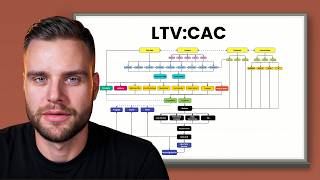
Matthew Larsen breaks down the LTV to CAC ratio, arguing service businesses should target 12-15x instead of the standard 3x SaaS benchmark. He shows how to calculate both metrics, then walks through tactics to lower churn and push customer acquisition cost toward zero through referral fees and partner introductions.
Chapters
Today we're going to be talking about LTV to CAC ratio, and we're going to talk about how to drive our CAC below zero. That might sound like a crazy idea to some people who haven't done it, but hopefully by the end of this training, we will get there. So this is our funnel here. This is how we acquire leads. But we're not really going to talk about acquiring leads in this video. We're going to talk about some hard numbers. And specifically, we're going to talk about two. We're going to talk about LTV and we're going to talk about CAC. So essentially, this stands for lifetime value, basically how much money the client is going to pay you over the course of your relationship. And the other one is customer acquisition cost. These are both averages through all of the clients you acquire. Some might be higher, some might be lower, but they're going to be averages. A lot of people will talk about their LTV, for example, but LTV could have basically 3 different numbers depending on if you use revenue, gross margin, or net margin. I think most serious people are gonna use gross margin because if you used revenue, that is going to give you kind of an unrealistic expectation of how these 2 relate. If you just say your revenue minus your CAC, there's a lot of costs in there that You necessarily, you know, it's gonna give you the wrong idea. So basically this is going to be total revenue minus fulfillment costs, but I have really bad writing here. And this is going to be spend on acquisition divided by customers. Now, if you're really doing a good job here, your gross margin needs to be at least 80%. And that means that you need to spend less than 20% on the payment processing fees as well as the fulfillment costs. So part of that 80%, you know, would lead from You know, premium pricing. It's hard to get 80% if you're charging too little, but it's also going to be really strong workflows, really strong automation and AI use. And then I guess if you did wire transfers, you could save a little bit on the payment processing fees, but I'm not going to write that down. Customer acquisition costs is going to be a blend between paid ads, content, outreach, and partners. We could also add referrals or some other form of organic in there, but those are the things. The reason that we want to have, in a lot of cases, We want to have paid ads, content outreach, and partnerships, not just one. Is that outreach is a very low cost and very linear form of customer acquisition. Content can cost a little, but it can also cost a lot if you have a full team, but all three of these content outreach and partnerships are usually going to be much cheaper than ads. And as such, we can kind of amortize or average out that customer acquisition cost. However, when you're doing this, you really want to also break this down by source so you can see, and I also like to break it down cold versus warm. And I consider paid ads and content or paid ads and outreach cold and the rest warm. So what we really need to understand is that LTV And customer acquisition cost don't really matter as much on their own as much as they do how they relate to one another. If you had, let's just say this example above, let's just say you had $30K revenue LTV times 80% margin or gross margin equals, that would be $24K LTV. And let's just say that you spent $12,000 and you got 4 clients. That would be a $3,000 CAC. And if we do that there, that is an 8:1 LTV to CAC ratio. So people always ask me, is my CAC good or is this good LTV? And I just tell them, I have no idea. Because if you only know one or the other, nothing is good or nothing is bad. If you had a $1,000 LTV, most people would tell you how bad that is, right? But if you had a $50 CAC there, That is a 20x or 20 to 1 LTV to CAC ratio. It's very good, right? So it doesn't matter as much except for how they work together. On the flip side or the other extreme, you could have a $20,000 CAC, but if you had a, you know, $1 million LTV, be very good. It's 50 to 1. So it doesn't really matter about these things on their own. It mostly matters about how they interact with each other. So a lot of people will do all of this stuff. And if they even have these numbers at all, doesn't really occur to them to put them together because nobody really explains, you know, what you should go for, why it's good, all of that kind of stuff. So let's do that. Before we do that, let's go over here and let's try to find LTV, or like, how do we even find this and how do we find CAC? I think that CAC is pretty straightforward for most people, just spend divided by customers, but LTV, we need to know a few things to get this average. So first off, we need to know our monthly churn rate. So that is, you know, the number of clients at the start of the period divided by the number of the clients at the end, or maybe it's the other way around. I can't, I can never remember. And then you divide 1 by that number to get it as a percentage. So if you had 10 clients at the start and 9 at the end, that is basically a 10% monthly churn. That is not all we really need to do here, because once we find this 10% monthly churn, in this case it's fairly easy, but we want to do one divided by monthly churn, in this case 10%, and that will give us the average number of months a client works with us. So basically, you know, 20% churn is 4 months or 5 months rather. 10% churn like we just did is 10 months. 5% churn is 20 months and so on and so forth. We're not done there because we need to have a few other things. The first thing was monthly churn. The second time, like, we need to use the monthly churn to extrapolate the number of months. So we're going to call that 1B. And then 2 is we need to do our average client payment because remember LTV is going to be an average. Some clients might have huge LTV, some might churn right away. It all averages out just like everything. So this is going to be total revenue divided by total clients. And again, Like I will typically use a rolling 3-month average here to get this number. You can use whatever you want, it's your business, but I feel like 6 months sometimes is a long enough length where there's a lot of material changes in the business and it's no longer accurate. 1 month obviously could be an outlier. So I'd like to do this. It's pretty much even better instead of average. Client payment to do median client payment, especially if you have a bunch of whale customers where that would just really actually skew this or make it disproportionate. And then the final thing is we need to times basically these two together. So we need to multiply basically months times median. And then we need to times it by our gross margin percentage, and that will give us our LTV. So a lot of people don't even have any of these numbers, which is weird. Obviously the bigger businesses do, but a lot of people, I ask their churn rate and they tell me a number. Most of the time it's made up. Sometimes when they, even if it's not made up, they, it's, they're tracking it wrong and it's vastly under what it actually is. Then median client payment, I think, is easy enough to get, and gross margin, I suppose, is easy enough to get. But that is your LTV. So how do these things work together? Because LTV to CAC ratio, we kind of need to have some kind of guidelines if we want to scale. So the thing, if you're doing software in Silicon Valley, you're always going to see a 3x. Like, that's what people are aiming for. That's kind of the benchmark. Of course, you want to have higher than that. You don't want to just have the average, but it doesn't really work like that. But that is really— doesn't do the whole piece of the puzzle because there's 3 parts. So. Let's just go up here and go sales, marketing, fulfillment. A lot of the time in Silicon Valley or in software, well, you're, we're doing SaaS, so there is no fulfillment or the product is the fulfillment. And a lot of the time, depending on what kind of business they have, either marketing is going to be product-led, meaning it just, the product sells itself, like free trials, or it's going to be sales-focused depending on what kind of the market. If it's a low ticket, let's say $97 per month, there's not really any sales because they just kind of sign up. And if it's an enterprise product, And it's very expensive. There's not really any marketing because they just kind of, you know, have a huge sales team. So like this 3:1 ratio is fine. Assuming you have something like this where there is no fulfillment, no marketing and no sales, that's not really the case inside a service-based business. Right. So there's a book on this. I feel like Alex Hormozi said it sometimes, but it's If you basically have people doing marketing, sales, and fulfillment, you're going to need something like 9x instead. So that basically means, like, if I have a— we'll just make it easy— a $1,101 CAC, I would need a $9,999 or basically $10,000 LTV. I'm going to put the gross there. A lot of people in some cases have more than this, but a lot of people don't at the same time. To me, there's so many other costs. If you think of 80% gross margins, but a lot of businesses run at 20% net, there's like 60%. Additional cost in here, and that is why we have to have that LTV. If we don't have very great gross margins like that, we are not going to have enough money to hire/train, ever increase our acquisition, you know, make sure we're financially healthy. And then especially when we grow enough where we have non-revenue-producing roles, such as HR, finance, all that kind of stuff. And then you have the software and the gear, all that kind of stuff. And then taxes. Even at 9 to 1, in my opinion, you're never going to have enough money to really scale in the way you need to. Something of these is always going to be the constraint. And when you are running at these like lower margins, 20%, even up to 30%, which sounds good, but there's at 9 to 1 LTV, there's not a lot of money to go around. I think this all changes to a large degree when you go from that 9 LTV to even 12 to 15 LTV to CAC ratio. And I could show you some math on that. So let's just say 20% is always going to be allocated to fulfillment. Let's say 5% is going to be a combination of payment processing fees plus software. You're going to have probably 10 to 15% for executive team plus non-revenue-producing roles. That's already 40% gone. Then you're probably going to have, I don't even know, 20% to 25% in tax. What is that already? 60%. Then you're going to have 10% into basically waste plus failed experiments. Call it testing. And that leaves you right there with 30% left over to do everything else you need to do, plus acquire customers. So if this 30% is going to be very different in the payback period versus, you know, the 3 versus 6 versus 9 versus even 12 to 15, based on the math there, you are going to be able to spend 15 to 30x more to acquire a customer at 15x. Versus 3x depending on the software and depending on your net margin. If that sounds unbelievable or very strange, you can actually plug this in to ChatGPT and do it yourself. You're gonna be able to spend 15 to 30 times more, not in true value, but when you take true value plus into payback period, this is the number that you're gonna model and that's gonna actually show there. So if you've ever heard of the stuff that basically says, you know, the person who can acquire a customer for the biggest price wins, sure, let's just say that's true. If you can spend 15 to 30 times more at this 12 to 15x rather than the 3x that a lot of people are running at, you are going to obviously be able to grow a lot more and you're going to be able to make a lot more mistakes. So I always going to go for this 12x. I'm going to cut costs where I need to, and then I'm going to be in this situation. And that's why I am able to acquire a lot of customers in addition, in comparison to a lot of people. So there's a lot, there's a couple of things that I want to talk about as well. The first, I want to talk about ways to increase our LTV that comes with customer success. Of course, because one of the levers to increase LTV is by decreasing churn rate. So where are we going to open my client success board here? So what we want to do in our client success, so LTV down here, we want to have a few different parts here. The first is we want to have a very simple, but a very effective onboarding flow. Whereas soon as the Stripe payment is done or the invoice is paid, they're redirected to an onboarding form that they fill out with the same time they get an SMS and an email flow confirmation. That also goes to the onboarding form, and that also enrolls them in an email and SMS flow for 30 days, basically talking them, getting them all up to speed. When they submit that onboarding form. Contact form redirected to join Slack or whatever you're using, probably Slack. And then when they're in Slack, they'll get an onboarding package. Right here is one of the most important parts in the process. I think this is the 5 quick wins. Doesn't necessarily need to be 5, but that's what I call it. And it's a list of things that they could do, you know, 1 to 2 hours of total work in the first 24 hours to actually get some meaningful quick wins. A lot of the time this comes to do with, you You know, you're doing them, having them do an exercise to do awareness. You're doing, having them do very small changes that actually lead to increased revenue. And when they do this, two things happen. Number one, they have a very good first impression of you because your time to value was very fast, right? But the second is a lot of the time between the Stripe being paid or the pay, the invoice being paid and the onboarding call, especially when you have a a really poor onboarding, like a lot of companies have, basically what's happening is in the person's head is they're sitting there and saying, did I make a mistake buying this? This is what's usually referred to as buyer's remorse. And that's definitely not what we want to have happen to us. We want them to be doing some quick wins to basically get a very good first impression. And we want to have the opposite, not buyer's remorse. Buyer's confirmation, who knows what you want to call it, whatever. Because if we do this properly and they get quick wins, they're psyched, they're ready. And we actually can get a lot of referrals on this onboarding call if we have these quick wins, much more than if we just let them ruminate and think negative thoughts about us if they made a mistake. We could also use this 5 quick wins to help them get done things that they need to get done to do our service. Because they're no, no one's going to be more motivated to take action as like shortly after they paid presumably a large sum. So we need to get them to do that. Very, very important part. And that's step 1 in client success is having a good first impression and onboarding. The next important part is making a roadmap for your client. So just like you'd make a roadmap for internal objectives in your company. So they're always confident that you have a plan, that they don't have to tell you what to do, babysit you, do your job. You need to have a plan that's broken down into long-term objectives, shorter-term key results, and then the actual things that you're doing on the daily basis or on a weekly basis with the date, the time required, and the priority so that your client feels that you are actually making progress. A lot of the time you're doing things behind the scenes, but your client doesn't know what they are. And a lot of the time, from the client's perspective, they can kind of think that you're not doing anything. That's not what we want to have happen. By having this plan, we actually will get it done. The client will see work being done with their own eyes, and they won't doubt you as much as they would have otherwise. The next thing we want to do alongside of this is we want to have a twice-per-day update, morning update and evening update. So beginning of every morning, you basically will tell them what they're going to do that day or what you are going to do for them that day. And then at the end of the day, you're going to do the daily progress and how that ties in to your key results. Does this take some time and effort? It does. Will it reduce your churn rate and therefore increase your LTV? Oh yeah. So the whole thing is when we're doing these things for us, to the client meeting, we'll be able to actually have a plan and we'll be able to show them what to do. And this is the fourth part of having a good client relationship and therefore keeping our LTV high. 30-minute meeting with you and the client. The first thing that you're going to want to do is look at your calendar and review the tasks you completed. Take 2 minutes. KPIs, what they were now versus last week versus last month versus when you started. You're going to go over your roadmap and where you are in that, another 2 minutes. Then you're going to do something that is very valuable in my opinion. It's called start, stop, keep. So you're going to ask the client point blank, what are some things that you like or that we don't do that we should start doing? What are some things that we do that you don't like that we should stop doing? And what are some things that we do that you really like and we should keep doing? You're going to write this down. And when you have 10, 20, 30 clients, you're going to notice a lot of patterns here. And you're able to tailor your behavior a lot better and stuff to satisfy your clients. The next is going to be adding things to their calendar. If they need to do it, you need to have a date, time required, and priority just for them, just like you and person who's going to do it. Then any blockers, remove them, and then any decisions they need to be made. So these 4 things together, basically. Other than you actually getting the result they pay for, are going to basically equal optimal client service. And you really need to focus on these because we need to very much increase that LTV as much as possible. Increasing your LTV, probably one of the most important parts of your business. And a business becomes, or in theory, a business is infinitely valuable When LTV is infinite and CAC is zero, right? If your CAC was zero, you could acquire as many customers as you want. If your LTV was infinite, you know, infinitely valuable business. Unfortunately for, you know, a lot of people, or, you know, just really in general, it's not possible to get an LTV that's infinite, but it is possible to get a CAC to zero. Very possible. And I'm going to show you how, based on what we did at our agency. So how could you get your customer acquisition cost to zero, right? Like that doesn't even make sense to a lot of people when hearing it, but there are a few very good options. Like the first one is a self-liquidating offer. You hear that in the low-ticket offer space. Sometimes you hear that in info products, but a lot of the time you'll do that in service businesses as well. Other ways are, you know, you are referring stuff out and like getting referral fees that more than cover the customer acquisition cost. Sometimes you are giving them an intro offer that the revenue from the offer covers the customer acquisition cost and also covers the cost of fulfillment. So it becomes zero. So there's many different ways to do that. So we could do self-liquidating. We could do referral fees. You could do intro offer. We could obviously just improve our customer acquisition ad funnel. Like that will get the customer acquisition cost closer to zero. So how do we do this? I will— let's go over what we did at our insurance agency to do this, because our insurance agency at this point, probably infinitely valuable because our customer acquisition cost is actually negative. And I'll show you that in a sec. So the first thing we do is in the onboarding, we made a list of every other service, every other tool, every other thing that our clients need that does not compete with us or does not do anything like that. Right. So what do they need? They need an accountant. They need a bookkeeper. They need a lawyer. They need agency ad accounts. Just leave it at that for that. Okay. So how much is a CPA? You know, $500 a month, maybe $500 to $1K. Bookkeeper, $750. For the lawyer, they specifically need an agreement that costs $5,500. Agency ad account, usually $1,000 per month on the low end, but it usually scales with spend. So what we did in the onboarding, on the onboarding call, we go with them. Do you need this introduction to the CPA? No. Okay. Do you need an introduction to a bookkeeper? No. Do you need this agreement? We can recommend a lawyer. Yes. Okay, perfect. Group chat, email, intro. There. Do you need an agency ad account? Yes, actually I need it because my ad account's banned because insurance is just kind of like that. Okay, perfect. Group intro. So in our case, CPA is going to pay us a $1,000 fee. The bookkeeper is going to pay us $1,500. The lawyer is going to pay us this. And the agency ad accounts are going to pay us this. A lot of the time people will take up, take us up on all of these things because they need it. We don't just sell these things because we made them up, right? A lot of people will take us up on all of them. So if they take us up on all of them, for those who are a little slow with the math, that is $4,500 in commission. For us. So it's very, very profitable to do this. And they're more locked in. We've helped them more. You could even say some of those are quick wins. It's not really the quick wins that I'm talking about, but those are the quick wins. And when we basically are getting a $210 cost per call and closing 15%, All we really need on our end is a $1,400 customer acquisition cost. And a lot of the time, on average, I'm not going to exaggerate completely, but on average, we got this to about $1,130 over the sample size. Of over 1,000 clients. So this basically takes our customer acquisition costs from $1,400 down to $270, which is very good on its own, right? $270 is obviously much better. You could think what that does for our LTV to CAC ratio. I'm not going to say our LTV, but let's just say before, let's just say it was 10,000 for a round number. 10,000 divided by 1,400 is a 7.14x. Certainly decent, and ours is much higher than that, but I don't want to say. 7.14, but now when we do that to 270, Our customer acquisition cost is $37. And this is where, especially on our margin, we really start to see how someone can spend 15 to 30 times more on a customer than someone else with the exact same, um, like unit economics. But that was not good enough for us. So what we did is we actually started referring people out. So we can only, or we don't, not can only, but we only deal with people who have a marketing budget of $30,000 per month or more. Don't necessarily need to spend that all with us, but at least theoretically, right? If they say no, which is quite frankly most people, instead of being able to book a call with us, they go through the Typeform and they get redirected to our SEO team. We don't have an SEO team, quite frankly. We partner with a series of SEO agencies that sell SEO from between $2,500 and quite frankly, I probably know upper limit, but $12,500 per month. And if they can't afford our service, we try to sell them $5,000 per month for SEO. That would be essentially going to be their whole marketing budget. So we are getting the $212 cost per qualified call for ourselves from earlier. Where was that? Or $210, sorry. $210 cost per call from ourselves earlier, but there's typically between 3 or typically between 2 and 3 unqualified calls in there. For every call, we get 2 to 3 people who are disqualified, who might have a $10,000 to, you know, $10,000 to $30,000 marketing budget, but not over $30,000. So basically what we do here is we go and sell them and we have a fairly low conversion rate on here. Just because they didn't really— the ads don't say SEO. They didn't really sign up for that, but let's do $250 divided by 2.5, because that we get basically $84 unqualified calls for this. And we close 8% of them. Remember, this is not really what they signed up for, or divided by 8%. Sorry. So we get $84 divided by 8% is $1,000 or $1,050 to sell SEO. So think about that. We on average are getting the first month when we sell it. So $5,000. Remember before our customer acquisition cost is basically $270, which was a 37x LTV. LTV. Now what we're doing is we are getting a $5,000 referral fee on every, for every $1,050 spent. Now, basically our customer acquisition cost, if we go this much plus this much minus $5,000. Now our customer acquisition cost has gone negative. We're actually getting paid to acquire customers with this system. So now it's not about what is my LTV to CAC ratio. There technically isn't an LTV to CAC ratio because LTV is whatever it is, and CAC is zero, or in this case, negative. So in our company and why we scaled it so big, so fast is that we can spend as much on advertising as we want, and we do, because there really is no consequence. We actually get paid every time. And even if we have a bad week or we try to scale up and our efficiency drops, We have a long way to go before this gets to zero. At the same time, we are running landing page A/B tests. We're running tons of new ads and stuff. So we were able to keep it back. And to us, without, you know, basically— there's only so many insurance agents. We're typically able to spend $10,000 to $15,000 a day in ads, getting all of those new customers. For essentially no cost. Sometimes we get this, sometimes we even waive the fee. So now that LT fee to CAC ratio started at, what was that, 7.14% up here, or 7.14x. Then in our onboarding, it went to about 37x, and now it's basically infinite, or basically rather doesn't even exist because LTV is whatever LTV is, but it's divided by zero. So that equals something that doesn't even exist. So this basically, and we had pretty good revenue before, but this got us within, I don't even know the timeframe, less than a year and a half, a 10x increase in total revenue. With very, very good profit. So when we're talking about LTV to CAC ratio, we got to start somewhere. We have to start where like we even know what the numbers are, because when we know what the numbers are, we can kind of gauge how much we can spend and how big our payback period is going to be. But regardless of what our LTV is, we need to increase it by reducing churn and our average retainer as much as possible, of course. But we also want to work on getting our CAC to zero through a combination of these tactics. So for me, I usually will do it with referral fees most day, because I have literally no operational complexity added, like nothing really. We're just referring business to other stuff that they actually need and then basically collecting a fee for doing so. If you're able to achieve what we achieved, you essentially have an infinitely valuable business. And that's why you get so many offers to buy it. Might take them one day, might not, but it's one of the most powerful strategies that we need to know. I would say level 1 in the game is knowing your LTV to CAC ratio. Number 2, working on getting your LTV up by reducing your churn. And then 3, working on reducing that customer acquisition cost to zero is the high leverage, high level business theory that you need to be doing.
More from Matthew







Everything I Would Change About This Ecom Email Marketing Agency (3 HOUR LIVE AUDIT)

Everything I Would Change About This Meta Ads Training Business (3 HOUR LIVE AUDIT)


