Create These Seven Offers To Scale Your Agency To $10 Million Per Year
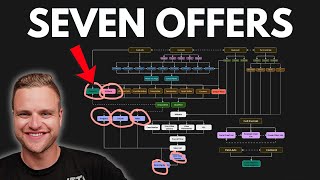
Most agencies rely on one expensive service and miss 99% of the market. Build seven offers instead: digital products, affiliate commissions, programs, courses, referral partnerships, an intro offer, and recurring service. This diversified funnel qualifies leads better, stabilizes revenue, and targets $10M/year with gross LTV around $30,000.
Chapters
This video I'm going to go over the seven different offers that every agency should have to help them scale to 10 million per year. Most agencies do it completely wrong and they just have their high priced recurring service. And the problem with that is 99% of people in the target market are just not qualified for that service. And then when you have 99% of people not qualified for your service, they're essentially going nowhere. So what you see on screen here is the scale your agency funnel. It is a funnel diagram I designed to basically put into a visual very complex concepts. So we have on the top we have our tubbo funnel, our paid ads, our content, our outreach and our partnerships. In the middle of the funnel we have our lead magnets and our funnel pages and our email flows. At the bottom of the funnel we have our different conversion mechanisms which I'll talk about soon. We have our website and then we have our offers. I've made 12 free agency trainings every step of this funnel. If you want to check them out, the link is in the bio, you can do that. So the first thing I'm going to do is talk about the different offers. So we have a lot going on here. And where are the offers? I'm going to pull out the pen. The offers are the digital products, they're the affiliate commissions, they're the programs, there's the courses, they're the referral partnerships, the one time intro offer and the main recurring service. So most agencies basically just have one of these. And as a result, if we kind of delete all of these things here, this is more what it looks like for the average agency if they even had the rest of this. And the problem with that is only 1% of your target market is going to be qualified at any given time. That means pricing, that means they're actively looking for it, that means you just want to work with them. They're in the same industry, same niche, they see a need and 99% are going to be unqualified. And as you can imagine, when 99% of your target market is unqualified, that doesn't necessarily lead to a great content funnel or a great paid ads funnel, or a great outreach funnel. This isn't really like info offers or some of those where you just hammer a bunch of call funnels to your main recurring service and scale up infinitely. It doesn't really work. You need to build up a funnel that generates highly qualified leads who in theory would be ready to go as you can take them as you build up your operations as you build up your systems and all of that kind of stuff, that's kind of how it differs from an, in an info funnel or something like that. So if I put these back, we have all of our different offers and they all play a role. They're all here to basically be for every different level of the target market. So no matter where someone is, revenue wise, time in business wise, whatever your metrics are, whatever your qualifications are, we have something to offer them. And this can kind of double to triple your revenue. But it can also kind of like 3 or 5 or even 10x your profit. Because we're your main service, we have labor, we have all of that kind of stuff. We have a lot of costs involved. Stuff like referral, partnerships and fees, courses, programs, affiliate commissions, products. Those are all a hundred percent pure margin or very close. Maybe there'll be some payment processing fees and maybe a couple software fees, but not much versus your recurring service. And even your intro offer could be 10, 25, 40% margin at most. And it's just a very, very good way to diversify your revenue as well as make your agency more valuable because there's a lot more stability. Not all of your eggs are in your recurring service basket, so to speak. So I'm going to go over the different types here just for a little recap. So your recurring service is what everybody has. If you have an agency, you have this service. It's your high priced main service that builds MRR and is the backbone of your entire agency. You are not going to succeed in any agency without your recurring service. If you're just going feast and famine, you know, you're closing project deals, you might be very successful at that, but you're never going to have the MRR and the stability to be confident enough to reinvest in ads, reinvest in your infrastructure, reinvest in your team. You're just not really going to get anywhere without it. The intro offer is usually a low or lower priced one time offer that acts as something of a paid trial. You use that to get your foot in the door and then you upsell them to your recurring service later. So I had an agency I sold that was a landing page and CRO agency for E commerce. My main recurring service was that 8 to 15k per month CRO mrr. I built that client base, you know, was very substantial over time. But it's very difficult even if someone likes your YouTube videos, even if someone sees your ads, even if you meet them at an event, to really get someone to commit to 8 to 15k per month. It's not that it doesn't happen, but it's very difficult. So what I did was for my ads, for my outreach, for referrals, for everything, I built them a landing page which is kind of like a paid trial. CRO is when you're doing landing page or you're doing page tests, a B test site wide, usually 4 to 8 per month. Whereas a landing page is just one page usually for their paid ads. In my case where you could do it and I just did it for 2,500amonth or not even a month as a one time fee, it would either be better than what they're currently using or be worse. Over the lifetime of my agency, it was 55% success rate, meaning 55% of the time it was better than what they had. I don't know what to make of that. I think it is pretty good. There's a lot of, you know, huge E commerce brands that I worked with that were just dialed in. Like they probably done hundreds of tests themselves and I was not able to do better. And it's fine. It is what it is. If you do a great job on the intro offer, in theory you're going to be able to get them in the door with that like foot in the door offer, that stepping stone offer. And then once you do a good job, it in theory becomes a lot easier to sell them the recurring service. Okay, I already made your paid ads way better with this landing page. The conversion rate's higher, the AOV is higher, the revenue per session's higher. Let me do that for your full sight. Very easy to just say that. It's not to say that they can't go to the high priced recurring service in any situation if they didn't want to. It's just, you know, another tool at your disposal. The referral partnerships are usually going to be with someone who is either too small or too large to work with you. Both of them happen. So if they're too small, you might refer them to someone who does your service in Eastern Europe or South America or something. Or they're just too large. You don't feel confident, you don't want to take on that, you know, risk. You don't have an indemnification clause or something that you know, gets that legal risk off you. You might just refer them to a larger agency. There's no shame in that. Or if in my case someone comes in for CRO now they need Facebook ads or TikTok ads or Google Ads or email marketing. You can also refer them to different services in addition or instead of yours it could be either one. A course is obviously an educational offer to sell to people who can't afford your main service and or want to learn to do them themselves. And courses kind of get a bad name but there's a lot of people who just want to learn to do it themselves and they don't really want to hire you. And if you don't have an offer such as a course, you're kind of missing out on that type of person. The program is very similar to the course but more support, more help, more active engagement on your part. It's great for those who prefer, you know, kind of a learning your learning it style but they want you to help them. Or for those with a big in house team who can't really justify working with you but they want someone else to come in and look at it. I launched a program for my agency thinking that I was going to get more the done with you types but it was actually dominated by people who are multi eight figure nine figure brands who had an in house landing page CRO team designers. They just wanted someone from the outside who is in their eyes a CRO expert to kind of take a look at what their team is doing. And that's a very interesting insight that I didn't expect before I did this myself the first time. A digital product is usually a productized offer under a hundred dollars because that's kind of the impulse buy cutoff in my view. That usually takes the form of templates or assets. If you're going to put so much time into kind of information and that kind of stuff, I would just go full on and do it a course. I would never sell information as a digital product in my opinion. And the key word here is product. I see a lot of people say I'm going to do 99 for you know, a 99 for something like I'll make them some ads. That is a intro offer. That is a service. You can't play any part or role in the digital products. It has to be automated or it's not really a product. And then the last thing is affiliate commissions. So this will usually come from software that are either using or buying to work with you or on their own. So let's say they do. They're like coming to me for landing pages. Whether they are going to use these or not. They're going to need a landing page software, they're going to need an A B testing software they're going to need X, Y and Z, and you can kind of just give it to them. There's. So let's go through the ideal setup, because it's one thing, in my opinion, to know this stuff, but what does this actually look like in reality? Because this is just a drawing on a screen, but it's the real world that really matters. We don't get rich on a screen. You know, they say wars are not fought on paper, and it's kind of the same thing here. So how does this actually happen? So for the recurring service, my view, like the ideal setup would be something that leads to less than 10% monthly churn with as little as possible, let's to be clear, but 10% maximum, and has a gross LTV of $30,000 or more. The reason for that is if you're churning, if you have a service that you can't optimize to get under 10% monthly churn, and you might have 20, 30% when you first start or when you launch a new service, and then you get better at it and better at it, you optimize your onboarding, your communication, your delivery, you get better results. But if you can't get it to 10% eventually, and there's not kind of a clear path or a clear reason why that it needs to be or is over 10%, probably not the ideal recurring service, there's either some kind of market fit, you just suck at it, and your skill set would be better off doing something else or whatever. And then the 30% or $30,000 LTV is very good as a benchmark to scale because at the same time you're basically getting better at your service, you should be getting better at your customer acquisition funnel, whether that's you're using an intro offer or whatever. And if you get a customer acquisition cost of 1k and a LTV of 30k or more, that's the ugliest 1k ever. We're just going to put 1k. That is where you're getting into hyperscale territory. If you get an LTV of a hundred thousand per more, that is like you are going to print and exit your business eventually. So I just kind of like to think of this as a worthy goal, so to speak, for your intro offer. I view it as something that you can deliver as $250 per hour or more, priced as close to zero as possible with the customer. Acquisition costs less than the total gross margin. So that's kind of a mouthful. Let's break it down. I always Want to deliver every service at $250 per hour or more as an effective hourly rate. So if you're charging a 5k per month retainer, it should take 20 man hours or labor hours or less to fulfill it. The reason for that is if you take into account the customer acquisition costs, the closing costs, the ad costs, maybe your content team and outreach costs, the cost for software, the cost for labor to fulfill it once you get bigger, the cost per revenue, non revenue producing roles like finance and HR and then taxes. If you're under $250 per hour, there's really just nothing left to try to scale. But you also want to price it as low as possible. A lot of people come to me and say my Intro offer is 8K. Kind of defeats the purpose of an intro offer. It's to reduce the risk as much as possible to get your foot in the door. So we want it to be as low as possible, but we don't want it to be super low. Let's say we could deliver it in one hour. We wouldn't want it to be $250 per hour because there's not a realistic chance we're going to get a customer for probably less than $1,000 in this day and age. So really your intro offer is probably going to end up something like $2,500 that you can fulfill in 10 hours or less. And that $2,500 will cover the customer acquisition costs. And then if you upsell them, this is basically 100%, you know, or the LTV to CAC ratio is essentially infinite because the intro offer took care of that customer acquisition cost. It's just math and high level thinking that we kind of need to. No, but for the referral partnership, three larger and three smaller agencies to provide the same service as well as adjacent services. So if you were doing CRO like I was doing in E Commerce, adjacent services would be Facebook ads, Google Ads, TikTok, email, SEO, stuff like that. I would definitely vet this and vet these people and really trust them if you can. That would be nice. Because if they fuck you and just do a horrible job for your client, that is going to reflect negatively on you. You can make a lot of money here. When you're at a super high scale and you're getting a hundred clients per month or a hundred leads per month, and you're referring 20 of them away and you're getting 1k per month each and you're stacking that up. But we definitely don't want to refer anybody who's going to fuck us over. Should be going out without saying. But it's an important note because trust me, trust me. The ideal course in my view is your own internal employee training that your employees would go through when you hire. That you should have in theory repackaged, made nice and pretty, put into a kajabi and a trello and something and sold as a course. When you do this, it's going to basically ensure the highest quality and it's going to kill two birds with one stone. You're going to make that employee training anyway, so you might as well make it right and turn it into another revenue stream. The program is basically the course with some one on one or group help that you can deliver at $1,000 per hour or more of your own time. When you're doing the program, it's basically you're going to probably be the one that has to fulfill this. You're the face of the brand. You're. You're the expert here. They're not going to be happy if some VAs are fulfilling it. So it has to be worth your while. A thousand dollars per hour or more. If you are doing this program for 6k over three months, let's just say it should cost you one hour or less per client and then your team can do the rest. Or who knows how you're going to set it up. The digital product should be a ton of templates that either make them more money or save them time or both that naturally lead into your main service. That naturally lead into your main service. So my landing page and CRO agency, I said it a million times if you've ever watched my videos before. But I did a hundred webflow templates for landing pages for $97. I sold over 14,500 units of that. Worked really well for me. And the kind of the cost to sell one of these templates was less than the revenue. So I was break even in this ad funnel from day one. No stress. And then affiliate commissions. The four most important tools that they're going to need. I found that if you basically do more than four tools, the effectiveness and the juice that each tool has and your recommendation, it's kind of wordy goes down. Like if you're just saying you need these four tools, you can put that in the onboarding, they're most likely going to sign up for that shit. But if you say oh we got to get these 50 tools, they're going to probably sign up for none of them. And that's just kind of how it is in my experience. So now I. It's a question, I get a lot. How are all of these incorporated? And it's a fair question because seven offers. How do we actually do that? So there can be a few different things here. So I've drew this little kind of shitty flowchart, but it's going to have to do. And I think it does a fair job of doing it. So first off, you're going to have your opt in form. This is where your content is going to go. From YouTube, from LinkedIn, from Twitter, from Instagram, who knows? That's gonna basically give them a lead magnet and they're gonna be in your email flows. Your lead magnet and your email flows are going to basically do the affiliate commissions. I'm actually gonna add one more here and I'm gonna go onboarding because this is kind of an awkward place to put this in the drawing because that kind of implies that they became a client. But you're going to get a lot of these affiliate commissions from your onboarding. You could also put that, you know, inside your community, for example, you know, community webinar, look at me, I'm adding to the thing live. Can you imagine? So let's make it all nice and tidy because we just. What should be done, of course. So community webinar, that kind of stuff. So those are going to pour into your affiliate commissions. Your stuff is also your paid ads, your content, you know, all of this kind of stuff is also going to redirect to your application form on your website, all that kind of stuff. And there's like, you'd split this out based on like your unique criteria. But if we were going to split this out on a revenue question, for example, like let's just say how much revenue are you doing per month? We have a question like this. For example, someone who's doing 0 to 10k, you probably redirect them using the conditional logic to your digital product because they can't afford your course or your program or whatever. So digital product, that affiliate commissions probably will be in there too. If they're doing 10 to 30k, we might sell them to the course, the program or the intro offer. We can kind of decide 30 to 100k, probably do the same. And if they're doing over 100k with we might send them to the recurring service. Like that is basically, you're probably going to have a bunch of these different things here. So we're going to go digital product. So here we might go intro offer, we might have course and we might have program, and then here we might have our recurring service. Like that is one way to incorporate all of these into your overall flow to keep it as simple as possible. This can come from your ads, your content, your outreach. They find your website somehow, and it more or less will direct them to the right offer. You might not want to have it as rigid as this. You might want to have other criteria as well, and it's just what you want to do. You might also answer the question like, do you want us to do this for you? Do you want to do it yourself, or do you want us to do it with you? If you did something like that, then you could also, you know, do it yourself. Okay, this is going to go to the course, do it with us program. Do it for us. That might go to the intro offer and recurring service. There's plenty of different ways, but I view this as kind of like a centralized thing where you can have your, you know, let's say your application here, basically. And then if they're unqualified, they're going to go to the products or they'll be referred away, or they'll do the course or they'll do the program. But if they're qualified, you can also get to the sales call, tell them the one time, or the recurring. But there's nothing stopping you from still recurring, referring them away on the call, or sending them to the course or the program. The key word is here is you actually give a shit about your target audience and your clients and try to recommend things that you believe would be the best for them, even if they don't know themselves. So I hope this video was helpful and I'll see you in the next one.
More from Matthew







Everything I Would Change About This Ecom Email Marketing Agency (3 HOUR LIVE AUDIT)

Everything I Would Change About This Meta Ads Training Business (3 HOUR LIVE AUDIT)


