Feel Like You're Not Getting Enough Done? Try This Planning Workflow
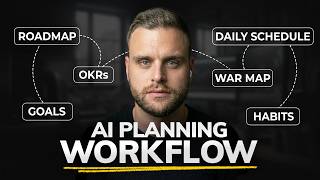
Matthew Larsen presents a seven-part planning system built on OKRs, Google's framework for setting objectives and key results. He walks through reducing churn to 7% as an example, showing how to break it into key results, assign them to teams, and schedule specific tasks daily. The core rule: what gets scheduled gets done.
Chapters
Do you ever feel like you're working very, very hard in your business, but you're not actually making progress? Like month over month, quarter over quarter, year over year, that type of thing. I've worked with a lot of businesses and to me, this is a problem that has its roots in planning and the planning workflow, both on the high level and then as well as the day-to-day. And I feel like a lot of businesses don't. Really have a unified planning system. And without this, it's kind of like not tracking your metrics. You're not really going to get anywhere. So I have been a proponent of the OKRs planning system from Google, I believe is the most popular example of who uses it. And that has gone for me for a very long time. So I'm going to show you the planning workflow that I recommend you do. All this is built into my tool HyperOptimal, but you can very easily do it in Google Docs, pen and paper. Google Sheets, you know, kind of any project management or any planning tool. So if we go to it first, we're going to go over here to planning. And I feel like there should be at least 6 things. There's 6 things in the tool here, but arguably 7. And they're the quarterly roadmap. They're the OKRs. They're the individual responsibilities. They are the weekly warmup. I took this from Sam Ovens back in the day, just coded into the tool. Very good. Then you have your daily schedule, of course, and then you have your habits. Arguably the seventh thing here is the goals, because like the goal is obviously going to, you know, determine what you're going to do. And that reverse engineering comes from where the goal can be found with the reverse engineering. I actually made a video about this if you watch the previous uploaded one. So that one here. Like if, you know, you could say our goals are to get 40% net margin. Our goal is to get 7% churn. Our goal is to get this and our goal is to get that. And then you would really, you would have what you need to do and those would be your roadmap items. But let's, let's go through how the OKR system works. And I'm just going to do this on Q3 here, just so we see. So in here we have the year, we have the quarter, we have the pod or the team inside the business. Then we have all of our team members. So basically, what is the objective, right? And all objectives, you know, should start with a goal. Maybe I'll change this so one is here, but they start with a goal and they start with an idea, right? So essentially, like, what should be our objective here? Like, let's just say I reduce churn to 7%. Maybe like that's a very worthy objective. And this is obviously the highest priority. We need to reduce our monthly churn down to 7% so that our clients stay for over 14 months on average. This is very important for more revenue. And like the kind of 4 categories when we are planning here, does this increase revenue? Does this increase Speed? Does this increase margin? Does this reduce risk? So I guess you could say it kind of does both, more revenue and less risk from a certain point of view. So what I like to do here and how this traditionally works is you have your objective here and you could have many objectives. I accidentally turned to 7%. You could have many objectives, but typically you're going to have like 6 to 8 every quarter. Or, um, yeah, every quarter. And then what you're going to do is you're going to take this objective. So churn to 7%, and you're going to break it down into key results. So OKRs, objectives, and key results. So the way that you're really supposed to think about it, and I think about it, is what 5 things that if they were true would basically imply or guarantee that my churn was 7%, right? So what could they be? Let's just brainstorm them. Onboarding flow that gets them 5 quick wins within 24 hours. You know, onboarding is a very, very big part of reducing churn. Making a good first impression really matters and can really buy you a lot of rope. So let's just say system to develop 2 times per weekday. Updates to clients. That would be a good one as well. What could be another one? If I'm thinking of some of the stuff that, you know, so reduce churn, probably your people are screwing up, right? So develop 30-day training protocol. We'll go system. We don't need to use buzzwords for every role. Get, you know, investigate and find repetitive tasks and automate them to free up time and headspace for team members. And what could be the last one? Last one could be implement a rigorous QA process before sending or publishing all work. So I would say like, you know, if we had a great onboarding flow, we had this system to give them 2 times per day updates. We had that great training system. We automated a lot of tasks to free up time for the people to do their job. And then we had a great QA process. Like I'm not, have a crystal ball and I can't see the future, but we probably could reduce our churn to You know, that percentage there. So let's go here. Like, let's just assign it to, you know, our pods here. So training, this would probably be product, engineering, and product. So let's just say this is where we, some people have departments like, you know, admin, marketing, sales, you name it, finance. But some people have like different pods. Like you can get as granular with this OKR system as you want, right? So you could do it, you know, like let's just say you're an email marketing agency and you just have a lot of clients, right? You know, let's say each pod takes, you know, 8 clients. We'd have, you know, fulfillment pod A, fulfillment pod B, or fulfillment pod Matthew, like I was the team leader, whatever. So like when we do that, now we have our objective and there it is right here. So what I do here is we have it here and then I'm going to click apply to the pod. And you can do this in Google Sheets. You don't necessarily have to have my tool. You can do really whatever you want. But when we go there now, it's broken down at a pod level. So we have it here. So onboarding flow that gets them 5 quick wins, system, develop, investigate, you know, we have everything that we had before. So now, like, it's a bit different, right? So now we kind of, this is the company roadmap or company objectives, but now we have to do our team objectives or our pod objectives, like whatever you want to refer to it as. In the Ocare system. So now like this, basically the goal here is to, you know, how do I make this onboarding flow that gets them, you know, all of this quick wins within 24 hours? So there's a lot of, a lot of stuff there. So like design the overall system, use templates, automation, et cetera, so they can get these, you know, within 30 minutes of work or less, because we don't necessarily want them to have to do a shitload of work. Develop the emails, pages, reminders, and flow to get them to do it. You know, create great marketing and education around these quick wins to You know, get them to want to do it. And then what could be a 5th one? Design the overall system. You know, you've got the templates, you've got the delivery, you've got the why. And then like I would probably do, if they do them within X time, give them Y bonus. We'll just say that's true. So that is what we have here. And then we Basically assign an owner to each of these things, and that will go into the next part. What hasn't gone to the next part yet is it's called OKRs. It should be called OKR-A, and A stands for assignments. Your assignments are your tasks, right? It just doesn't sound good. So like what we would do here is each of these things and each of these key results would have a task. So let's just go. To Matthew Larsen in the next one. So Matthew Larsen Q3. So design the overall system, right? So this is my basically KR. So now, like, I have to put in, or I have to bulk create, or whatever you want to do in this tool, but you would make a list in your Apple Notes, in your Google Docs, in your project management tool, or if you use this tool, that's cool as well. And like, you would basically be doing everything that, you know, has to be designed in this overall system. So create onboarding document. Like that would be number 1. Okay. That could take us 15 minutes. That's an A. We'll do that tomorrow. And then I'd write notes in it. The next one is going to be, what should the next one be? The next one could be Go through sales calls, transcribe, and get ideas for what is most valuable to clients. Okay. That could take us, you know, probably take us quite some time, to be honest. 4 hours. That's also an A. We'll do this on Wednesday. What would the next one be? Narrow research down to 5 things that deliver great outsized proportions. You know, you know, 80/20 rule. Let's just say stuff that takes 5 minutes, but can make a meaningful impact. Say that takes 60 minutes. And then now we have all of our stuff, right? I'm not going to go on forever here. But we could have 1 task, we could have 100 tasks, who knows? But now we have our company objectives, our pod objectives, and now they're actually assigned and broken down to individual people. And now we're building the assignments. Now we can put them into the next step. So let's just put April 20th for these, adding to the next step. And you can do this in literally any tool, but I just prefer the one here. So now if I go to April 20th, you can see here, I did a little duplicate, but on April 20th, I have them here. And this is the, this is where kind of the OKRs process switches from the macro or the high level to the micro and like the actual trenches, so to speak. So I like to do 5 big tasks per day, 3 to 5. I'll remember this thing for the rest of my life. It was a Kevin O'Leary interview. I think it was a short-form piece of content. And he said that he used to work for Steve Jobs, not a nice guy, et cetera. But he said like the number one thing he learned from Steve Jobs is, you know, what are the 3, like all that matters in business is not shareholders or quarters or anything. It's what can you do within the next 18 hours, the 3 to 5 things that you need to get done. And that is the signal and block out the rest, which is noise. And you want to spend at least 90% of your time on this. So I have, you know, schedule basically 3 to 5 of these. I try to get them to take about 6 hours focus work. And then I have time for meetings, I have time for other stuff as well. And then I just check them off. So you're going to have this on a on an actual weekly level, whether you do that, you know, piece of paper, calendar, agenda, you name it, project management tool, but then you're actually going to want to schedule them into your calendar. So if you don't have this tool, you would use this in your actual daily calendar, right? It's very important, but here I have it. So like, okay, I'm going to put this right here. And then I'm going to put this right here. And this is, I'm going to put this right You know, let's just say, let's open it up a little bit just because, and let's put this right here. It's very, very important that you like put this stuff into your calendar because as the saying goes, like what gets scheduled gets done. And then the final one is habits. So like the recurring tasks that you have to do for me, like YouTube video. I don't know, takes about 60 minutes. Let's just say, you know, just go Monday, Wednesday, Friday. Let's put it at 12 PM. So like, it's very important to block your calendar off for these habits. It's going to be really hard to succeed without doing that. So then you have basically you have a full planning workflow, so to speak. And I think that a lot of people, I would have to say more, just like kind of stick in the weeds instead of the high levels. But a lot of people, you know, do a bad job of doing both. They have, you know, their high-level planning versus their in-the-trenches, on the like literal micro-level planning. And I think that if you want to make long-term progress, you have to do both. Because if you just do the high-level stuff and have no accountability or no follow-through, like nothing gets done. But I feel like if you are only focused on like, what am I going to do tomorrow? And you have nothing of the big picture, you're not really getting into, you know, sustainable measured progress over time. So the planning workflow, I think this and the metrics workflows are like the two things that unless you really nail these, you're not even going to graduate to the higher level workflows you could do. And you know, that is all businesses is a collection of workflows. You have your, you know, actual tasks, you have your people, you have your metrics workflows, but all of them are workflows. And when you really have them dialed in like this, that is when you could put on the AI and pour the AI on. Without the actual underlying workflow, you can't really do anything to do with AI. Like if we had our objectives and our roadmap here, we could say, what do I have to do if I want to achieve this? AI could give us you know, a good idea of the answer, or you just have all of these tools and, or you have all of these assignments. Okay. I want to work 4 hours a day. These are the order of importance. One click to AI puts it in your schedule for you, but without the underlying workflow, this isn't really going to work for anyone. So with that being said, thank you for watching. If you want to join HyperOptimal, you can get a demo in the description and I'll see you in the next one.
More from Matthew







Everything I Would Change About This Ecom Email Marketing Agency (3 HOUR LIVE AUDIT)

Everything I Would Change About This Meta Ads Training Business (3 HOUR LIVE AUDIT)


