Five Lead Gen Concepts To Help You Scale To $10 Mil Per Year
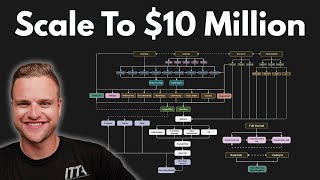
Five concepts for scaling a business to $10M annually: build a full lead-generation funnel across paid ads, content, outreach, and partnerships; understand the infinite cycle where more leads lower desperation and raise prices; follow Alex Hormozi's rule to do more, then better, then new; expect results lag from long sales cycles; and use leverage through media, code, capital, and labor.
Chapters
This video is going to go over five very, very important lead generation concepts that you need to know if you want to scale to $10 million per year. So without further ado, let's just get started. The first is the importance of having a full and complete lead generation funnel. Most people will say stuff like choose one method and master it. I don't really agree with that at all. I think you need to have an entire funnel because it's kind of like building a vehicle. If you just have every piece of the vehicle except the steering wheel, the brakes and the door, that basically makes it useless to you. And it's the same thing with a lead generation funnel. This one you have on the screen is designed to solve four specific problems that everyone has in any business that deals with leads, whether that's a software, a service, or anything else at the top. We have the problem of we just don't have enough traffic, right? That is usually the root cause of most problems. But we solve that by having paid ads, by content, by outreach and partnerships, which are the four ways to drive traffic. Anything you can possibly do is going to fall under one of those four buckets. And like I said, it's very important that you have all four of these for at least two reasons. The first reason is things change all the time. Algorithms, accounts get banned, stuff just matures or sophisticates, there's new methods, and if you have all your eggs in one basket and something changes, you are effectively going to go to zero. The second way is to. Or. The second reason you need this is because each of these will make the other ones more effective. So for example, if someone has senior paid ads running and they've viewed or consumed your content before and now they randomly get some outreach for you, they're much more likely to recognize your name and know and respond versus just receiving outreach from you and treating you as an anonymous person. Likewise, someone sees your paid ad on Facebook or Instagram, for example, and they click on it and they click on your profile and there's a bunch of content they might watch three or four reels or three or four posts, and they're much more likely to view you favor favorably and click the link and take whatever action that you are trying to get them to take, whether that's a webinar signup or call booked or whatever than if they clicked on your profile and it was completely bare. And there's many, many combinations of these things and it's very important to have all of them because they all feed into each other. The second problem that most people have is they just don't have a way to capture, nurture and qualify leads properly. So that's where your lead magnets come in. You know, maybe your paid ads or your content goes to a free course or a download, then they receive it and they consume it and they start getting your email flows. They're pushed further and further down the funnel. They'll start getting your newsletter, maybe they might join your community and get contacted by your appointment setter, maybe check out your webinar or whatever it might be. And you'll have two ways to qualify them in addition to nurturing them at that point. Number one, they'll just kind of consume enough of your stuff where they say, okay, I want to work with this person, this is for me. And they self qualify. And the second way is when you get them to sign up for all this stuff, you can ask for information like website revenue, whatever qualifiers that you need, and you can qualify them manually that way. The third problem that most people face is that, you know, all of their clients come from referrals or networking or that kind of stuff. And that's great. I love referrals. It's kind of the best client you can get, but they're out of your control, can't scale them. You can't really just, oh, I need to get some more referrals today. So we need to be able to drive traffic, capture leads, and convert cold traffic at scale. The nice thing about this problem is if we solve problem number one and two, we have traffic and we're capturing and nurturing and qualifying leads. Not all of our clients are coming from referrals anymore. So we just solved that by default. And the final problem is that no matter what you do, it's estimated roughly 3% of people are in market right now, which means they have a problem, they know they have a problem, they can afford it, they're looking, all that kind of stuff. The problem that a lot of people have is that, you know, if only 3% of people are in market at any given time looking to buy your product or service, that's 97 people who aren't, right? So we can make a lot of money in some case double or triple the revenue, but also double the profit by having different offers for different levels. We might have a digital product that's, you know, a hundred dollars or less. Our entire funnel might be stacked with affiliate links. We might be able to refer to someone who does it cheaper than us and collect a fee, or someone who does an adjacent service. Or we might sell a course too, basically repackaging all our internal training or a program doing kind of the same thing but with a little bit more one on one help. And those are all, you know, don't really take any time to fulfill. And they're also, you know, upwards of 95% margin after the little software and a little payment processing fees. So we really can direct that 97% of people to other places. If you don't have a full funnel like this, like a lot of people will just have, you know, let's just say content at the top and then website and then sales call, you're missing out on a lot of the big benefits. If you're trying to scale a service based business, this is the kind of thing that you really want to do, especially in a B2B business. The next concept is the infinite cycle of lead generation. This is a little chart I made and I'm just going to take you through. When you get more leads, you know, you become less needy because it's just, you're abundant now. When you become less needy, it's easier to sell. When it's easier to sell, you don't have to take on any nightmare clients that you can tell are going to be a pain in the ass from the beginning. And you just also get more clients. More clients means more referrals, which means even more leads. And we're going back to the top because now you've inverted the supply and demand. You can raise prices. Higher prices means better clients and also means more margin. More margin can be invested in better hires. Better hires means less time spent spent working on the business or in the business and more time spent working on the business for you. You can reinvest that extra margin in terms of money as well as the time in growth. And it gets more leads. And this cycle just keeps going and going and going and going. Everybody is either on the positive side of this cycle or on the negative side. There's not really any in between and most people are on the absolute negative side. And when you're on the negative side, the opposite is also true. Less leads means you're more needy. More needy means harder to sell. Harder to sell means you have to take on those nightmare clients because you need money. Just means less clients overall and less referrals. If it's really bad, you might even need to lower prices and get lower margins and worse hires. More time is spent babysitting, less time on growth and less leads. So we really want to make sure, especially through the full funnel that we're on the positive side of this cycle, the next is one that Alex Hermosi talks about. It's more and better and then new. So basically, if you want to grow, you have something that's working, just do more of it and just do more and more and more of it until it stops working and then do it better and better and better until you can't possibly do it any better and then only then you do new. I have so many clients and I, I'm also the same over time. Like you just, oh, this is working. Let's just try something completely different, right? Whether that's an ad campaign or a cold email campaign, if you're sending 5K cold emails a day and you are getting, you know, two to three calls instead of, you know, trying to ab test your script, the first thing we do is send 50,000 instead. If we are spending 1k a day on ads that we're getting a, let's just say an acceptable CPA on them, whatever it is, you know, instead of trying to get some new ad angles, why don't we just 5x the budget? If we're getting people from YouTube, why don't we just, instead of two YouTube videos a week, do seven? You know, this is what you really need to do and that's what's going to make your life easier. It's actually less. Maybe it's more manual legwork to do more, but it's, you know, less thought power, less actual important resources. Because one thing can really, when you just do more, can multiply into tons and tons of things. And that's the concept of leverage, which I'm going to talk about soon. The next one is that results lag. This usually be kind of depending on the price you're charging. You know, if you're charging very little, could be a few days, could be 30 days, 60 days, 90 days, 120. And this is a concept that's both good and bad and it's usually plays out poorly in your favor. So the what I say by that is for every input you do so every YouTube video you create or ad campaign you run or cold email you do or whatever, you know, prospecting, some people might convert right away, but most people are going to go into the sales cycle. Let's just say that sales cycle is 120 days. Let's just say that's true. It's always going to be different. You can't really simplify it like that, but let's just say that's true. That means you're going to be posting 120 days of videos, doing cold email and doing YouTube, doing Twitter, doing Instagram, trying to form partnerships before anything really takes place. And a lot of people just get too discouraged, and they just aren't consistent enough to even get through that 120 days. So they just really never see that outcome. So that's obviously a very bad thing because you have to discipline yourself and develop momentum and habits and, you know, with the belief that this is going to work, right? If you get through that stage and, you know your business is going well, this actually plays out in an effect that's bad too, usually because a lot of people will get to, you know, now I'm generating, let's just say, 100 leads a month, and I have to do operations. I have to build the business. I can't get any more clients. So they either even slightly decrease the amount of inputs they put in or they, you know, cease it altogether. And the problem with that is because the results are delayed, they don't even notice. You know, at first it's okay, not real different. But 30 days passes and 60 days passes, 90 days passes, and their pipeline and new lead generation are completely and utterly dead. And then they panic and, you know, go and go hard on the inputs, and then just. They kind of just repeat the cycle over and over instead of just being consistent and building systems and hiring people to buy back your time over and over and over to kind of keep it up. So it's very, very important that we know that results lag. And it's almost always a bad thing because it prevents us from getting started, and it also prevents us from noticing when we are not doing the right thing. The final one is I want to talk about leverage a little bit. So Naval Ravikant is a businessman. Can Google him if you like, but he likes to talk. He had a great blog post at one point about the four types of leverage. So we have media, we have code, we have capital, and we have labor. For this, we'll define leverage as kind of the difference of what you put in versus what you get out and the more leverage that you have, both in terms of types of leverage, but also the degree of leverage, you know, the higher you can go. This is why some people consumingly get 10,000 times the result that you can when you both have 24 hours in a day. This is why people in finance, for example, are typically much more rich than people in, you know, retail. They just have infinite capital leverage or much higher capital leverage. Versus people in retail who are working an hourly wage or something like that. It's just an example. So, for example, why are these so powerful in terms of leverage? Like, I'm making this YouTube video right now. I don't know how many views it's going to get. At a minimum, probably several hundred, maybe a thousand or two thousand or three thousand. Who knows? I didn't have to get on a zoom call with a thousand people, for example, and explain this over and over. I just had to record the video once and then I posted on the Internet and an untold amount of people are going to see it. Same thing with newsletters, Same thing with short form. Same thing with podcasts. Same thing with written. You're basically doing something once and an undetermined amount of people are going to see it. Of course, the better it is, the better you are at it, the more people will see it. You'll also accumulate a bigger following and personal brand, which will lead to more people. And essentially, if you could film a YouTube video and 7.5 billion people could see it on earth, you'd probably be the most powerful person in the world. And whatever you tried to apply that to, same thing with code here. Both your funnel, your software and AI. When I'm doing cold email, for example, using a software like that, I'm sending 50k cold emails a day. I don't have to sit there and manually, you know, do that, right? I just upload the list, upload the script, and it does it manually. That's an example of code leverage. There's going to be an insane example of AI leverage over, you know, even now, but especially over the coming years. And it's going to be very, very good. Your funnel, of course, you know, at the top, middle, bottom, you don't need to manually explain something to people at every step. They come in through paid ads, high leverage. They come through content outreach, partnerships, then they are nurtured through your system, then they are qualified, and then they get in. You don't have to individually go to someone's house, knock on their door, you know, say, do you want to get my lead magnet? And then here's, okay, here's my newsletter and then here's my stuff. Like it's all code based and that's high leverage. The next is capital leverage. And I usually have three places in here for this kind of lead generation. One is paid ads. If you can have a paid ad funnel where you put $1 in and you get $2 out, even, let's say even more than that. But $2 out, that is a form of leverage. You're putting in $1, you're getting two out, you're getting out way more than you're putting in. When you have all of these leverage sources and all of this kind of stuff, like I said before, you're going to be inverting the dynamic of supply and demand. There's more demand for supply now. So you're raising your prices and you're raising your margins. That's in my opinion, the probably one of the best forms of leverage is you get all this stuff, which means higher prices, very, very powerful. The final one is labor, overseas labor. You know, basically you are hiring someone for 3k a month. You're getting 10k a month of value out of them. Same with systems where, you know, you have hire someone, let's say not even overseas, 10k a month, who's a good employee for you and they're giving out 50k in value from your systems and training. That's a great form of labor leverage. Then the partnerships, you know, if you a hundred partners, you're basically reaping the fruits of a hundred people's efforts instead of your own. So if you really want to grow to a very, very big business, you need to know these five concepts. In my view, you're never going to get past a certain level without it. So I hope this was valuable and I'll see you in the next video.
More from Matthew







Everything I Would Change About This Ecom Email Marketing Agency (3 HOUR LIVE AUDIT)

Everything I Would Change About This Meta Ads Training Business (3 HOUR LIVE AUDIT)


