How My Client Grew His YouTube Agency From $61k/Month To $379k/Month
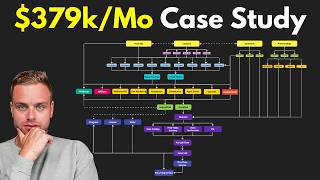
A detailed, practical case study by Matthew Larson describing how he helped a (anonymized) solo-founder YouTube agency grow from $61K/month to ~$379K/month in 11 months. The video explains behavioral changes, a seven-offer value ladder, sales and funnel systems (top/mid/bottom), operational scaling (hiring, SOPs, AI), and concrete metrics/results (December 2024 breakdown, conversion improvements, team size increases).
Questions this video answers
From $61,000/month to $379,000/month in 11 months.
11 months.
December 2024.
~$378,000 (reported as total across offers; speaker uses "over 378k" / ~379k).
Digital products: $18,400; Affiliate: $2,300; Referral fees: ~$900; Course: $45,000; Mastermind: $121,000; One-time offer: ~$11,000; Recurring service: $178,000.
Chapters
This is a full video case study about how my client went from 61k per month to 379k per month in revenue with their YouTube marketing agency in just 11 months. I imagine that this video is going to be between 60 and 90 minutes long. I don't know because I haven't recorded it yet. I'm just trying to tell you what you should be in for, but it is a full pre made presentation with great detail into what my client did to get this result. If you have any questions after watching this you can put them in the comments and I'll answer them if I can. And I'm also going to link this document that I'm going through in the description as well. I prefer this way of doing it as opposed to the typical style of case study which is just a bunch of rambling and are mostly done so that the agency or consultant can get a good clip or testimony for their business as opposed to actually revealing anything that could help the viewer. In this case study I'm not going to reveal my client's name or business and that way I can go into a lot more detail. If you have a problem with that or you don't like it, you can feel free to click off this video now. The great thing about YouTube is there's so many choices. So if you never heard who I am before My name is Matthew larson. I am 29 years old from Calgary, Canada but I spend most of my time in Miami, LA, New York City and Dubai. Over the past 12 years I have grown and exited three successful marketing agencies all in the E commerce section. Two were multi seven figures in cash and one was over eight figures in cash plus earn out. The first two I was the junior or the minority partner and I didn't have that much say to begin with so I should say for those two I was a part of two agency exits but the third one I was a 100% owner. Nowadays I have a non compete from starting a new agency until July 2026 and I'm doing a lot of consulting and I work 550 agencies every month through various coaching, consulting and other kind of stuff. So this case study that I'm going to show you is going from 61k per month to 379k per month in 11 months. So I started working with this client shortly after my most viewed and viral YouTube went live. I think it was 2-19-2024. This client wanted to work with me directly one on one and didn't want any group coaching or Just consulting or anything like that. And I almost didn' work with this client because I thought 61k per month revenue was too small for me to really profit. And like everyone, I am self interested, just I don't apologize for that either. This was a true growth partner relationship. I'm very, very involved in almost every aspect of their business and I'm being paid a retainer plus a percentage of net profit. So this client was my very first growth partner client. I've obviously heard of the model before, but I never did it and they were the one that convinced me to do this model and I've made over 1 million dol from this model since. And I owe this client a lot because of was very clear to me from kind of the first 15 minute call we had that this client was kind of going to succeed regardless if they if they worked with me or not. I just accelerated their progress by probably three years. If I had to guess, they would have succeeded with or without me. But I was able to help them succeed faster and maybe to a greater magnitude. My client runs a YouTube agency and this is not a B2B agency. They work with entertainment and media companies and big YouTubers, you know, pranks, lifestyle vloggers, that kind of stuff. My client is American and I don't want to dox them. So they're between 21 and 29 years old and they are a solo founder. If you know me, you know my person, me personally, like maybe 10 people. Do you probably know who this is? But I want to make it very difficult for everybody else because they asked me to do so. My client also has a decent sized YouTube channel in his own right. It's between 10 and 50k subscribers and it's very, very active and it is growing. The main problem the client had, like many solo founders before I came in, is balancing lead generation and operations. That's a very big problem for agencies of all sizes where you generate enough leads. Now you have to fix your operations and work on client work and then your lead generation becomes inconsistent and then you hire and then eventually your clients churn as they always do. You can't really get stop that from happening. Every client churns eventually and now there's no more leads and then there's no more leads, there's no more clients and then they have to lay everybody off and then they have to go back to lead gen and of the agencies and of the business owners that kind of get to the 500k to a million dollars per year mark. This is what kills them or causes them to stagnate more than anything else of the people who are successful, that's their problem. Trying to balance both, especially as a solo founder. If you want to work with me, the best way to do so is in my high level mastermind. You can be my next success story if you like. The link will be in the description and the pinned comment. And based on a recent study of 33 people in my high level offering, my clients grow by an average of 78% in terms of revenue within the first six months of working with me. Some more, some less. That's of course an average. So let's get into the table of contents of this case study. I have three goals for this. To brag about my client results, to convince you to work with me in some capacity. And. And the final one is to open your mind and show you what's possible and to give you some ideas from a real business that's not just some theory somewhere. So there's 13 parts that I'm going to go over. The introduction and the table of contents we've kind of already done. So I'm going to go over the five parts of a successful business. I'm going to go over behavior change, the big picture offers sales, bottom, middle and top of funnel, operating the funnel, operations and client fulfillment. And then I'm going to finish off with a little summary. So in each part, I'm going to go over at least three things or at least four things. Sorry. I'm going to do what my client was doing before they started working with me. The changes we made together, the result of those changes and actions, and then some action steps for you. And I hope this will provide a very clear before and after and give you some ideas that you can take and implement for your own business. Because this is real life. This is not theory. This is not something someone drew on the back of a napkin somewhere. This is in the trenches, so to speak. So before I get into it, we want to go over the five parts of a successful business. We have lead generation, we have operations, we have employee hiring and training, we have AI systems and automation. And we have personal behavior change. And all five of them are important. And one of them will always be the constraint. So when you solve it, you're going to grow. Let's say lead generation was the constraint, you've solved it, now you're going to experience the next leg up in business. Then, for example, employee hiring and training might be the constraint. Then you solve it, then you grow again. And business is really just getting over and solving those constraints over and over and over again. That's all there really is to it at the end of the day. So let's go to the big picture quickly. The four problems agencies or any like really any service business face are they don't get enough attention, they don't get enough leads. All of their clients come from referrals and they have no way to monetize unqualified traffic. And these plague businesses of all sizes. They're not really revenue specific, you could say that maybe even a billion dollar company. Now their current problem that's holding them back is they don't have enough attention at this stage. They just need to get more people to find out about them then you get the picture. So this is the average lead generation funnel that most people have. You can replace this whatever you want, but it's usually one kind of traffic source into their recurring service. You could put content, you could put SEO, you could put outreach, you could put ads, you could put whatever you want. It's usually just very small. And one thing, and this is the lead generation funnel that I built for my client. This is the Chad funnel, this is the version funnel. Compare them and you can see why this is going to go so well. This funnel right here basically solves all four of those problems. The problems where we didn't get enough attention is solved by running paid ads, doing content, doing outreach, and doing partnerships at the top. Problem number two of not getting enough leads is solved by creating different landing pages, lead magnets, email flows, creating digital products, webinars, VSLs, communities, newsletters, content appointment settings, things like that. If you are now driving traffic with your ads and your content, your outreach or partnerships, you're capturing leads and then nurturing them. Problem number three really doesn't exist anymore. It's just no longer true. You're getting attention and capturing leads. All your clients are not coming from referrals anymore. And then the final thing is you have no way to monetize unqualified traffic. So the problem with that is no matter what you do, 99% of your leads are pretty much going to be unqualified. Whether that means they can't afford it. Now is the not the right time. They do it in house, they already have an agency, whatever it might be, that's going to be mostly the case. And that is quite a shame because you're doing all of this work, you're driving all this traffic. And if only 1 out of 99 or 1 out of every 100 people can buy from you, you're leaving a lot of money on the table. So what you want to do is create different offers for every level of the target market. For example, you know you have a. If they're very unqualified, you might have a $100 digital product or stuff your lead magnets with affiliate links and build up commissions. If they're somewhat unqualified, maybe we can refer them away or sell them a course or a program and then if they are qualified, we'll sell them a one time service or a recurring service or whatever we can. We don't really solve this problem by doing anything. It's kind of like gravity. Can't fight against gravity. Gravity just exists. You have to find an alternative way to solve it. So we don't try to change the fact that this is true. We just find an alternative way to solve it. And we do that by creating all of these different offers. Before you do a lot of this stuff, however, you kind of have to make a lot of personal changes because most people just aren't good enough in terms of their focus, experience, knowledge to create something like this. So we have to make some changes in our personal life and that kind of stuff first. And that's where we'll start with this client. So this does not really show up on the overall funnel diagram. But like I said, you're not going to be able to have the time to create all of this and let alone run it if you don't have focus or capability or capacity. Right. So before we started working together, I would consider my client to be unfocused, inexperienced, stressed out, working on stupid low leverage tasks instead of the high leverage tasks that actually move the business forward. And these things are all forgivable, they're all common, especially because he is very young. But I told him if he wants to get to the next level, he is going to have to change. Currently, the constraint in his business is the same that is true for so many people. It's himself and the funnel, the operations, client, fulfillment, employee hiring and training can be taught, of course, but you need time, focus and energy to do so. So we made a series of five changes that are key for everyone, not just my client. The first thing we did was block off 7am to 12pm local time in his calendar for deep work. No one could book calls or meetings or even contact him. He whitelisted his mother and his father as emergency contacts in case there was a fire or something. I don't know. The next thing he did was the working in 60 minute sprints with a work form at the end of each hour. So what I got him to do was buy a physical timer. I'm gonna hold up my phone here. But he was using an actual kitchen timer. He's going to have a Google form basically saying, what did you do this hour? What hour of the day was it? Like, what could you improve on? And he's going to submit it after every 60 minute session and that's going to send a notification to me and I'm going to read it and he's going to fill out this form at least 10 times per day, Monday to Saturday, and he could have Sunday off. The truth of the matter is you're not going to accomplish much unless you can focus for long periods of time. And that's what I was stressing to. The next thing that I really wanted to stress to him is outside of oxygen or air, whatever you want to call it, content is what people consume the most in the year 2024 and beyond, which is when this took place. But most people do not think about the quality of content like they would their air quality. If you had a bunch of haze or there was a forest fire near you and there was smokey, you would immediately pick on up on that. But a lot of people just mindlessly drone on in their life with no real regard for what they're reading, what they're watching, what they're consuming, listening to all of that kind of stuff. So we got him a much, much better information diet right away. We used a tool called Focus Me to block news, block pornography, block sports. I told him he needs to listen to only business podcasts, not music. I got him to delete YouTube from his phone and put his phone away when he was working. And then I also invited him to an accountability group with other successful business owners that were kind of the same revenue level, or at least the same goals as him. The next thing we did was set up his environment for success. We turned off all notifications on his phone and computer. I made him wear earplugs and noise canceling headphones when he was actually working because that really drowns out pretty much everything. I also made him invest $1,500 in a great office and desk chair. You're going to be spending 10 plus hours per day and you need to be comfortable. And then I got him to black out the room when he was working. So I got him blackout blinds. I find everybody can focus a lot better in the sense that if it's dark versus there's big window and lights with a lot of stuff going on. And then like I said before, the accountability group, so his work form submissions would submit to me and send an email to me and his group members. I would check his forms every day to see how many he did. And I'd be very, very mean to him if I did not see 10. And a lot of you would kind of be shocked at the kind of mean things I would say to him. But we'll leave it at that for now. So the key insights that I gave him are of course most people's biggest problem or enemy is themselves. They're not able to do the rest of this funnel because they're just not good enough to get it done. I also told him that, like I said, your information diet determines your mindset. So after oxygen content is the thing people consume the most and you're also not going to be able to achieve a result like we've seen in this case study, like he ended up actually achieving unless he's willing to work 12 plus hours per day for at least a lot of the time. 10 forms per day, those are deep work. And then plus client work plus meetings is extra. I think that. And what I told him is don't listen to any of the idiots who tell you you can do something like this. Because he told me he wanted to go to millions of dollars per year. You can't get from 720k per year to almost 4 million or maybe even more than 4 million. Yeah, more than 4 million like he did. If you're going to work 4 hours per day and just chill or go on vacation, you need to spend the first five hours of your day when you are the most fresh on the most important thing in high leverage work. For most people, that will be client acquisition. Nothing bad is going to happen to you like blocking your calendar. Like I said, things can wait. If it's an emergency, call 91 1. I've heard someone say that in a YouTube video recently and I couldn't agree more. There are some also some things that I did and things that did not tend to be 100% correct. All of my advice was good, but I could have pushed him a lot harder in the beginning and we would have got an even faster and better result. Especially with young men who want to prove themselves, who feel like they're already behind even though they're very young. You could probably, you could push them as far as your imagination would and you're going to get a much better result. So in this period he turned from being unfocused, inexperienced, stressed out and working on low leverage tasks to being an absolute beast. So he worked for 10 hours every single day in terms of the form, six days per week. He only missed two days in this 11 month period once he really committed to it. And that's pretty impressive in my opinion. So he spent the first four hours per day on acquisition. So his content, his ads, his outreach, his partnerships, and then he also did two hours per day towards systems. So learning how to make good SOPs, learning how to make good employee trainings, how to use AI, all of that kind of stuff. And then he spent however much time he needed to client work, managing the team and that kind of stuff. Because he did this, and I don't want this to be lost on everyone, he was able to learn much more rapidly and he got maybe five years of experience in a few months in terms of the equivalent of what people would need to do in corporate America, for example. I also taught him in this period that he needs to focus only on his three highest leverage tasks and either delegate or just don't do the rest at all. And that's really what it comes down to. Brian Tracy, the author, has a great quote or a great rule here called the Rule of three that says however many things you do in a week, whether that's ten things or a thousand things, only three will contribute 90% of the value of you as a person. So I really stressed that rule to him as well. In terms of action steps for you, there's A few block 7am to 12pm in your calendar and delete all existing appointments during this time or reschedule them or whatever. Buy a physical timer and create a Google form for tracking hourly work Sprints. Delete your YouTube, delete your stupid news apps, install website blockers on all your devices right now, get some of those noise canceling headphones and earplugs on Amazon and then join an accountability group and send your first like accountability message. Get your form set up, get the notification set up and just go for it. The next thing I want to talk about is the offers. So 99% of those leads will always be unqualified. Like I said before, there's nothing you or I or my client or anyone else is going to do to actually change this. We need to solve this problem by creating different offers so you can monetize all levels of the market. So before we started working together, my client was pretty much like everybody else. They had their main recurring service and that's it. This service ranged from about 3,500 per month to 12,000 per month. And that was pretty much depending on what the client needed in terms of support and number of videos. I still really don't understand his niche that much. He understands a lot better. It's very difficult to have a standardized price point for a bunch of different YouTubers who may need three editors who may need X, Y, and Z. He took care of that. This is fine that he had the main recurring Service, but again, 99% of the market will always be unqualified. And if we only have the main service and nothing else, we're missing out on a lot of potential revenue. So what we did together is we basically implemented the seven different offers, and this took about six months. We had three different digital products that were $100 or under. All of them, as a matter of fact, in this case, were $97. So he had a bunch of assets for thumbnail templates. So I think there was about 400 different icons, like graphs, like in his thumb thing in Canva. They could just download it and make thumbnails themselves. He also had a bank of winning hooks for videos as well as titles. There was about 200 in there, and then he had kind of like a PDF or crash course. That was his list of top 25 YouTube hacks. All of them are good because all of them will get someone more views if they do it, and that's basically their desired result. We also had affiliate links for content and emails. So there's a bunch of different softwares youtubers use. All of them have their own kind of favorite ones. But typically, in terms of the affiliate commissions, they'll usually get 10 to $50 per month, and those are recurring commissions. We also made a course that was 12 different parts and 60 modules. So there's mostly like five modules on average per part, but it kind of varied up and down. We sold that for 5,000 or 4,997. Technically, we got a bunch of referral fees, but that varied. And a lot of people do one thing, but they don't do it. All right, so maybe we need to. Maybe we need more script writers or we need more editors. We need more thumbnail designers. And my client either is maxed at capacity or just doesn't do that. We had our partners that we referred to away, and we collect a commission or a referral fee from that, and there's a bunch of different ones. The referral fee definitely varied, usually between 10 and 20% of the deal size, but it did Vary. So the next one is the prod program, slash Mastermind, we call it a Mastermind. And it was 15k for 6 months. So the value was you'll get direct feedback from my client on your cooks, on your titles, your thumbnails, your videos, all that kind of stuff. You're able to network with other successful YouTubers in there and to join you had to be 50,000 subscribers or above, which is not that big for the mass market entertainment youtubers, but it definitely gets rid of a lot of the riff raff, we'll call them. For his two offers for qualified people, he had a one time offer of $5,000 to edit, to make thumbnails and titles for four videos. And then his recurring service was 3,500 to 12K per month. That was typically two to eight videos depending on length, depending on you get the pict. This is basically how it works. So if they're very, very unqualified, they could buy the digital products or sign up for the software and get affiliate commissions. They were somewhat unqualified, they could go to the course, the mastermind or we could refer them away. If they are qualified, they can get the mastermind, they could get the one time offer, they could get the recurring service. It's all kind of dependent on how they really want it to work. The key insights that I gave him in this period were the amount of people who sees his ads, content, outreach, that kind of stuff. The vast majority of them who don't have 50,000 subscribers is going to be huge. And you're wasting all of these by not having these different offers. In my travels, in my experience, the difference between having the main recurring service like most people have only and having all seven is typically going to be about a two times increase in revenue and up to five times increase in profit. Because a lot of these offers, like the course, the referral fees, that kind of stuff have near 100% margin. I've done this with over a hundred people and it's always true. Recurring service, you add your one time, you have your referral fees, you have your course, you have your Mastermind digital products. You're going to double your business in terms of revenue very quickly without guaranteeing it, because that would be illegal. I guarantee it right now and it's because a lot of people want to work with you. They're going to buy your lower tiered offers like your digital products and your courses and they will trust you and they will grow on their own and then they will convert to your higher ticket done for you services over the following months and years. If you impress them. All of these offers should be high quality because all of them are a step in your overall funnel and value ladder and they all lead to the actual big ltv. There is also just a huge percentage of any market that just won't buy done with you or done for you services. But they still want to work with you, especially if you have a decent personal brand. And that is where the Mastermind offer come in. These people already have it all covered. They have 50,000 subscribers. They know how to make a title a thumbnail, they know how to write a hook. They know how to make the content. They have it covered. They don't really need my client, but they just want ideas and they want peers to surround themselves with and it's a very good for those type of people. There are also some key insights that I gave to my client that turned out not to be true here. I'm going to break it down for the sales for each in a minute. But the percentage of total sales of the one time offer turned out to be much lower than you typically see with all my other clients. And we also did not nearly get the amount of referral fees from our partners that I anticipated. People wanted to work with my client a lot of the time, but they wouldn't trust his recommendations in terms of, you know, I'm booked to capacity, but here's Joe, who's an editor. They just wouldn't go for it. And you could say that's positive, you could say that's negative. That's up to you to decide. But there's a lot of things that I like. These two things specifically didn't really work out as well as we were expecting and hoping, for better or for worse. So the client gave me a breakdown by offer for December 2024. So these numbers are very recent and up to date. So December 2024 he did 18,400 in digital product, 2,300 in affiliate revenue, 900 and some in referral fees, 45k for his course, 121k for the mastermind, almost 11k for the one time offer, and then 178k for his recurring service. And that's the kind of numbers he was getting. So that's where the, you know, spoiler of the overall case study comes in. That's where we get to our number. If you want to do something like this yourself, I have another five action steps for you. The first thing that I would do is list out seven different offers. One of Each. Then you want to create and bookmark a document for each and just put that in your browser so you have easy access. Next thing is sign up for affiliate programs in your niche that people actually use. I wouldn't recommend promoting more than five. I've found that in promoting more than that just makes it less juicy for each one and actually gets you less overall commissions. The next thing you want to do is lay out some categories or parts and then the modules for each part for your course and then write down maybe 10 types of referral partners. So if you're a Facebook ad agency, you could do email agency, SEO agency, like all of that kind of stuff. The next thing we want to do is talk about sales. Amazing part of the journey. So you can do everything else in the like correctly in the top, the middle and the bottom. But if you can't actually close these leads, you've really wasted your time and money, especially when you're running a lot of ads. The key to sales is to think of it as a process or system instead of a script. And that's going to lead to a lot more consistency. Something that I loved. I think Alex Hermosi said it was instead of trying to get better at sales, make a system so it makes selling easier. Beautiful. Couldn't have said it any better myself. So before we started working together, the client did all of the sales himself and he was just winging it. I think we've all been there. No real shame in it. But there was absolutely no sales process. There's no closers, no setters, no presentation, no pre call flow, no pre call reminders, no retargeting ads, no call recordings to get better at. And there was little to no follow ups. This was really not working out poorly for them by any means. Like I'm not sure what his close rate was because he didn't track it before we started working together. But he was getting several new clients per week so it can't be going that bad. But the changes we made and there were a shitload. The first thing we did was immediately start tracking metrics like click to call, booked rate, show rate, qualified rate, close rate, customer acquisition costs, that kind of stuff. We started recording all the calls and adding them to Google Drive. We installed a pre call flow which is usually 10 to 24 emails and then reminders, SMS, that kind of stuff. We started running retargeting ads on Google, YouTube, Facebook, Instagram and Twitter. And we created a 24 part follow up sequence that was sent over 47 days to make sure that you had adequate follow up. And we also created a sales presentation in this time. We also created a process for appointment setters and a process for closers that we could slot people into to handle basically any growth that we might have to do in terms of leads and sales calls. The key insights that I gave to the client here where we need to start tracking our metrics because it's going to be very apparent where the bottleneck is and then we can fix it. Without metrics we're just basically either guessing or not gonna even know that we have to fix something. So in his case, when we first started doing this, the bottleneck turned out to be his qualification rate, which makes sense because he wants to work with people doing 50,000 subs or more. And we fixed it with a type form. If they didn't, they put in their channel and subs. If they didn't say 50,000 or above, they were just redirected to eventually his course instead of his actual book. A call. After about three months of working together, he had over 110 call recordings. I remember that specifically. We took all of the closes basically and transcribed them and fed them into AI and asked the AI for the top 10 things that all these successful closes had in common. So basically we could replicate that with the sales process instead of having to try to watch and identify all of these themselves. So part of the process is now, now when people kind of fail on a sales call but they think like this person was qualified, I could have closed them. What the rep does is he uploads the transcript and asks the AI to compare his call transcript to all of these successful ones and what they had in common so the rep knows where they mess up. It's something that you should do in your business as well. We also needed to use a lot of retargeting ads and email flows because we want to answer a ton of questions and objections and frame them before the call even takes place. So between the time the call is booked and the time the call, if we slam them with retargeting ads and we slam them with emails, they are going to know so much more and be so much better prepared for the call than there they were before where they got nothing. And the final thing is we need to basically figure out the successful appointment setting and successful closing process ourselves before we ever hire people. You can't expect them to figure it out. Then once we figured it out, we can basically slot people into an already successful system that already works and get a great result. Because no closers, no setters are going to really work for you long term if they're not making a lot of money and half of the battle is on you and half of the is on them. But we need a very good process and we created one. The things that didn't work here was basically nothing. Everything we did was pretty much a slam dunk home run and we're not going to be modest about that. There was no advice I gave to the client here that didn't work to perfection. So the result here was, although he had no data before we started working together, we quickly got some data in the first month and I'm using those numbers as a comparison and a benchmark. So his ad click to call ratio went from 2.4% to 9.1% on his thank you page. His show rate of his calls with the pre call flow and the retargeting ads went from 55% to 68% and his close rate went from 21% to 35%. And that was a mix of cold and warm traffic, but mostly cold. So right now he currently employs a real official professional sales team. He went from zero appointment setters to 10 of them currently and those are a mix of inbound and outbound setters. He went from zero closers to five. And he has a sales manager that reviews every single call and appointment setting script. And he reviews them and trains his people presumably with manual work and AI. And the founder as a result is completely out of sales at this point. I have few five more action steps for you here. So number one is set up a recall recording software and start recording with your next call. Create a spreadsheet to track all of these sales metrics. Starting tomorrow, lay out a 24 part follow up sequence. Set up your first retargeting ad campaigns and set up your pre call flow. You can do all of this in 24 hours or less and it's going to greatly improve your sales process. Let's just say that the next thing we want to talk about is the bottom of the funnel. So the bottom of the funnel nurtures leads and kind of automatically qualifies them. And it does that in two ways. So typically to gain access to different conversion mechanisms or bottom of funnel components, we require more information like name, email, phone number, website revenue, that kind of stuff. Whereas if they're at the top of funnel filling out a form, they might just ask their email to get access to something like a webinar or community for example. We can ask more information because they're more deeper in the funnel, they're more nurtured, they're willing to give it to us. The second option is, let's just say they read enough of our email flows, our newsletters, they are active enough in our community, they watched our vsl, they consume our content and they decide this is for me. They self qualify and book a call. There's two main ways this works. Before we started working together, I would say the client's bottom of the funnel was fairly terrible. Not going to lie, they had a CRM, but like so many people, they didn't use it. The client only had one real conversion mechanism which was his VSL was a pretty good VSL to be fair. And the client was putting out very inconsistent content, which is mostly just YouTube videos, sometimes three times per week, sometimes none, sometimes one, sometimes two, all that kind of stuff. The main constraint across this entire funnel that the client had was they were not converting enough people from his leads content, email lists into actual sales calls. And he didn't really realize this before we started tracking it because to be fair, he was getting a decent amount of sales calls up to that point. But in terms of pure percentage or in terms of total potential, it wasn't really good at all. And we made a few changes. We made sure that he actually used his CRM. We built it out properly, but simply because there's nothing worse than an over engineered CRM. We put two reminders per day to him from me using Slack workflows to actually update it. And we hired a VA specifically to be the CRM champion we called it and make sure that he and eventually others used the CRM all the time. The next thing we did was had the like create a prerecorded webinar with his top 10 YouTube tips. This was about a 90 minute webinar and it was evergreen and prerecorded and you could kind of access it at any time. And we used webinar jams everwebinar feature if you want to know. And there was a pitch at the end. So it was about 75 minutes of content, about 15 minutes of pitching. And then we had the client do once per month live workshops or live webinars, whatever you want to call it. Basically this was about 90 months as well. It is usually about a specific topic and what was working right now. And there was some great key insights in there that you could only kind of get based on actually living it. So a lot of successful YouTubers, even with millions of subscribers, show up to these because we did it once per month. There was a lot of hype built up through the entire month and he would have 750 to 2,000 people from his email list, mostly actually show up to these live workshops or live webinars. We found also that Wednesdays at 2pm had the best attendance rate. We tried weekends, we tried nights, we tried mornings, probably tried about maybe like seven different ones and which I guess is not a huge sample size, but we found that Wednesdays at 2pm Eastern Time had the best attendance rate for him. You could say maybe most of his clients were American or European or I don't know, it's just I have no idea why. We had the client also create and write a five times per week newsletter about YouTube. So everyone who booked a call, all of his leads, all of his opt ins would be added to this newsletter with zapier automatically. And every newsletter was a 2 to 3 minute read and focused on one actionable tip, nothing else. And then that newsletter had the links to whatever offers were relevant. So they had his digital product, his course, his mastermind, his service. And people could basically read that and then choose which one they wanted to do. The next thing we did was we basically had the client post three times per week on YouTube. Monday, Wednesday, Friday. YouTube is just so important to actually nurture the leads. And it's extra important for him because YouTube is a service. So he needs, you know, an Extra Good YouTube channel. If you did ads, you better have good ads yourself. If you do cold email, you should be getting cold email clients yourself. Whatever you're selling, you need to really double down on that specific thing as well. And then finally we had the client hire appointment setters. So I usually say we want to get two appointment setters per closer and we hired both inbound and outbound setters. So an inbound setters would be the ones calling basically all of his leads that opt in on the site and outbound would be manually messaging people on LinkedIn, email, Twitter, Instagram and that kind of thing. So we had both. The key insights that I gave the client here is that you're going to get double the amount of clients by actually using your CRM properly. Because that includes following up from sales calls and actually making sure people don't slip through the cracks. You'd be amazed if you audit your whole sales team and how many people are fucked up from your CRM. The second key insight I gave them is that people need to be educated and trust him a lot more to hire them for their channel because a lot of these people have decent success on their own, so they need to think that he's even the next level. A long form webinar basically was in my opinion the best way to show how much he knows about YouTube and educate and sell them all in one sitting. 90 minutes for this. In my opinion, a typical VSL just isn't long enough just because there's so many different parts that you have to cover. And the third insight I gave him was live workshops are an amazing way to convert people who are already on your email list. Doing them once per month leads to basically maximum hype and show rate. And every live workshop we did converted a minimum of 10 new clients and 25 plus course or mastermind signups and that was what would that be? October, November to 7 before this case study was basically made. The next insight I gave them is your newsletter is the thing that converts people. Most of the time they may come in through ads or content on YouTube, maybe even outreach. Then they're going to read 5 to 10 of your email newsletters and then they're going to book a call. That's just how it goes. You can't build a newsletter without ads and content, but the newsletter is actually what converts them. So you could argue that comes from ads or a newsletter like that's up to you. It's all one big system. The next thing I told them was it's mission critical that you have a good YouTube, as that is the service that you're selling. It would be important anyways to get people to see your face and spend time with you, so to speak, on YouTube. But it's doubly important because he actually sells YouTube services. And then the final thing I told him is you'll book about three times as many calls with the same amount of leads if you have appointment setters calling them, not just texting or emailing them, calling them within five minutes of them opting in and then six times per day for 30 days, assuming they don't respond. Just gonna get you such a better result than just hopefully they book a call. The only key insight that I gave that turned out not to be true here was I told him to launch a free community and he did this. This can be a great way to convert people, especially if you have appointment setters involved. But it did not work better or remotely as well as the live workshops or newsletters or webinar. So we just decided to scrap it. We just had a lot of noobs joining sadly, and that kind of just ruined it for the More advanced people and the results that he got. And I want to keep it as honest as possible here, I want to preface this with the, with the fact that he was also massively increasing his traffic at the same time. So he got a better conversion rates for everything, but he was also getting a lot more traffic. But in this period he went from about 30 calls per month to over 350 calls per month in a four month time span. So I estimate that he got three to four times as many calls as he normally would have got because of this webinar, these live workshops, this newsletter, these YouTubes, the deployment center, that kind of stuff. But he also got about four to five times more traffic than he was getting before. But nevertheless, it's still a huge increase in calls from about 1.5 per weekday to about 17.5 per weekday in a very short time, just a four month span. And the five action steps that I have for you is schedule a live workshop once per month, sign up for your newsletter and make a template that you can basically duplicate and do five times per week. Write your webinar or VSL script, create that landing page for your digital product and post a job listing for an appointment center. Do all of those things today to get your bottom of the funnel. Really, really there. The next part will be the middle of the funnel. The middle of the funnel is basically the bridge that connects your traffic with your nurturing and sales process. And without it, all of the traffic will be basically wasted and useless. And that's not a good thing. So before we started working together, client almost had nothing that makes up a good middle of the funnel. No lead magnets, no email flows. He did have basically a two step opt in funnel which was a landing page and then a thank you page with the vsl. And that's a start for sure. But with no emails to nurture and no lead magnets to basically prove his competence, it doesn't really work very well. But it is a start. We created nine different lead magnets together that cover the different parts of the YouTube. And the way that I like to think about these lead magnets is each of them should solve a problem or a step that has to do with succeeding on YouTube or whatever niche that you have. So these ones that we made are ideas, titles, thumbnails, scripts, editing, speaking well on camera, analytics, production, value, and then introduction. So the hook, the first 30 seconds type thing, all of these lead magnets followed what we called the VAR formula. So the value rule, even though lead magnet is free, would you pay $50 for this. If it's not like you wouldn't, then it's not good enough. The actionable rules so are there some quick wins that they can implement within 24 hours? Because people taking your advice and seeing results with it is basically the number one sales technique on earth. And then are they readable? So is there only one image and one idea per slide? Is those are the three things that make up the VAR formula. Then we made email flows. So we had four emails in the first four hours introducing him and his services, and then we had one email per day for 30 days going over our different FAQs and objectives, hoping that they would just basically answer all the questions and they would book a call. His funnel of the two step like opt in and the thank you page was fine, but we changed the headline and we remade the VSL and the opt in rate was 28% better than the original. So the key insights I gave for his middle of the funnel is people don't even book a call, let alone buy, until they're confident that you can solve all of their problems. They might need some details, but they're confident that you could do it. There are nine main problems associated with YouTube which we have over here. And by making a lead magnet for each of those problems, basically what we're doing is essentially overcoming objections automatically at scale. We're distributing them, people are reading them all and they're basically, wow, this guy is competent. The same thing goes for many FAQs and objections. So by making a list of the top 30 FAQs and objections and creating an email flow with one email for each, basically we're kind of addressing all of these potential objections and reasons not to work with us through our email flows. And the insight I gave them is most people really only have one or two objections and then once they receive those emails in the flow, then they're going to book a call. For example, it might be, I don't think this will work for me. That would be email four on day four and then the second one, I don't think this will work in my niche. And that would be email 17, for example. Once they get to day 17, all of their questions were answered and now they'll book a call. I also told them on landing pages and the funnels, your headline should always have the dream or desired result and the sub headline should basically prove or elaborate on how they're going to get that result. And both of them should have a timeframe in them. So like get a hundred thousand subscribers on YouTube in let's say 180 days, you know, and then the sub headline would be something like we'll do X, Y and Z and then this will happen and et cetera. All in a nice condensed, snappy sentence. The next thing I said is this VSL is targeting more successful people. They are basically already have 50,000 subscribers. And in this case you want to be more direct with less overall editing and that's typically going to work better. His VSL was very, very super edited before, which makes sense as that's his job, but it was very off putting to higher level people. Someone told me or someone said recently that the more editing you have in your VS or in anything, the less connection you have with your audience. I think that's true in most cases. And I thought that was. I think that applies to what I gave him here. And then the last one is on the landing page. We added name and phone number and YouTube channel into the fields instead of just email like you had before. And I told them that a lead who fills out all of these is 10 times more qualified than the one who only fills out the email, both in terms of the amount of information and the effort required they did do put in. So anyone who is serious and qualified and actually wants to work with them is not going to be off put by having more form fields. So he's not losing any potential customers, he's just cutting out the riffraff who are too lazy to fill out even four fields. That's a very big important distinction. There are nothing that I said here in the middle of the funnel that did not work. Everything kind of just turned out to be perfection. At the risk of bragging and if you want to go over the results here, it's the entire funnel works together to book calls. And I really want to stress that enough. The middle of the funnel, the top of the funnel, the bottom of the funnel, sales, the offers, it's all one big thing. It's kind of like a car where, you know, that's the wheels, this is the steering wheel, that's the door, that's the brakes. You get the picture. We were able to book three to five times more calls with the same amount of traffic. When we had this middle and bottom of funnel combination working as opposed to what he had before, we could not specifically attribute this to one thing. But all of these changes work together and all of them helped. The new landing page had a 28% higher opt in rate than before and it was capturing many more leads for the Same amount of traffic. And because his email flows were answering these FAQs and answering these questions and addressing these objections beforehand, prospects were much more qualified and prepared on the calls and more likely to know what his sales team was offering. And also because of the lead magnets, people trusted him a lot more and they were much more bought in than they were otherwise. Where you know, is this guy an expert? He could be, maybe. But now they were very, very bought in after they saw his lead magnets. To do something like this for yourself, some action steps for you are to lay out six to 12 different lead magnets, brainstorm 30 biggest FAQs and objections, create a landing page and thank you page for each lead magnet. Embed a form in the landing page and then connect the landing page form to the 30 day email flow. The next thing is going to be the top of the funnel. And the top of the funnel drives the traffic through a combination of paid ads and content and outreach and partnerships. And all of these are very important because each one makes the other ones more effective. So for example, if someone has, you know, senior paid ads and seen your content before and follows you, for example, they're much more likely to respond when you email them or DM them or something like that. Another example, if someone sees your Facebook ad and they click on your profile and you have a bunch of content on there, that's going to make them much more likely to click on your link or convert than if your content was just, or your profile was just bare. So it's very important that we have all of them because they all work together. Before we started, the client was getting 90% of his clients from referrals and 10% from his YouTube. That was working well for him for a long time. But eventually, as always the case, you can't scale referrals, you can't have any control over them. And eventually churn equals the amount of new customers you're getting. You know, cancels out and then you stagnate. So he didn't have anything in the following, didn't have paid ads on any platform. He didn't have any cold emails or cold DMs, he did not do any manual prospecting, no Twitter, LinkedIn, Instagram or TikTok content and no partnerships. So the first thing that we did together is, is we created systems to take care of all of the top of funnel methods because we want to have all of them. So for paid ads, we immediately had retargeting ads on all platforms. Our primary ad Funnel was on YouTube just because that's where his target market is the most. We had a secondary ad funnel on Meta, so Facebook and Instagram. And then we scaled the ad spend 20% every week as long as the customer acquisition cost was, you know, met. And sometimes it was, sometimes it wasn't. But we scaled it from $100 per day, like when we first started with these retargeting ads, to 1750 per day at current levels, all profitable. So I like to scale 20% per week because if you do like compound math there, you know, 20% or 1.2 rather, which is 20% to the power of 4, is just over 2x. So if you just increase 20% per week, you're going to basically double your budget. A little bit more than double every month in a nice controlled pace. For content, five posts per day on Twitter, two carousels per day on both LinkedIn and Instagram. That was the exact same content for both. I got him to do three YouTube videos per week and one short form per day for reels, shorts, and TikTok is the same content for all of them. For outreach, we basically had 30 cold email domains sending 5k cold emails per week. We had an outbound appointment center for Twitter, LinkedIn, YouTube and Instagram. So on Instagram, they would go and find people's channels and find the email and then email them. And then we had automated outbound DMS from 10 accounts on each platform. So Instagram, LinkedIn and Twitter just kind of burner accounts. And then for partnerships, we had another 10 domains, I believe. And we were sending a thousand cold emails per week to potential white label and referral partners. And then eventually we hired two different partnership managers. One to try to get on podcasts, newsletters, and YouTube collaborations. And the other one to try to get kind of in real life, speaking at events, conferences, trade shows, those kind of gigs. And all of these became very systemized and delegated. And the only thing my client had to do was to film new ad creatives and YouTube videos, as he is obviously the star of the show. There's the rest of these were very repurposed from this previous content. Very, very good. The key insights I gave here are we need to do all four of these client acquisition methods for two reasons. The first is every client acquisition method makes the others more effective. So someone clicks on your ad, like I said before, and they see a bunch of content, they're much more likely to click to your landing page. The second reason is if something changes, like the algorithm or method gets saturated or you get banned or for ad spend. It's like black around Black Friday. An election year and the price goes up. You're just kind of screwed. You're back to square one. We need to diversify our traffic as much as possible. If we can do that, we want to be as close to an even split in terms of acquisition between all four methods. It's rarely a perfect split, but it reduces risk and leads to more stability. So we kind of want 25% of our clients from paid ads, 25% from content, 25% from outreach, and 25% from partnerships. Doesn't really work out that way, but that's a worthy goal. And the third key insight I gave him was what works on paid ads and outreach will always work with content, but the opposite is rarely true. That is because people are a lot more cold, so to speak, with paid ads and outreach than they are with content. When people are watching a bunch of YouTube videos, they're usually your fans or followers, and they're very warm, so to speak. But that's not the case with paid ads and cold emails, where they just hearing about you from the first time. So we want to build everything in the funnel as if it has to work with paid ads and outreach. And then our content marketing is going to be that much better because it works with paid ads. It's going to work doubly as effective with content. But a lot of people have something that barely works with content, and then when they do paid ads, it just completely is a train wreck, and we wanted to avoid that. And the final thing I told them is we want to make sure our offer works with cold email before doing ads, because if something doesn't sell well with cold email, it likely is not going to sell well with ads. And we can save a lot of money and ad spend by ensuring that it works with outreach first. And then if it does, or once it does, once we've gone through several iterations of offers, then we can do it with ads. There are a couple, or I would say one main key insight that I gave that turned out not to be true. And I initially suggested, not that I really think it's bad advice or regret it, but I basically said that everything should be geared toward the main done for you service. And that's kind of standard advice. I wouldn't say that's bad advice, but over time we found it to be more effective to advertise the mastermind through things like paid ads and outreach, because the TAM or the amount of people who would do that is Just so much, you know, basically more than the 50,000 plus subscribers needed for the DFY services. And a lot of people eventually cross sold upsold into the done for you services too, as a result of being in the mastermind. So basically I'm gonna kind of try to conceal my client's identity a little bit here. I'm just use the word over instead of an exact number. But he in this period gained over 20,000 YouTube subscribers. He gained over 160,000 combined followers on LinkedIn and Twitter and Instagram. I didn't put Instagram. My mistake. And then he went from an average of 85 page views on his site to 2,700 per day. His email list grew from basically Nothing and then 300 kind of from the people who booked a sales call with him in the past to over 66,000 active subs. He increased his meetings booked from 1.5 per weekday to 17.5 per weekday. He currently has 12 white label partners paying him for one or more of his services, like editing, script writing, that kind of stuff. And then he got on a combined 33 different YouTube channels, podcasts, newsletters, speaking engagements, and that kind of stuff. So if you want some action steps, you gotta sign up for all your ad accounts, all of your social media platforms, get something called hypefury and connect it to all the platforms for scheduling. Buy and warm up 30 cold email domains inside instantly AI and write down a list of 10 potential white label referral media partners, that kind of stuff. Now we need to talk about operating the funnel. So of course we have to create the funnel, and that takes about 120 focused hours in my experience. But once we do that, we still need to operate it. And the good news is that this is typically a lot easier or less time consuming to the initial creation because there's less thinking involved. You've done the hard part and now you need a few roles for it to operate smoothly. So before we started, there was really no funnel to operate. So it's kind of a weird comparison, but there's also very like no systems for almost anything in the business. And at the risk of, you know, insulting him a little bit, he was completely clueless in terms of how you would actually hire, train and delegate. And he would probably insult himself a lot more and say that how true this was more than I'm saying here. He's well aware of that. So the changes we made together, we got someone for every single task. And because we dialed in the processes and systems beforehand, we're basically able to make checklists and trainings and have lower paid people, to be quite honest, do just as good a job as higher paid people would have been. So he had a director of marketing for the funnels and ads and to manage all of the people of the marketing team. The director of the marketing in this case is kind of like doubles as the director of sales, even though that's not their official role. His in house team that he used for clients did everything for YouTube because that's his main service. It makes sense. He also did everything for short form. We had a contractor to create the LinkedIn and Instagram carousels based off his previous content. We had a contractor to write the newsletter and Twitter post based off the previous content. We had a contractor to manage all of his cold emails and DM responses from one platform we used. We had two employees, one for the that did the partnerships and one that did the once per month live workshop. Just because it's a lot of work. We had in house appointment setters, in house closers and then we had an employee virtual assistant who basically test the funnel every single day for QA and make sure everything's working and not broken type thing. The key insights that I gave are a very cliche thing, but rich people buy time because that's what the highest leverage thing is. It's common, but it makes a big difference. You're never going to get anywhere without paying people to do things. You can't do it all alone. And he saved about 60 hours per week just operating this funnel. With just 30k per month in salaries, I think a little bit less than that. The second insight I gave him is that you cannot manage all of these people yourself or that kind of defeats the purpose. You need a director of marketing and he was kind of resistant to that. But eventually it was the best thing that he ever did. The third insight is you need consistency for this to work. Everything in this funnel compounds on itself and it gets better over time. And that's why you need to pay people whose sole job is to do one or two parts of the funnel to ensure that it always gets done. And the final insight I gave is that you don't want to be overly involved in either lead generation or operations. And we'll talk about operations in a few minutes. You need it to run without you if you want to be able to sell your business. Because he said before we started working together that he wants to do what I did and sell his business one day. The main thing that I told him that was not actually True is I didn't encourage him to go far enough because I thought he might have to be the one to write his tweets and newsletter and that kind of stuff still. But that turned out not to be true at all. His employees and his team could do it as good as he could just based on his previous content, his lead magnets and that kind of stuff. So it's actually better than expected. I was surprised because of this setup. The founder had little involvement in the operation of the lead generation funnel and that basically freed up his time to do high leverage things such as YouTube which is in the funnel, and employee training and that kind of stuff. This also means that the founder is actually building a real asset that can be sold unlike most of you and doesn't just have a high paying job. YouTube is relied on him because of the face. The rest of the content is not, paid ads are not, outreach are not, and partnerships are not. So he has a very sellable asset with low key man risk, so to speak. You want to do something like this? Follow these five action steps, Write down every task you need a role for, make a job description for each, make a step by step training checklist for each as well as a video training, and then make a series of reminders in Slack and your project management tool to make sure that they get done. So let's talk about operations and client fulfillment here because basically this doesn't show up in the funnel at all. But if you use this funnel, you're going to get a ton of clients and you need to actually provide the service that you're selling. That would be nice, wouldn't it? So before we started working together, the client was heavily involved in operations and a lot of it was manual in the sense of not automated or not systematized. He estimated on our first call that he did about 40 hours of operations work per week, which is just not sustainable. He had a small team of all contractors with no employees and no managers. Don't like that either personally and the operations were pretty consistent. He had a monstrous churn rate of 15 to 25% per month. So there are times when he had 25% a month. That means if he had 10 clients, four of them were leaving or 2.5 of them were leaving. Sorry, if he had 25 were leaving. I can't do math right now, but not good. And that's why he couldn't scale with referrals. So the changes we made together are we knocked his margins down from 80% to 20% within 30 days. By actually hiring five full time employees and a manager. This was necessary for him to scale. But most people have like a repulsive feeling when you see 80 to 20% margins. But it's necessary. Most people don't get past this phase because they have either they're not, they just can't do basic math, their ambitions aren't high enough, or they're just greedy and they probably take too much money out of their business because they're unwilling to lose margin. So we set up an operation system. We listed out every task, when to do it, how to do it, a checklist, examples, trainings, all that kind of stuff. We set up a training system for every role and list out the steps and created videos and checklists for each. And we trained an AI for video ideas and another AI for script writing, which are about 90% as good as the people we hired. So we switched the entire job and role to basically copy reader or copy fixer instead of copywriter. And now 90% of his delivery is based off like AI, which I also don't want to reveal his identity for that reason, because some people wouldn't like that. The key insights I gave are you need checklists and SOPs because we cannot be having or we cannot let people ask us questions. We have to be able to refer them to a checklist, SOPs, that kind of stuff. Because we're not going to have time to do all this later when we already have 5, 10, 15, 20 plus people working for us. We got to create all of this stuff ahead of time. So I told him to record everything he does for the next 30 days. So we have training videos or looms and then he can transcribe them. The second key insight I told him is that he needs managers to manage the people. That's literally why they're called managers. He cannot do it himself or it defeats the purpose. So he needs to spend the money, lower his margin temporarily and do it because he'll never get going to get to the next level without that. And the next one I gave him was you need a real employee hiring and trading system where you're never going to be able to scale because you need a way to automatically hire and train people without you just having to go on a call and babysit them. So basically what I told them to do is post job application, we want to interview 10 people, we want to choose the top three, give the top three an assignment, choose the best one, and then have a 14 to 30 day basically Kajabi course or an automated employee onboarding sequence that they can go through and train them. And then the last insight is I, you need to incorporate AI into your client fulfillment because there are a ton of tasks in terms of ideas and scripts and thumbnail ideas that he could upload 20 good examples and train an AI to do at least 90% of the work which we did. There is nothing that I suggested for operations and fulfillment that didn't work. I've done this myself many times and everything worked swimmingly. So the result that he got was zero to 30 full time employees. He's completely out of operations, he's completely out of hiring and training and AI does about 60% of the client work. If you want some action steps for you, so get 20 plus examples of your work, feed them to Claude or some other AI, start a project there, spend the money and hire a competent operations director which will save you 40 plus hours per week. Get away from all your part time contractors and take the leap and take the risk and hire full time employees. You're not going to scale without it. And then create a 14 to 30 day employee onboarding training for basically every role and get all your SOPS trainings, checklists in a spreadsheet with all of your tasks that you can share easily with your team. So in summary, here's a few things that happen. We've got to put it all together here so we can think of all these different things that we went over like a band where the top of the funnel is the guitar, the middle of the funnel are drums, the bottom of funnel is the bass player, the sales process is the singer, the operations are the piano. These could be all very good individually, but in real life the band plays together. We need to operate it as one system at a high level if we want it to work. They can't think of these as individual things. So in terms of personal behavior change, my client went from unfocused inexperience and stress to implementing a strict 7am to 12pm deep work block. He used my work Sprint system with a timer and a form. He completely changed his information diet and his environment completely. And he basically transformed into a beast that is working 10 focused hours per day with clear priorities for his offers. He started with just a single recurring service. He expanded to seven different offers. He added digital products, affiliate links, courses, masterminds and a one time offer. We went over the revenue breakdown in December and now his total across all offers was over 378k for December 2024. For sales, he started with no sales process. Or tracking at all. We started tracking all of the metrics and recording all of our calls. We made a pre call flow, retargeting and follow up sequence. We grew from a zero person sales team to 10 appointment setters and five closers with a manager. And we increased the overall close rate from 21 to 35%. For the bottom of the funnel, we basically had a VSL and nothing else. We built out a CRM, we recorded a webinar and did monthly workshops. We started doing a five times per week newsletter. We had an appointment center and all that kind of stuff. And we scaled from 30 to 350 booked calls per month for the top of the funnel. We basically initially were relying on 90% referrals and 10% YouTube. We started our paid ads, our content, our outreach and our partnership machine. We scaled ad spend from a hundred bucks in retargeting to $750 per day in cold traffic. We grew that email list from 300 to 66K subscribers and increased daily page use from 85 to 27. In terms of operating the funnel, we started with no systems or delegation. We built a complete team with a director of marketing and all that kind of stuff we created in house like team members and a contractor mix that takes care of every single part of the funnel. We have daily QA testing and the founder is completely removed from the operations of the funnel. For the operations and client fulfillment he began working at 40 hours per week in operations. We reduced our margins from 80% to 20% which is scary to hire people and build infrastructure. And then we created SOPs, training systems, all that kind of stuff. And we trained an AI that does 60% of the client work and now he scaled to 30 full time employees. So if you like this case study and you want to be my next case study, the best way to do so is in my high level Mastermind program. The link is going to be the first one in the description as well as the pinned comment. And based on a recent study of 33 people, my clients grow their revenue by 78% on average within the first six months of working with me. Most people do it more than that, but there's a few losers who drag that down a lit. So if you want to do that, book a call in my description. I hope you enjoyed this case study and I will see you next time.
More from Matthew







Everything I Would Change About This Ecom Email Marketing Agency (3 HOUR LIVE AUDIT)

Everything I Would Change About This Meta Ads Training Business (3 HOUR LIVE AUDIT)


