How To Build An Entire Agency Lead Gen Funnel In 22 Minutes
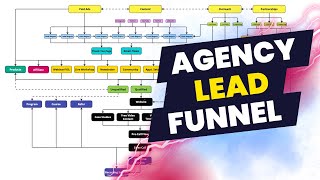
This is an instructional YouTube tutorial (Apr 16, 2025) that teaches agency owners how to build a lead-generation funnel that filters unqualified leads, trains ad pixels on qualified prospects, and improves conversions through landing pages, forms, and sales processes. Key elements: send paid-ads (or warmer content traffic) to a VSL/opt-in, route applicants through a qualification form that splits to separate thank-you pages (unqualified pages without the pixel), and use the qualified signal to optimize ad targeting. The video also covers a real example (business lending), four failure points to monitor (ads, landing page, form, sales call), recommended page/form structure, metrics to track (CPC, form-starts/clicks ratio, submission rate, close rates), and follow-up automation (pre-call materials and a 12-week follow-up workflow).
Questions this video answers
April 16, 2025
How To Build An Entire Agency Lead Gen Funnel In 22 Minutes
Over 550 agencies
Over $900,000 per month
$200,000 per year
Chapters
Hey everyone, this is going to be a basic funnel training for agency owners. And the reason that this video is so important is because without a funnel, you're really not going to get that many leads. And if you do have a funnel, you can expect to consistently grow your revenue every month. But if you don't, like I said, you can expect to have a pretty terrible agency that is solely reliant on referrals to grow. And those are of course of your control. So on this channel, all we do is talk about scaling agencies to millions of dollars per year. And this funnel is the exact one that I had when I scaled my previous agency to over 900k per month. And this is exactly what I teach over 550 agencies in my program called scale your agency. So all of the tips and the lessons of this video can be applied to really any service based business or any business that deals with leads. But we are going from a, an agency point of view. So in this one, if we have our whole funnel map like this, it's kind of going to cover the paid ads and the content part of the funnel. Because although they are two different things, the funnel that we build is going to be pretty much the same outside of just one major step. So they're just going to go in through paid ads now, they're going to be in our email list, they're going to consume more content, our appointment setter is going to contact them. They they're going to be either qualified or not. And then, you know, the process takes place. So this is the overall agency funnel that I teach to all of the people in scale your agency. And we're going to kind of go through that. So in this video I have four points for you. I'm going to talk about the funnel first, then I'm going to show you an example of that funnel out in the wild. Then I'm going to talk about the four points that you could really have to master in this funnel or the four constraints. If you're not doing them good enough, that's going to prevent this funnel from working. Then we're going to break it down into some action steps. So in the funnel, the first thing that we want to do is we want to filter out unqualified leads from our funnel for a few reasons. Number one, it's pretty much a waste of time to talk to them if they're not qualified in terms of revenue or they can't afford it or whatever. And even if you wanted to talk to these people, let's just say you want to get on the phone, you have time and whatever. You have sales reps that need calls. You still don't really want to allow unqualified people through your funnel because that data is going to go back to the Pixel with paid ads and actually it's never going to improve or optimize over time. So if you have, let's just say your funnel and 51% or more of people are unqualified, but you're still allowed to fill out the form, you're still allowed to book the call, whatever that funnel is, whether that's an application or just a book a call funnel, basically you have 1% more if we take 50 or basically have 2% more people. 49, 51. So your data is going to be optimizing at the start on like a minus 2 percentage points. So it's going to have all of your data in there and it's going to search for unqualified people, you know, 2% more of the time basically right at the start. But then that's going to get even worse and then it's going to be now you have 4% more unqualified leads and then that data is going to be the new baseline. Then it's going to go to 8 and then it's going to go to 16, for example, and then so on. And all of a sudden you find yourself with an ads that are not targeting the right people. You have garbage leads that makes your CPM go up because it's less engaged and less resonating. Your cost per click goes up, you're panicking, you don't know what's wrong, and then you're just kind of screwed. So we don't ever want to have unqualified people going through our funnel and if we must, we can just send them to an unqualified thank you page that does not have the pixel on it, if you like, but we'll talk about that later. So this is essentially the funnel that we want to build, starting from the left and going over to the right. So I always start over here with the different options kind of separated. So the ads and the content, although they're kind of going to go to the same funnel, there's going to be an extra step most of the time for content and you can also just send your ads to the opt in page and get the lead magnet first. But there's certain things that have to be true for that to work, and I'm not going to cover those in this video. So let's just say we're running paid ads on Facebook that's going to go to a page with a vsl. That BSL could be a training vsl, like a lead magnet, like a webinar, just a video. It could be a video case study or it could just be the typical direct offer vsl. And it's kind of your choice. If you don't have a clear direct offer that you would consider to be a grand slam offer, probably go with the training or the video case study. If you have something that is especially for high level people, that they don't really need training, they don't need like a direct offer that's usually like a setup or something, then you might do a case study to prove that you've done it before and give some insights because that always sells well. Or if it's something that they kind of like need to trust you or try out your ideas a little bit before they really hire you, something like a sales trainer comes to mind. Something like that. A training could be good. When we're doing our content, we really want to go to some sort of opt in page or lead magnet because that is what will grow our email list. And those people are a lot more willing and, you know, able to give you their name, email, phone number, website revenue, et cetera because they already trust you from the content. The ads and the content are coming from the same funnel basically, or going to the same funnel. But the content is going to be significantly warmer and more qualified than ads just because they've watched your YouTube before, they've read your Twitter and your LinkedIn and your Instagram, whatever. When this opt in page and lead magnet, when they fill out a form, they'll still be redirected to the same page with the vsl. So not to worry there. It's going to end up in the same place. It's just kind of an extra step for specifically with content. Then on that page there's going to be a big call to action button. Probably going to say apply or get started or something like that. And that's going to take you to a form that'll be a type form, that'll be a hey, flow form. Realistically, whatever you want. And then for the people who have gone in and who have filled out that form from content, they'll also be added to your welcome flow. For the people who came in through ads and were not really given the chance to do this, if they fill out an application, they'll also be added to your welcome flow. But we'll just keep that separate from now, let's delete some of these things here. When they're in your form, they're either going to be qualified or unqualified. And you can kind of see that up here. Qualified and unqualified. I circled them backwards. But you can see if they're unqualified, you have a few options. You can just turn them to a page that has nothing on it and, you know, whatever, have a nice day. Or if they're really unqualified, you can sell them a digital product that costs a hundred dollars or less. You might be able to send them to a community, or you might even be able to sell them a course, get them to join a program, a mastermind, refer them to someone cheaper, like, hey, sorry, you're not rich enough for us, but we're partnered with this agency in Eastern Europe that does great work or something like that. So they're, they're going to be qualified or unqualified, obviously. So the qualified people will go to what we'll call the normal thank you page, and the unqualified people will go to a different thank you page. The different thank you page will not have a pixel on it, nor will they really trigger an event because they didn't fill out the rest of the form. But that ensures that people do not get into our pixel. Because what happens when we're advertising our pixel? Basically, if we get 10 submissions on a form, for example, and eight of them are unqualified and two are qualified, which is not that uncommon for someone who clicks on your ads. We have all of our data in there, 80% of the data and 80% of the people that it's looking for, more people similar to that with the machine learning, are going to be unqualified. And it's just going to get worse and worse and worse over time. So we absolutely don't want to be tracking on that page there. We can have the course, we can have whatever we want. If you can monetize them Somehow, even like 20% of the ad spend back, that would be good, but not usually going to happen like that. And if they go to qualified page that is going to have a few things, it's going to have the pixel to get the data. You know that thing that, you know, like you book a meeting and then it has an invite in your inbox, you kind of want to take a picture of that, whether that's Outlook or Gmail, and say, go to your inbox and like accept that. So maybe I can put another thing here. Let's just Actually make this flowchart even better. I will put tell them to accept invite. There we go. We're also going to have videos that go over some FAQs. We might have an accordion and then we're going to have proof. So that's going to be like your screenshots, reviews, case studies, that kind of stuff. We're going to have that there as well. We've made the flowchart even better. So that is how the funnel is going to basically work. And basically look, oh no, we don't want to send them back that bad. We don't want to click Control Z. My bad. I just wanted to get rid of some of these red things here just so I can show it to someone and it's not drawn all over next time. So that's basically what we're going to do. We're going to have kind of one extra step for content, our VSL and our page. And our funnel is going to be their training, a video case study or a direct offer. All of them have their situations and pros and cons. If you could get them all to work for me in a profitable sense, like you just. You could have all three. There's not really anyone forcing us to choose, basically. So now I'm going to show you an example of this in the wild. This is one of my old ones that's not live anymore. Didn't work that well, so don't copy it. But I don't want to show you my live one because there's a lot of people who will just rip your stuff off on YouTube. So there's tons of qualifying questions. In my form, the pixel is not on the unqualified thank you page. So the Facebook is not counting that as the data. But basically I have one of my ads here for business lending. I have my landing page here. There's no VSL, but it's a B2C offer. You don't need it as much. This is the form which I'll open and then the. If they're disqualified, we cannot fund you. Sorry, no pixel on this page. And then if they are approved, there is pixel on this page and that counts. And that makes it so over time, it's looking for more and more people who are qualified and the ads will actually get better over time. So let's. So if we're in this form, for example, how much do you need? You know, why do you need a loan? For example? We don't do commercial real estate as one that would get disqualified for that. So I'M not going to choose that one. Are you the business owner? There's almost no situation where a business owner would get someone who's not the business owner would get a loan at least 12 months in business. Just kind of standard. Four months of bank statement standard. Have you ever received a business loan before? Just good to know. Have you ever defaulted? No one's going to pay money to people who have defaulted before. Do you have more than four loans? Basically? Not really. I'm going to loan people money for that. We require $200,000 a year in revenue or more. We don't fund poor credit just because it's a lot worse and a lot more difficult to do. What's your industry like? We don't do trucking or E Commerce for example. So business services, your business name and then you fill out there and then if they were to do that, you know they're on the, they go to the pre approved thank you page. So the reason that I like to show you that is look at how many opportunities there are to get people out of my pixel. There's the reason for the loan, there's the, are you the business owner? There's, there's the 12 months in business, there's the four months of bank statements, there's the, have you ever defaulted? There's, do you have more than four loans? There's the annual revenue, there's past three months revenue, there's the credit score. So that's a lot of different ways to get them out. So that means if we go back to the top, you know, the vast majority of people at the start would get disqualified. And that's kind of sad, right? You're technically losing ad spend. You know, it's not very good to be that strict. But it was a situation where according to the Federal Reserve data or U.S. bureau of Labor Statistics, 18 to 22% of business owners $500k or more per year. Basically that's really bad writing there. And based on our data that we got because we've trained our pixel on people to look for people who only do 200k or plus plus all those things. Now it's 52% do 500k or more per year. So that's like an example of where you can really get it to target who you want it to target. But most people, number one, don't know to do this or never think of it. So they just like oh my God, my ads are getting worse. This is shit leads and nothing else. Two, they don't set it up properly. Or three, they don't let it go long enough for this to actually work. Because Facebook is a multi trillion dollar does $160 billion a year on their ad business for a reason. It's not just a donation or because some other random. It's because it works. Yes. And they know who your target audience is. You just need to set them up for success based on how you set up your pixel. When you have your funnel, there's only four places that it can really go wrong. And you have to know where to look and how to diagnose each step. So the four places that could go wrong are your ads, your landing page, your form, or your sales call. And you can either have basically two high costs per click. Not that it matters precisely, but if you have something like $20 per click, something's probably seriously wrong here. Not enough form starts as a percentage of clicks. So let's say you have a hundred clicks and only five people started the form. That's a big problem. You'd have a bad form submission rate or you're just messing up on the calls. So you're gonna know which one is the biggest problem. If you have any common sense at all. And you wanna spend all of your time and all of your resources on the biggest problem. Because one of these things will always be the biggest problem. And then once you solve it, another one's the biggest problem and then the other one, and then it might be the first one again and it's just kind of whack a mole or a cycle on how to optimize all of these different things. So basically you're gonna look at this ad, you're gonna see cost per click. You're going to see that basically inside your ads manager, because your ads manager would know that. The form starts, for example, you're going to have to divide form starts by clicks. So you're going to have to look in your type form or your hayflow or whatever it is and divide that by the outbound clicks, your submission rate. You know you're going to form, you know, you're just. Form's kind of just going to tell you that. And then your close rate is basically going to be, you know, self monitored in calendly, you know, new clients divided by new meetings or something in calendly or something like that. And it should be fairly accurate. There's some people who lie on the forums by chance and get through, but because you're filtering it out, you should really be able to go two different metrics. One close rate as a percentage of meetings booked and then close rates as a percentage of meetings shown. And both of them are useful because, you know, show rate is a separate problem here. To do this, there's like many different things that you need to do to optimize your funnel. And you want to focus on the four points of failure and add anything that you don't have as part of the list below. Because all four of these things are equally as important. But you're going to know which one's the biggest constraint and which one you should start with first. So if we do in our ad, we should probably have two bodies for our ad. So two bodies, VSLs focusing on proof and depending on the type of offer you're running or type of agency. Like a lot of these ads, the good ones are just proof over and over. You tell them what you do, why you like what you do, why someone like them needs it, and then just as much proof as possible. That's really what makes a good ad. You want to form or film five different hooks as well. And you'll edit these five different hooks each on the ad. So you'll have 10 unique variations of the ad. Because you never really know what hook is going to do the best and what body's going to do the best. But when you do it like this, you can kind of, because you have two bodies, you can see which hook is going the best, you know, in the two different ad sets. And then you can see which body is doing the best because you know you'll be able to see that in the ad manager. Then in terms of your landing page, I always go with the following format. I go the logo at the top, very small. I'm going to go a star rating. So if we go back to this one here, like from the screenshot, the logo at the top, a star rating, a call out with a different color background, just for contrast of your audience. Your headline should be on three lines or less. In my view. The sub headline should go on three lines or less. And if the headline is their desired result, the sub headline will be like kind of elaborate how they will get that result, if that makes sense. So if my thing is you get business funding, how is that going to work? It works is kind of what you want to do, in my opinion. Then you're going to have a VSL or an image. Do as I say, not as I do in this case, because that doesn't have one. You're going to want your Apply now button. You're going to want to have your logos as the client proof type thing. Then you're going to want to do a section on how it works. Just 1, 2, 3 bullet points and then proof. And that's really what you need on your landing page. And you could put another apply button at the bottom too. Very good to do that. So they don't have to scroll all the way up. Let me just put that in there. Very good. So let's go more. Now we want to go on to the form. Typically I'm going to use type flow or type form or hay flow. It's kind of a matter of preference. I prefer hay flow. You're going to start with at least four yes or no questions to make it easy for them to get started. These should all be qualification questions. Kick them out very fast. You know, employee count revenue. Like, are you over this revenue? Are you over this many employees? Have you, you know, done X, Y and Z? Have you raised funding? If you only work with funded startups, are you the founder? Do you have the authority to sign someone type thing? Are you looking to get started within the next three months? I don't know. Something of this nature. Then we want to have at least 12 questions total. So I usually divide this into three categories. One, like the actual qualifications, two, the numbers and then three kind of stuff that's just good to know that would help you on a sales call. If you go back to this one. Like the question about have you ever received a business loan before? Not really. Requirement or a number. But that's just helpful for the sales rep to know because the way you would approach the entire call is different based on where they're coming from or how many. Like if they've done this before. I always like to ask, and sometimes you might have different forms and landing pages, but I always like to ask where did you come from? Because if they came from YouTube, that's very different than them coming from cold email when they book. And I also like to ask something like how long have you known about me? They've known about me for 12 months and come from YouTube. Probably watched a lot of videos. That's going to be a very different conversation than someone who's come from cold email that found out about me eight seconds ago. So I like to ask that kind of stuff. Then of course, the unqualified alt to a different thank you page qualified to the normal one. The screenshot of the invite One to three videos, FAQs and proof that we talked about earlier. And then on the sales call, we want to have A pre call flow. So when it trig when someone books a call in calendly a zapier to whatever email service you're doing. Just think of the top 18 or so FAQs, top 6 12, 18 FAQs that have to do with your service and just like send them there. Do something either like 10, 15 minutes of research or have an AI scraper that can generate a summary. This is like you shouldn't be asking stupid questions that you can find with a little bit of research like who does your target market? You know, what clients have you worked with? Who's your executive team? I have a puppy board that I scrape with every call and it generates one for me. I would do something like that. You always want to have a plan for your sales call kind of beyond the scope of this video. You want to send them the next steps instantly after the sales call's done. Can't imagine or tell you how many times I've been on calls personally, let alone my clients. And I'm like kind of ready to buy or at least heavily thinking about it. And they wait like 6 hours or 24 hours to even send the next steps and by that time you're done. And then we want to have a 12 week follow up workflow. So call, you know, they call booked tag in our CRM call completed tag. Once the call completed tag is or status is applied then it's going to automatically follow up for us. That's really what we want to do. So that is like a basic, basic agency funnel. You can do different agency funnels in different circumstances, but as a rule of thumb, everyone should have this at a very least. I hope this video was helpful to you and I will see you in the next one.
More from Matthew







Everything I Would Change About This Ecom Email Marketing Agency (3 HOUR LIVE AUDIT)

Everything I Would Change About This Meta Ads Training Business (3 HOUR LIVE AUDIT)


