How To Make Decisions Inside Your Facebook Ad Account
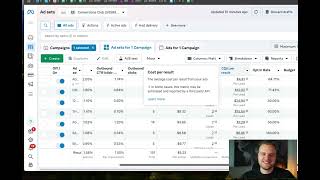
Walk through your Facebook Ads account to spot what's working. Set up columns for CPM, CTR, cost per result, and opt-in rate. Start with $50 a day, plan for 90 days, and know what acceptable costs look like for lead magnets and booking calls.
Chapters
Hey there. I'm gonna make this video because a lot of people don't know how to actually make decisions in their ad account. And the process of this is going to be through Facebook ads, YouTube ads, native ads, anything you might really do. But I'm gonna do it in the Facebook ad manager for this one. And this is specifically going to be about lead generation and B2B ads, but it's going to be the same thought process for anything. So I have my Facebook ad account open here and I've zoomed in a bit exaggerated, we might zoom out a little bit, but I would just really want you to see it. So first off what I do is I get my columns in a very specific way. So this allows me to make decisions properly and see all the data that I need. So I always have mine. Campaign delivery actions, cpm, CTR all outbound CTR outbound clicks, cost per outbound click results cost per result, opt in rate because these are lead gen ads, budget, amount spent and then I have my quality ranking, my engagement ranking and my conversion rate ranking. And these things give you really all of the information that you need in comparison to a lot of the preset columns I find just don't do that. And if we don't have the right information, we don't really get to make good quality decisions. So let's see, let's go into one my campaigns here. I'm not currently running ads, but I just have this open to show. So for example, let's go to, let's go to this campaign here. So these are some different lead magnets that I've tried for my business at some point. And keep in mind this or all of these metrics here are in Canadian dollars. So you have to basically times everything by 0.7 to get US dollars. So if my CPM or something looks high, it isn't really that high, it's just a matter of the conversion rate. So the first thing that I always do is I check my CPM here. And you want to do this because it's a good way to determine how good your ad is, at least from an algorithmic standpoint. So you can't really have direct control over your cpm. And your CPM is going to vary quite a bit depending on things like niche country, that kind of stuff. If you are running an offer to business owners in the United States, for example, that is going to be a lot higher CPM than you are targeting consumers in India for an example, or you're targeting everyone in Nigeria, like where the money is and the type of customer going out for is going to make a huge impact on your cpm. But the CPM is very important because Facebook ads are an algorithm and every YouTube ads, whatever you're talking about, is an algorithm and you got to think of it, what does Facebook want? How does Facebook make money? They make money by having people use Instagram and Facebook and stay on those platforms as much as possible because then they can deliver more ads and just charge more. Right? So Facebook is not going to prevent you from showing any ads assuming they're compliant. But if your ad is terrible, judged by the algorithm, and remember no one is, there's not a person just going through your ads and judging it if it's good or not. This is all algorithm based, based off clicks, watch time, average, view duration, you know, customer feedback, score, all that kind of stuff. But if they, if your ads are ranked or judged by the algorithm, that's better, you are going to get a lower cpm. And if your ads are judged as worse by the algorithm, you are going to get a higher cpm. It's not going to prevent you from showing your ads, but it's going to penalize you a little bit. Another thing is if we open up, let's just say we open up Instagram for example, and we have just, let's just go to the first ad we see. So the first ad we see is Yield School. I actually know this guy, he's from the same place as me, his name is Frank. Join. Join Yield School. If you haven't, I guess you see this is when I've opened my account, this is the very first ad I've seen and that is one impression. It's made an impression on me. It's going to be tracked as part of your cpm. This is important because if we scroll down to, and I'm not going to do it here, but let's just say we scroll down to the hundredth ad I've seen after I opened it up. That is also still one impression as tracked in your cpm. But the difference between the first ad someone sees versus the hundredth ad they see when they're just doom scrolling and their brain is mushroom. There's a lot bigger difference in terms of conversion potential there. So not only are you going to get cheaper impressions and your CPM is going to be lower when you have better ads as judged by the algorithm. Again, you're also going to get better quality traffic as you're going to be one of the first ones shown instead of the 10th or 20th or 30th or 40th or 100th shown. So you really got to keep those in mind. Anecdotally, and there's nowhere that it says this, but having high quality content on your Instagram and Facebook account is going to lower your CPM and get you better quality impressions. You know, you can go, oh my God, whatever, like where is that in the documentation? It's not, but I've run an AD or 2 in my life and have had over 350 AD clients in my life and it's always the case. So that wraps up the cpm. If you're going to do something business related, you're going to 30 to $60 CPM. If you're targeting Americans in the United States, if you really get a good quality score and you have a bunch of content, your profile, it might be lower, but that is something good. If it's more than $60, you kind of have a problem with your ads in my view. And you just got to keep in mind if you were to target Canada and UK and Australia and that kind of stuff, your blended CPM is going to be lower, but it's not going to change your CPM in the United States. In my view. I only target the United States with my ads. It's just where most of my clients come from. Historically it is the most highest cpm, but it's also the most, you know, the best conversion rate. And I think if you're just getting started with ads or you don't have a reason to go beyond the United States, don't just do the United States. That wraps up cpm. And those are just kind of decisions you have to know going into it. It's not really an active decision. But if your CPM is out of whack, you know, that's a good sign that your ads are not quality enough. The next here is I have CTR all and it's important because it's related to outbound ctr. So the difference between the two is outbound CTR is what tracks the click to your link. So outbound off platform CTR all is anything that's clicked on your ad, whether that's, you know, clicking on your video, clicking on the comments, clicking on see more clicking on your profile, any click whatsoever. And it's kind of good to have both of these because it can give you an idea of like the relationship between two. Like there's situations where you might have like I have 1.56% click through rate and 1.05 outbound here. And the CTR all is of course always going to be higher. It's never going to be the same or lower. It's just not really possible. But it's very good as kind of a metric to diagnose because there's certain situations where you have a very clickbaity ad and then your CTR all will be like 5%, but then it'll be like 1.5% click. That's a situation where your hook is very, very good or your scroll stopper is very, very good, but the rest of the ad is not as good as. And that's just something. It's good information that if you don't have both of these there and both set up, you just wouldn't really catch outbound clicks. Is self explanatory. Cost per outbound click is self explanatory as well. The cost per outbound click is going to be like what's good and what's not is kind of dependent on what you're going to be advertising. So for example, if you're advertising lead magnets, you you really want to get a cost per result or cost per lead of a dollar. And that is if you want to scale lead magnet ads, especially on low ad spend, that's what you're going to have to get. It's just a matter of math. And therefore if I have a $5.52 cost per outbound click, it's just physically impossible for me to get that. So we're going to, if we're doing lead magnet ads, we're going to try to target around a 75 to a dollar cost per outbound click with 75 cents being the ultimate goal. But if you are just having a book a call ad, for example, it doesn't really matter as much. Like you could have a $10 cost per click and you could have a 5% call booking rate and you would be getting like calls for $200 and then you close 20% of them and you're getting $1,000 CPA or cost per acquisition. It doesn't really matter that much. But in lead magnet ads, it's just a matter of math. We need to get that as low as possible. So lower is typically better. Like if you have a $70 cost per outbound click, like and you're doing book of call ads, that's not really going to get you anywhere. But anything under 10 for the book a call ads is probably fine. The results is just whatever you're tracking and your cost Per result is of course your number of results divided by your outbound click or your number of results divided by your total ad spend, depending on how you set it up. Usually it's going to be a number of results divided by total ad spend. But same thing, your opt in rate is going to be the amount of people so if you have a lead magnet ad, the amount of people who download the lead magnet. If you have a lead magnet ad and funnel and you're doing that or a newsletter funnel, you are going to need to have a 50% up in rate or above with an aiming to get 70%. If you are doing a call funnel and you're tracking the amount of people who book a call, 10% is an excellent metric to go for. But realistically it's going to be 3, 5, 7%. But 10% is what you're going to want to hit and you're not going to get any good results for less than 3%. So these are different, you know, metrics that I always track in terms of the budget. What I do is I'm going to project 90 days in advance because in my experience when you're doing these kind of ads, you know, just see an ad and book a call. They see an ad, they book a call, they get your email flows, they watch some of your YouTube, they get your newsletter and then about 90 days in advance they actually become a client. So you really have to kind of go over that or plan for that when you have your or when you're deciding what to spend. Realistically, I always recommend people start at $50 per day because if you're not getting calls, it's not working at $50 per day, it's not going to work at 500 or 5,000. Your performance gets way worse over time and over when you increase the ad spend. For the simple fact is, let's say, let's break it up into percentiles. Let's say if I was spending $50 per day, I'm targeting the top 1% of most qualified people from the algorithm. And that's probably true, right? If I was to go $500 per day, I'm targeting the top 10%. Now just because I'm increasing my ad spend doesn't mean there's more super targeted people. It means it has to disperse the ad spend to broader and broader audiences who are less and less qualified and less and less aware. So that is why your ad performance usually decreases as you increase the spend. So set your ad account up like this and try to hit the metrics that I said. Every business is different, but I've given you some really good benchmarks to go off of. I hope this was valuable, and I will see you in the next one.
More from Matthew







Everything I Would Change About This Ecom Email Marketing Agency (3 HOUR LIVE AUDIT)

Everything I Would Change About This Meta Ads Training Business (3 HOUR LIVE AUDIT)


