How We Built Our Agency’s 75+ Person Sales Team
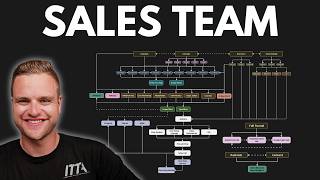
An agency founder breaks down how they built a 75-person sales team booking 600 calls weekly. The structure: two setters for every closer, with setters spending one hour daily on outbound prospecting. Before hiring, the founder personally validated every channel and process, then built SOPs around what actually worked.
Questions this video answers
About 600 calls per week.
Approximately 75-person sales team, USA-based.
Two setters for every one closer (2:1).
About 25 full-time closers and 50 full-time setters.
Target 5 calls/day with ability to go up to 8.
Chapters
Are you in the process of building out your sales team? For me, this was the hardest part about building my agency. I'd always been good at lead generation and fulfillment and fairly good at sales personally. But building out a sales team was a big obstacle for me while I was scaling up. And for context, we currently have a 75 person USA based sales team and book about 600 calls per week. So in this video I I'm gonna teach you three things. The first is what our sales team looks like. Second is how to design a sales process. And three, I'm gonna sprinkle in the three biggest lessons that took me from a five person team to a 75 person team at my agency. So to start, let's break down the structure and makeup of our sales team and include one of the three big lessons while we do it. So one of the three big lessons that I learned is that for every closer, you're gonna want two setters. Whether these are outbound setters or inbound setters is going to primarily be determined if your main traffic source is ads and content or cold outreach. If it's outreach, they should be outbound setters. If it is paid ads or content, they should be inbound setters. So the outbound setters should be cold emailing, cold dming, cold calling, all that kind of stuff. The inbound setter should be confirming appointments, texting people and phoning them as fast as possible and calling old leads in the pipeline who either did not book a call at all or or did not show up. Once those inbound setters have gone through all of their inbound leads on a given day, they should begin outbound setting. And I like to have all my setters, inbound and outbound do one hour of prospecting to start their day no matter what, to start building pipeline. So if you listen to this and you can do basic math, you'll be quickly able to decipher that. We have about 25 full time closers and 50 full time setters at our call centers. Two setters for one closer. Since we primarily use paid ads as our traffic source, and then outreach is second and then content, most of them are inbound setters. Our content is used more so to nurture leads who find out about us through ads and outreach than it is to actually get leads on its own. Although our content will probably be better than 99% of agencies, it makes up less than 1% of our call volume. At our agency. I aim to have every closer take five calls per day with the ability to go up to 8. The reason for that is if you book more calls per closer than this, you're too reliant on each closer. And if they quit or do something you're caught scrambling and more than eight calls, they get very tired and don't take any calls as seriously. All of my closers have selling stuff that is high ltv so they don't require that many calls, which is great. So that's enough about me. How do you build a sales team on your own and what does the process look like? Because it sounds easy enough when it's spelled out in front of you. But I don't think most people do a good job of utilizing their setters or closers correctly. And that brings me to the second lesson. And the second lesson is that you have to figure out how to set on every platform yourself and close both inbound and outbound sales calls before you ever hire a setter or closer to do it for you. No one is going to figure it out for you. How could they? It's just a very unrealistic expectation, yet almost everyone does it. Why would a setter that you pay $500 per month and then maybe $100 per call be able to figure out your entire sales process for you? You hear that kind of crap all the time, but it doesn't make any logical sense. I was talking to a client who paid me for a consulting call recently and on the call it's like, oh yeah, we had a marketing girl as our intern during the summer. She couldn't even figure out our paid ads. So it's not just closing, it's everything. Why would a 22 year old presumably girl straight out of university or at her summer co op be able to figure out the paid advertising strategy of a $40 million manufacturing company? Right? Unfortunately, people do this all the time in every area, but especially with their sales team. So here's what I recommend. You have to figure out an outbound setting process that works on every platform. So Instagram, Facebook, LinkedIn, Twitter, cold email, cold call, cold DM, you name it. The keyword there is you, you, not someone else, not your setter, not an employee, you, the founder or maybe the CMO in some cases, or the CRO in some cases. But it should be you. You have to do this yourself manually and then keep doing it and keep improving it until. Until you are able to book consistent meetings. The process you use for each platform might be slightly different, but they're all more or less the same. So if you figure out instagram for example, you're going to be LinkedIn and Twitter and Facebook, et cetera. If you need to, you can replicate it and tailor it to each platform. Once you do, you should record yourself via loom of an hour of doing it and then transcribe that loom and turn it into a checklist or SOP and then a one pager. So what you want to do when you hire a setter is you do this for an hour on zoom in front of them, show them what to do, then have the setter do it for an hour on zoom in front of you. If they're able to replicate the process properly, finding the people messaging them, responding, then congratulations, you have just trained an outbound setter and you can replicate this process over and over and scale to more setters. And maybe eventually you might have a head of setters who recruits and trains new ones for you on each platform. So that is the outbound setting process. But what about the inbound setting? And this is where it's different in my view. I've tried everything and I think that you have to have an inbound centralized setting process. So the nice thing about learning to do the outbound setting first is that it's infinitely harder than inbound setting. When you're inbound setting, they're coming to you, they know who you are, they've indicated that they are interested by doing something. They're filling out a form dming you, booking a call or whatever action that is much different dynamic wise than outbound setting. Because when you're outbound setting, they have no idea who you are. Probably not interested in any way. Just takes a lot more skill to do. So. One of the key differences is the outbound setting. And the inbound setting is outbound setting. You're going to have a bunch of people working somewhat independently. It's good if you can export a huge list and then break it up. So everybody gets a thousand contacts, for example, so there's no overlap. But even if you get that perfectly, there's not much coordination or cohesion in an outbound team. And that's the opposite of what your inbound team should be. With your inbound team, you should completely centralize it so all inbound leads go through the same application form. A use case is you split up the form so you have one form for every source, so you can separate the metrics. That's very valid but should be centralized. Then all qualified applicants book on the same calendar, and that calendar distributes meetings in a round robin format to your Closers. The process here is a bit different, but we're going to go through that as part of the overall sales process in a few minutes in this video. But before we do that, we must focus on the third of the three lessons, and this one might be the most important of all. And that is in your sales team, do not try to make each sales rep 50% better. Focus all of that time and effort on making it 50% easier to sell by having a better sales system. A very popular saying is that a rising tide lifts all ships, and that is especially true when it comes to your sales stream. Especially as the team grows, you're going to be hiring less and less qualified closers. And that's true in any role, but especially when it comes to sales. There's so many, only so many A players, and there's more spots eventually than there are total A players. Just supply and demand. So instead of trying to turn B players and C players into A players one at a time, it's better to instead focus on improving your process. So what does that look like? I'm going to go over this from top to bottom with what we do and what has worked best for us. And I'm just going to do that as simply as possible. But before you absorb what I'm about to tell you, try to resist the urge to instantly think, well, I already have that. Like you and I are enemies or you are trying to get me or something. Many people have many things, that's true, but most people don't do them right. A toddler holding a baseball bat has a baseball bat, but not in the same way that a major league baseball player has a baseball bat. This is often the case with people in their sales process and other parts of their business, and it's really frustrating to act as a consultant to those people. How you use each tool in the sales process matters a lot, so I'd recommend using it the same way that I'm describing it to the best of your ability. Using these tools and processes and succeeding with them is going to act as a better form of social proof than me just going on a thousand hour video telling you how great it is. The intent of the lead, first of all, matters a lot. So a lot of people just book meetings however they can. Most of their messaging and their offers are usually unintentionally on the beginner side, and as such the leads that come in are much lower intent than what they would like to be. Most people can sense that this is happening, but they just can't quite put a finger on it and articulate the problem properly in your sales process. If you think this is a problem and you are doing everything right and it's still not clicking and you don't know what's wrong, that's probably it. So this phenomenon happens in many areas of business and life. The easiest way to reduce your churn is to not do any of the tricks or hacks or even improve your service. It's to work with richer, more qualified clients that are going to succeed with or without you. They're just less likely to churn. The easiest way to ensure you don't get divorced is to just ensure that you attract and have a better spouse. Right? Less likely to get divorced. The easiest way to ensure that you have a great community and social circle is just to have better friends. That might sound like really stupid advice to the uninitiated person who does not understand what I'm saying, but it's extremely important and extremely profound. The easiest way to improve your sales process in this case is to attract better, higher intent leads. And you do that with your messaging. So whether that is with paid ads, whether that's with content or outreach, higher level and better messaging equals higher level and better leads that are more likely to convert. So in practice this usually means video ads, VSL types with a big banner at the top talking about the problems, outcomes and circumstances that your target market faces, then presenting your offer as the solution and telling them the next step. It's pretty simple. It's usually going to be booking a call. The next thing you want is to have a good pre call flow that hits them from every angle. So between the time they book a call and the call actually taking place or happening, you should be absolutely blasting them with information on every platform. A great way to describe this from Jeremy Haynes that I like is the reason that people don't show up to the call is because there is a deficit of information. These people booked a call with you because they're interested, at least to some degree. They want to get more information. If you blast them with all the information they need before the call, they're more likely to show up. They will be much further along in the sales process during the call. So it can be more about answering questions and closing than it is explaining how it works and breaking self limiting beliefs. So what does that actually look like in practice? What are the components? So email one email every four hours for 72 hours for 16 in total. Each email focuses on one of the main objections and completely destroys it and Overcomes it using stories, examples, insights pointing to case studies so that individual objection is no longer in the way or no longer exists. The next is retargeting ads. So turn all of those emails into 30 to 60 second videos that basically is the video version and run them as retargeting ads on every platform. Facebook, Instagram, Messenger, Audience network, Google display, YouTube, TikTok, anything you can do, LinkedIn. You want to blast them and ensure that they see these ads 30 to 50 times before the call because that means they'll see the ads so many times and every single objection is going to be taken care of. The next thing is on the thank you page, create a VSL that is essentially a one sided sales call of you know what you're going to be doing and run through the offer presentation just like you would on the sales call. That's going to let them know ahead of time everything they need to know. And then on this page tell them to accept the calendar invite and then have three to five different videos on this page that basically are longer versions of overcoming the three to five biggest objections and completely destroying them just like that. The next is a quick win. When they book a call on the thank you page and usually by SMS and email, you should give them an asset or something that has its own instructions that takes maybe five to 10 minutes of work to set up, but actually makes a tangible difference. So if they do this quick win, between the time they book and the time the call takes place, you'll have essentially sold them. It's like a free trial of your service. If they were on the fence before, they're definitely a no. The final thing you want to do is actually pick up your phone and record a selfie of you talking to them, saying their name, talking about their business, making sure that they know it's unique. Voice notes fine too, but either are good, but that will start building rapport before the call. So if you know those five things, you will notice that your show rate goes up by 50% and sometimes more importantly, the call goes up 2 times better, 4 times better, 6 times better in terms of quality. It's just amazing. The next is pre call research. So the morning of the call your closer should be researching each of their meetings for the day and you can have an AI tool that speeds that up. And they should be reaching out to each product like prospect to number one, confirm the appointment with hopefully a selfie video or a voice note. And then two, send them any relevant information and case studies that have to do with their specific business. So doing 10 minutes of research before the call will sometimes double your close rate. You'll make them feel special, like you actually care. And because you did research, you will be more confident. So don't let anyone on your team skip the pre call research. Make them be professional. The next is a one pager plan for the sales call. And I don't believe in word for word scripts whatsoever. They sound wack as hell when you're on the receiving end of them and it sends the wrong message to your team. You're not hiring robots, you're hiring people. The difference between robots and people is that people have a soul. And you're going to see that as AI gets better and better. Instead, everyone should have a one pager that is based on what the most successful sales calls have in common with actual data and actual call recordings. It should be a bullet point and they should have the person stay on track as much as possible. If they go off track, they should come back. Have you ever heard of Jordan Belfort's straight line selling system? Who's the Wolf of Wall street guy? It's kind of like that, but I changed the rest of the process significantly to tailor it to my business. So our one pager goes something like this. The intro line, the first five questions to ask, the thing to say to transition to the sales presentation. The sales presentation, the transition to the objection handling phase, which is how much do you like this on a scale of 1 to 10? 7. Okay, why 7? They're going to tell you and then you go into the objection handling phase. Then we list out the top 12 or so objections and their answers. The top five ways to transition to the close, the next steps and then how to conclude the call, which is mostly just hyping them up. It's the closer's job to follow this plan and bring the conversation back to these points as fast as possible. And while of course fully finishing the prospect's thought or answering their question. And the final part here in my view is centralized follow up. And the keyword is centralized because it would be nice, but I've never been able to get my closers or sales team to systematically follow up in a way that is a hundred percent consistent in any of my businesses. And at this point I've really stopped trying as I don't think it's possible. And instead I just have a centralized follow up system for all. For what we do. For follow up, I follow a specific process that I read in one of Alex Shamozi's emails. That goes something like this. So for the first, every day for the first three days after the sales call, I follow up. The first day I send the biggest case study in terms of dollar value. The second, I send the biggest case study in terms of percentage gain. And then the third day, I send my biggest industry insight the following week, Monday, Wednesday, Friday, I send three total emails. So on Monday I send an email addressing the biggest FAQ or objection on Wednesday the second biggest and on Friday the third biggest. And then I follow up for 30 more days, twice per week, on Mondays and Thursdays. On Mondays, I send a case study email. On Thursday I send an email going over a specific industry insight. And that's the process from start to finish. So how would you apply what I taught? I think the nice thing about this is it's a foundational system that means that you should and could use this. Whether you are at one closer or 25 or even a thousand, the process is the same and we're setting them up for success, making it easier to sell. Instead of trying to get them better at sales, we are plugging people into an overall system instead of running around trying to manage 25 different ways of selling. In my opinion, that is the key to success. If you're building a sales team after you book about 25 calls per week for four weeks, you should hire your first closer, then replicate that process at 50 calls, time for a second closer at 75, time for a third, and so on. That's really all it takes. If you would like my help with your sales process or building your sales team, you could always book a call with Lead Generation Academy, which is my consulting offer, and I will see if you qualify. So thanks for watching and I'll see you in the next one.
More from Matthew







Everything I Would Change About This Ecom Email Marketing Agency (3 HOUR LIVE AUDIT)

Everything I Would Change About This Meta Ads Training Business (3 HOUR LIVE AUDIT)


