How We Grew Our Finance Agency From $113k/Mo To $1.8 Mil/Mo 18 Months
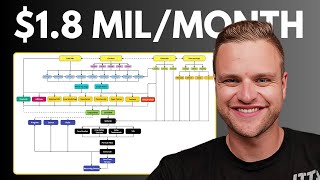
A first‑person case study (YouTube video) by Matthew Larson describing how a finance lead‑generation agency scaled from $113k/month to $1.8M/month in 18 months. Covers the agency’s business model (pay‑per‑lead for financial advisors), the four core agency problems they solved, a multi‑offer funnel (recurring/reoccurring lead sales, intro offers, courses/programs, referrals, affiliate commissions), traffic mix (paid training funnel, cold email, LinkedIn DMs, content, white‑label buyers) and operations (appointment setters, sales reps, 30k email list, follow‑up sequences). Includes concrete metrics about pricing, funnel performance, conversion rates and staffing.
Questions this video answers
From $113k/month to $1.8M/month in 18 months.
Paid 30% of net profits on a quarterly basis.
Minimum order: 50 leads per week, equating to $11,000 (at ~$220 cost per lead).
Intro offer: 25 leads for $4,840.
Reported ~30% margin; ad cost to fulfill 25 leads ≈ $3,388 (leaving ~$1,452 margin).
Chapters
So in this video I'm going to show you how we grew our Finance Agency from 113k per month to 1.8 million per month in 18 months. The agency that I'm going to talk about relies on, you know, getting leads for financial advisors on a pay per lead basis. That's nearly 85 to 90% of the revenue on an ongoing basis. So this is much different than most agency models that rely on retainers. It is higher risk but much more scalable and much higher reward than the average agency because the greater the risk, the greater the reward, just like most things in life. So I met the client that I partnered with this agency on at an affiliate marketing forum about three years prior to when I am recording this video as you see it right now. And when this happened they were very small, 30 to 40k per month gross, let alone net. I have no idea what the net was back then, but I know what the revenue was. And, and since the, you know, previous 18 months when we built this up, they were, you know, starting at 113k 18 months ago, another at 1.8 million. I am paid 30% of the net profits on a quarterly basis for this work. So that's been the previous how that six quarters or so, it's going to actually become the seventh quarter soon enough. So in this video I will show you how we built the marketing funnel to both generate the leads we sell as well as to get clients for the agency. If you never watched my channel before, you have no idea who I am. My name is Matthew Larson and I am from Calgary, Canada and I'm 29 years old at the time of recording, currently in Dubai on a business trip. So it's not my normal setup but over the past 12 years I have been a part of three agency exits, all in the E commerce space. One was Facebook ads, one was Amazon agency, mostly Amazon ppc and the last one was a lead to Earm landing page and conversion rate optimization for e Commerce in July 2023. The first two were multi seven figures in cash and some earn out and the previous one was 10 million in cash. Over 10 million in cash and no earn out. The first two I was a minority or junior partner with. I was the apprentice learning from the master so to speak. But I owned the 100% of the previous agency that I sold for 10 million in cash. Learned a lot in the past 12 years and all I really do is make an agency, build it up, sell it, wait for the non compete to expire and then do it all over again. I'm confident that I could run up any agency based on the exact strategy that you're going to see in this video. So take notes, see what would work for you, see what can be done, and hopefully leave this video with some action steps. So the things that we're going to talk about are about me and the business and kind of already touched on that. We're going to go over the four problems that agencies face. We're going to talk about the offers we created for this agency, the funnel we're building, the how we drive the traffic, how we operate the funnel, and then we're going to touch on operations, hiring, training, and that kind of stuff very briefly. So there are four main problems that every agency faces, and every agency suffers these to a varying degree. The first is that no one knows who they are or even if they're a bigger agency. Just they're now their main constraint is they aren't getting enough traffic. The second is they're not generating enough leads. The third is all their clients come from referrals. And the fourth is 99% of leads they do generate through paid ads, through content, through outreach, are unqualified. And they basically have nothing to offer them. So it doesn't matter if you have the best service in the world. If no one knows who you are, you can't sell it. And this is really the root problem for most agencies. They get no attention, you, no one cares. So for most agencies, it is kind of like they don't even exist at all. Most of their clients that they get are purely through luck and they don't really have a duplicable, duplicatable, duplicable, repeatable or predictable way to get more clients. So without solving this problem, we're not going to solve the other three. The second is they're not getting enough leads. And most agencies generate zero leads. They may get one or two here, and that's basically purely through luck, but they don't really have any real pipeline and no system for generating demand. So this problem is very closely linked to that. No one knows who they are, but it's not the exact same thing. Because people can know who you are for the wrong reasons doesn't mean you're generating leads. Without a system to capture and nurture and qualify leads at scale, there's almost no real hope to succeed in the agency business. The third is all their clients come from referrals. And referrals are great. We all love referrals, but we cannot solely rely on referrals to scale. They're out of our control and we'd be putting ourselves and our livelihood and our family at the mercy of one of our clients, just randomly stopping throughout the day, thinking of us and just bringing up someone and referring us to their friend. We really need to take our life and our business into our own hands. And that means not scaling off purely referrals. And that means to generate a system to convert cold traffic at scale. The fourth problem is 99% of their leads are always going to be unqualified. There's nothing that you or I or my partner in this video or anyone else is going to do to change this. Most agencies get stuck because they have nothing to offer outside of their high priced, main, high commitment, recurring service. Well, this is probably the most important service that you could have and it pays the bills. It's hard to be profitable in your paid ads, your content, your sales team and all that kind of stuff if we're essentially wasting 99 cents out of every dollar we spend on marketing because we don't have anything else to offer. And I'm going to go through that in the video. So before we get started, before we get into the funnel that we built, this is an example of the average lead generation funnel and it might be even a bit too generous. Someone basically might have a Twitter thread or like Twitter feed, or they might have a LinkedIn account, or they might have some ads or some outreach and it goes to their main recurring where they're basically pushing it through and hoping people buy. This is the funnel that I built with my client and the one we build inside our scale your agency program where we have multiple ways of driving traffic with paid ads, with content, with outreach, with partnerships. We have a bunch of different lead magnets and assets to capture leads, we have email flows to nurture them, as well as a webinar and a VSL or a live workshop or a newsletter, a community appointment center or all of the above. Those things will determine if they're qualified or not qualified. And then we have a bunch of different offers so that no matter where they are, no matter how, no matter where they are or how much revenue they're doing, we have something to offer them. We have our one time service, our recurring service, our referral partnerships, our course, our program, our products and our affiliate links. So I'm going to get into how we built every single part of that and kind of like a house, we have to build it from the ground up. It wouldn't make much sense to build the bottom of the funnel before the. Or build the top of the funnel before the bottom of the funnel, similar to how it wouldn't make much sense to build the roof of a house before you built the walls or the foundation. So part one will be creating the offers. So this is the funnel where basically at the bottom, we're going to create this offer and then this offer, this one, this one, this one, and this one, and then this one. I'm going to show you what we did for each. So the types of offers are the recurring service, the intro offers, the referral partnerships, the courses, the programs, the affiliate commissions, and the digital products. And we need multiple offers because, like I said before, 99% of our leads are unqualified. And we can't change that. It's like gravity. But what we can do is we'll have multiple different offers. So no matter what their revenue level, no matter where they are in their business journey, so to speak, we have something to offer them. And if we don't do this, like most people don't, we'll lose out on a ton of potential revenue and a ton of potential profit. So for the recurring service, this is the foundation of every business. It's what generates the mrr, the monthly recurring revenue. And without it, you're not going to have a stable and predictable business, and you will not feel confident enough to hire the best people and to reinvest in your business. So in this case, this finance agency that does pay per lead, it's not really a recurring service so much as it is reoccurring. We're not just locking them into some sort of MRR retainer. We sell them leads. And although there's no contractor commitment, a lot of clients get into, you know, I want 50 leads per week or 100 leads per week, or 500 leads per lead or so on something like that. So it's not recurring in the sense that it's a subscription, but people buy again and again. So effectively it's kind of the same thing. So in the context, the minimum order size that we do at Our agency is 50 leads per week, which is $11,000 at an average of 220 cost per lead, which is the current market. Great. At the time we. I'm filming this video. So the biggest problem we found with the recurring service, basically this is a function of the kind of niche, in my opinion, is that it, it takes a really long time to get financial advisors to scale up how many leads they want per week or per month. Because unlike a lot of finance Things where they get their commission. A lot of them just get paid on their percentage of their portfolio and their client's portfolio every year. They don't just get some, you know, bonus or commission or upfront cash flow. So this makes it very hard for us to scale the amount of leads that we send or sell to every client in comparison to some industries like mortgage and loans and stuff where they can often get their commission within seven or 30 days or something of that nature. So in the past 18 months, we eventually did find big buyers. You know, I'm not going to name any names, but there are a lot of big financial advisor companies. But it took many months for us to scale up like the amount of spend, which is unfortunate for us on the front end, but if you're playing a long enough game, it was fine. The second is the intro offer. And although the recurring service I'd argue is the most important, it's kind of harder to sell to a lot of people because it's higher risk and higher commitment from the buyer's point of view. So the intro offer should be the opposite of this. It's one time awesome, no brainer offer that they can kind of try you out without taking the full leap, so to speak. If you think of it as, you know, working with you over here, your clients over here, and there's a big river like flowing and you're, you're on each bank of the river, the intro offer should be like a stepping stone. It makes it easier to get across. So the number one problem in this industry, the pay per lead industry in finance, regardless of the vertical, is that people who buy leads often get screwed over by paying for absolute terrible leads. And just like most agencies, I would say, are terrible at delivering their service in a traditional MRR setup, most lead sellers are absolutely terrible at generating quality leads and they're essentially scamming their buyers. So we tried to be empathetic in this situation and we solved this problem by finding the absolute, what I would say minimum order size that we could sell to someone with. That basically costs, that basically covers a cost of fulfillment and client acquisition and leaves a little bit of profit left over just to reinvest in the business. So there's the cost that it takes us to acquire the leads, and then there are other costs, like, you know, our paid ad cost to acquire the customer, the content cost to acquire the customer, the appointment setting costs, the closing costs, software admin costs. We basically turned out to be 25 leads and we'll sell them for 4840. So without giving away too much, we are generating these leads at about 30% margin which means to fulfill 25 leads, we spend about $3388 on ads. So this leaves us with about $1452 in leftover margin which basically is designed to cover the rest of our costs. So we are getting about $105 per qualified call right now and closing 22% of them I think is very good. And that is about $476 in ad spend plus another 484 in sales commission if you take into and that to explain that a bit instead of just glossing over it. So we pay about $476 in ad spend to get those calls that it takes to close. We pay a $484 on 4800, which is 10% commission to the sales rep, we pay 5% to the to the appointment setter. And that leaves us just barely enough profit left over to, to cover the admin costs. So the software costs, the non revenue producing costs like finance, hr, that kind of stuff, while still at least breaking Even on the 100% of time on the front end. So we're never losing money by acquiring a customer. We're always breaking even or maybe, you know, a few bucks left over. So we're acquiring the customers at a break even on the front end and we make the big money, so to speak, when they upsell or they buy more leads again. So about 31% of our customers buy leads three times or more. And every time they buy those leads, we're making at least that 30% margin as the customer acquisition cost is already paid for, the sales commission and the setting costs are already paid for. And that's where we really make all of our money. We don't really make anything on leads that, you know, just buy once and then churn like it's doesn't really similar to how you wouldn't do that on pretty much any agency. For our referral partnerships, we can actually make a lot of money referring people away if they don't fit our criteria. As far as I see it, there's kind of three main situations where that's true. They're either too small for you, you can refer them to a smaller agency, they're too big for you, they can refer to a larger agency, not really the case most of the time, but. Or they actually need a different service and you can refer them to an agency that does that service. So in our case, we basically generate all of our leads purely through Facebook, YouTube, TikTok native advertising. So if the client wants lead gen through a different method, so to speak, such as content or cold email or call centers or something of that nature, we're basically able to refer them to our partners that do those service and we collect recurring commissions every single month for doing so. So it's a nice little revenue stream for our course. There's always people that want to learn to do it themselves and they're not going to hire you for the main service if you don't have something to offer them. I based on everything I've done In the past 12 years, you're missing out about 15% of the total market. So the best thing, the best way that I've found to think of a course is making a complete training system for your internal employees. So like one module or one course per role and then repackaging it to make a course. This kills two birds with one stone and you're going get in the right frame of mind. How would I train my employees to do this is how you would basically do your course. So in this case it's not like a lot of agencies. In this case we don't necessarily want them to know how to generate leads themselves with ads as that would defeat the purpose of our service and create competition for us directly in the ad auctions. So instead we made a course on how to set up the sales processes and systems and automation specifically for night for financial advisors and that helps them close more leads that they bought from us. So it's a good revenue stream for people who do buy it. And we sell more of these than you think. Like to be honest, I'm not going to say how many, but we sell more than the than you might think. So it's a good revenue stream for us. And if they set it up and they're successful now, they're having a higher close rate and they're going to buy even more leads from us, which makes it even better for the program. I like to think of the program typically as the course with some extra one on one or group help. This could be like a traditional program or a mastermind or something like that. And it's similar to the course in the sense that some people don't really want you to do it, but they also don't want to do it themselves so they want you to do it with them. So done with you is why it's called that. So when I think of the program, I usually try to basically incorporate the course but focus on getting A specific result while holding their hand along the way. So in this case we didn't really have a program in the traditional sense. What we did was they could essentially rent someone from us, which is a VA to help them set up their systems. So the course was their systems, but this VA was basically a one time cost and it would set up their appointment setting system, their sales system, their CRM and their automations if they don't already have them and they don't really want to do it themselves. It's essentially the same course but has large elements of done for you instead of purely do it yourself. I would still can like classify it as a done with you program. And it's a good revenue stream for us. And it's kind of like the course where if it is successful it's going to lead to them buying more leads from us. And that's why we really focus on offering it. The next one is our affiliate commissions and most of the people who come into your funnel are going to be unqualified to buy something from you. We've said that multiple times, but a lot of people will sign up for the software they need if you teach them. So we can really create a lot of recurring affiliate commissions if we recommend those softwares to them. So the most common scenario that we basically get affiliate commissions is when they sign up for a software that they need. So financial advisors in terms of technology and automation and what's possible is very unsophisticated in comparison to something like SaaS or E commerce or something where everybody has it dialed in completely. So in these industries, cold calling and mass outreach, direct mail, that kind of stuff is still the norm. So a lot of them don't even have the most basic software. So we basically get a lot of affiliate commissions when they sign up for a CRM. We recommend Close.com to our clients, but it kind of is whatever an email marketing Software we use ActiveCampaign because a lot of them don't accept financial investing type of businesses. And then an SMS marketing software we recommend Twilio. So we have, I don't know the exact amount but it's like 18,000 to 20,000 per month in just commissions passively from this. It's not the biggest, you know, revenue stream, but it's not bad at the same time if they're going to sign up for that stuff anyway. The last one is a digital product. And a digital product is a necessary offer in most funnels because it serves two purposes. It's another revenue stream for someone who can't afford our main offers or our course. It can act as a stepping stone, kind of like an even miniature intro offer to get people in the top of funnel through paid ads, through content. So whether this is a challenge, a digital product, templates, there's many options and we don't really have one of these for this business. We really couldn't find one that we thought makes sense that was not already included in our course. And we didn't want to make ad templates or landing page templates or something like that because that would just create direct competition for ourselves in the ad auctions. So now that we wrapped up the offers, we're going to talk about building the funnel. I like this part the best. And to recap, this is the exact funnel that we're going to build or that we did build and we've done the kind of offers and now we're going to move up to the sales, the website, the conversion mechanisms, the middle funnel, top of funnel. So the pieces of the funnel that we really wanted to do are the opt in page, the sales page with the vsl, an application form, a disqualified thank you page. So people who submit the application and don't fit the criteria, they're disqualified and go to that page and then we have the qualified thank you page for people who can book a call. We also want six or 12 lead magnets. A welcome flow, a pre call flow, and a follow up flow are the different parts that we made. So we need the full funnel. We don't just need 90%, 99%, we need 100%. Because a good marketing funnel is like a car. A car is greater than the sum of its individual parts. I don't know if I said that phrase right, but it's greater than its individual parts. It's the sum. If any parts of a car are missing, it's not going to work very well. And if it does, it's not going to work nearly to the same extent as if all of the parts are there. So if we had all the parts of the car except the door, the brakes, the steering wheel, that kind of stuff would be very useful. Would it doesn't really matter that in theory, 95% of the car is there. It will not function in the way that it's meant to function. And it's the exact same thing with the full marketing funnel. It all has to be there. And I think everybody will be fooling themselves to think otherwise. So the first thing I'm going to talk about is our funnel pages. So as far as the funnel goes, it has a few different parts. The core of the funnel is a few different pages of esl, an application form and a call scheduler tool. Calendly for us at least. So the first thing that we had was an opt in page that promised a free training on how to close more clients. As a financial advisor, this is heavily promoted in all of our content and on our website. But we don't really use this page at all in paid ads because we're trying to get sales calls booked. And we found it's a lot better to advertise directly to the sales page, which I'll talk about next. The sales page is actually very simple. There's a headline, there is a vsl, there's Apply now and then there's proof. So for most of the journey and most of the video that we're going over now, the headline was close. Three to six more clients per month. As a financial advisor without cold calling, direct mail or referrals, even if you're not the most established in your area. So I've tested about 150 different headlines. The landing page testing is my specific job and nothing has beaten this. This is actually one of the first headlines we've tried. No matter what I've tried, I really can't beat this. So if you could comment something better, let me know. I would be the most keen person in the entire world. If you think you could write a better headline, I'll even pay you for it. So the VSL told them everything they need to know about buying leads from us, including the math and roi. You know, this is what you can expect if you get, you know, this cost, this close rate over the next five years. This is what you can expect if you get this many referrals, what you can expect then how it works, what we would be responsible for, what they're responsible for, and just stuff like that. It's pretty simple. The VSL is just the business owner, my partner in this case, reading through a slide deck that's about 70 pages long. Not really unlike the video that you're watching right now, except an actual instructions type thing instead of a case study. The VSL is about 32 minutes long. The apply now button led to a type form that has 12 filtering questions. So we filtered out any financial advisor who didn't already have clients, anyone who didn't have at least three people working for them, anyone who's not willing to spend at least 200 per lead, anyone's not willing to spend at least 4,000 on a test order and anyone who has self indicated that they're not willing to call the leads at least seven times before giving up. So the 200 per lead. Well, 220 realistically and 4800 for our intro offer. But on the form that is what the questions state. The proof section is pretty basic because I think this is a different industry than some. Like if you have an E commerce brand you like, they're stoked for your agency and you refer them to your friends because your friends probably aren't competing with you directly because they have different products. It's not really the same as this here, where if you're financial advisor, you're killing it for them. They don't necessarily want to sing your praises and attract competitors who also want to buy leads from you. A lot of the big financial advisor firms are national and can serve every state. So it's not really like an e commerce store. Like if they're giving a testimonial, they're creating attention that could lead to direct competition from themselves. So the proof section is kind of basic. We with all of this revenue, we have about five case studies that were people who only serve a small area, most of them, and then we have a couple of testimonials, but from the same people that have the case studies. It's truly quite basic. For our lead magnets, we made eight different lead magnets that were free trainings that financial advisors could download. They're essentially masterclasses for every step of selling and closing more leads. So these eight masterclasses are how to maximize search results, how to set up the CRM, how to set up the website, how to set up the appointments, how to run a sales call, how to follow up, how to onboard, and how to retain. So all of these lead magnets were 75 pages at least, and the longest one is 211 pages in a PDF format. They're really good. They're really in depth. A lot of, I would say most of the financial advisors download one or all of these before buying from us. It's, I think it was 68% or something like that. Downloaded these before. They eventually closed either before the sales call or after. So they're very important tool for us in, you know, gaining the confidence of the financial advisor. There's also three sets of email flows we have. So we have the welcome flow, which is whenever someone opts in for our lead magnet or fills out the application, they're added to the welcome flow. They receive one email per day for 30 days. Each addressing an objection or question through storytelling, examples, case studies, insights and more. Each of those emails are valuable on their own and it's the goal of ours to completely destroy every single objection until there are basically none left. Just destroy it. Don't even just address it, destroy it. The next is the pre call flow. So whenever someone booked a call, they'd be force fed four to six emails per day before the call, each addressing objections, questions, expectations and more. This is very good because they would show up to the call way more educated and ready to go than they are otherwise. So if someone, you know, submits the application right away and then books a call, we have an automation to remove them so they don't get both. Because these are very similar flows. It's just the frequency and for example, the pre call flow always references that. We have a call coming, coming up at X time and date. But they're essentially the same flow, just different use cases and different frequencies. Then we have the post call flow. So if the call is over and the person didn't buy on the call within or within, like right after the call, they're added to this flow. 97% of people will not buy on the call or right after according to our data and we need to nurture them. So this flow is three times per week for 12 weeks. And it's very similar to the other flows in terms of content, but it's different because it's heavily shortened. Sounds like someone actually manually wrote this. It's not part of a flow and it's also referencing, you know, we had a call on X date and X time and here's how to get started in the PS statement. So there's a few different parts of it, but they're essentially the same flow just for different use cases. All the content is the same. For our conversion mechanisms. When someone is in our funnel, there are a few different ways to get them to convert to basically scheduling a call with the sales team. The first is we have a prerecorded 67 minute webinar that taught the eight key lessons to closing more sales. As a financial advisor, this is an evergreen webinar on webinar jam, which means they can basically watch it every time. A lot of people do live webinars once a month or something. This is just they can access it whenever they want. The content for this webinar is basically the eight lead magnets summarized and put together in a slide deck. Because the content is the content. Like that's what's going to be helpful for Them. We also have a newsletter which is a second conversion mechanism which we send five times per week. Each newsletter is a one to two minute read. I went over one tip to how to close more clients as a financial advisor. This goes out to our entire list of about 30,000 active readers. And active means they've in our case opened or clicked in the last 30 days. The next is the community and we have the largest free community of financial advisors on Facebook. So from the POV of a group member this community is pretty dead and relatively inactive. It doesn't get a lot of posts and or engagement or any of that kind of stuff. But we got a ton of clients coming through this community. Before booking a call, you know, they'll download our lead magnet, they'll read our newsletter, they'll see the community in there, they'll go in, check it out, see some of the content and then book a call. So it is a. Although it's not the most active, I would say it's a very important part of what we do. In my opinion the final conversion mechanism is our appointment setter. So every time we get a qualified application we have an appointment setting team reaching out with 5 minutes within 5 minutes by SMS. Email and social media for us is the most effective way to book calls. If they're not ready to book a call from our appointment center, our team usually sends them to the webinar or the community. They're added to our newsletter by default because we have their email at this point. But we'll go to the webinar especially to try to nurture them even more. And let's talk about the website. We have a basic but very effective website. So it's kind of, it really is what you'd expect though. It's the headline, the sub headline, the vsl, the Apply now button, the client logos that we work with, the how it works section, the math, our lead qualification section, our historical data, our free trainings, our proof, our FAQ and how to get started. And then we have a few other pages. We have a wins page that has basically a big long scroll of every Screenshot In Slack, iMessage, WhatsApp, email, everything you can think of of anything that clients are winning or giving positive feedback. We have a case study page with all of our whopping five case studies. We have a review page that links to Trustpilot. I think it has 60 reviews, not too many. We have a free trading page which has links to download each of those eight lead magnets. And then we have a get started page which links to our form. They can't book a call if they don't go through our form for our sales process. The sales process is heavily, let's just say subsidized for lack of a better word. It's made a lot easier because we have this funnel. By the time most people get to the call, they've already probably consumed some content, be receiving newsletters and email flows, checked out our sites, probably our webinar, maybe you're a lead magnet community and they've been definitely harassed by our appointment centers multiple times. So our sales process is actually quite easy because almost every lead who's ever getting on a call with us has already significantly warmed up by all other areas of our funnel. And that's kind of the entire point of this. Our typical sales process is, you know, they're either going to go through the appointment center or they're going to self book on the calendly. They're going to receive the pre call flow, those four to six emails per day, the pre call reminders and then we're going to go through a five minute introduction by our sales rep. We're going to go through a 5 to 7 minute screen share presentation and then that leaves time for about 18 to 20 minutes of objection handling and closing and getting the client to talk after the call's over, we send an immediate follow up within two minutes and then if they don't close three times per week for 12 weeks, based on our data, our average time to close was 4.4 days after the sales call takes place. So that's like not five minutes. So we have to follow up and we have an average of 25.5% close rate within 30 days of the sales call taking place. I said 22% before and that's within seven days, but within 20, within 30 days it turns up to 25.5%. The next thing in part three is going to be about driving traffic because we have our offers, we have the funnel now we need to drive traffic there and that is going to be at the top. We've basically done the offers, we've basically done the middle parts here and now we need to take care of our paid ads, our content, our outreach and our partnerships. So the types of different traffic are paid ads that can be broken down into multiple platforms I suppose, But Facebook, Google, YouTube, LinkedIn, Twitter, Instagram native, you name it, YouTube videos, short form videos, LinkedIn, Twitter and Instagram posts, our cold email, our LinkedIn and Twitter DMs, our white label partnerships, Our referral partnerships and our media partnerships. And I'm going to go through all of them. We want to have multiple traffic sources for two main reasons, or at least two good reasons. One, we don't want to put all of our eggs in one basket. If we get banned or the algorithm changes or the tactic becomes obsolete for some reason, you know, we have multiple ways and we're not screwed. And the other one is each traffic source works together like the pieces of a car, I guess you could say, to make all the other ones more effective. So if someone sees our content and sees our paid ads for a while, they're much, much more likely to respond to our outreach as if they didn't see either of those. Or if someone clicks on our ad and we have valuable content on our profile, they're much more likely to book a call. And there are many combinations of that. So the first thing we did was our paid ads. And almost all of our paid ads are geared towards a training funnel, which was basically what we talked about earlier. This is the same funnel and the VSL that I was talking about. And there are three main categories of paid ad funnels that you can run. As far as I can see it, they're going to be the training funnel, the direct offer funnel, and the case study funnel. So in this business, we've kind of actually had success with all three of these funnels, but we, when we run three, all three at the same time, we're putting 85% of our spend like manually. It's not a CBO campaign or anything. It's geared towards the training funnel. So when we ran the case study funnel and when we do, we basically generate higher level clients mostly, and this is great. And we actually turned off the other two funnels when we first had success with this because we're like, oh my God, we're only getting the best clients now. But unfortunately we quickly learned that. We know although we are attracting high level clients, they're very unpredictable in the sense that they're not consistent lead buyers, they're hard to close, and they're very small in number. Most financial advisors work for either themselves or a small shop. There's just very few of these national Financial Advisor type things that would be buying these leads at least. I'm sure there's tons of huge investment companies. But for the ones that actually buy these leads specifically and can like that aren't a part of a big bank or something, very few. When we ran the direct offer funnel, which we attracted fairly good quality leads and this is the, you know, this is the try 25 leads funnel type thing. And we got a lot of clients this way and they're usually quite good and you know, normally they buy leads as their main source. But we quickly learned that the number of financial advisors who have the correct systems to actually close these leads is kind of small. And we couldn't scale this campaign. We just get a lot of people who'd buy once and then churn. So when we're running the trading Funnel now with 85% of our spend, it's almost out of necessity. It's the only one that allows us to scale. So most of the clients are open to buying leads, but maybe have had trouble in the past balancing their financial advisor duties with getting new clients because they're the ones who actually have to do the actual work too. And the training funnel showed them how to do that. And that's where our paid ATS basically go. The next is the YouTube videos and the business owner, which is the client of my partner in this, only has created 16 YouTube videos over the entire business, which most of them were in the last 18 months, but this is since he started. These barely get any top of funnel traffic on their own or any new viewers. They're all masterclass style videos similar to the lead magnets and webinars in terms of topic. However, when we actually look on our call booking form and we ask have you watched any of our YouTube videos? 68% of people have said yes. And I said that earlier for a different statistic. I can't remember what it was, but 68% of people also say yes. We have watched your YouTube videos before. I think it was people who joined the community too. That's, that's crazy. Actually when I was, didn't even notice that when I was making this. So although we barely get any new traffic or new customers from the YouTube, the number of people who come through through paid ads or other content or outreach and then just happened to stumble across our YouTube channel and watch before booking a call is huge. And this is a prime example of what I mean when I say that the four methods of driving traffic, paid ads, content, outreach and partnerships work together to make each other more effective. We don't do any short form video like this is a good area of opportunity, but it is what it is. We just haven't done it. Partner doesn't want to and I'm really not going to do it myself because I'm not a financial advisor. No interest in doing any of that. It's just what it is. We make heavy use of written content on all platforms. So LinkedIn, Twitter, Instagram, Facebook too. I just include that on Instagram. Facebook's very important because a lot of your Facebook ads are going to show on Facebook and so many people just ignore Facebook completely. It's not really a good thing necessarily. So what we do is we post twice per day, both long form posts on LinkedIn, Twitter, Instagram and Facebook. So we schedule these for Twitter basically through hypefury and then we cross post as carousels to LinkedIn and Instagram and then just the normal long form Facebook post. So every single one of these posts is how to close more sales as a financial advisor. So the best way and what we kind of do is we break down the lead magnets into 10 part threads over and over and over again. And we have about 250 threads that are all high quality and would post on every platform available, all automatically through hypefury. So it's a small niche financial advisors, I'd say, but we have over 75,000 combined followers on every of the platforms, which is pretty good for this kind of niche thing. For cold email, it's one of the most important client acquisition channels for us. It's very, very easy to scrape a list of financial advisors. And we have a hundred cold email inboxes sending 33 emails per day, Monday to Friday. So this equals out to 3,300 emails per day, five times per week. And we generally book between three and five meetings with a combined 18% lifetime close rate from cold email. The cold email script is all centered around a loom, giving them five tips on how to close more meetings, and that's by buying our leads. Very nice. So you can think of this as even a small or more miniature version of our VSL or webinar. Just 3 minutes, 15 seconds I believe. So over time we've gotten over 260 clients from cold email alone. And 40 of those are still current clients buying weekly or monthly. Basically to this day, we also have the exact same strategy on LinkedIn as we do through cold email. We bought 30 age LinkedIn accounts and we filter people through LinkedIn Sales Navigator with the job title Financial Advisor. They make it nice and easy for us by identifying themselves as that. So we send 30 emails per day, Monday to Friday, every account for 900 per day and 4,500 per week. So the script and loom are essentially the same, but they're shortened a bit. So for these 900 messages, we typically kind of get two to five sales calls per day. And it makes it much more effective, or much more effective on a per message basis than cold email. I put a typo there. We also have a VA repurposing and rewriting all of the threads that we have on our main thing with AI. So we have content that's basically rewritten on all of those 30 profiles. And we found that to be a lot more effective than messaging from blank accounts that have no content. Obviously the Twitter messaging and the Instagram messaging are the same. I didn't really include them in here, but we do that on a smaller scale as well. Not as effective, but we still do it. So for our white label partnerships, we didn't really have an active system for developing these at the start, but over time we have 22 different lead sellers or content sites essentially buying our financial advisor leads from us and probably reselling them for more, if I had to guess. And it's a very significant source of revenue for us. It's about 775k out of the 1.8 million per month that we do at our peak. And it's very, very significant. They'll come, they'll buy all of our leads for X price. I'm not going to say it here, and then probably resell it for Y price. It's a little bit of a discount, but they buy a lot of volume for us. And it's very, very profitable and very, very big scale for us. Very, very important. The next is referral partnerships. And we don't really do a good job generating referral partnerships, but the most common people to us, our marketing and sales tools or SaaS that financial advisors will use. We get about 20 meetings per month through these partners, which isn't a lot, and especially when five to six of those 20 are qualified in any way. This would be a good opportunity to expand on this area, but our other channels are working very well and we're just focusing on what works the best right now for us. We've not done a good job at generating media partnerships such as speaking at events, you do promotions, podcast promotions and so on. But we have a very good system for getting guest posting opportunities on blogs and newsletters and doing guest training for financial advisors and communities like Facebook groups and Slack. And there's much more or much more of those than people might think like the referral partnerships. We probably could expand on this, but we have our other channels working really well and you have limited time and resources. And so that's what happens for all of our traffic and for operating the funnel, I want to go through how we actually keep this running so we don't have to do it ourselves or you know, working on the business instead of in the business. So for our offers, we're basically selling the leads without locking clients into contracts. But many are buying weekly, you know, 500 or 50, 100, sometimes more. So this is very consistent revenue even though it's not a traditional subscription to lower the risk for first time buyers. As a recap, we offered 25 leads for 4, $840. The aim here is to break even after costs. And about 31% of people buy three times or more. And that's where we make our profit. If someone's not a fit, we refer them to other agencies and collect a monthly commission. This worked well for services we didn't offer like outbound, Legion, cold calling, cold emailing. We just don't do that for the actual clients. We sold a course that helped advisors get better leads and close the leads more frequently, taught them systems, processes and if they're successful with the course, they buy more leads from us than they did before, which is even better for clients who didn't want to do it themselves. We have a one time service where they can basically rent a VA to set everything else up. So CRM automations, that kind of stuff. We earn affiliate commissions through recommending tools like Close.com, activeCampaign, Twilio. We're going to sign up for those anyway and then we don't have a digital product because it just doesn't make sense to create competition for ourselves with something like ad templates for a top of funnel. We have paid ads, we run a training case study, indirect offer funnels. 85% of that goes to the training funnel. We have low amount of YouTube videos, but 68% of book calls have watched at least one YouTube. We don't really have short form videos at all. It's a missed opportunity. We post two long form threads per day and cross post those to Twitter, LinkedIn, Instagram and Facebook. We cold email 3,300 people per day, Monday to Friday. This got us 260 clients total with an 18% close rate of those calls. We have a LinkedIn and Twitter messaging campaign that sends 900 dms per day, usually get two to five calls per day from those. We have 22 companies who throughout the lifetime, not now, but have, you know, bought and resold our leads that in the best month is at 770k per month in revenue. No formal system for doing this, but we just kind of get them as they come. In our referral partnerships we get about 20 meetings per month. Very bad quality in my opinion and very low volume. Not much to say. We don't do too many media partnerships, but we do a good job of getting guest posts on blogs and training systems. Probably very untapped potential to send myself or my partner going to speak at all these financial advisor conferences For Middle of Funnel we have a free trading opt in for our lead magnets. It's used in our content, not our ads. We have our sales page with a 32 minute VSL and apply button. Kind of straight to the point. Our VSL is an overview of the service, the ROI and the process. Our application form is 12 steps. Filters for size, budget commitment. That kind of stuff we split into disqualified versus qualified thank you pages just so we don't talk to unqualified leads. We have eight long form PDFs that are all kind of masterclasses in the biggest sales systems. And we have a 30 day email flow that breaks down trusts or builds trust, breaks down objections and that kind of stuff. For a bottom of the funnel we have a 67 minute evergreen webinar. It's kind of the same content that's covered in the lead magnets but condensed and put into a video. No live workshops. We send our newsletter five times per week. We have an email list of 30,000. We have a large community that's relatively inactive but helps with conversion. Our appointment setting system is industry leading in my opinion connects with all qualified leads within five minutes or less. Our content is core to the funnel. Long form posts, emails, lead magnets, YouTube videos, all that kind of stuff. For our sales system we have a four to six emails per day before the call that handles the objections. Set expectations. We have our sales call that goes kind of an intro, then a five to seven minute screen share presentation, then the objection handling and close section. From when they book a call to when they convert. The Average time is 44 days. We do a sales presentation which is kind of a short walkthrough of what we're due. Most education is done pre call in our content, in our email flows, all that kind of stuff. If they don't close we follow up three times per week for 12 weeks and if not they kind of get recycled to marketing. They're still going to see our videos, our retargeting ads. They're still going to receive our newsletters, but that's our formal follow up flow to do this everything I just described. We have a few different roles. We have our inbox manager. We have one in every time zone. So one in Colombia, one in South Africa, one in the Philippines. I did this exact same setup at my old agency that I, I sold, that I referenced earlier. So we have 24, 7 coverage to basically respond to people who are interested in cold email, you know, as fast as possible. Our YouTube videos we have, they're very minimally edited and they only have 16 videos ever. We don't have a short form editor because we don't need it. We have a content repurposer that takes the threads and turns them into emails or takes the lead magnets and turns them into threads, emails, content, that kind of stuff. We have many, many appointment setters. It's one of the most important roles in our funnel. We have about a dozen sales reps at the current time that take these calls with people and follow up and try to get them to upsell. And we have a, we don't have a partnership manager, which we should. So all of our partner deals are inbound or passive. Maybe right after this video, I'm going to go hire one. That's basically how it is. Our operations are not really too many operations just because we're lead selling. We have a tech team to basically set up the CRMs and connect our lead forms to their CRMs off our landing pages. But there's not too much outside of, you know, all the roles here and then kind of a tech and integration team. So that being said, I hope this video was valuable and I'll see you in the next one.
More from Matthew







Everything I Would Change About This Ecom Email Marketing Agency (3 HOUR LIVE AUDIT)

Everything I Would Change About This Meta Ads Training Business (3 HOUR LIVE AUDIT)


