I Used This Lead Generation Strategy to Go From 0 - $900k Per Month
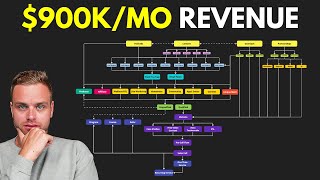
A complete B2B lead-generation system that scaled to $900k per month, covering paid ads and content at the top, email flows and lead magnets in the middle, and webinars and appointment setters at the bottom. The creator breaks down seven different offers to monetize different customer types and the sales process that ties it together.
Chapters
In this video I'm going to show you the exact strategy that I use to go from 0 to 900k per month at my last agency. Looks something like this. So let's get into it. This is how I went from 0 to 900k at my last company. It's actually what I would consider to be an improved strategy since I've learned a lot since then. It was a while ago and, and I've had a lot of time to reflect on what could have gone even better. So this video will be how you can apply this to your own business. I already made a video on what I did previously and you can check that out on my channel if you really want to. But this video, I want to be about you. So this is going to be able to apply to any B2B business, whether it's services, courses, coaching, SaaS. And believing otherwise is a self limiting belief. You can really just. You have to be creative when you do this. It's not that it doesn't work, it's just that you're not thinking about it the right way. I believe this video is going to last 100 to 150 minutes. Obviously I don't have the luxury of knowing that before I film it and there's going to be absolutely zero fluff. Unlike most other YouTube videos, I'll be using two tools for this video, this document, and when necessary, a Miro board. And it's very important that you implement everything in this video. You can't be missing even one or two things because all of them are interconnected and all of them work together. And even if you miss one or two things, it really reduces the effectiveness of the whole strategy. This document is going to be linked in the YouTube description if you want to download it. I also have 12 free trainings that I'll be linking in the description. This is a screenshot of a previous video, but they're going to be right here, so you can just look for that if you're interested. This video is meant to be better than any course or consulting that you'll ever find. It's going to be worth more than tens of tens of thousands of dollars worth of courses ever will. And you can get very far by watching this video and reading this entire document. I hope to convince you through this video that it's going to be very easy to make at least a million dollars a year if you have all of this. That might sound unbelievable or patronizing to those who haven't done it, but if you have this entire funnel Built out just the way I' it's almost unreasonable that you wouldn't make a million dollars a year or more and have a very strong profit margin as well. This video is free. It's on YouTube, accessible to absolutely anyone, anywhere in the world, including your competitors. If you don't watch it, you have absolutely no one to blame but yourself. You're already here. You're already listening to this. If you don't consume it in its entirety, it's completely on you. I know it's a long video. Do what you have to do. Bookmark it, listen in the background, break it up into multiple sessions. If you have as long as you watch the whole thing. If you don't, and you're not making as much money as you want to, there's no one else to blame but yourself. Maybe you can remember me saying this right now and run that through your head. You know, a week from now, a month from now, or sometime in the future, make sure to take notes. This video is going to be jam packed with nothing but substance and little to no fluff. I know it's going to be long, so you should have a notepad next to you, whether that's pen and paper, or using an app or. Or have something on your desktop and really write down some ideas on how to apply this to your own business. If you want to learn how to do this faster and cheaper than the years it would take to piece it together by yourselves and the tens of thousands of dollars in testing, we have a program that helps you do this in 4 months called 1000x leads. The link will be in the description. So let's get into it. Part one is going to be the overview. There's always three main parts to any B2B business. There is the marketing funnel, there is the offer, and there is the person. And these three things are forever intertwined and they all have to be good. Typically, one of these things will be the main bottleneck or the restraint. And that is what has to be worked on and removed if you want to keep growing. If the marketing funnel isn't generating enough leads, that's a typo there. It doesn't matter how good the offer is and how smart the person is, there's just not enough leads. The marketing funnel is the bottleneck. If the marketing funnel and the person are both brilliant, but the offer sucks, that's not great either. It's not likely to do very well if no one wants the offer. Doesn't matter how good the other things are. If you have the Absolute best marketing funnel and the best offer in the world, but an idiot is running it. It's still not going to do very well. And that just really comes down to these three things. There are four things that will kill your business, and these are connected to these three things, mostly the marketing funnel, but the other things as well. These four things are no one knows who you are. You don't get enough leads. All your clients come from referrals, and you don't really get any clients on your own. And then you don't have anything to offer. 99% of the leads you generate that are unqualified. These are always going to be the four things that will kill your business. Having one or more of these problems will completely inhibit your growth and keep you trapped where you are now. It's your responsibility as the founder to solve these business killers. It's on you. It's something that you personally have to do. And you cannot pass this off to someone else or an employee or outsource it. No one except you has the technical knowledge, the personal investment and the standards needed to do it. Leo and I, my partner and I can't do it for you. We do not have the technical knowledge to do all of this for an infinite number of niches and services. Your employees don't have the capability to do this. Neither do other agencies or service providers. It's all up to you. And if you decide to go for it, you'll get all the credit when it works. If you don't, you will incur all of the blame that just has. That's just part of being a leader, whether that's in business or otherwise. It's your responsibility and no one else's. And any excuses are probably made up. They're a sign that you're not taking responsibility. And that is the biggest killer of all. These business killers have nothing to do with specific revenue numbers. This is very important to understand in this entire process that these problems plague big businesses just as much as businesses that are just starting out. There are many large companies who have got that way just by providing a great service and growing solely through referrals. It happens all the time, and there's nothing truly wrong with it. The problem is that that only works for so long, and there's going to be a ceiling that every company faces that they're not going to be able to break through that ceiling unless they solve all of these four problems. There's actually a fifth business killer, and this is going to be worse than the other four put together. For most people. And that business killer is yourself. No ability to focus, lack of taking responsibility, crazy amounts of self limiting beliefs, poor work ethic, no planning excuses for absolutely everything. There's nothing worse than business killer number five. And after talking with thousands and thousands of businesses in my career, this is likely the one that affects most of them. This video will show you how to overcome business killers one to four. But it won't help you with number five. That's something that you have to do on your your own. This is one of my favorite memes and it really encapsulates business killer number five to a T. The funny thing about life and all of this kind of stuff is people at the opposite spectrums of the IQ scale or chart tend to come to the exact same conclusion, although usually for different reasons. They tend to come to the same conclusion where people in the middle are kind of the ones who don't come to the right conclusion. A lot of the time the dumbest people watching this video and the smartest people watch this video will say this is a lot of work. But I'll just get started, build this out one step at a time and in a few months and maybe a year, I'll have this in my business. Whereas the people in the middle make all sorts of excuses. They are the problem. Who they are. The people who suffer from business killer number five the most, they don't have time. They're just so busy, they would need to hire so many employees. It's just not the right time. They got to do other stuff first. They already know how to do this. Despite being in business for years and years and having virtually none of it. This is a perfect picture to illustrate those who suffer from business killer number five. And if that's you, that's the purpose of this is to make fun of you a little bit. Borderline mock you a little bit, to kind of jolt you into the right direction. I make you aware of of business killer number five being your main problem. Behavior change is so necessary to solve Business killer number five. It can be fixed. And that's the good news. The bad news is that's entirely up to you and to you alone. I can't help you with it. Someone you hire can't help you with it. No one can help you but you. You have to make the decision to change on your own. And this is necessary because going back to before where we said these are the three parts of your business. Your marketing funnel, your offer and you, it's so important because it doesn't Matter if both of your funnel and your service are 10 out of 10. If you're a 2 out of 10 in terms of behavior, your entire business will cap out at a 2 out of 10. You're only as strong as your weakest link. It's a very great analogy here of the ladder analogy. It doesn't matter if you are have every rung in the ladder for your offer, your funnel, they're both 10 out of 10. If you are a 2 out of 10 personally in terms of your focus, your work ethic and everything like that, your entire business is going to cap out at a 2 out of 10. The flip side of this is let's say this was you and you started to develop a great work ethic and you got rid of the excuses and the self limiting beliefs and everything like that. You quickly shoot up to a 6, a 7 and 8 or even a 9 out of 10 and your business would 5 to 10x in a year. If you've ever seen a business really grow at 1000% or even more a year, this is usually the scenario. They had every piece in place, just there was one bottleneck or constraint and they solved that constraint and now they're just going crazy. I took this part from Alex Hormozi because although I've incorporated the same ideas for a long time, he just explained it much more beautifully and simply than I ever could. And that's the concept of leverage. Leverage is the difference between what you put in and what you get out. And this is what allows some people and some businesses to go so much further and faster than you while seemingly putting in less effort. The four main types of leverage we can have in our business. Media leverage, capital leverage, labor leverage, and code leverage. And the more leverage you have, the bigger you can grow your business. So that is good theory, but what does this look like when we actually add it to a business? I've had some examples here. So media leverage. I'm making this YouTube video that you're watching right now. I only have to make it once, but a thousand people, 2,000, 10,000, maybe even more people will see it. I only have to make it once. I don't have to hop on a zoom call with all 1,000 people, if that's how many people view this and basically recite the same thing I'm doing now, each individually. That's a form of leverage. I make it once and thousands of people see it. And that's a form of media leverage. Capital leverage in the context of a B2B service business usually refers to your ad funnel. If you have a profitable ad funnel that you put $1 in and you can get $2 out or even more, that's an example of capital leverage. You're getting out way more than you're putting in in terms of labor. If you can use overseas employees to do the same thing or get the same result as hiring someone in the United States, if that's where you live, and doing so for a fraction of the cost, that's an example of labor leverage. You're getting the same result while putting in a lot less, so you're getting in more in return than you put in. If you would have to pay someone $50 an hour in the United States to do something and you could pay someone overseas 10, that's an example of labor leverage. Another example of labor leverage is if you're very good at training people. For example, you can hire someone for 60k, train them up, and they're essentially doing 240k worth of value, of course, of a year. That's an example of labor leverage where you're getting a lot more out than you're putting in. And another one is partnerships. If you're partnering with 100 different businesses, for example, which we'll go into later, you can essentially, you're one person, you're one business, but you're benefiting from hundreds of other businesses worth of labor. That's another form of labor leverage. And then the last one is code. Let's say you wanted to send 10,000 cold emails per day. That would probably take 10, 20, maybe even more employees doing it manually. But you can scrape the leads, put it into cold email software, and one person could do that. That's an example of code leverage where you're getting a lot more out than you put in. One person can do 20 or even more employees worth of work just by using code and software. It's very important because we've all heard this quote, give me a lever long enough and a fulcrum on which to place it, and I shall move the world. Made by Archimedes, who is a famous Greek philosopher. Your marketing funnel is going to be the fulcrum. Your leverage is obviously going to be the lever, and. And you really can go bigger and faster with less effort than you possibly could have imagined by incorporating this kind of stuff into your business. Leverage is extremely important because the top 0.01% of businesses incorporate tons and tons and tons of different leverage into their business. Not only will they have all the four types, but they'll have multiple different ways or types of implementing each type. The difference between the top 99.99% and the top 99.9% of businesses. This is a typo. Is far greater than the distance between the top 99.9% and the bottom 1%. It's a big difference. And this is very important to understand. And really, you know, if you had a top 99.9% business that's top one in the top one business in a thousand, top 99.99% is one in 10,000 for context. And the one in 10,000 business is exponentially more, much more big than the top one in a thousand business is to the bottom percentage of businesses. Very important. So this is the funnel that I used and that I'm going to teach inside this video. For the rest of the video, this will be what we're focusing on. So this funnel is specifically designed to solve all of these business killers. At the top we have our traffic. Top of funnel, we have paid ads, content, outreach and partnerships. In the middle of funnel, we capture leads and nurture them with our lead magnets, our thank you page and our email flows. And the bottom of funnel, we convert them through our conversion mechanism. And I'll go through each of these for the rest of the video. This funnel absolutely destroys each and every single one of these business killers. It helps with the problem that no one knows who you are by literally driving tons of traffic with four different ways, people are going to know who you are after you implement what you learned in this video. Guaranteed. It helps with the not enough leads problem because it has a bunch of different lead magnets to capture leads, email flows to nurture them, and and then a bunch of conversion mechanisms to help you filter out who is qualified and who's not. If you solve problems number one and two, by default, you're kind of solving problem number three. If you get a But if a lot of people know who you are and you're getting a bunch of leads, you're no longer really only getting clients via referrals. Solving one and two kind of solves number three as a byproduct. And this also helps the I don't have anything to offer 99% of leads who aren't qualified problem. By developing seven different offers that address different levels of the market, you'll always have to have something to offer someone. And this funnel ensures that it's not a coincidence that these, this funnel solves these problems. It's specifically designed to do so because why not, right? The Thing I want you to understand because it can look like this is a lot of different stuff and a lot of things to learn. Learn. Right. But the thing that I want you to understand right now is it's not really as much or it's not so much how good each part is. It's how it all works together as a system. You know, you don't really need to have each and every one of these things in the top 1% or the top 5 or the top 10% for it to be effective. Being in the top 25%, even of each and every one of these components, so not even anywhere near the peak or the apex is going to be ten to a hundred times more effective than being in the top 1% at just three or four of these and having the rest missing. You know, that would be nice if every single piece of this was in the top 1%. I'm not denying that. But I want to, you know, get it through your head that it's not strictly necessary for that to be the case to have success. I like to explain this with the harmony effect. So individually, these parts might not be very good or might not be the very best, but it's similar to a bad singer. I'm a terrible singer, unfortunately. But if you put me in a group with a bunch of other bad singers and we start to sing, our voices start to form a harmony, and if you add more and more and more bad singers, eventually it starts to sound pretty good. You know, obviously it would be better if we were all good singers. I'm not trying to say otherwise. I'm just trying to say that you do not have to be an expert or the very best at each part of the funnel to have a great result with it. This funnel is going to really put you on the right side of what I like to call the infinite cycle of lead generation. So this is, in my view, could be one of the most important graphics or diagrams that you really ever see. And I'm going to explain it here because this either works for or against you, and you definitely don't want it to work against you. And if you, after I kind of explain it, you'll probably know which one is which. So when you generate more leads by default, you become less needy. When you're less needy, it's easier to sell to people. It's easier to sell to people. You're going to get more clients, and you can turn away those people, people that you know are going to be nightmare clients. When you get more clients, you're going to get more referrals, which are more leads. When you get more leads like this over and over, you invert the dynamic of supply and demand. Now there's more demand for your supply, so you can raise your prices. Raising prices leads to more margin. More margin allows you to make better hires. Better hires allow you to spend less time working on the business or in the business in terms of fulfillment and more time on the business. You can reinvest both money and time in growth, and that will lead to more leads. And the cycle just goes over and over again. And that's why I call it the infinite cycle. The thing that is not so good is the opposite of this is also true. If you have less needs, you become more needy. More needy means it's harder to sell. You might have to take on those nightmare clients because you have no choice. You're going to get less clients in general, which means less referrals, less leads. Puts the law of supply and demand against you. Now there's more supply for less demand. You might have to lower your prices, which would mean less margin, which means you'll have to settle for worse hires. And you'll have to spend more time babysitting, checking, correcting mistakes. And you'll have less time and money to reinvest in growth, which will mean less leads. So as you can see, like, this is really how it works and is potentially the most important graphic to understand in all of B2B marketing and lead generation. It's no. There's no neutral here. It's either in your favor or it's against you. And you really don't want to have it working against you, as that just leads to a shit business and a shit quality of life. This is what I would consider. And it's not both of these. It's usually one or the other. This is the average marketing funnel. They might post content on Twitter and try to sell people their recurring service, or they might do cold email to sell their recurring service. In reality, a lot of people's true funnel is just this. There's no marketing whatsoever. They just have their service and they kind of wait for someone to find them or for someone to refer someone to them, and that's it. And this is basically the equivalent of most people's marketing plan. This is the marketing plan where you're just waiting for referrals to kind of come and, you know, magically hire you and grow your business that way. I really want. If this describes you, I really want you to try this exercise, because I do this exercise quite a bit whenever I can tell I'm on the wrong path. If your entire marketing strategy, business and livelihood rely on waiting until someone else gives referrals, I really want you to try this. Look in the eyes of Teddy Roosevelt here and try to explain to Teddy, a very tough, a very, you know, hard man, a former president, that the well being of you, your family, your kids, all of your hopes and dreams rely solely on someone else stopping in the middle of their day thinking of you, opening their email, introducing to someone to you and that person being interested, booking a call and agreeing to pay from you. And really think, what would Teddy think of that? And this is kind of like the meme earlier of the IQ chart, but this is really like, I'm dead serious about this, that you should try this. If you are the type of person who just waits for referrals and that's your entire marketing plan, your entire life, as well as out of your family is relying on someone else. And to me there's nothing wrong with referrals. It's a great sign, it's a great indicator that you have a great offer and service. But that is a prime example of not taking responsibility for your own destiny, in my opinion. So it's a very great exercise to do. Compare these two funnels, you know, with the funnel that I'm showing you in this video. It's not hard to see which one is going to be more better performing. And that's the reason I'm doing this video, to show you what is actually possible. I did this exact strategy myself, but this is actually a slightly better version of what I did because I didn't have all of these parts. But let's get into it. You'll see in the bottom right here, the full funnel and they're gonna see these three lists. And these lists are very important because there's gonna always be a certain type of person who sells to, you know, the high level, the Enterprise, the Fortune 500 companies who say this looks good but you know, is a high powered executive, is a CEO really going to go through something like this? In my view that is, you know, cope. That is a self limiting belief. I have gotten clients for my consulting program that are doing 100 mil, 200 mil and one that's doing 800 mil per year just off these YouTube videos that I make that you're watching on my channel right now. So it's a self limiting belief but hopefully I can break it by showing you what I'm going to show you. So this Funnel works for targeting small individual consumers all the way up to the enterprise level and Fortune 500 companies. And when you make a funnel like this, you're going to be automatically creating three different lists or segments. And these are imaginary or theoretical lists, not actual lists that you would have in a spreadsheet. But the three lists are the social proof list. This is made up of people who probably are never going to buy from you. Not a good fit in terms of price, you know, the actual need, whatever. But these still, these people serve a purpose to you. These are the people who are going to tag you on posts, bring you up in chats and communities, follow you, write reviews. They're going to lead to you getting increased media opportunities and visibility. Word of mouth, social proof, you know, for someone who is an ideal prospect, who needs what you do, you know, they're going to see these people and say, you know, this guy I know tagged Matt, which is me on my post. This guy I know recommended Matt. Everyone seems to like Matt for a reason, right? So it's very important that you understand that even though you're going to get a lot of people who are not going to be qualified for your service with this funnel, they still serve a purpose to you, they're still valuable, they will still make you more money. The second list is your potential client list. There's really nothing to say this. These are the people who are currently buying your services now and will be buying your services with this funnel. But it becomes a lot easier to sell to them if they've been doing things like reading your newsletter and watching your webinars and following you and watching your videos and reading your posts and seeing your ads and that kind of stuff. And the final list is your, what we call the dream client list internally. And this is, you know, those high level Fortune 500 companies, enterprise companies, you know, your dream clients, the big ones that if you worked with them, it would look really good to have their logo or their case study or their testimonial on your website. The dream client list is going to be built, you know, using internal champions, name recognition and past experience. Well, it's not very true that the high level executives and CEOs are not going to go through this funnel. If you have that self limiting belief, not to worry anyways, because these kind of sales really, you know, take place from the ground up. The boss is going to say we need someone to, we need to find someone to help us with lead generation and their employees who do know you, who have gone through your funnel who might have been a low level employee in a previous company and now have been hired away and promoted as an executive and have past experience with you are going to be the ones vouching for you internally. Matt has one of the best webinars I've ever seen. I love Matt's Lead Gen newsletter. Matt has a ton of reviews. I follow Matt. We should hire Matt. This is actually how it works at large companies. In an enterprise sales, you know, cycle or process. The boss tells someone, whether that's the C, the boss is the CEO, the owner, a director of marketing, whatever. The boss tells someone, you know their employees, that we need to find someone and you want to be the person your employees recommend to the boss. Let's go to part one, which is the top of the funnel. There are four ways to acquire customers and at top we have our paid ads, our content, our outreach, and our partnerships. What's important to realize is that all of these things are important to have because all of them make the others more effective. For example, if someone is much more likely to respond to your cold email, which is a form of outreach, if they follow you and consume your content. I've seen your paid ads for a while than they would be if they've never heard of you before. Another example is that if someone loves your YouTube channel and you start running YouTube ads and they see those ads, they're much more likely to click. We sell business killer number one by incorporating these four main traffic sources and if we do paid ads, outreach and partnerships and content, people will know who we are. And that's just a fact. So let's get into the each individual parts. We'll start with paid ads, which which is right up here and is circled. The reason that people fail so hard with paid ads in an agency or a service business or any form of lead gen sense is because they think about them completely improperly. The most common thing for people to do is to treat lead gen ads the same way they would treat e commerce ads. And it's especially true for businesses who serve e commerce brands. Lead gen ads and e commerce ads are so fundamentally different that the only thing they have in common is they're both paid ads and they're both called paid ads. Literally nothing else is similar in terms of the process, in terms of what you're trying to do, etc. In ecommerce ads, you run an ad and they buy or they don't. If they buy, that's kind of the end of it. When you run lead gen ads, the truth is when they sign up for the form and become a lead. That's just the start. The cash flow doesn't happen right away and we really need to recognize this. There are four main types of ad funnels that really matter and that are available to anyone. They're the webinar funnel, the newsletter funnel, the group funnel, and the paid product funnel. Each of these work for any business. And it's not necessarily that you have to choose one or the other. You probably would start with one, but you can have all four. Because just like the different types of client acquisition, each one will make the other ones more effective. If someone has. If someone is in your group and reads your newsletter and has seen your webinar and they start seeing ads for a paid product, much more likely to buy than if they saw none of those things. That's just one example. The webinar slash VSL funnel is the first one that I'm going to talk about. And this is a classic funnel that's been proven time and time again. The only thing that I don't personally like is how most people run it. So most people will run it right from a Facebook or a YouTube ad directly to the VSL or webinar sign up. And this is a big mistake in my opinion and does a few different things. Your cost per qualified call will be two to three times higher, which is a bad thing. Then if you run it directly to the VSL or webinar signup opposed to running it through lead magnets, you're going to get calls faster running it directly to the VSL and webinar. That's true, but two to three times higher prices if you're in it for the long run, that's not a good thing. The second thing that will happen is because they haven't gone through your lead magnets, your email flows and that kind of stuff, a lot of the time they don't even know what you're offering and what you do. And this leads to a lot of bad quality calls which ruin your sales team's life. And also because they haven't gone through your lead magnets and email flows, they're not going to be very nurtured and there's not going to be much rapport on the call. This will make it harder to sell and your close rate is going to be a lot worse. And for these three reasons, I prefer to play the longer game, which takes two to three times longer, and run all of my webinar and VSL ads through a lead magnet through the thank you page and email flows and then to the signup where most people will run their paid ads kind of all the way around and try to circumvent all of this and just get right to a sales call. So this is what it would look like in kind of the funnel path. You'd run a paid ad to a lead magnet. They would be redirected to a thank you page, added to the email flows. And the email flows and thank you page would promote the webinar or the VSL sign up. And the webinar and VSL would help you determine if they're qualified or unqualified. This is what it really would look like. So you'd have an ad, they go to a lead magnet and you collect their email address. Once they sign up for the form, they'd be redirected to your thank you page, which would promote the webinar signup. They can either sign up directly from there. They'll also have signup links in the email flows. Your appointment setter will also encourage them to sign up. You post content with a link to where they can sign up and you might have some retargeting ads one way or the other. The goal is to get them to sign up for the webinar, which will sell a productized or introductory offer, usually for $2,500 or less. Something that they could just check out with without having to go on a sales call. And once you do a great job with that, you would want to go and upsell them to your main recurring search service. The second kind of funnel that I really like is a newsletter funnel. So this funnel really involves running paid ads to a lead magnet that is relevant to the target audience and then converting them over time via a newsletter. This is especially good for super high ticket offers that have a long sales cycle. Like let's say you sell something that's 250k where they kind of got to think about it. It's a corporate environment. You know, a newsletter is a great way to stay in touch over the long term. And it also works for services that people only get when they need it, you know, in an emergency, like plumbers or like hiring lawyers. Also good for them too, because you don't really probably wouldn't have a group or a paid product for like a plumber. Right? I just, I don't know what you would possibly make it about. But if you have a newsletter that, you know, they see your face, they see your name every single week, and one day when they need plumbing services, you're going to be the first person they think of. This is the typical funnel path where you have a paid ad that goes to a lead magnet. The lead magnet also goes to the thank you page and adds to the email flow. And the newsletter over time will help you determine who's qualified and who's not. The newsletter funnel is kind of similar and the newsletter funnel is unique in a way because regardless of what type of funnel you're running, whether it's a webinar, a newsletter, a paid product or a group funnel, you're going to get their email address in all of those scenarios. So even if you're running any other funnel, they're kind of going to be added to your newsletter funnel. By default you'd have an ad that goes to an email only opt in with a co registration pop up. If you don't know what that is, Google it. I'm not going to go over that here. Your thank you page makes them aware of the offer, so it's very important that they know what you're selling. You'd Send a newsletter 3 to 5 times per week that tries to get them on a call or a webinar or something else like that. You try to sell them your productized or introductory offer, just like the previous example, and once you do a good job, you upsell them to recurring. The group funnel is my personal preference and it involves running ads to a lead magnet and then trying to get them to join a group of yours where you can start to develop a relationship and talk to them. This in my view, is either the absolute best type of paid ad funnel by a large margin or the worst by a large margin. And the difference between the two is how much effort you put into it. If you don't put in a lot of effort. This really sucks and is worse than other paid ad funnels, but with a lot of effort, it's by far the best. It's the one that's the least automated. You know, your paid product, they buy it or they don't. Your webinar, it's pre recorded. Your newsletter, you write it. You know, take an hour per day and write it. But with the group funnel you gotta really be in there and talking to people and managing it. So that's why that's where the effort is required. Here's an example funnel path for this where you run paid ads to a lead magnet. They hit your thank you page, added to your email flows and added, you know, encouraged to join your community where you can determine if they're Qualified or unqualified. So this is typically what it would look like. Your ad goes to an email and phone number. Your thank you page promotes the group, whether it's on Facebook or whatever. Your email flow and you send them a text message to also join the group. And once they join the group, you have content every day, appointment setters, email flows, and retargeting ads to try to get them to a sales call. The last type of paid ad funnel that really matters is the paid product funnel. And if you are a complete beginner at paid ads, I usually recommend this one because it's by far the least technical and the least nuanced and is more similar to selling an E commerce product than the rest. So it's easy to understand for, you know, people who are first starting. The key here in my view is to make a product that helps make solving a problem faster. So what I did at my previous one is I had a landing page in zero agency if they want to solve the problem of creating a landing page. My paid product was landing page templates. If you can make, at a very minimum, break even on your ad spend. So for every $100 you spend on ads, you get $100 or more in sales. Essentially what you're doing is acquiring leads for free and then you can upsell a percentage of them into your main service. So it's completely risk free. If you do it right, the cash flow is similar to E commerce, where it's instantaneous. The thing about a paid ad funnel that's a bit different than the other ones is that you have a couple of different paths that you can take here. So you can either go through lead magnets and the thank you page and the email flows to go to your products, or you can go directly to the products with your paid ads and both will end up in the same place. But there's two different paths that you, you can run unlike the other ones. So here are, you know, kind of what you need to do when you have a paid product funnel. You want your product to be from 10 to $100. Anything less is just you're going to get a lot of people who are poor. And anything more kind of removes the impulse buy factor of, you know, $100 or less. You want to have an upsell there to ensure that you get $100 AOV, which stands for average order value value. The higher your aov, the more wiggle room or margin of error you can get. The more you can spend on your ads to acquire a customer once they Purchase your thank you page should make them aware of the offer. And then with a combination of, you know, directly signing up, you know, having an email flow, you know, your appointment setters, your content, your retargeting ads, you can get them to a webinar or a sales call to sell them your productized or intro offer. And the same way with the other ones, you upsell them to your recurring after you do a great job. We have content circled here. It's our Instagrams, our Twitter, our YouTube, our TikTok, our LinkedIn, and any other site that we use. So content really is the difference maker because it fulfills three different purposes. You can use content at the top of funnel to get people to learn about you for the first time. You can also use content to convert people who already know about you in the middle and bottom of the funnel. And then you can also use content to help you retain current clients. Because the more content they consume, the more they become bought in, the less likely they are to churn, argue with you, etc. The difference between those who make content about their niche and those who don't is vast and it literally makes everything more effective. From your ads to your cold emails, to your sales calls, to absolutely everything. In my view, content is a must have for anyone who's serious about making a lot of money and generating a lot of leads. So this is kind of what it looks like. You know, when you make content versus you don't. The people who make content are going to make all of the money and everybody else is going to be fighting for scraps. You don't have to make original content for every single platform, but you should be posting on every single platform, in my opinion. So for example, your Twitter posts can be repurposed and cross posted to Facebook, Instagram, LinkedIn. Just by turning this on in the settings of a lot of Twitter schedulers, it will turn it into a carousel for Instagram or you know, just cross post it. You can then take your highest performing tweets, the ones that get the most likes or engagement or whatever metric, and you can use those as ideas for short form and long form videos. If people are liking the topic of the tweet, chances are they're going to like a video of the same topic. You then cross post your TikToks to YouTube shorts and Instagram and Facebook Reels, etc. This can all be done in under one hour per day and it's one of the highest leverage things you can do because remember that content is media leverage. So the best way to come up with like, what do I post? That's always going to be one of the biggest questions and by far the best and the easiest content strategy is to divide your niche into 6 to 12 subcategories. So for example, I used to have a landing page agency and my subcategories were site speed, headlines, hero images above the fold. Design offers copywriting, AB testing, and analytics. Those are examples of subcategories that have to do with landing pages. And once you have these categories, think of 20/4 FAQs or objections for each one and make content answering these objections in different ways. So what are the ways you can improve site speed? How does site speed impact my conversion rate? That kind of stuff. And you just keep answering these questions over and over. If you have 20 FAQs for eight different categories, like in this slide, that's 160 possible topics. Once you, you know, post all 160 ideas, just start over. Doing this is going to get you the right type of audience and it's also going to make sure you never have to think of topics ever again. The best way to come up with these FAQs is to, number one, use your own brain. Like that would be nice. You probably know what a lot of these FAQs and objections are. Number two, you can just ask chat GBT for 50 or 100 and then kind of narrow it down to 10 to or 20 to 40 and using quora.com where people are actually asking, or Reddit, you know, also a good thing to do. Let's go to the outreach now because it's one of the, it's the third, you know, top of funnel acquisition method. So when I think of outreach, I think of cold email on this thing. There's cold email, cold DMs and prospecting, but the most efficient is going to be cold email. Cold email dominates the outreach department in my view because it's by far the most effective in terms of the effectiveness to volume ratio. For example, cold calls, which aren't included in here, they're going to beat cold emails in almost every case in terms of, you know, percentages. But they're very time and resource intensive. So if you send a thousand emails, you might get, you know, one in every, you know, you might get two calls out of that. One in every 500 people might go to a call, versus if you cold call a thousand people, you might get 20 calls. But the efficiency is just so much worse. A single person can send, you know, 50,000 cold emails per day. If they really wanted to to and just sit there and reply to anyone who's interested. And a single person can make 250 total cold calls at best. Cold email is a volume game and if it's not working for you, this is an example of you suck at it. You just don't have the skills or the understanding. Nothing wrong with that. But a lot of people won't admit that to themselves. They'll think, oh, it must be cold email. That's the problem. No one likes it, no one wants to reply to spammers, but if it doesn't work for you, it's just you're not doing it properly and you're probably not sending anywhere close to enough cold emails. There are four things that make up success with cold email and three of these things have to do with the actual cold email. And there's one bonus thing, if you want to call it that, that has nothing to do with the actual email, but it's just as important and unfortunately, success with cold email requires all four of these things. And if you don't have all four, the results are to be terrible. That's just how it is. It's isn't something where you can have, you know, one of the four, two of the four, even three of the four things and expect to succeed. It's all or nothing. So let's get into the first one. The first thing is a list that's clean and relevant, with relevant meaning it's full of people in your target audience. If it's the people on your cold emailing are not in your target audience, it's kind of, you know, non starter, but that should be kind of obvious. But a lot of people just email the wrong list. And to build a list properly you really have to use your brain. I'm not going to go over like tons of different examples here because it's going to be so dependent on who your target audience is. But you can use your brain with a software like Apollo I.O. where you can think of the proper criteria for your audience, set up the filters and then export them. So one example is if I was targeting e commerce brands doing one to five million dollars a year, I would need to use my brain a little bit for this. I might go into Apollo and set the location to United States, the technologies used to Shopify and Shopify plus the job titles to founders, CEO, marketing related titles and the employee count to three to 10. Because based on my brain, my background in E commerce, I know that if someone uses a 3PL, which stands for like it's a shipping center, a third party logistics center and they don't manufacture their own product. You can build a pretty big e commerce brand which is three to 10 employees. Maybe you know a founder or two marketing person, some customer support people, you know, operations, three to 10 people, you can really get to $5 million a year. So this is an example of knowing your using your brain and knowing your niche. That's why you really need to learn how to do this yourself as opposed to just kind of get someone to do it for you. So the first thing is who is the correct audience? The technology, shopify titles, marketing related, founder, related location, United states employee count 3 to 10. You'd want to export this list if 80% look good. So you're just going to get a massive, massive list. If you go through like 20 of them and 80% look good, that's probably something you want to export. If not, 80% look good or 80% don't look good. Probably want to mess with the filters a bit. Until 80% or more look good, it's never going to be 100%. So you know, don't feel bad. And then you want to clean the list with million verifiers. So you get rid of people who have invalid emails whose emails are going to bounce because that's really bad for your email delivery. The next thing is the offer. So your offer is what you are offering in the cold email to the person who is on the receiving end. And that will probably sound like the dumbest statement, but it really isn't once you take a look at it. Where most people go wrong is that they don't just have a terrible offer, they have no offer at all. The entire cold email is written around get on a call with me so I can sell you something. It's not really an offer, right? This is by far the biggest cold email sin and the reason for most failures. Why would someone want to get on a call with you? They didn't ask to be emailed, they have no idea who you are, they might not even need that. What possible reason would they want to talk to you? Like I'm being dead serious here when I'm asking these. There's no reason that they want to talk to you, so you can't really do it with this. They don't trust you, they don't know you, they didn't ask for it, etc. So you need to do three things. Lead with value, as in, you know, try to give them something, not get on a call with me. Differentiate yourself by doing that, by giving something and then make it easy for them to say yes. So typically the two main ways to be successful with cold email are, you know, number one is a loom based video strategy and number two is, you know, you're giving them some sort of free work, hopefully that is done with AI so you can do this at a tremendous higher volume. This type of email or both of these types of cold emails are going to perform a lot better than can you jump on a call with me. A loom is great because, you know, you could say I made a loom that goes over the three most important things e commerce brands in the 1 to 5 million arrange need to do to go to 10 to 20 million. May I send the loom over? Like it's a very much softer, much easier call to action. You send it over, they see your face, they hear your voice, and hopefully your loom's good and it helps them and then they're much more likely to explore the next step with you. The third thing is the script. So this is the final thing that has to do with the actual email. And if you have a super targeted list and an amazing offer, the script actually becomes the least important part in my opinion. And it's more about not messing it up the than it is being super good at writing the script. You want to follow these rules. Write how you actually talk in real life. A lot of people will not do this. They'll just use words like comprehensive and bespoke and just some random marketing jargon in their cold emails. Stupid. Write as if you're talking to a single person, not your group of 10,000. Cold email. This is much more similar to marketing or to sales than it is to marketing. It's much more similar to, you know, a sales conversation than an ad campaign, for example, like just be normal, you know, just normal. Ask yourself if you sound retarded in the cold email before sending it. Sounding retarded usually refers to, you know, using words like bespoke and comprehensive and just, you know, not sounding normal. Keep it to 75 words or less. Not necessarily a hard rule, but a good rule of thumb. You don't need to write paragraphs that people are going to read. Make the loom your main CTA and you want to embed the loom in the cold email with a thumbnail showing your face. Because if they see your face as opposed to just like a link that says loom, much more likely to view it and they know what you look like, they remember Maybe they see you on YouTube or something or on social media and remember what you look like and follow you. It all works together. So something like this. This is not really a full script but you know, I've made a loom about the three most important things email marketing related. The most important email marketing related things that can help brands in the 1 to 3 million dollar per year revenue range get to 10 million. These three things are AB testing the welcome flow twice per month. Writing emails so good that people open based on the sender, not the subject line focusing on the first sentence because that's what most people will read. And do you mind if I send this over in a loom? I made a loom about this, you know, so that's like something you would do as opposed to writing a huge paragraph, you know, saying please get on a call with me. This is definitely not a complete script. I made it in about five seconds before I recorded this. So don't copy and paste this one, it's not complete. And the last thing, the bonus thing, the thing that I said before has really nothing to do with the cold email is what I call non outreach related gains. So this is everything that happens not in the actual email. For example, this is the video testimonials on your site because a lot of people will receive your cold email, not reply but will go to your site and take a look. Having content on your social media profiles, having good PR or reviews in Google. All of your domain should redirect to the main site because if you have like if your main site is mine, 1000x leads and your cold email. One of your cold email domains is try1000xleads.com and you and they go to try a thousandxleads.com you know, and it's an error that's not going to look very good, is it? It needs to redirect to the main site, having a VSL on the site, having case studies, having free videos. All of these things are going to have a positive effect in your cold emails even if they have nothing to do with the cold emails themselves. So something like this, if you searched a thousand x leads after I cold emailed you, what shows up? You know, darn trustpilot's lagging. But my LinkedIn, my YouTube, my Twitter, what shows up and that's very important. The last part of outreach is manual prospecting and nothing will keep your pipeline full quite like 30 minutes to 60 minutes of manual prospecting per day. This is where you actually manually go through LinkedIn and Twitter or whatever and start reaching out to people and trying to form genuine friendships. So even if these people don't buy, they might know people who will. And networking prospecting like this will add a level of consistency and stability to your business that not a lot of other methods can provide. Nothing on earth, in my view, is going to be more boring or tedious than manual prospecting. But in the same breath, nothing is going to help your business more. It's simply the price that you're going to pay for success. So the next part is partnerships. It's one of our top of funnel thing. We have white label, referral, media and joint venture. So referral and white label are essentially the same thing. They're one of the most powerful things in your funnel to get these kind of partnerships. And they're the same thing in the sense that the exact same avatar or partner or person is gonna, you know, you're gonna be reaching out to the exact same person with this. And whether it's referral or white label is simply a matter of how they most prefer to work with you. If they want to work with you in a referral sense, they'll just introduce you to their clients. Others will want to hire you for your services in a white label sense and then offer it directly to their clients. It just depends because it's so powerful. Because if you partner with 50 or 100 of these people over a year or two and you solve a problem for their business, essentially you're going to be taking advantage of a lot of labor leverage. You're going to have tons of different partners feeding you clients, with you really not having to do anything. Another form of partnership is a media partnership. Usually this will be like YouTube video interviews, podcast interviews, guest posts on websites, guest posts in newsletters, speaking at events, things similar to this. These are so powerful because you're essentially leveraging your partner's audience for your own gain. Think about it. They've spent years and tens and thousands, maybe more dollars building their audience, developing trust, giving goodwill, and essentially that's transferred to you and your business in the blink of an eye. When you have a media partnership like this one, the last one is a joint venture. And if you can partner with someone to create an offer that is better than what either of you could create on your own, that's an example of a joint venture. And these can take many, many forms. Far too many to list out here in this video. But these are so powerful because you're essentially combining your marketing and client pools and experience to make one Bigger, you know, offer that will grow much larger than either of you in the partner sense would have been able to grow on your own. You need to have absolutely all four of these things. They all work together, and they're not separate things. They're all just your business marketing funnel. It's not paid ads, it's not content, it's not outreach, it's not partnerships. It's just your business. It's all the same thing. They all work together to get you leads. And this is a very big paradigm shift that will help you grow your business bigger than ever before. Each of these things provide leverage in their own way, and that's why it's so important, and that's why we could build such a great business. Content obviously builds media leverage. Content and media, in my view, are kind of like interchangeable terms. You make it once and an unlimited number of people can potentially see it. Paid ads are a form of capital leverage. If you can build an ad funnel that you put in $1 in ad spend and you get two or more dollars out in revenue, that's unlimited leverage for your business in terms of capital and money. Outreach is usually a form of code and technology leverage. Especially with the cold email, we can scrape tens of thousands of leads in an hour, import them to our software, click start, and we'll reach tens of thousands of people per day if we wanted to, all automatically. Partnerships are a form of labor leverage. You're benefiting from the time and resources of other businesses to help you grow your own. Like I referenced, if you have 100 partners, you're essentially benefiting from the labor of 101 people and businesses. And you're just one person. You're benefiting from your business, which is one plus 100 others. You're getting out a lot more than you put in for all of these different strategies because they all incorporate leverage to a huge degree. The next part is the middle of the funnel leads. So we've gone over essentially what is the top of funnel traffic, but how do we go to the middle of funnel leads? So the middle of funnel. I said it in the beginning of the video, but if we don't remember, it's the lead magnets, the thank you page, and the email flows. And we're going to start with the lead magnets here. Clients have problems, people have problems, you solve problems. If people didn't have problems and you didn't solve problems, you wouldn't be in business, there wouldn't be a capitalist society, and there would really be no reason to, for anyone to exchange money. So here's a example here. Let's say business owner X is trying to start a YouTube channel. Lots of problems associated with this. How do I set up my camera and lights? How do I make good titles? How do I make good thumbnails? And all the way down the line, YouTube is very difficult. That's what they're thinking, because all of these problems exist in their mind. You know how to solve these problems. In the case of this hypothetical YouTube marketing agency, if you didn't know how to solve these problems, people don't wouldn't buy from you. You do know how, and this is what makes people buy from you. They're not an expert. They don't know what to do. And most of the time they don't have the time or desire to do it anyways. So your lead magnets are basically an extension of your brain. Put in a document or another format that you can send to people to communicate your knowledge and expertise to them. It's important that you put your heart and soul, every piece of knowledge that you have, you give away for free in these lead magnets. Because people can't read your mind. A lot of people will make their lead magnets very basic. And like I said, people can't read your mind. If your lead magnets are basic, people will think all you have is basic knowledge and they won't hire you. You are the expert. All of these problems that exist, you know how to solve. This is why you need to make tons of different lead magnets. You want to make a lead magnet to solve every single one of these problems. These are typically guides, checklists, masterclass, swipe files, templates that other people want. You build these lead magnets to solve every problem or objection that has to do with your service. You need to make all of these lead magnets because there's all of these different problems and steps and objections. You need to come into it with the mindset that you're going to solve all of these problems so thoroughly and so completely for free that people really, really have no choice but to trust you. If they come to you and you have an answer for absolutely all of their worries and concerns, it just becomes a natural next step for them to help hire you. That's why you need so many. This is how we solve business killer number two from earlier. If we have a dozen different ways to generate and capture leads, that's going to solve this problem. On top of that, like I said earlier, if we solved problems one and two, we will Kind of solve business killer number three, which is all of your clients come from referrals as a byproduct. If people know who we are and we're generating leads, we're obviously going to be begin to get our own clients and not have to rely on referrals. What we need to do, like mission critical, like really is we need to make a lead magnet that solves every single one of these problems. In this case, a lead magnet that solves their camera and their title and their thumbnail and all of these other problems. So everything is so utterly and completely solved, it just becomes natural for them to think, I might as well just have hire this guy or this girl. Like that is the result we're trying to get. At the end of the day, if you have more lead magnets, there's more chances to generate leads. Not everybody is going to struggle with every single part or every single one of these problems. Some people will probably know how to do one or two or three things. That's why we need more lead magnets. If we don't have all of these lead magnets, two things will happen and both of them are bad. You might solve one of these problems, but the rest are going to exist. If we stopped at one lead magnet, we might have solved their camera and lighting problem in this example. But all of these other problems still exist, and those are all reasons for them not to go ahead and purchase from you. Even one of these problems unsolved can derail an entire sale. And anybody who has been in sales or business knows that. The, the second thing is you will miss a percentage of the market that simply doesn't struggle with that problem. In this example, if we only made the lead magnet that solved their camera and lighting problem a certain percentage of the market, 5, 10, 15, 20, 25%, who knows, simply won't struggle with that problem. So that lead magnet will not be desirable to them. That's why it's important where more lead magnets have more chances to generate lead leads. Because different things will appeal to different people in the same target audience. If we only, you know, only made this lead magnet, and this is 20% of people either know how to set up their camera and lights, or they don't even have any to set up, or they don't believe in it. Like that's 20% of the market we're missing. And when we only have one of these lead magnets, people aren't necessarily grateful to us for solving their problem. They're thinking about all these other problems that aren't solved and they're going to look for someone else to help them. And that someone else is not going to be us. To brainstorm the lead magnets is very similar, or not really even similar, but identical to how you would brainstorm your content strategy from earlier. You'd find your niche, think of six to nine, maybe even more subcategories, and make a complete lead magnet that you should kind of view as a course for each. So like I said earlier, the site speed offers social proof, copywriting, headlines, hero images, just normal images, types of landing pages, winning a B test to run how to a B test analytics. You know, you could go on and on. The most important part about your lead magnet is the quality. Because like I said earlier, if you have a basic lead magnet, people can't read your mind. They're gonna think that all you have is basic knowledge. And no one wants to hire someone with basic knowledge. So we want to follow the var formula. Number one value. That's the V. Even though your lead magnet is free, would you honestly pay $50 for it? That's an important question to ask yourself and probably some friends. Hopefully you have some honest ones. And if the answer is no, then it's not good enough. That's basically all there is to it. Number two is actionable. Is there an exact plan in each lead magnet that they can implement within 24 hours to get some progress, to get their first quick wins? This is in your favor because if they listen to your advice and get some quick wins, they're going to trust you a lot more and be more likely to buy from you and then readable. Imagine if we had this video that I'm going over so far and there was no headlines, there was no different slides, there was no images. It was just. Just one big block of text that I was scrolling down. Not readable. One of the most important parts of your lead magnet or any form of writing or documentation is making it readable. One image and one idea per slide. Your lead magnets are going to be distributed with opt in pages because the lead magnets are free and because they're going to be clicking on an ad or a CTA from your content, they should know more or less what they're getting into. It's not a crazy commitment. So less is more on these type of pages. You might just have something like this, not a full page where you know it takes an hour to read it. Less is usually more, but there's kind of some nuance here that you have to think about. You kind of think about your opt in pages coming from paid ads versus opt in pages from content a little differently due to the nature of, you know, how they work. When you're running paid ads, for example, you are risking actual money to get leads and as such you want it to be as low friction as possible. So in your form, when you're running from paid ads, in my view, you're only going to want to ask for the email address or in some very specific cases, the email name and phone number. But never more than that. For every field you add, like this one has email, every field you add will increase your cost per lead by 50% or more. And that's something very important to keep in mind. That's a bad thing. We're going to be having to pay 50% or more per field for the same person to sign up. Even if you only ask for their email address and there's a typo here, there's still plenty of opportunities to get more information from them later via your conversion mechanisms. So it's not a big, big deal. It's just a better idea to ask for only email and get leads for half the cost or less when running paid ads because of the money involved. So this is the same picture, but this is what you would have for a paid ad opt in page. It's a bit different with content because you have a couple of advantages. The first is it's going to be free or very low cost because you know making content is free unless you have like an editor or something to. So to some extent it doesn't really matter as much if they opt in because you're not losing tons of money on ads. And second, people from content will know and trust you a hundred times more than people coming from ads who probably never heard from you before, don't even know it's you most of the time. And as such you can ask for a lot more information and people will be much more willing to give it to you. So this gives you an opportunity to add form fields and get more complete and useful data. So remember the first one, we just asked their name, but if it's coming from content, we might ask their name, their email, their phone number, their website, their monthly revenue, or kind of whatever we else we view as necessary. Now let's go to the thank you page and the email flows. Because this is still the middle of funnel, the lead magnets work with these two things to, you know, really push people down the funnel. Regardless of if you're doing paid ads or content when they fill out the form, whether it's this kind of form or this kind of form, they're going to be redirected to your thank you page, or they should be if you're doing this right. This page provides a great opportunity to promote one or more of your conversion mechanisms, which we're going to talk about later. But the conversion mechanisms are things like webinars, live workshops, groups, paid products, stuff like this. And these things are going to have a much higher perceived value, which is the important term, than individual lead magnets will. And because of this, we can ask for more information if they want to have access to them. So even if we only got their email address in our paid ads at the start, if they want to go to our webinar or our group or stuff, we can kind of compensate for that by asking them for their name, email, phone number, URL, if they want access to the rest. So this is the best of both worlds. So, like, this would be a group thank you page. This is the one that I actually use for my business. So my forms would be redirecting to this thank you page. And if they want to join the group, that's where they have to put in their name, their revenue, their phone number, their email, their URL, and their that kind of stuff. So you can think of it as, even though it kind of sucks that we don't get all of this information right away, we still have a chance to do that deeper into the funnel. So let's talk about the email flows now, because we've kind of talked about the lead magnet and the thank you page. And the final thing to do is the email flows. So I think of this in two separate things. You'll have two separate sets of strategies for these email flows. One takes place within the first 20 minutes and one is after that. So minute zero to 20 and then minute 21 to forever. So the first, the goal of the first one is to repeat the main thing you want the person to believe as many times as possible within the first 20 minutes of them signing up for your form, because your form will add them to the email flow. This is because they will never be as engaged and you'll never have their attention quite like you will within the first 20 minutes of them signing up the first time. And you want to hit them hard and frequently. Them forgetting who you are is a hundred times worse than them being annoyed and unsubscribing. Trust me, we want to make them impossible to forget who we are here. We want to take advantage in the first 20 minutes, especially something called the mirror exposure effect. So if you ever heard someone say, like, oh, someone has to see something seven times before they buy, that's kind of a lazy application of the mere exposure effect. The mere exposure effect is, you know, the more someone sees something, the more likely they are to believe it's true or to like it just because they see something. That's the basis of propaganda repetition. And we want to kind of spew a little bit of our own propaganda from for benevolent purposes, not for evil in the first 20 minutes to. Because that will make them a lot more likely to believe, you know, the things we want them to believe. And then our service or our offers are just, you know, positioned as a way to solve those, the things that we're trying to get them to believe just naturally. So this is what it would look like. You'd have your opt in. You'd have them opt in. You have 20 minutes of their full expansion. You need to really take advantage of the mere exposure effect. Repeat your main point six times. And when you do that, it becomes difficult for them to disagree or to challenge it. So you'd have your paid ads or your content to the opt in. They would see your messaging on the thank you page. Immediately after they opt in, they would see it in the lead magnet delivery email, which is delivered immediately. They would have seen it in the original ad, the original opt in page, as well as inside the lead magnet. If they open it, if you have their phone number, we can send it to them in a text and then we want to send them 5 minutes, 10 minutes and 20 minutes after they sign up. The what, the why and the how emails is what I call them. At least you know, what the problems are, why they need to solve it, how they need to solve it. And then at the end of the how email, you know, there you are with your service that's specifically designed to solve it. What a coincidence. So we want to keep repeating the main point six plus times within 20 minutes. We want to plan for extra in case they don't see some like, if they don't open, you know, the lead magnet email and they won't be able to see the lead magnet. If you don't collect their phone number, they're not going to be able to get an sms. So we want to kind of have a little redundancy here just in case they don't see it. And if these are good emails and good lead magnets and good stuff, they're not going to get annoyed or Unsubscribe, subscribed them. Getting annoyed is a function of you're sending them crap. So don't send them crap and it'll be just fine. After the 20 minutes are up, I go to what I call the ongoing email flows. Not exactly a brilliant or revolutionary name, but each of these emails should be divided into three parts. The first part is an actionable tip. The second is a link to your other content or videos and and third is to answer an FAQ or objection. And then we want to make sure our CTA links to one of our conversion mechanisms. This is a very easy and effective way to think of and create email flows as it's kind of a templatized approach that makes for fast creation but doesn't lose any effectiveness. So something like this where you know, here's Matt from 1000X Leads, this would be where the actionable tip goes. This is where the link would go, this is where the FAQ would go. And oh, if you want to solve these problems, here's our program, right? That's how I typically do it. Now we got to get into the bottom of the funnel conversion mechanisms here. So this is like right here we've talked about the top of funnel to drive traffic, we've talked about the middle of funnel to capture and nurture the leads. The main purpose of the conversion mechanisms is to sort out in an efficient way who's qualified and who's unqualified. So these offer three main purposes. Number one, they offer more value and push people further down the funnel. Get them to trust you more, like you more, that kind of stuff. They allow you to collect more information to enrich your data. Like in the situation where I said, you know, you only collect the email from the paid ad and then to join your group they have to do the rest. And the third is they help you determine who's qualified for your service and who isn't. And without these, it's impossible to do these three things at scale. There are a few main types of conversion mechanisms. We have our paid products, our webinar vsl, our live workshops, our newsletters, our group communities, our appointment setters, our content and our unique mechanisms. So numbers one to seven are what I would refer to as like standard conversion mechanisms. And almost every non standard type you know as a case of number eight will fall under the name unique mechanism. As the name suggests, that is unique to your particular business. If you have a way of converting people that aren't part of the standard 1 to 7, by all means go for it, like obviously. So that's why unique mechanisms is there at the bottom. So let's get into these one at a time. If they buy your paid product, it's a great conversion mechanism because if they've done so, a few things are guaranteed to be true. They have a credit card, you know, because they bought your product, they've indicated they're willing to pay money to solve the problem. And since your paid product is essentially should be a miniature version of your main service, they indicated that they might be a good fit for your main service. You know, I sold landing pages and landing page templates. If someone buys landing page templates, like it is possible and maybe even likely that they need landing pages for their business, right? Someone who spends even a dollar has indicated they're infinitely more qualified than someone who hasn't spent anything at all. And that's really the value of paid products. Webinar and VSLs are also great because they allow you to give more value than a normal lead magnet. And these are usually or almost always on video. If someone knows your name, they know what you look like, know what your voice sounds like. The amount of trust built is infinitely higher than if none of those things are true. In most lead magnets, these things won't be true, right? Unless you. Even if they download it, they're not likely to remember or even know your name in the first place. They won't know what you look like unless you include some pictures. And even then they probably won't remember because lead magnets are usually of a written nature, they're not going to know what your voice sounds like. So webinars and VSLs let you achieve all of these three things while providing more value, while determining who is qualified for your service and who is not. So the qualification takes place in two ways. So they're going to have to fill out a form with all of that information we said earlier to access this. And you can use this information to determine, you know, check their website, check their revenue to determine if they're qualified or not. And if your webinar or VSL resonates with them enough, they might book a call on their own. And that's like they're self qualifying. This is for me, you know, I'm going to book a call now. The three webinar formats that I consider to be the easiest to pull off, especially if you've never done it before, are, you know, top things to do to achieve why top 5 things you need to do to have a landing page that converts at 4% or the opposite or the inverse of this. You know Top five things to avoid if you want a landing page that converts at 5% or a case study format, you know how we helped X business achieve Y result. These formats are easy enough to understand and once you get more experience you can come up with your own unique formula or some advanced ones. Live workshops achieve all the the things that webinars and VSLs achieve, but in my view offer an even bigger opportunity. As they're live and people can interact with you, you can do Q and A chat with the viewers, take their feedback into consideration in real time and show off your skills. Newsletters are great because they offer an unobstructed path to your brain. They feel very intimate and personal in comparison to many other forms of conversion mechanism. Like I said earlier in this video, they're great for things that have a long sales cycle because you can keep in touch via newsletter for the long haul. When they decide they need your service, you'll be the first one they think of instead of going to Google or asking people for recommendations. They're a long term conversion strategy where the other conversion mechanisms really are not. They watch your webinar. It's kind of over at that point. If they join your group and they don't open it up anymore, it's over. They can only come to so many live workshops or watch so much content, whereas newsletters, you can send this to them very efficiently for years. Something that I referenced to earlier is that the caveat is people will kind of be on your newsletter by default. If they've signed up for any lead magnet or conversion mechanism, you're going to have their email address. You don't really need to specifically promote your newsletter as a conversion mechanism. It's going to be promoted and grow as a byproduct of all the others. So that one of the most important things about newsletters is similar to the important things about lead magnets. Is it valuable? Is it actionable? Is it readable? So like, this is an example of like let's just go over the format. You might have a summary at the top with a link to a conversion mechanism. Actionable tip. You know some links to your best content. Bonus points if it's your content that they can consume. A deep dive that answers, you know, an faq, you know how you can help them. A poll like see how many people liked it and if they have suggestions or comments and a referral program. The group funnel and the group conversion mechanism, like I said earlier, is my favorite. But they really have to be done properly and they're so good for a few reasons. They allow you to interact directly with your fans, leads, prospects. They're a good home base for you to promote your other conversion mechanisms from. So it's very possible if someone's in your group, you can promote every single one of your other ones in your group, but it's not really possible to do the reverse of this. So if someone's in your group, you can promote your webinar, your paid products or your workshops or your content in your group. But if someone's watching your webinar, you can't really do the opposite. You can't say you don't, you wouldn't say on the webinar, now join my group and my live workshop and watch my videos and read my newsletter. Like that just wouldn't happen. So that's one advantage a group has over the other ones. And groups act as a form of social proof in the way that other lead magnets and conversion mechanisms don't. Because people can see how many people in your are in your group and how you interact with them. This is very helpful in the sales process. So this is my group that I have one 3k people in it posts every day, that kind of stuff. Appointment setters are a vital part and a vital conversion mechanism. These are employees or contractors. Maybe you're doing it manually. If you're first starting, who will manually reach out to all of your leads through email and SMS and phone, try to qualify them. If they're qualified, they try to get them to schedule a call. You can get three to ten times as many calls from the same amount of leads with an appointment setter as you can without one. It's simply that powerful. So I just like my email flows. I split my appointment setting flow into two separate things. The first 72 hours after they sign up and after that. I typically prefer to warm them up before ever trying to set set an appointment because I find this more effective and I generate enough leads where I'm not desperate to book calls like that. So in the when they sign up in the first five minutes, either manually or automated, I send them a link to my most important YouTube video because content is another conversion mechanism and nothing is quite as good at, you know, getting clients as great long form YouTube content. After 24 hours I send them a text to sign up for my second conversion mechanism. Let's just say for my webinar after 48 hours I send them a text to join my third one, my live workshop hey, you signed up for my webinar and stuff. But I'm also doing a live workshop on Tuesday at 12:00pm you know, sign up for it. Then after 72 hours I'll send them a text about my offer and tell them I'm calling in the next hour. Telling them to call in the next hour is very crucial because it's going to get them to pick up the phone at like 10 times the rate, as opposed to you calling them without warning them first. And then you call them in 15 minutes or I said in the next hour, however long and you know, try to get them to book a call. In terms of ongoing appointment setting, once the 72 hours is done, I usually switch them over and then I try to appointment set 2 times per week for 12 weeks before I eventually give up. So one of these is going to be sales focus, like get on a call or do whatever. And the other one is going to be cross promotion or you know, a sample. So the prospect should be in your CRM and they should be tagged for every conversion mechanism they sign up for. So if they're in your group and they've seen your webinar, they should be tagged there. And this is important because we want to promote conversion mechanisms that they're not tagged for, that they haven't done yet. It's very important, or it should be the goal, rather. Got to scroll up a little bit here to get them to, you know, use every single one of these conversion mechanisms. If they are, you know, use or seen or are part of all of them. They're much more likely to become a client if not. But there will come a point where you've promoted all the conversion mechanisms or they've already done it at this point. You would give them bits and pieces and examples, give them a framework or give them some case studies or some examples or something like that. One time per week is to try to get an appointment. One time per week is to send them to other conversion mechanisms or something like that. Content is one of the most powerful things we can do because it shows up as different parts. And the funnel, we've gone over this earlier, but repetition is important. If you remember, we had content at the beginning of our funnel as one of the top of funnel traffic sources. But it also appears again as a conversion mechanism because a lot of people will come into our funnel through paid ads, through outreach, through partnerships. They won't buy away, buy right away, but eventually they're going to find our content and convert over time as they begin to watch our YouTube, read our Twitter and LinkedIn and see that we know what we're talking about. So this is like a content strategy or schedule that you have for Twitter, LinkedIn, Instagram, that kind of stuff. And then you'd have your YouTube channel there. So this is how that kind of works in a funnel path, like let's say someone came in through paid ads, downloaded a lead magnet, added to the email flows, but didn't really take any action if they start seeing your content. Like, that's one path they can take, take to determine if they're qualified or not. And book sales calls. It's a very important part. And the final thing is unique mechanisms. These can be anything. They're ways that you convert people that are unique to your business, hence the name. I've gone over all of the standard conversion mechanisms, but if there's something that you know that works for you, don't ignore it or think it doesn't work just because I haven't mentioned it. There are infinite numbers of good use, unique mechanisms. An example would be an AI tool that can write good cold email scripts automatically for you. If you had a cold email agency, you can offer these scripts for free to show that you know what you're doing and they don't know it's done by AI. So something like this, where they fill out a form, it'll write some scripts for them and formulate it into a document and send it to them, would be a great example. You need all of these conversion mechanisms for the same reason that you need all the traffic sources. They all work together and each one you add makes the other ones more effective. Someone joins your group and your appointment setter sends them the link to your webinar and they watch it. The algorithm starts recommending your YouTube channel, and that YouTube video has a link to your live workshops. And your live workshop eventually links to your unique mechanism. And this entire time they're reading your newsletter. Much more likely to convert than if you just had a group. It's a fact of life and you need all of it. These. So here's how it might work. You get someone to join your group by doing so. Obviously they're in your group, but they're automatically added to your newsletter and your appointment setter will have their contact information. So we have three, you know, conversion mechanisms right away. You promote your webinar and your newsletter. You get them to sign up for that. Your appointment setter gets them to your live workshops inside your group. You post about your paid product, your unique mechanism, and all that kind of stuff. Stuff. All the while you're posting content and linking to it in your group, someone's in your group, reads the newsletter, talk to your appointment setter. Do you think they're more or less likely to buy your paid products or sign up for your webinar? It's kind of self explanatory. More if someone has watched your webinar, bought your products, consumed your content, is inside your group, attends your live workshops, talk to your appointment setter and read your newsletter. Do you think they're more or less likely to become a full client? And that's why it's so important. Now we are at part number four which is offers and the sales process. Very important part here. And this is going to be down here. It's going to be a combination of some stuff we've talked about to this point, but also some new stuff. So we've already gone over the top of funnel, middle funnel, bottom of funnel. But this now is what we're actually selling them. No matter what we do, 99% of leads are going to be unqualified for our main service. That could be because of price fit. They work with someone else, they're doing it themselves, they just aren't in your industry or just don't need it. Whatever the reason, it really doesn't matter. It's just this is a fact. If you go back to the beginning, this exact thing is the basis of business killer number four where you don't have anything to offer. 99% of leads that are unqualified. There's nothing that you or I or anyone else is going to change, is going to do to change this fact that 99% of leads are unqualified. It's like gravity. We can't change it, we can't do anything about it. It just exists. We can't solve gravity by doing anything. We have to find other ways to do it like build an airplane. There's seven types of offers and we solve business killer number four by having different offers. 99% of B2B businesses only have their main offer which is whatever high priced recurring service they're selling. And that is precisely the problem. They only have this on top of our high priced recurring service. We need to have a lower price one time service. Our paid digital products. We need to have affiliate links inside of our lead magnets and our email flows. We need to have relationships with, with different agencies or people or freelancers or whatever and we can refer people to them that they can do it for cheaper and we'll be collecting a fee, we need to have a course, we need to have a program and these are all offers that we need to create because not only will we get two to three times more revenue, but we're going to get like five to 10 times the profit which will lead to a more stable and profitable business that will let us make more money and will be much more attractive to a potential acquirer one day if we have ambitions to sell our business. So the first thing we need to do is we need to sell the one time service first and then once we do a good job on that, it's going to be a lot easier to sell them the recurring service where lots of people will just try to go for the high priced recurring service right away. If we sell them something that's a lot cheaper than that and we prove ourselves, we'll have a much higher close rate because it's lower risk, lower commitment and all of that kind of stuff. And if we do a good job, which we should be, you know, very easy to just say, okay, now I have this full service that, you know, I want you to hire me to do that kind of thing. Here's the, you know, kind of the thing here. So we want to use our conversion mechanisms to determine whether they're qualified or not qualified. Whether yes, they're qualified or no, they're unqualified. And that's really what's going to determine, you know, where we send them. We're able to qualify them with a couple of different ways through the data they put in the form when they signed up. If you remember way back when we have the form here or they have to fill out a form to get in our conversion mechanism. And the second way is with our appointment setter reaching out. If they are qualified, we'll send them to our one time or recurring service as in, you know, this path down here. If they're not, we can send them to a course or program or refer them away or send them to the products or whatever we want to do. But it's very important that we have these things. And I'm going to go over some exact math here in a minute. So let's say someone comes in with paid ads, they download a lead magnet, they're in our thank you page, in our email flows, they sign up for all of our conversion mechanisms, we determine whether or not they're qualified. If they are, we might send them to our website, they watch our bsl, they go through a pre call flow and they go to a sales Call. If they're not, they're going to go the opposite direction with these dotted lines here. Having these things is often the difference between your ads being profitable or not. 99% of people who try to run lead gen ads end up failing. And failing is could mean a few different things. Obviously, if it just tanks and you don't generate any calls or leads, that's one way of failing. But really anything short of running profitable ads could be considered a failure. And in most cases, unprofitable ads really have nothing to do with the ads or the landing pages at all. It's due to the lack of these other offers. Think about it. If you are running ads and only 1% of people are qualified, that's like running ads knowing 99 out of 99 cents out of every dollar you're spending is going to be on it's going to be lit on fire. And that's not a very good start. Is doesn't matter as much with content or outreach or partnerships if 99% of people are unqualified, because those are very cheap in comparison to running paid ads or potentially even free if you don't have an editor and stuff like that, where when you're running paid ads like you are risking real money to generate leads, where content, outreach, partnerships, you might be risking a little bit of money to, you know, for the software or maybe for an editor, for, you know, some labor costs if you have to hire someone to help you with those things. But it's not anywhere near the cost of paid ads. If you want to build a big business, it's inevitable that you're going to have to make paid ads work. And if 99% of your spend is wasted, like right off the bat because you don't have these offers, it's very unlikely that you're going to succeed. So I have two examples here, example A and B. Example A will be scenario one, where you just have the recurring service and that's it. And the other version, or example B will be you having all seven offers. And we're going to compare the economics of each. So let's just assume you have a hundred thousand email subscribers and you know, you're pushing them through this funnel, whether it's paid ads, you know, into your different conversion mechanisms, you know, determine who's qualified or not. If they're unqualified, there's nowhere to go. They basically just stay here. And that's what most people are doing. So let's say there's a hundred thousand people, 100,000 email subscribers and 1% are qualified because that's basically what it's going to be. That means there are a thousand qualified people, but that doesn't really mean a thousand qualified people that are going to book a call or care enough to do so or whatever. Only about 10% of people is what we're going to assume are going to book a call in this scenario. Because we have to choose some form of numbers just or it's just not going to work. Right. We need some numbers. For an example, 10% of a thousand people means 100 calls. And let's say we close 25%, which is about standard. That means we have 25 clients and we have an example of $10,000 net margin per client, which is $250,000 profit. Now we have example B where we have seven offers. We're not changing anything at all except for the fact that these other offers exist. And this screenshot is a little blurry, but we've seen how it's supposed to look previously. So now we have the products, the affiliate. Now we have the one time service and the referrals and the course and the program. So let's see the economics here. We have the same amount of total subscribers and the same percentage are qualified. A thousand people. But now since we have the one time service, you know, that's cheaper, that's less risky. 50% more people book a call. So now it's 15% book instead of 10%. Now we have 150 calls instead of 100. Now we might close 40% instead of 25% because it's less risk. This time the one time service is available. So we're getting 60 clients instead of 20, 25 because we're getting a higher percentage of people booking at calls because there's more options and a higher close rate. To make it fair, I've lowered the net margin from $10,000 per client to 7,500 because the one time service, not everybody's going to convert from that to the recurring service. But even so this is $450,000 profit instead of the 250,000 before. But we are not done. That's just by adding the one time service service here. If we get 1% of people, 1% of this 100,000 to buy a digital product, that's a thousand people times $100 AOV, that's another hundred thousand dollar profit. If just 1% sign up for any of our affiliate links and we might have 10 or 20 affiliate links and the average commission is $25 a month and they churn after three months, all what I would consider to be conservative numbers, that's another $75,000 profit. If we refer just 0.1% away, and there's a typo here times $1,000 referral fee for each, that's 100 referrals a year, one in every under three days, that's another hundred thousand. If we sell our course OR program to 0.1% of this hundred thousand, and that's, you know, giving us another thousand dollars per. That's another hundred thousand. With the exact same ads, the exact same funnel, nothing changed at all. We now have $825,000 total profit instead of 250,000. That is the power and that is the reason why you need to have all of these different offers. Let's say it's costing US$5 per lead, maybe a bit high, but let's go conservative there. If we have to get 100,000 email subscribers at $5 cost per lead, and we're only doing $250,000 profit, we have a negative 50% margin. We've lost $250,000. But if, now, if we spend $500,000 to get 100,000 email subscribers, we have $325,000 total profit. You know, that is really what's going on here. Now. These ads are profitable versus losing tons of money before. So let's compare the economics. I just kind of did this, but I've done, you know, in the actual slide here, we spent 250,000 on the ads to get 100,000 email subscribers. Very reasonable. $2.50 cost per lead. I said $5 before, but very reasonable. Let's say you're very good at ads. It's entirely achievable with decent ads and a good lead magnet. You made 250k, but you spent 250k and your net profit is zero. In example B, you spent the exact same 250k but now have 825k in sales. You have 575k in profit. These seven different offers are worth 575k to you in terms of actual real profit. Because a lot of these offers are going to be 100% margin or pretty close to it. Maybe some payment fees and a little bit of software fees. But that's without changing anything in the funnel in terms of ads, lead magnet services and so on. That is the difference between having these offers and not. It's literally that important. So now that we have our offers, we have our top of funnel, we have our Middle of funnel, our bottom of funnel and our offers. The final thing we have to do is ensure that our sales process is is correct. So our website needs to look professional and has to have at least a few key components of vsl, case studies, video testimonials and free content. The reason for this is a lot of times people will see your ads and your content and your cold emails, your outreach, your partnerships and they won't take the action that you want them to take. Whether that's download a lead magnet or follow you or respond to your cold email or whatever. They'll go to Google and they'll go to your website and find it that way. And if your website doesn't make a good first impression, it destroys the effectiveness of our paid ads, our content, our outreach and our partnerships. Our website needs to build trust by doing a few things. The two main ones are get them to remember our name, our face and our voice from our VSL and give them six to 12 free trainings. So our core recording ourselves going over your lead magnets is a great example of this. It looks really strong. When they're looking for people who do what you do, there's tons of different options, but you're giving them 12 plus hours of free content without asking anything in return. Looks very, very strong. The second thing your website should do is incorporate social proof. Case studies testimonials will act as a form of social proof if you can incorporate trust, trustpilot reviews or show a picture of your group. Because remember a bunch of group members is a form of social proof. The more social proof you can collect the better. That should be obvious, but not a lot of people do. It could also have a trusted buy or as seen in section like this or our client section. Here is the website structure that I usually recommend. So it should follow a structure that feels natural and everything that needs to be included is included. So our headline then our vsl, our sub headline, our process and philosophy, our video training section. So that would be something like this. Then we need to have our case studies, our video testimonials and a how to get started section. So our headline should do a couple things. Communicate the big claim or desired result and call out the demographic target audience. So if you are working with e commerce brands, you know that are doing one to five million dollars a year in revenue, you know we help e commerce brands who are doing 1 to 5 million a year scale to 10 to 20 using email. That would be an example of a headline. And our VSL should show your face and your voice. You want to try to get them to remember your name. Just having a VSL will build 10 to 20 times more trust than if you were comparing completely anonymous. Keep this to five minutes or less but there's no hard time limit. Do what you need to do. Introduce you and what you do in your vsl. It should have a thumbnail that is similar to a YouTube thumbnail and you should have a call to action at the end of your vsl. Your sub headline should go. If your headline explains the result they will get, your sub headline should explain how they will get that result. Your sub headline kind of backs up your headline that if you didn't put a guarantee in your headline I always put it in the sub headline and guarantees when done wrong just sounds stupid and actually make people less to hire. You don't our landing page will help your brand or you don't pay. Our landing page will be your current one by at least 10% in an A B test or we will give you a full refund and we'll put this in writing. That would be a much better sub headline. Your process and your philosophy. What you do that is going to get them results where they won't get results with your competitors should be very logical, believable, easy to understand and you can have a roadmap as well. Your video training section like I showed you earlier. You should have video trainings of all of your lead magnets and embed this on your site. An amazing way to differentiate yourself from competitors, amazing way for them to see spend more time with you even if it's in watching your video to further show your face, your name, your voice, etc. And it just looks so strong when you're giving away so much value for free. Case studies are more important in an implied sense than you know what is actually in the case study in my view. But you can really differentiate yourself by making these case studies extremely in depth. So you want to touch on the monetary result or whatever the desired result is. Like if desired result was weight loss or they won their lawsuit or whatever. Like it doesn't have to be monetary, how long it will took you to get this result and details of the process. You want to get it as detailed as possible without kind of revealing inner workings or confidential information and making them angry. Film yourself going through the case study. Don't just have a PDF or a webpage, put it at the very top of the case study page for your video testimonials. Make sure you have your client's face in them client says the company they work for kind of as proof and make sure the client touches on the result they achieved if possible. Like I made X amount of money or they helped me get X result if it's not monetary and try to have that at start of the video if possible. How to get started, what is the first step or what are the steps they have to take? What is the entire process from start to finish. This will reduce uncertainty and bonus points if you have a video in this section actually going over step by step what they would expect. The next thing we have to have is a pre call flow. So if we go back to the actual we're going to go back quite away. We've gone through the website, the case studies, the free video content, the test in the vsl. Now we have to talk about the pre call flow, the sales call and kind of by definition the follow up. So let's go all the way back there. We need to have a strong pre call flow. When they book a meeting in Calendly or whatever software you're using it has three main objectives. Number one, collect great information with the pre call questions. Don't just let them book it without giving you information that's that's going to be helpful on the sales call. Like what is their dream results, how much money or revenue are they doing, you know all of that kind of stuff. Want to send reminders so they actually show up. That would be nice and make it crystal clear what our offer is. And these three things simply must take place before the call as they will increase the odds that they show up and we close the deal by a factor of 10. If they, if we don't have all the information we need if they don't show up to the call and if they don't, if they show up to the call but they don't know what we're even selling that's really going to harm the quality of the call, isn't it? So those are the three main objectives. Here is what it kind of looks like when I do it so calendly, you know three different things, pre call questions, that information will be used to set the tone for the call. And you can always, if you ask what their ideal outcome is and say ideal outcome, write two or three sentences. You can always begin the call by asking or referencing this ideal outcome. And it's a very nice way to start the call. For reminders you want to have at least three email and SMS reminders. This will increase the close rate. And in these reminders you can link to your presentation or whatever, case studies, examples, previous work that will be useful for them to know before the call. And in our offer document and video, when they sign up for the calendly and they click submit, you always want to redirect it to your offer document or whatever you're doing. VSL Offer document presentation. Don't just let the calendly page, you know, say thanks for booking a call, redirect to the proper page. And then we also, in all of these reminder emails like I mentioned, link to the the offer document or video inside each reminder to increase the odds that they view it for a sales call. We want to think of it assuming it's 30 minutes in three separate parts. The introduction, you know, this is the kind of bullshit, how are you? You know, that kind of stuff. This should last around five minutes. You ask about their ideal outcome, all of that kind of stuff. The presentation where you screen share that document or whatever document and you go over what it is you're offering should last between five and 10 minutes. And then the Q and A, overcoming objections, going for the close, should last 15 to 20 minutes. If we follow this structure, we're going to have a nice key, you know, hit all of our key objectives that we need to increase our close rate. There's no really telling all the infinite possibilities and objections and ways a call could go. But if we have this structure, it will provide us with kind of at least a foundation to work off of and that will prove invaluable to us. So I have the doc or kind of a graphic here, so intro, five minutes or less. How are you? You know, I'm very busy, little frame. First question is why they booked a call today and how, where they're coming from. Second question I always ask is to repeat or go over their ideal outcome. And then I transition from the introduction to the presentation by I think the best way to go is to show you an overview of how we can help. And this will last about seven minutes or however long. Okay. Okay, let's get started. So, introduction to us and our company, what are the problems that we solve, why these need to be solved and the consequences of not. And then how we solve them them with one to three examples, not very in depth, very brief. And then after that we're okay. I just talked for seven minutes straight. Now you can grill me and cross examine everything I say, like what are the questions? And if you just say something like this, it's very disarming in my opinion. And they'll Just tell you so take notes during the call so we can remember stuff that we can use in this section or this part of the call. And normally you're going to know ahead of time almost every objection that can occur, like within reason. If you do enough calls, you're going to know, like if you do 100 calls, you're probably going to know the 5, 6, 7, 8, you know, most common objections. And it's very good if you kind of bring these up before they do. The goal here is to help them come to the conclusion that they should buy from you and that it's their idea to buy. You're not selling something from to them. You're buying, they're buying something from you. People love to buy, they don't love to be sold. And the difference is very subtle but very powerful. Ask a lot of questions and then ask more questions and dig deeper. If they something, say something that you know, instead of challenging it or, you know, moving on, ask why or what do you mean? Or how do you come to that conclusion? Or what are some examples? They say, I don't believe this will work for my business. You say, you know, what do you mean? They'll tell you what they mean. They tell you something that's obviously, you know, not true. You know, how did you come to that conclusion? Or like, why do you believe this? They'll tell you and just keep going and going and going until, you know, they come to the conclusion on their own that what they believe is not true and they should hire you. The follow up is where the true success lies because not many people are going to just buy straight off a call. I divide the follow up into two main parts. One immediately after the call and then ongoing follow up. Both of these are very important and you should have it dialed in for both. After the call, we should follow up immediately or within one hour at most. Send them the details, contracts, payment links, invoice, whatever they need to buy. But if they don't buy immediately, which most people won't, we'll have to follow up. I typically follow up every Tuesday and Friday. I follow up Tuesday because Monday they're kind of busy getting into it, and Fridays, although, you know, it's the weekend, I view that as a positive because not many people follow up on Fridays. And I want them to be thinking of me on the weekend when they have free time, when they're not thinking about work. Is this a good idea or not? I don't know. Makes logical sense to me, but who knows? I always include some sort of value in my follow up to make it seem less annoying. So some examples of that are, you know, post call, follow up, immediate follow up, send all the necessary stuff, and then ongoing follow up. If they don't close right away, we have to follow up. So two things I do in every single follow up is give them something like a small piece or trial or proof of service, like here's a framework or here's an example or here's a case study, etc. And then, and then I remind them how to buy or what to do if they want to move forward. Those are the two things I always do. And the last part of this video is putting it all together. You cannot miss a single piece of this overall marketing funnel that we've gone over because it all works together. It's not paid ads, it's not content, it's not outreach, it's not partnerships, it's not lead magnets or email flows or conversion mechanisms or offers. It's just your business. They're all the exact same thing. They're not separate. And missing any piece of the funnel is like missing a piece of a Formula one car, or just any car. It doesn't matter if you have 99% of the car. If you're missing one piece like the steering wheel, the car is not very useful anymore. And it's the same with your marketing funnel. The nice thing about this funnel is that 80% of the work is a one time seller. And once you have it all set up, the only things you're going to need to worry about from an ongoing basis are posting the content, running the paid ads and making creatives, responding to cold emails, managing your live workshop and group and writing your newsletter. That kind of stuff. Setting appointments and taking sales calls. Those are the only six things that need to be done on an ongoing basis after you set it up. And the rest are either one time setups or or can be automatically managed with software or technology. So those are the roles you need. And these are roles, not necessarily people. The same person can probably fill multiple roles, maybe, maybe not. But for content, I would say this has to be you as the founder. It cannot be outsourced. No ghostwriters. Very important. Running paid ads. You as the founder should at least know how this works before delegating it or hiring it out to someone. Responding to cold emails. Do this a few times yourself, but you should have an inbox manager and pay mostly commission for managing your live workshop. At least set it up yourself. But then you can train a low level employee to handle the specifics of it. Setting appointments. I'd always have an appointment setter that you usually pay low base salary and then commission per call or per sale and taking sales calls. This will be either you or your sales team, if you have one. And that is the entire funnel from start to finish. That's exactly how I went from 0 to 900k per month. Hopefully with all of that in there, you can kind of see how that's possible. Thank you for watching and I'll see you in the next video. Take care.
More from Matthew







Everything I Would Change About This Ecom Email Marketing Agency (3 HOUR LIVE AUDIT)

Everything I Would Change About This Meta Ads Training Business (3 HOUR LIVE AUDIT)


