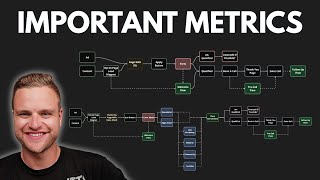
Track three things in one spreadsheet to scale to $10M: inputs (ads, content, outreach), sales metrics (applications, calls, close rates), and financials (revenue, costs, profit). Watch your daily input numbers, expect a 90-day lag to results, and calculate churn rate, LTV in months, and payback period.
Questions this video answers
$2,000 per month
Clients at end of month divided by clients at start of month (e.g., 36/40 = 90% retention → 10% churn)
Payback (months) = customer acquisition cost ÷ average monthly net profit per client
Chapters
This video is for the people who feel like their business is kind of going well, but they don't really track anything and they don't know what they need to track. Because at the end of the day, growing your business is a game of math. And there's some kind of magical force that I can't really explain that happens when you start to measure and you start to track everything. Because as the saying goes, what gets measured gets managed. And what gets managed can be improved. So something of that nature. Who knows what this thing is? Let's get right into it. This is the funnel that is going to get you to $10 million per year. We have our paid ads, our content, our outreach, and our partnerships to drive our top of funnel traffic. We have our middle of the funnel lead magnets, funnel pages, email flows, newsletter appointment setting, all of that kind of stuff to capture, nurture and qualify the leads. That pushes them down to our website, that gets them to book a call, and then on the call we have a bunch of offers which we can sell them. The thing you need to do is you have a spreadsheet that basically does three things. We track our inputs, we track our actual results, and then we track our financials. The spreadsheet can look something like this. You can make your own, you can automate a few things. And then I have a virtual assistant whose only job that gets paid 2k a month is to do nothing but fill out the spreadsheet and make sure I'm aware. Money well spent as far as I'm concerned. And without a spreadsheet. And you could probably spend 10, 20 hours doing this. If you want to do it effectively, you're not really going to get anywhere because that magical force is not there where you're not aware when you have it on the spreadsheet. And you see, okay, I did zero videos today, or I got zero applications today or whatever. It's like, wow, I better actually do something for a change. And then you'll also spot where your metrics are kind of getting fucked up and then you can actually improve them. Without this, you're flying blind and you really have almost no hope for success. So let's get right into it. These are the lead generation inputs that I recommend you track. I am a big proponent of tracking inputs because to some degree I want to make a million dollars per year. It's kind of nonsense, right? It's okay if I want to make a million dollars per year. Working backwards, I have to get this many clients at this LTV and this Margin. And to get that, I need to run this many ads and send this many cold emails and post this much content and do all of this kind of stuff. And when you track inputs like this, you can quickly see, okay, I'm not getting the result because I'm not doing enough. And then you just see it on your screen in a spreadsheet. Okay, I'm at 10 creatives a week, how do I make that a hundred? Or I'm getting 200 newsletter subscribers per week, how do I make that 20,000? And that sounds extreme, but this is really the type of thinking that's going to get you to actually making a lot more money. So the things I like to do, I track ad creatives just is like a count of them. So if it's on Facebook, it's on Google or whatever, just how many unique new ones I created, how much ad spend I've done, how much my cost per click is, which is just out ad spend divided by outbound clicks. My outbound CTR that's just going to be in a metric in Facebook or wherever. Outbound clicks same. You can just look at your platform, total newsletter subscribers from your paid ads, from your content people on your actual mailing list, what the opt in rate of that page is. If you look at the link in my description or maybe the pinned comment, if I remember, you will see my free trainings or sign up to my newsletter. What is the opt in rate there then the cost per subscriber if I'm running ads to it, how many newsletters I posted, how many open rates and click rate I have in my newsletters, how many YouTube videos I posted, how many views those generate, time spent on YouTube in terms of how much watch time am I getting then my number of link time, LinkedIn posts, Twitter posts, Instagram posts, cold email sent and you could even get further into this and do cold LinkedIn sent, cold calls made, all that kind of stuff. These are the baseline that what I track and then I will add or well not really remove. Usually just add based on the specific business if there is something in that business that needs to be done. The thing that we need to understand is that our success or the results are going to leg the inputs by I like to say 90 days as a baseline. That is usually a horrible thing in every situation. This leg. The first reason it's horrible is because most people just don't even do it for 90 days to even see the results. They just give up far sooner. But then if they are successful and they get There, you know, and you stop, you know, take your foot off the pedal a little bit. You don't even notice for 90 days and all of a sudden you don't have any leads. So it's very, very important to track the inputs and set standards and goals for yourself and your team and actually following through on them, because that is what's going to get you to the results in the next part. The next part is I usually will just classify it as sales and client success. That is the number of applications started, the number of applications completed, that completion rate, calls booked, calls shown, call no show, show rate, close rate, closed call rate, basically, you know, calls shown. I like to track my close rate of calls that are shown as well as total calls. I think it's very good information to have both the speed to lead in my CRM, the average time for when they fill out an application or call or book a call to the first contact, the number of new clients that I got in a particular month, the number of churned clients I had lost in that particular month, the monthly churn rate, which is basically the number of clients you had at the start of the month, or you have at the end of the month divided by the number that you had at the start of the month times a hundred for a percentage. So if I started October with 40 clients and I have 36 left, that would be 36 divided by 40, and that would be, I believe, a 90% or a 10% monthly churn and a 90% retention rate. Very, very important. That's a super, super important metric because that's what leads you into your LTV metrics. And you're not really going to survive very long if you have a churn rate over 10% monthly. The best companies will have a 4%, sometimes even less. But I've seen a lot of clients and I've seen a lot of people that have just like a 30% monthly churn rate because presumably they're just awful at what they do. And no lead generation efforts are gonna outpace that in the long term. You need to get the churn rate down. Then we have the LTV in months. So we just do one divided by our churn rate. So let's say we had 10% churn rate. We would do one divided by 0.1 for the 10% and that equals 10. So that means we the clients are with us for an average of 10 months before they churn. We charge 10,000amonth. That is $100,000 in revenue per client on average. We Have a, you know, 80% margin. That's, you know, you get the math. It's very, very important to just note when you have all this stuff on the screen in front of you, you can really quickly see where the bottlenecks are, where you need to focus more attention and you know, what a client is actually worth to you. The final kind of category that I like to do is obviously revenue. Then revenue after fees, then our total software costs, our ad costs and our labor costs and our payment processing costs. I kind of have that twice in there, that's my mistake. Then our miscellaneous costs and our total costs. Then we have our revenue minus our total costs and we get our net profit and our net margin. And it's very easy. It's very formula based. Then something that's very, very important I put if applicable here. But it's very, very important. If you are kind of not profitable on the first order, which when you're scaling, a lot of people aren't. How long does it take to get your money back? So customer acquisition costs divided by average monthly net profit per client. So sometimes people don't get fully paid back until month three, month six, sometimes even a year. It's not my idea of running a good business or having a good time, but I suppose in the certain situations call for it. But that's really what you need to have at a very, very basic level. One of my biggest pet peeves is when I ask my clients or my friends, you know, what's your monthly churn? And they're oh, I think it's about. No, no, it's just a number that you can pull up in one minute, probably even one second, if you actually do it properly and you actually are organized and care about your business. What is your LTV? It's about 14. No, it's 14,127. I just clicked on my browser here, it's bookmarked to my bar there. And I told you in one second there's no, I think it's about. There's no I think there's no about there. There's no it's around. It's just a number. And until you track these numbers, you really aren't going to get past a certain level. And once you do start tracking them, you have nowhere to go but up. It's kind of like a magical law of the universe. Very, very important. Everything at its core is a game of math and game of numbers. I hope this is valuable and I'll see you in the next one.