Six Ad Funnels To Scale Your Agency To $10 Mil Per Year
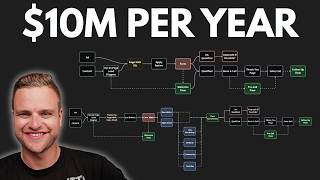
Matthew Larson breaks down six paid-ad funnels agencies use to hit $10M: direct offer, training, case study, webinar, lead magnet, and digital product. More leads reduce neediness and let you raise prices. You need five things first: outreach experience, $3k/month to lose, someone answering calls within five minutes, a market of 10,000+ businesses, and a proven offer.
Chapters
Hello. This will be a video on the six different types of paid ad funnels that agencies can use to scale to $10 million per year in revenue. On the screen we have the scale your agency funnel. For this video, we're really going to be talking about paid ads and the different funnels that we can do to ultimately book calls and make sales. So let's go into it a little bit. There's going to be nine different things that we're going to talk about. The first is we're going to be talking about the funnel as a little whole. The table of contents is where we are right now. I'm going to talk about myself a little bit. Then I'm going to talk about the four problems agencies face, the infinite cycle of lead generation, how this ties into paid ads. And then we're going to go over three things in relation to these funnels, when to do paid ads, the six different type of paid ad funnels you can do. How I can help you build these. And then as a bonus right now, if you want to go into the description or the pinned comment, you can download my 12 free agency trainings. So about Me if you've never watched one of my videos before, my name is Matthew Larson. I have built and exited three agencies since I started in 2013. I consult with over 550 agencies every single month. And I make all of these videos about scaling an agency to $10 million per year. I don't really make these videos about scaling to $10 million per year arbitrarily. I just think that if you have a $10 million per year revenue, you can easily net 5 million or more after tax with you and a co founder. And that will set you up for life where you can either build another agency, go do something different, or all of that kind of stuff. These paid ad funnels are very important because this funnel that we had on the screen earlier solves the four problems that agencies face. The first is not enough traffic. And that's really what we're going to be talking about today. But the other ones are not enough leads. All of their clients come from referrals and 99% of their leads are unqualified. And essentially this funnel is meant to solve all these problems. You want to solve all of these poor problems because if you don't, we're going to be what I call on the wrong side of the infinite cycle of lead generation. So this cycle is something that I made up as a, as a drawing to basically illustrate a very real and a very complex situation. So you are either going to be on the positive side of this or the negative side. It's never a net neutral, so let's just explain it here. The more leads you get, the less needy you become. The less needy you become, the less you need any individual sale, the easier it becomes to sell. You can also say no to nightmare clients who you tell are going to be an absolute dog to work with. You're also going to get more clients, which means more referrals, which means even more leads. Even more leads means now the laws of supply and demand have swung to your favor and you can charge higher prices for the same thing. Higher prices for the same thing equals more margin. More margin equals better hires. Better hires mean less time spent on the actual work. And now you'll have more time and money to reinvest in growth, which will lead to more leads. And the cycle goes and levels up, and levels up, and levels up. However, the opposite is also very true. Like if you have less leads, you're going to become more needy. More needy is harder to sell. You're going to have to take on those nightmare clients. You're going to get less clients and less referrals in general. You may even need to lower prices, which means lower margin and worse hires. You're going to spend more time working, more time fixing mistakes, more time babysitting, less money and time to reinvest in growth and get lower amount of leads and then so on. The cycle repeats itself. This is the situation for most agency owners and that's why I made this video today. So if we go back, we are going to talk about the different types of paid ad funnels that agencies can create. So starting at the top with paid ads up here, we could do something like a lead magnet funnel. We could do a digital product funnel. We could do a webinar funnel or a VSL funnel. We can do all of these different types of funnels. A case study funnel, a training funnel, who knows? But they all basically lead to the same place, which is to generate more calls. So paid ads definitely solves problem number one, which is not enough traffic. Paid ads are definitely the most scalable form of traffic, as opposed to content, which is unpredictable, and outreach, which is very linear. You should consider paid ads more of a situation of pouring gasoline on a fire that's already burning than anything else. At its very core, at the root of paid ads, paid ads are buying attention and impressions. Paid ads also represent the most risk of any client acquisition method, just in the sense that you can lose A lot of money if you don't do it properly. I don't really believe in using paid ads to start the fire. In most cases that's would be akin to pouring gasoline in a fire pit and lighting a match. It's just a very cheap, unsustainable way to get a fire going. You really want to build a solid foundation, put the logs in the fire, get the fire going and then you can pour gasoline on it. Like I said before, and something that I think a lot of people just don't fully grasp, even though I wouldn't consider it to be super complicated, is that buying more impressions and attention to something that doesn't work is not going to do anything. You're just going to waste your money. And I feel like this is what a lot of agency owners do. Should I run ads like, okay, why would you do that? And then we're going to get into that. So let's see. There's five things that I believe must be true before we want to do paid ads and I'm just going to go over them here. The first is you are already doing outreach and content. The reason for that is let's say you're running Facebook ads and just meta ads, meta Instagram, that kind of stuff. If someone sees your meta ad and they click on your profile and there's basically just nothing there, it's bare or it's very uninspiring, that is not going to look trustworthy at all. You need to be posting valuable content, you need to be active, you need to have a fully branded profile in all of the platforms before you even think to running ads. Because that is really going to lower the effectiveness of 50%, 75% even more. Being active and being valuable is very, very important. And I, if you're gonna do this, I would prioritize being active. It's a very, very interesting concept and phenomenon. I don't think it's too like hard to understand, but the conversion rate and the click through rate of ads is directly proportionate to a much greater like degree than I think most people would think by just having an active social media profile on whatever platform you're running ads. The second thing that I think we should do before we start running ads is we have to be in a situation where losing 3k per month in like in this, in the scenario that these ads just completely bomb doesn't mean anything to us. If we're just starting out or we're in the early stages of our agency and we just wouldn't want to lose 3k per month like that would actually do a meaningful impact to our bottom line or our income as a whole. I don't think ads are for us. We should only do that if we're going to spend 3k or more, which is a hundred dollars per day. Anything less than that, the debt is going to be too slow and it's just probably not a good idea. The next thing is that you have an appointment setter to contact the leads you generate with ever with whichever paid ad funnel within five minutes you're very going to suffer if you don't have this. It's going to be 2, 3, 4, 5 times as many calls with an actual appointment setting and sales process versus not having that. I also believe that if you're going to run ads, the target market should be a minimum of 10,000 businesses. If you sell to Fortune 500 companies for example, and there's you know, 500 companies in this situation, it's much more likely you're going to have like to be putting your time towards outreach, prospecting, building relationship networking events, that kind of stuff, than trying to spend the same amount of time and effort making an ad funnel that works. And then the fifth one is your offer is proven to convert. And I like to test out these offers usually with outreach and content before ever trying to do it with paid ads. Just because you're going to get the same feedback, you're going to get the same amount of testing without potentially losing a lot of money. And I think that these five things in general, if we don't have all five, we should probably not run ads. These things aren't that like tough to do or tough to achieve. So most people can and should run ads, probably upwards of 95% of agencies, but I think a lot of them will be very important. So you should be doing outreach and you should be posting content. You should probably be 30k a month or more in revenue to where losing 3k a month doesn't really mean much to you. You should just have an appointment setter in processing that takes maybe a week to set up. Your target market is your target market, but it should be 10,000 plus businesses. And then you have an offer that you have sold. If you've only ever gotten clients from referrals, you don't really probably even have an offer, to be honest. And that's a situation where most people you know, won't have success with ads if they just don't have an offer. Because when you're doing paid ads, you know, your social Proof doesn't really mean as much or it's not going to get you in the door. You know, you don't have the credibility of someone referring you and that kind of stuff. So you really need to. It's kind of playing on hard mode in comparison to content and in comparison to referrals. So there's six paid ad funnels that I think that pretty much every agency can take advantage of. Or there's just six options and you're gonna decide which one's best for you. The first is going to be a direct offer ad funnel. The next is going to be a training funnel. Then there's going to be a case study funnel, a webinar funnel, a lead magnet funnel and a digital product funnel. There's these will be better in different situations with different offers and niches and target markets. All of them have their place in some degree, but depending on your situation, one or two are always going to be better than the other. Basically four. So the first is a direct offer ad funnel. And this is really good when you have a strong intro offer that would be good for your target market. There's certainly some situations where you know that is not the case and you just can't do it in comparison to a lot of other kind of agencies. The next is a training funnel and I forgot to do this best for when they need to try your ideas out to believe you. This is very good. Consider like a sales process or a sales trainer or a sales agency. They are basically a business owner or a, an employee who's doing a lot of sales. You say to do X, Y and Z, they don't really believe you. But then if you give them a few tips and you try it out and it works, then they come back and they convert. That would be a good use of a training funnel. A case study funnel is best for when you're targeting bigger businesses. I feel very strongly about this because if you're targeting, you know, multi, eight figure, nine figure, maybe even bigger businesses, their bureaucracy is probably going to be too strong to have a direct offer actually work. And they have gotten to where they're trying to go in general, where they've gotten to this point by being good and they don't necessarily need training. So a case study funnel, like how we helped X company get to Y results with our service is going to be a lot more appealing to those big businesses because it's a form of social proof and everybody likes ideas of businesses similar size to them. The webinar funnel would be best when you need to either artificially condense the sales cycle or explain something very complex or both. So for example, watching my YouTube videos, it takes the average person three to six months anywhere in that range to actually become my client. They need to know a lot about my philosophy. They need to know how this works. My overall funnel is not something that's frequently taught or just, you know, part of the cultural norm. So a webinar would be great for a situation like me where I can jam pack three to six months of YouTube videos and training and indoctrinating them into my philosophy and in a 60 to 90 minute webinar or if you have some sort of complex service, it's also good too. I'm going to also add a demo in here for anybody who sells to kind of like companies that would need a demo. The next is going to be a lead magnet funnel. These are best for when you're already scaling and you already have one or more ad funnels working and you essentially want to buy more impressions and build your list and basically add fuel to the fire. And then a digital product is best for when you have some sort of templates or assets that you just, it's inherently obvious that you could sell to them and it would be great stuff like you're an email marketing agency, email templates, you're an ad agency, ad templates, you're a landing page agency, landing page templates, something like that. Now let's go through some situations where you wouldn't use some of these offers. You would never use a direct offer when you don't have a service or some side of intro offer that is inherently obvious as to how it's valuable in the context of your target market. That was an extremely wordy thing to say. But there's certain situations where whatever service you provide, you just don't have an obvious intro offer. Something like a Google Ads agency is pretty good example of this. Yeah, you could set up some campaigns for example, I guess, but it's just, I don't know, there's not that many options for a direct offer. You would not use a training funnel if your service has been around for a long time and there's no real perceived value in training. The key word here is perceived. There's always value in training. But if people kind of think your stuff is commoditized and you know, it's just obvious, there's not a lot of to do stuff like email marketing, stuff like SEO just been around for so long that the training funnel would have little to no Perceived value. You would never use a case study temp or a case study funnel if you don't have a very impressive case study to your target audience. Let's see, let's add that in the context of your target audience. And what I mean by that is if you're targeting, let's say you have a, a Facebook ad agency for E commerce. If you have a case study that says this is how we added 200k to, to this client's bottom line or 200k to this client's revenue and they like, that's not really going to be appealing to someone who's doing 8 and 9 figures. Like just why would they want to add 200k if you had something that we added 6 million per month over the course of a year, like that would be an appealing case study. So you need to have a case study impressive to your target market. And that can be different depending on what your target market is. You probably wouldn't use a webinar funnel if you have ultra high ticket or enterprise clients, as just time is of the essence. The higher and higher and higher and the richer and richer and richer the people get. Time is more and more valuable and they're probably not going to be as likely to sit through your 60 to 60 minute to 180 minute webinar. Is there always exceptions to that rule? Of course. But just because there's exceptions doesn't disprove the general idea that that is true. You would not use a lead magnet funnel unless you have every other part of the funnel. Because lead magnets are more like pouring attention and gasoline on the fire as opposed to starting the fire from scratch. If you have your YouTube videos rolling, you have your content rolling, you have another type of ad funnel, you have your newsletter, your webinar, your vsl, your community, all that kind of stuff. Lead magnets are a way to just pour extra fuel and extra attention on the fire. And you wouldn't use a digital product unless it's kind of obvious how your product makes them more money or saves them time. Like a Google Ads swipe file for search ads probably wouldn't be that good as a digital product. Info is not really good. It's a digital product. In my opinion, the digital product should be under $100 and should save them time or make them more money. Basically, if you can't offer templates or frameworks or assets, I probably wouldn't use a digital product. So I'm going to go through for the rest of the video kind of what some of these funnels look like. I made some frameworks for you to follow along to try to hopefully simplify it in number of steps and to get started is going to be the direct offer, training and case study funnel in this case. These are all booker call funnels that run through a vsl. They're all going to look the exact same. It's just a matter of what your VSL and focus is. So you're going to basically drive traffic to this through two paths. One is through content and one is through ads. If you're going to drive it through content, you probably are going to have your content go to an opt in page with a lead magnet to basically capture their email address and start marketing to them. The reason for that is people are a lot more warm, so to speak, through content as opposed to paid ads. Much more likely to give you their name, email, phone number, website revenue level than someone with paid ads. Whereas paid ads, you're spending a lot of money, you need it to work, you need them to consume your VSL and book a call. Not really the case with content. You can kind of just maybe they'll come back eventually another time. So paid ads will always go to the page of the vsl. When they're on the page of the vsl, there's going to be an apply button with a form. A form is going to separate out who's qualified and who's unqualified. Usually you'll do stuff like revenue level, are they okay with the price, Are they okay with the timeline? You know, if they are just too low of revenue level for you, you might use the conditional logic to put them to a downsell page. Maybe you have a course or a digital product or even a webinar or something like that. You will filter them out there. But if they're qualified, they're going to be able to book a call. The book a call would be to the thank you page with extra information, FAQs, more videos, that kind of stuff. And then they're going to go to the sales call whenever they book it. Whether they opt in from the lead magnet or they end up coming from the form, they're going to get that welcome flow. This welcome flow is going to nurture the people who do not book a call over the course of 30 days. And hopefully they book a call. Then when they book a call, they're going to get a pre call flow with FAQs, with information, with case studies, with proof, with next steps, all of that kind of stuff to basically get them prepared for the call and after the call, assuming they don't convert in five minutes, they're going to be added to a follow up flow which will basically follow up automatically for you with more information. So whether you have a case study or a direct offer or training, this funnel is more or less going to look the exact same. I actually am probably going to in the future put an appointment setting thing right here just to signify that there is an appointment setter here. But it's all going to look pretty much the exact same. The next is going to be a webinar funnel and it's kind of gonna look rather similar, but there's just a few different steps. So from content I still like to do an opt in page. The opt in page would redirect to the webinar signup page. So they're gonna get there either way and the paid ad goes directly to the page. If they have opted into the lead magnet, they're going to get that welcome flow that's going to basically point to, you know, the webinar signup. But if they sign up for the webinar, basically you are going to conduct the webinar. In many cases they are going to determine whether or not they are qualified themselves. And if they are unqualified, you might go to a downsell. If they're qualified, they're going to book a call and you're going to go through pretty much the same process. It's just basically in terms of a webinar, in most cases, if you structure it right, they're going to be the ones who are going to say this is for me and book a call or this is not for me and maybe buy something else for the lead magnet funnel. It's kind of a longer funnel than some of the other ones in terms of, you know, what we're doing. Basically we have the lead magnet opt in page here. In the other funnels this still existed, but this is gonna be the focal point of this one. So both the ads and the content will go to this. In this situation, instead of the VSL with or the sales page with the vsl, normally what you're going to want to do is promote some sort of other conversion mechanism on your thank you page. So in the context of this funnel, if we go back to it at the top, the conversion mechanisms are going to be our webinar and bsl, they're going to be our live workshop, our newsletter, our community content, all of that kind of stuff. So if we go back down. So on the thank you page you're kind of gonna want to promote whichever one you have determined is going to make the most sense for you. Let's just say that way. And then let's say that's a community. So your community would be on the thank you page. If they join that you can ask them for more information, name, phone number, email, website revenue, and that helps you qualify. Then your newsletter is going to hit all of them every single day and your appointment setter is going to reach out to the ones that are qualified. Your newsletter and appointment setter can either go to, you know, directly to like let's book a call with me and get on this thing. Or they can also cross promote other conversion mechanisms such as live workshops, prerecorded webinars, community, your YouTube channel, your content on all that kind of stuff. Essentially if the appointment setter kind of gets to the point or discovers that they're ready for a call, he would, he or she, I guess would encourage them to do so. Or if they find out that you know, they are qualified or not, he would encourage them to book a call. If the newsletter or the appointment setter or the enriched data from the signup page of any of these conversion mechanisms eventually determine they are unqualified, usually revenue level or something else, we go to the downsell. If they determine we are qualified, go to the similar process to the other stuff. Hopefully I explained that right. The final one I'm going to talk about in this video is going to be the digital product. So still I have the exact same start with the content and the opt in page going to the sales page. This would be the sales page for the digital product. Whether that's templates or something else. The buttons would go to the checkout page. The checkout page after they purchase would go to a one time offer as an upsell to try to increase that average order value. Then they would be redirected whether they took the one time upsell or not to an onboarding. There's three things that I think are very good with onboarding. We want to provide the training, the access and the swipe files which are examples on how to use the templates as well as a post purchase flow that usually 7 to 14 days worth of content every single day to make sure they accessed it, are using it properly, that kind of stuff. It'll actually have a much higher consumption rate if you do have that and and it will also prevent a lot of chargebacks or refunds from people who are too low IQ to even use your digital product. And then all of those should also try to get them into a community for this digital product. Then they're going to go in your upsell flow. That's going to be, you know, email retargeting, ads, appointment setting, that kind of stuff to basically do the same process as any of the other funnels. Are they qualified or are they not? And then we go through the same process. So in all like this is a video, hopefully I've done it a a good enough job of explaining the different types of paid ad funnels that an agency can use as far as to which one's the best. That's going to be kind of dependent on who you are, what you're selling, your target audience. But also these are not mutually exclusive. I like to have as many of these working as possible. I would start with one, get it working and start and add another get. You can never have too many different ad funnels, assuming they all work, because each are going to make the other ones more effective. If someone has downloaded your lead magnet funnel and they like your stuff, they're much more likely to sign up for a webinar or they're much more likely to watch your case study. They've watched your case study and seen your webinar and downloaded your lead magnet and now they're hit with a direct offer. Much more likely to schedule a call. They all work together. It's one cohesive system, it's not individual parts. And if you want me to help you do this, I actually do this for about 550 agency owners within 16 weeks in my agency program called Scale youe Agency where I give you a step by step plan to do this. I give you the real time feedback and what you need. I give you all the templates, assets and frameworks and examples that you need. If that sounds interesting to you, you can book a call with me and we will get started right away. Thanks for watching.
More from Matthew







Everything I Would Change About This Ecom Email Marketing Agency (3 HOUR LIVE AUDIT)

Everything I Would Change About This Meta Ads Training Business (3 HOUR LIVE AUDIT)


