The Exact System To Create An Agency Offer That Prints
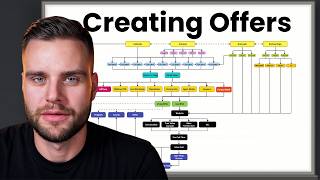
Matthew Larsen shows how to design an intro offer for an agency that converts. Price it between $2,500 and $5,000, make it low-risk and productizable, then map it to Alex Hormozi's value formula: dream outcome, likelihood, time delay, effort, and sacrifice.
Chapters
Today we are going to talk about offers, and this is going to be the third video in the lead generation series. So if you missed the first two, go back and watch them. The offer is definitely alongside messaging the most important part of your entire marketing machine, because the offer essentially will improve every step of the way. You'll get a higher click-through rate on your ads, so cheaper cost. You'll get a higher application rate. You'll get a higher booked call rate. You'll get a higher show rate. And then a higher close rate. And then as long as your offer isn't a complete scam, like a lot of people's is, you should have a higher success rate and more referrals too. But a lot of people put all their time in making a great offer and The marketing is great, but the fulfillment is not. So you can think of this here, like even if you got— it's not really like a lot of people will have a bottleneck in their funnel somewhere. And when they do that, you know, they'll try to increase their ads by 20%, right? Or they'll try and increase their show rate by 20% or whatever. But if you had a great offer and let's just say it Improved everything by 20%. That is 20% here, 20% there, 20% here, and 20% here. That is 1.2 to the power of 5. Basically, you're going to get with a better offer 2, almost 2.5 better results. And that's just in this example with a 20% gain. A lot of the time it could be even more than that if you have an amazing offer. So the offers are inside our overall marketing machine are down at the bottom. We're driving our traffic through paid ads, through content, through ads, and through partnerships down to our funnel where we capture, nurture, and qualify leads through a variety of different pieces. And they get to our website, they book a call, and then we sell them whatever. This video is specifically going to be about the one-time service here. Also known as the intro offer, because this is the piece of the funnel that you really can make the best offer with. A lot of the time, I think a big mistake is people try to make a great offer based on their core main recurring service. It's just kind of very awkward. It doesn't work very well. Like if you did email marketing, for example, you know, and you say, you know, our email marketing is going to increase your revenue by 50% or your money back. It doesn't really sound believable. It doesn't really make sense. Right. It's just kind of awkward to do versus if you have something very specific, you know, it's much easier to make a great offer around it. It's much more low risk, much more measurable than there, and it just becomes very, very good. So what we need to do is we need to put all of our effort around our offer on the intro or the one-time service. And then when that goes good, we can just easily upsell them to the recurring service. In almost every case, I would never put an offer on the recurring service, just because in my view, it doesn't make a lot of sense, both reading it visually and economically for you. So we're going to be focusing on that. The first thing that I think people kind of misunderstand is most people don't have an offer to begin with. It very much is just buy my stuff. But secondly, they kind of do this whole process backwards. They start with whatever offer they want to run, and then they kind of like go back and say, okay, who would buy this? When in reality, if you want to make a lot of money, you want to start at the exact opposite side of the spectrum. You want to start with, okay, what is an ICP? An ideal customer profile, or an offer with strong demand already. And it should be something that they simply must buy, either legally or just functionally. So for this training today, I'm going to be using auto insurance as an offer. Sometimes when there'd be beneficial from other examples, I might use those. But we're gonna be using auto insurance with this, and I'm gonna go be one, one at a time to show you what this could be. So an ICP with strong demand, auto insurance. You probably have it if you have a car. Basically everybody who has a car has this. So auto insurance, there's already tons of demand. I think there are, let's see, how many auto insurance policies are there in America? It's probably, probably the wrong question. Hundreds of millions of auto policies, sure. Reflecting up to 875 million policies. You know, companies have them, individuals have them, you just kind of have to. So huge huge amount of people, 875 million, whether that's literally the amount, not really the point of this video. It's more to show you that, you know, there's just tons of it with demand already. Think of this here, auto insurance, something they must buy. In this case, that is legally, right? Legally, you are need to have auto insurance, at least the basic version of it. Liability, I think it's called, in order to drive your car. I'm sure some people don't have auto insurance and they're driving illegally, but this is something that by law you must have. That is an amazing thing for your offer because the demand is built in and the demand is guaranteed. Not the case with a lot of different offers that we have where they're more nice to have. Something like my consulting program, you know, It's nothing really mandating people from having it. So it's a lot harder to sell than something like auto insurance, isn't it? Things that you're legally mandated to buy are more rare, but there's stuff that you're not legally mandated to buy, but kind of functionally you are. So like medical insurance, you're not, you're not legally mandated to buy it, but if, unless you want to experience medical bankruptcy in America. If you ever get something in trouble, you have to buy it. Let's go to a different example, like something like e-commerce. If you want to have a successful e-commerce store, you need to do email marketing, right? So in that situation, you, I guess it's not legal, legally mandated, but functionally it's mandated. Same with paid ads for e-commerce. If you want to be in business, you have to have a website, right? It's not legally mandated, and I guess some people don't, but if you really want to be successful, you have to do that. Once you've narrowed this down, we want to think about our ICP here. And the ICP stands for ideal customer profile. Some people might call it your avatar. Some people might call it your target market. You know, those are all the exact same thing that they're referring to. And we really want to narrow down our ICP very well. So some things that we basically want to keep in mind is our ICP should be about 80% of all of our buyers. We're never going to get this to 100%. There's always going to be outliers. There's always going to be all that kind of stuff. But if we look at our customer list, even in the past few months, we can always Find a list of common traits amongst them. Some things I have on the screen are age, are gender, industry, revenue, or household income if it's business to consumer, the tech stack they use, the job title, employee count, the location, sometimes the race if it's relevant. But no matter what we do, if we export our customer list in the past 6 months, we We can really go through it. Probably going to know the gender based on the name. Probably going to have collected some sort of household income if we did that, or revenue. We can probably ask them what age they are. We're probably going to know what industry they're in. Probably going to know what location they're in too, at least in the country. So we really need to find out who this is. So in auto insurance, the ICP. Is people aged 25 to 60 with an emphasis on homeowners because auto insurance is quite often bundled with, um, home insurance is often bundled with auto insurance. And then the preference is they have 2+ cars. Because, you know, those policies, when you have multiple cars, becomes more valuable. If you ever had an insurance agency for this, or you ever did marketing like that, really is the ICP for that. So now the question is, what insurance offer would people aged 25 to 60 who have a home and 2+ cars be interested in? Right? Of course, there's nothing stopping someone under the age of 25 or over 60 from doing it. There's nothing stopping people who are not homeowners from buying or people who have just one car. I guess people have zero car would not need to buy this. So there is restriction there, but there's nothing stopping those. But the 80% of the people that we want are going to be in this above, in this example. So what we need to do next is go here and we need to do a little bit of research because the research is going to help determine the things they like and they dislike and the language they use to describe it. And that's going to play a big role in how we phrase our offer. So if we go here, the, the places that I like to look at are like things like Trustpilot, things like Reddit, things like Quora, you know, Facebook comments are very good. Amazon comments, if it's a product, very good. So if we go to something like State Farm Insurance here, we would go, not the best reviews. Of course, insurance companies are scum. But here's one. Here's a good one. So I've been with State Farm for over 40 years, made only one claim, paid every single bill. Terrible customer service. So the things they don't like, let's get some of this over here. Terrible customer service. We're gonna put, they don't want to repair anything and they threaten to not renew you, and they're not even nice about it. So this is a person who is an example with their, their home. They most likely have a car. Car insurance proof. Yeah. So this person, very likely they might be a little bit old if they've been over there for 40 years, but this person is very good example in the ICP. So very unprofessional. Yet the government says we have to have insurance. They can do, make your life a living hell. So let's just find maybe 5 different things. When you file a claim, it's an utter mess. Sounds like a fake review right there. You got multiple cars from them now. Perfect. Now home insurance. Boom. It's right in our research process right here. But do not make a claim to them. And it's a flat no based on someone's opinion. So denied claims. So that's all we're going to do here. We're going to find their likes and the dislikes. Both of them are powerful. A lot of the time, likes and the dislikes are just inverse of one another, but sometimes you get some different ones. And then the language that they use is very strong as well. What I like to do is I'll typically copy and paste a bunch of reviews or Reddit threads and then ask AI what, how, how like they would describe the problem or build an AI project for this, a Claude project. I think that's a very strong way to do it as well, because you're just going to get much more natural. So now we're going to go with the problems and the circumstances that they're facing. So, you know, bad service is the problem. Denied claim. What else is a big problem? Two different vehicles. That's in the ICP. You know, paid faithfully and treated like garbage. No communication. Long approval process or long claims process. Won't cover claims. So I had denied claims already. But there seems to be a theme, lack of respect. We'll stop there for now. Kind of get the picture. This is very useful both to create your offer, but it's also very useful when we're eventually going to make ads for our offer. Like all of these things that they like and dislike, mostly dislikes in this case, and the language they use to describe it. Are going to be very, very good at angles and hooks. Are you sick and tired of being faithful to your auto insurance company for 30 years? And the one time you have a claim, you know, it gets denied, like stuff like that. That's kind of an example of a hook in the language that they use to describe it. So what we really need to do here is we take all of this bad stuff and we need to basically position ourselves and our product as a solution to getting the outcome that they want. The outcome that they want here is, you know, customer service, support, fast claims or fast approval, no lowball offers. Communication, and then respect. It's like these could all be different outcomes that they want. And in this case, a lot of the time we could put them all in there into one offer if we wanted to, but their most desired outcome to me If I had to guess, would be fast approval, real-time support, and then fair claims process. It's probably what I would say is their most desired outcome. You might be able to value stack. Well, I wouldn't call it a value stack, but you might be able to incorporate more in there, but that's probably what they want. So this is why it's important because people have bad judgment. Not really saying that to attack them, but when you just make your offer kind of arbitrarily without, you know, doing any research or asking anybody. Like it's very unlikely that you're gonna hit all of the things that they like and they dislike based off, you know, just chance or based off your arbitrary opinion. So what we can do here is once we have the desired outcome, we're gonna go over to the intro offer. So the intro offer, this can be a bit different based off of You know, what you're selling, all that kind of stuff. But to me, unless you're doing some like cheaper mass market stuff where this isn't possible, you're always going to want to place your intro offer between $2,500 and $5,000 per year, or per like per intro offer rather. And the reason for that is anything above $5,000 to me kind of defeats the whole purpose of an intro offer, which is meant to be easier to accept, meant to lower risk, meant to lower commitment. A lot of people will come to me and say, I have this intro offer for $20,000. I'm like, doesn't really sound like a low-risk intro offer to me. Right. And then anything under $2,500, you probably aren't going to have enough time, resources, and You know, the money that it costs to acquire the customer to turn a profit. We don't necessarily want to lose money on our intro offer if at all possible. So we want to get it into this range and we want to have a $250 per hour or more in terms of effective hourly rate. So if this costs $2,500 at the $250 effective hourly rate. We need to be able to deliver it in 10 hours or less. If we did the $5,000, it could be 20 hours. The reason for this effective hourly rate is if you have less than $250, by the time you pay for the customer acquisition, the fulfillment, the payment processor fees, just, you know, non-revenue producing roles, software, just miscellaneous costs and taxes. Under $250 per hour, there's not really much money left. Like, if you book this at even $50 to $100 per hour, like, think about it. We're not really— if you had to pay, you know, 50 hours worth of labor on this $2,500, you're not really going to have any money left over to reinvest and scale. So I would— obviously, this is $250+. If you could fulfill this in 1 hour, which I think auto insurance, you very well could, that would be even better. The stronger that your effective hourly rate is, the more you can scale because that's just infinitely, or, you know, directly proportional to, you know, your net margin, I guess you could say. But you'd never really want to drop down to it. So it kind of gets complicated, right? This is why offer creation is so high leverage. You know, we have to find an ICP with that strong demand. We, something that they must buy. We need to do research to find out who the ICP is. Then we need to find out their problem circumstances and describe it in the language that they use to describe it. Then we need to find out the outcomes that they really want, and then we all have to make it work here. So this is why, like, people are like, oh, just make a good offer and make tens of millions of dollars. You know, sure, but it is a high skill and there's a lot that go into it, right? And we're not even done the intro offer part. So $2,500 to $5,000, the average auto insurance in America is $201. So if they have 2 cars or more, that will be definitely in that range. For auto insurance in the example, all you're really doing is a sales call. There's not really any fulfillment after you have your salesperson, you have your underwriters, which a lot of that's automated, and then you have your customer support. Definitely $250 or more over the course of a year on average, or over the course of this intro offer. The strong guarantee. This is where I think there'd be a big, big example here where you could have a guarantee that's not really money back or something, but I think it's a strong guarantee in this one, be like, we will pick up the phone or live chat within 2 minutes, or your policy is free. I can't imagine the big insurance companies such as State Farm doing this because they're too big to fail and they probably don't give a shit. But as far as the individual brokerages go, who actually resell and sell this auto insurance, I think especially with AI and automation, like this is not very difficult. You could also do, we'll pick up the phone within 2 minutes and your claim will be settled within 30 days. Or refund, something like that. I think you could probably do both of those, and that would be an extremely strong guarantee that reinforces their desired outcome. And I think you would absolutely crush if you had your ads, for example, let's just say, are you sick of, are you sick of being with an insurance company for 30 years, always paying your bill on time? And then every time, and the one time you file a claim, they drag it on for 6, 8, 12 months a year. You know, welcome to XYZ Insurance Company. If you have ever submitted a claim, two things will happen. You know, we will answer the phone within 2 minutes and we will settle your claim within 30 days. And if we don't do so, your next annual policy is free. I think that'd be like a very strong thing to do in this case. But this is definitely reliant because a lot of people will just do some kind of fake-sounding money-back guarantee and then it's free. Like, we're gonna 5x your ROI or you don't pay. It's not really the spirit of what we're trying to do. The guarantees don't always have to be around financial stuff. Sometimes it makes sense, sometimes it doesn't, but you need to, in my view, do your guarantee around what they actually want. People just want like what they want. It's not for you to decide. It doesn't matter what you think they want. What they want is what they want. And doing your deep research when you're making your offer is going to be important. Then the last thing we have, so we're going to put guarantee here. The last thing we have is, I don't think it's a word, but productizable. The thing that you're going to get into big trouble with in an intro offer, when you have to hit these things, is custom stuff. Your intro offer just needs to be your intro offer. Of course, it's gonna be this like slightly different for every customer because every customer's unique maybe, but it can't just be a custom work, whatever they want. You have to have a, it to be a very specific process, very specific deliverables. And you need to do that both in order to have effective advertising because all your advertising is gonna be on the same thing. And then secondly, to maintain that $250 hourly rate and then to maintain your guarantee, it all has to be the same. In an auto insurance example, auto insurance really is auto insurance. It's a bit different than other stuff, or it's a bit easier to hit that productizable thing, but it's very, very, you know, important here. So after we have done this, and I'm going to erase some of this stuff here. Just to make, make the stuff cleaner again. Now the stuff here, I think we can really go to Alex Hormozi's value formula. Once we, once we have all of this stuff, let me just erase some of this because we like a nice clean workspace. I'm not going to do all of it because that would take too much time, but now we can go to Alex Hormozi's value formula because that is a very great tool and always will be. But in my opinion, it's not really enough on its own in isolation. It's enough for Alex Hormozi, who has a very good, very high IQ, very high brain power, very high experience. When you just do this, you're going to hear a lot of really stupid offers and you can just scroll ads library on Facebook if you want to see some of these. And that's mostly due to a lack of understanding and a lack of nuance. So the dream outcome is going to come from essentially our previous research. So 30-day claim. That's fair. 2-minute support guaranteed. So for perceived likelihood of achievement, basically going to have reviews. They can test out the support themselves if they want. But for this, there's not really too much proof. Probably have anonymized case studies. You might have a thing on your website that says, you know, last 30 days averages of settlements times or claim times. And that's good. Like this is, there's limited amount of stuff that we are going to do with this because it's kind of just is what it is, right? More reviews, more proof is always going to be the best. Dream outcome, we've already found that early in the process. But time delay. So let's go number 1, and effort and sacrifice. We want to decrease this. So time delay. Sure. The 2-minute thing and the 30-day thing, of course. But I think that auto insurance, and I've been in this industry for so long, it's very out of date where, you know, the, even the process of signing up is very bad. So I would probably have. You know, buy via WhatsApp or buy like an e-commerce one. You'd have to have good underwriting too, but you could either set it up online and that saves people from having to talk to a person, which they really hate, or going back and forth with email with insurance brokers, which is definitely like pulling teeth. So, you know, We'll stop there for now, but you are going to get all your claims processed within 30 days, or you're going to, and you're going to have 2-minute customer support. If that's not the case, your policy for the following year is free. We have tons of reviews. We have tons of, you know, examples of how these things are true on our website. In addition to like the time delay and the efforts and sacrifice, not having to jump through hoops to do claims, you can also buy this via WhatsApp or buy it in an e-commerce fashion on the website instead of wasting weeks going back and forth via email. This is a very valuable insurance offer in my opinion, versus basically everything. And you can just see how non-valuable a lot of the average insurance offers are. If you go to any, you know, insurance company in the United States, you are going to get wrecked. So very, very good. And then the final output of all of this work we did with our offer is we want to have a one-liner. We want to have a 30-second elevator pitch, and then we want to have like the traditional full offer. Could be a presentation, could be whatever. So the one-liner: the only auto insurance company that will guarantee that we'll respond to you in 2 minutes and your claim will be in 30 days. You know, auto insurance that you can buy on the internet where we guarantee that you have 2-minute customer support or less, and all your claims will be settled within 30 days. And you can, you don't have to talk to an agent. You can buy it on WhatsApp or you can buy it with e-com, like on a website. Full offer. I'm not gonna go over there, but I think like the output of what we want to have with our offer is this, like this is our offer and everything we went in here. Is basically prepping to get this one here. So I hope this video was valuable and I'll see you for the next training in the series.
More from Matthew







Everything I Would Change About This Ecom Email Marketing Agency (3 HOUR LIVE AUDIT)

Everything I Would Change About This Meta Ads Training Business (3 HOUR LIVE AUDIT)


