The Exact System To Grow Your Agency From $1M- $10M Per Year (STEP BY STEP)
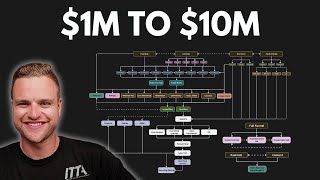
A five-step system for scaling a lead-driven agency from $1M to $10M: fix your daily habits first, build a customer-acquisition funnel with paid ads and email flows, codify systems for ads and sales, hire in a specific sequence starting with an admin, then iterate by scaling volume before improving quality.
Questions this video answers
6am or earlier
10 hours per day
Work six days per week; take Sunday off
When you can pay your own bills; example: hire when you make $8,000/month
When you consistently get eight inbound leads per day
Chapters
If you are around a million dollars per year and trying to get to 10 million, you can pretty much follow this system to a T. It's going to work with any type of business that deals with leads, whether that's B2B or B2C, whether that's a service or a software or anything in between. 72% of businesses are dealing with leads. So chances are, unless you're selling a product, this is going to work for you. The first part and the first step in the plan is to fix your habits. And there's five main habits that really, really matter for most people. You need to do this because you have to do a lot of work to set up your funnel, to set up your systems, to hire your team, and so on. And you can only do that if you have the habits to support it. If you want to get to 10 million per year, you have to be a $10 million per year person and entrepreneur. So the first habit is time blocking. I always want to be waking up at 6am or earlier and blocking off the calendar until 12pm A lot of people are extremely resistant to this idea. They say, oh my God, there's too many fires, oh my God, bad stuff is going to happen. But I've been doing it for eight, nine years at this point and I can't think of a single time where anything bad actually happened. You can still look at your phone if something actually happens in your personal life, like your house is on fire or something, and your clients aren't going to churn your client, your team's not going to do anything. You're just going to have time until 12pm every day to work mainly on customer acquisition. I like to set a timer. I have a timer right here. Set it in 60 minute cycles. Do things like paid ads, content, outreach, all that kind of stuff. Do repeat that process four times and really get a jump on the day and get my highest leverage, work out before noon every single day, six days per week. The next is I want to have a work form and I want to have a notification as part of it. So if I open up my browser here, after every hour that I work, I fill out this work form and what that does is I have my date and hour here. What I did, reaffirm my top five goals and then reaffirm my standard of working. I do 10 hours of work per day as part of this process. And then what happens is I, when I submit the form, it sends an email to my accountability group, which consists of business partners, best friends, spouse, parents, all of that kind of stuff so they can see proof that I'm working and hold me accountable. I also think that the number one hack here is to have your accountability group or your best friends or business partners do that and send it back to you because it creates a friendly competition, it creates a constant reminders to keep working and doing this. When you have five emails per hour in your inbox, you know, saying that your business partners did this form and what you really want to do is set the timer and just train yourself to literally sit there and work and do nothing until the timer goes off. And then just keep doing that 10 times per day, six days per week, and then take Sunday off. It's kind of a skill and it gets easier and easier the more reps you put in and the more you do it. Where to the point where you do this for a few weeks and you find yourself the only thing you're or time you're happy in life is when you're filling out these work forms. It's gamifying the concept of work, public accountability, all of that kind of stuff. It's a great way to work more in terms of volume, but also more effectively in terms of quality. The next is a weekly plan. And on Sunday night I plan out my 10 hours of work per day for the entire week. What I do is I start with my habits, I'll open it up on the screen here, and then I get into my daily five, which are my five most important tasks. Then I get to my team's tasks and then I get to my chores. So that is what I will do. And I'll train myself to just literally start at the top, go line by line and complete every task every day. Don't do anything but what's on the thing predetermined, your most high leverage tasks ahead of time. When you don't have a plan, you're kind of just going into the day blind and you want to do it in a weekly plan in my opinion, instead of just the next day. Because then you are forced to look at the greater picture. You have a big to do list and then you can select the highest value tasks. The next is a metrics tracking spreadsheet. So you need to have all of your metrics in one big dashboard. Both your inputs and your results and your client stuff and all of the above. The reason you want to do that is when you have your metrics tracking set up, you can easily spot bottlenecks and you can take action to fix constraints. And if something's really messed up. You have no choice but to face it. I like to track my inputs too. Like how much ad spend, how many new creatives, how many new YouTube videos. Because when it says zero, for example, you can no longer ignore it. Like you can when you aren't tracking your metrics properly. The most important thing is you have a spreadsheet like this or a dashboard or whatever it's built in, it doesn't matter. And you should be able to access this stuff in one click. No guessing. No. When I ask you your ltv, um, I think it's around, like, no, it's what is your ltv? It's just a number. There's no guessing, there's no. It's around, there's no I think. And when you do this metrics tracking, like, I can't explain it, but there's a magical force that there's only one way to go but up. It's probably because then you can improve in concrete fashion. You can no longer ignore the fact that you're not doing stuff if that's the case for you. But everything good happens when you start tracking your metrics religiously. The final thing is energy levels. And many of your decisions in terms like. And things of like diet should be looked at through the lens of energy. Will eating this give me more energy or will it give me less energy? Will this workout give me more energy or less? Will this X, Y and Z? We need our energy levels to be as high as possible throughout the day so we can work more and achieve more. We need to do everything we can to maintain perfect physical, mental and spiritual health. Because all of those, in my view, contribute to energy. It's not enough just to take your supplements and eat right and exercise, although that's a great start. We also want to have public accountability. We also want to pray. We also want to have big compelling goals and habits. Is gonna be the first part of getting to $10 million per year. The next part is to build the entire funnel. So that is more of the setup. And this is an example of a great funnel. We have our paid ads, our content, our outreach and our partnership at the top to drive traffic. We have our lead magnets and our email flows and our thank you pages and our newsletters and our communities, VSLs appointment setters and so on to capture, nurture and qualify leads. We push them down through our website where we have tons of proof into a sales call where they get a pre call flow and then we have a predetermined sales process and Then we have different offers to give to them depending on where they are and what level of revenue that they're at. So when we build the funnel, you know, things like our offers, things as our cold email and LinkedIn setups, setting up our social media profiles and personal brand, our ad accounts, all of our funnel pages, the upped in, the sales page, the application form, the thank you page, that kind of stuff. Our email flows from our welcome flow to our pre call to our follow ups. We need to have a sales call plan on for the on the call for our sales reps. We need to have a presentation and a website and a newsletter and a community and a VSL and all of the automations to have it all run effectively. And that's phase two. When getting into the $10 million per year range, this is the perfect fundamentals based marketing funnel. And when you have it firing on all cylinders, you'll be amazed at how many leads you can get, how quickly you can get them. A lot of people will have bits and pieces of this, but it will not be one cohesive system. And that is why they get stuck usually around the 200 to 300k per month range and just can't seem to get past it after you've had it set up. The next phase is to create the systems you need to run it. So the systems, you know, we need your paid ad system, how to media buy, how to make decisions, how to make creatives, all of that kind of stuff, how to make landing pages, how to ab test our landing pages, how to research ads, our content system. So how to come up with ideas, how to make YouTube assets, how to film record, how to repurpose that into Twitter, Instagram and LinkedIn content, how to repurpose that into short form video content and newsletter content and so on. We need our outreach systems where you know, how are we going to scrape lists and build offers and write copy and do inbox management to book appointments and so on. Same with our DMs, same with our cold calling, same with our manual prospecting. How are we going to form white label and referral and media partnerships with people who have the same target market and the same customers that we have but don't sell a competitive service. How are we going to make sure our webinars get done or our newsletters get done, or our community is managed or our appointment setting works? Then we have a sales system. How will we pre frame them for the call? What exactly do they do on the call? How do they do the follow up Then going further, how do we collect social proof? What is our process to get video testimonials, trustpilot reviews, screenshot, client wins and so on. When we actually get a client, how do we onboard them as smoothly and as effectively as possible and get them quick wins soon after so that their first impression of our service is amazing and their buyer's remorse is at zero? How do we make sure we're tracking all of our metrics and how do we plan out tasks for our team? This all goes into building systems and systems are what's going to allow you to scale. Of course we need to set it up, but we need to scale at the same time. And to do that we need systems that run without us being the business owner. The next phase is to hire a team. So things like our admin assistant, our inbox managers, our appointment setters, thumbnail designers, and all the above. So I'm going to go through these and say, like what they need to do and when you should do it. I like to hire admin assistants to do any tasks that I don't want to do or any tasks that just don't make economical sense. When you take into account how much money I make per hour. I always hire my first admin assistants when I can pay my own bills. So if I need 5k per month, as soon as I make 8k per month, I'm hiring an assistant, buying back my time. So the next one you need is going to be inbox managers to manage cold email and LinkedIn replies and get them to book meetings. You need to hire this person as soon as you start doing cold outreach. You just need to have this person. Unless you're going to do it yourself. Then we're going to hire some outbound setters to manually reach out to prospects on LinkedIn and other social media sites to book meetings. We might have 100 outbound setters. Who knows, depending on our target market size. We're going to do this as soon as we figure out how to do this ourselves, what kind of messaging works. Because we can't rely on these outbound setters to figure it out. We have to figure it out as the founder and then we can replicate it by scaling labor horizontally, so to speak. The next is going to be a thumbnail designer. We need to have three variations of thumbnails for each video so we can a b test them and get a higher click through rate. We're going to do that as soon as we start making YouTube videos consistently. The next is inbound setters we're going to manually reach out to all inbound leads as fast as possible, hopefully within five minutes because that will increase our call booked and our show rate. We're going to hire this person as soon as we consistently get eight inbound leads per day. Because at that point it's worth it to have a full time person instead of doing it yourself. The next is going to be closer, obviously to take sales calls and close deals. No closer worth their salt is going to work for us full time. If we can consistently book them 25 calls per week, they're going to work somewhere else because so much of their salary or compensation is based on commission. So we need to have 25 calls per week. We're going to get a partnership manager whose full time job is to get white label partners, referral partners and media partnerships with you, with other brands and businesses that serve the same target market but are not competitive with you. We're going to hire this person. In my opinion, around 200k per month is when we have enough social proof, we have a good enough service, we have a big enough company to make it worth it. Next person we're going to hire is a content repurposer. We're going to turn our YouTube content into LinkedIn, Twitter, Instagram, short form and newsletters so that we don't have to do it ourselves. We're going to hire this person when we start consistently making YouTube videos three times per week. We also might hire a content assistant to come up with ideas based on high volume search results, interests. What else is working for other people? Again when we start making three times YouTube videos per week, then down the line we might have a creative strategist to brainstorm copy angles and make creatives for our ad campaigns similar to the outbound setter. We're going to do that when we have already created a profitable ad funnel ourselves. We can't rely on a creative ad strategist to see the big picture as an employee and figure it out from scratch. We need to figure it out from scratch ourselves first. Then we might hire a media buyer to manage everything. And we do this. You know, media buying is not as valuable as we it used to be, but we'll do this when we're so far along that, you know, this becomes important and not a good use of our time anymore. We're going to hire a funnel builder whose job is to build new funnels for new offers, angles, types of funnels. Maybe we have a call funnel that's working now. They have to build a Digital product or a lead magnet funnel or a webinar funnel. And we do this when we get our first profitable funnel and we want to start a B testing. We also have to hire a video editor for our YouTube in short form. I don't like to hire this person until I've made a hundred YouTube videos because I believe that you need to develop the basic speaking and asset creation skills that hold attention in a so called boring video. It's kind of like to start a fire you need to build, start it with wood, with fuel and get it going. An editor is like pouring gasoline on it. You don't want to start the fire with gasoline, you want to make the fire bigger with gasoline. Then we might have a client success manager when to ensure all our clients are happy, responded to quickly and to reduce churn. I like to get this when I've got two criteria. At least 12 clients and at least 25 calls booked per week. And that's kind of the team that you need. Then it's all about once we have the setup, we have the systems, we have the team, it's all about the more better new formula. First we do more until it doesn't work anymore. Then we do better until that doesn't work anymore. Then we do something new. So for paid ads, how do we do more? More creatives, more different types of ad funnels, more ad spend for YouTube, more YouTube videos per week, longer length to get our watch time up because that's the most important metric when in terms of getting clients for written content on Twitter, on Instagram and on LinkedIn. Just more posts per day newsletter, more newsletters per week. Cold email, you know, instead of 5,000, send 50,000 per day, more inboxes, more emails sent cold LinkedIn, you know, rent more LinkedIn accounts and hay reach seats and scale horizontally because you can only send so many per day. Prospecting, more time spent prospecting, more outbound setters. Same with white label and referral partnerships. More time prospecting and more partnership managers and then more media partnerships. Go on more podcasts, write guest posts from more newsletters, more blogs, get interviewed on more YouTube channels, speak at more events and so on. This five part system of fixing the habits first and becoming a better person and entrepreneur. Building the funnel, creating the systems, hiring the team and then going more better new until you get to 10 million is all you really need to go from 1 million to 10 million in any business that deals with leads. So I hope this video was valuable and I'll see you in the next one.
More from Matthew







Everything I Would Change About This Ecom Email Marketing Agency (3 HOUR LIVE AUDIT)

Everything I Would Change About This Meta Ads Training Business (3 HOUR LIVE AUDIT)


