The Paid Ad Metrics You Need To Track To Scale To $10 Mil Per Year
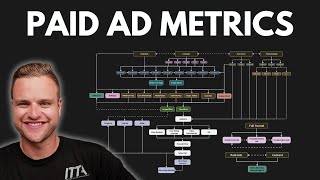
A spoken guide on the essential paid-ad metrics to track for lead-generation funnels aiming to scale to $10M/year. The speaker lists specific benchmarks (outbound CTR, application rate, qualified booked call rate, show rate, close rate), explains how to measure each (formulas or denominators), and gives practical tactics to improve them (ad angles, landing-page congruency, booking flows, pre-call sequences, follow-up). Emphasizes that ads are one part of a multi-step funnel where ads → form → booking → show → close can each fail.
Chapters
These are the most important paid ad metrics that you need to track in terms of lead generation. A lot of people are trying to get to 10 million per year or more with their ad funnel, but they're still not tracking the important metrics as nicely as they should be. If I asked you what these metrics should be, it shouldn't be, oh, it's around or I think, or you shouldn't even hesitate for one second. You should go to your Bookmarks tab, open your spreadsheet and be able to tell me within three seconds if that's not true for you. You're not tracking them properly. So this is an example of a lead generation funnel that gets to $10 million per year. And paid ads are a very, very important part of that. Whether it's a call funnel or a lead magnet funnel, or a newsletter funnel, or a webinar funnel, or a digital product funnel, or a community funnel or whatever, there's plenty of different options. But our metrics are what's going to be most important and it's going to apply to all of. So I have the metric, what the benchmark should be in my view, how to improve it, and then some notes if it's necessary. So the first one is going to be outbound ctr. And I think that for most people who are running lead focused campaigns, you need to shoot for an outbound CTR of 3.5%. This of course is also going to be a function of your CPM as well as your country. But. But in the United States, with a kind of normal or acceptable CPM, I am going to aim for 3.5%. And if I haven't got there, what I'm going to do to improve it is going to be different or better angles and messaging that resonate more with the target audience. I'm going to write better hooks, I'm going to have clearer copy that's easier to understand. I'm going to have better thumbnail and scroll stoppers. And sometimes if I view that a certain age or demographic clicks through at a higher percentage and those people are who actually end up buying, I might restrict it to something like that. An important note is that if you're already at about 3, 5%, I would say that's going to be good enough. And there's more value to be had in optimizing your funnel and your actual whatever the offer is on that funnel. So if that's a webinar, that's a community, that's a newsletter. If you're already at 3.5%. You should just kind of focus more on that. But it should be noted in my opinion that you need at least four AD angles that perform at a high level. So 3.5%. The reason for that is when you don't, when you just have one or kind of two angles or whatever that work, that's fine. But you're not going to kind of grasp or you're not going to capture the entire target market. And if one of those angles should stop working for some reason, you're kind of screwed. Good example is a friend of mine who has a crypto offer and he was at 3 to 4 million a month and then something happened and he went from 3 to 4 million a month to 200 to 300k per month almost overnight or within a 30 day period. The reason was his only ad angle that worked. Talks about, you know, don't get left behind in the crypto bull market. And then the bull market was over. And as you can see, that's a big problem. Most people don't have an egregious, you know, lack of messaging that is so dependent on something as that. But we need to have three to four ad angles that perform, that hit a high outbound click through rate. Of course, the next is the application rate and typically you're going to want to see 6 to 10% and that's going to be dependent on how strict or how tough your form is. So of course we, the job of the form is to dequeue as many people as are unqualified as possible because we don't want them to count as a conversion and get in the pixel data as well as there's really no benefit into talking to unqualified people. It'll just waste time on the calendar and make you think you're worse at sales than you actually are. But it's going to be 6 to 10%. Normally, sometimes it'll be less, sometimes it'll be more, but you're really going to want it to be in 6 to 10% because that's going to indicate it's proper. When you're constructing the form, you want to make it the exact length it needs to be. Not lower, like not shorter, not longer. You want to add as many disqualifying questions as you need, but you don't just want to start adding more questions and more friction for the sake of it, right? So if your application rate is lower than this, and that's going to be total applications divided by outbound clicks, you are going to want to Especially have a better landing page headline, a better vsl, a clearer page and offer better congruency between the landing page and the ads. And then if you're asking sensitive questions, put a reason or a reassurance for it. Like if you're asking them, you have a, an insurance based offer and what kind of insurance do you have? You want to put a like kind of a, a sub headline or a note like what's that used for? You know why we're asking. It doesn't even really have to be a good reason. It's just more of the fact that a reason exists and that if you see a very very high drop off rate at a certain part of the form that doesn't necessarily warrant a high drop off rate, always make sure to add those re reasons or reassurances for those more sensitive questions. The next is the qualified booked call rate and that is going to be a benchmark of 3 to 5% of outbound clicks. So qualified book calls divided by outbound clicks. In this case, you know almost everybody who's getting through your form to be even to book a call should be qualified, but sometimes they sneak through. So this is going to be a direct function of your application rate and your calendar availability. Obviously a higher application rate is going to mean more qualified book calls. But to improve this we can do a few things. Number one is we can put the calendly inside the form so they can't submit the application without booking a call. That's one option. Sometimes it works for me, sometimes it doesn't. Or if we have an external call booked page, put social proof on the page, add scarcity and urgency, say the call is with the founder. If that's actually true, that's a good way. But anything we can do to improve it here is going to have a positive effect. The next is the show rate and that is going to be obviously calls shown divided by calls booked. I like to aim for a 70% show rate here, especially on cold traffic. Sometimes people will say 50% but you're going to be wasting a lot of time for your sales reps. You're going to be not scaling at that rate. So to increase this, you know, an aggressive pre call email flow that really gets them all the information they need, only allowing calls to be booked 48 hours in advance because the no show rate just skyrockets after that. Retargeting ads to force feed them some more content. FAQs on the confirmation page, manage the expectations, you know, manual reach out by both SMS and Email and sometimes call if you have the capacity within five minutes. Introducing yourself, showing them the tons of case studies, social proof and above all kind of like a promise of an offer or a plan of action on the call. Just a reason to join the call in addition or on top of just we want to try to sell you something. You're going to walk away from the call with something is a very good way to increase the show rate and then the close rate on cold traffic. I like to aim for 25%. For me, if you're at over 25% it's kind of more of a sign that your price is too low and you need to raise it. I like to every time I get over 25% raise the price until you know it drops below 15% and then I kind of leave it there. But 25% is a great thing to improve that. We want to pre frame them correctly before the call. We want to get a good introduction that takes charge of the call. We want to ask them five questions that we've predetermined that using all of our data that kind of pushes the call forward and goes in the right direction. We want to have a clear sales presentation, good objection, handling a clear plan of action of how to get started and most importantly a systematic way to follow up for at least 90 days. Pushing FAQs, case studies, any proof that kind of get them to convert over time. Because 95% of people are not going to convert right there on the call. And the follow up is where you lose. Most of these people, they forget they're thinking about it. You're not top of mind, they just kind of are lost. Whereas you have a systematic follow up thing. You are going to close a lot of deals that you wouldn't otherwise have done. I almost feel like having the follow up is more important than the sales call itself. But that's just my opinion. When you're trying to increase close rate, the most important note and the most important shift that I ever had is instead of trying to train your salespeople to be good individually, focus on making it easier. So you have the pre call flow, you have the retargeting ads, you have the way to reach out within five minutes. You have all of the videos and all the case studies and all the FAQs, you have this sales call plan and call research automations. Then it just becomes easier. Instead of trying to train 10 people to get to 25% close rate, you can just make your system that much better to where 25% close rate is just the benchmark or the standard that people are going to get. If you do that, that's a far superior way to increase or improve your paid ad funnel. Paid ads in lead generation are very, very different than in E commerce, for example. And that's why a lot of E Comm agency people or people who are previously in E Comm kind of struggle with it. The paid ad is kind of the first part of the funnel and it's, you know, one of the four places that can go wrong. You can go wrong in the ads, it can go wrong on the landing page, it could go wrong in the show rate, it could go wrong in the close rate. It's going to be one of those four always going to be the biggest problem. And a lot of people treat their ads as if it's the entire problem or the entire process. But you go from the ads, you go to the form, you fill it out, you know, you go through the appointment setter, they book a call and then they have to show up for the call and then they have to close the call. Just viewing it as just paid ads as a lead generation source is not really going to get you the best result. There's many places it could go wrong and these are the metrics that you have to track. So I was hopefully this is valuable and I'll see you in the next one.
More from Matthew







Everything I Would Change About This Ecom Email Marketing Agency (3 HOUR LIVE AUDIT)

Everything I Would Change About This Meta Ads Training Business (3 HOUR LIVE AUDIT)


