The Secret To Hiring & Training "A Players" For Your Agency
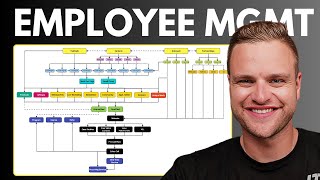
Speaker presents a 5-part system for hiring and training new agency employees during their first ~30 days to reduce churn and speed productivity. The five habits are: 1) structured onboarding (an internal course with modules, assignments, and feedback), 2) daily one-on-ones with team members/supervisor, 3) a defined "daily five" (recurring daily habits and one-off tasks), 4) daily Start/Stop/Keep feedback, and 5) the duplication method (documented SOPs + live-demo then trainee repetition). Advice is anchored with a cold-email outreach role as a running example and emphasizes measuring progress, probation if no improvement, and the potential to monetize internal courses externally.
Chapters
In this video, I'm going to go over five things that you have to do when hiring a new employee for your agency. And you'll typically go through these things within the first 30 days. After the first 30 days, you can change a lot of these things from daily to weekly or monthly. But I really think that you should be developing these five habits for the first 30 days. I've hired over 125 people for my agencies in the past. I was very unsuccessful when I was in my earlier years at hiring and training and managing people. But since I've had a combination of these five things, I've done a lot better. Still not perfect, but better than probably 99% of the people out there. So I'm going to go in and do step number one here, which is going to be onboarding. So onboarding is typically thought of as kind of a thing you do with your clients, but it really should be something that you do with your employees. Right as well. So in employee onboarding thing, there's three main things that I like to think about. The first is going to be a course, and that is kind of like similar to if you made a course to sell to people, you'd have kind of the exact same thing but for your own internal employee training. So if we go back up here and we go to the scale your agency funnel here, let's just say we were hiring to help us run our client acquisition and it was for some role. For this example, I'm kind of going to pinpoint that to being outreach and specifically cold email. So you'd have this course for this and that would cover the, you know, main parts of doing it. So list building, making an offer. What would it be? Another one script. Another one could be deliverability, of course. Let's just say that you don't need to write out the full word offer list script, you know, appointment settings, slash, inbox management. And then, you know, that could be good, you know, let's put the setup as well. So in this course for your internal employee training, you would have modules that have videos, they have step by step, they have examples, they have all that kind of stuff for every part of their job. So the course could be, you know, one part course if their job is simple. It could be a hundred part course if their job is more in depth. But you kind of want to have this for every single role. So the first thing is the course and basically we'll think of that as the modules and the learning material. The second thing we want to do for this is, we're going to call it assignments and that is basically what are you doing with this course material. So after the list building situation or the list building module we might have, okay, make me a list of this target market or maybe it could be multiple just to prove that when they're going through their list building they're actually developing and learning the skills that they need to another one for the offers. It could be, you know, make me an offer for X, Y and Z demographic or target audience. That could be another offer or another assignment and then you know, write a script for that. And these assignments are very, very important to basically prove that they're progressing. If they're not progressing, if they're going through the course and it's been, you know, 30 days already and they're just absolutely terrible at it, probably not a good fit. And that probation period should probably be end in, you know, they don't work here anymore. If you really want to be honest and do the truth here. And the next is going to be the feedback. So as they're going through the assignments, you should be giving them the feedback as like, okay, let's just say in this hypothetical scenario they made an offer for a B2B SaaS or an E commerce email marketing agency. The last part is the feedback from you, their peers and then their supervisor or if they have one, you know, for a smaller agency that'll be just you people in their department, their supervisor. You are giving them feedback on all of this stuff and that's very, very important to it. So that is phase one and that's going to be onboarding. This whole process is probably going to take 30 days, 14 to 30 days depending on the role. Some roles are more in depth, some roles are more complicated. But, but think of these as the list of all your video sops that you've made over the course of the lifetime of your agency, all kind of prepackaged in an intentional way to where that they can actually learn from it. A bonus point when you do this is that if you do it in an intentional and high quality way, you can basically repackage all of this and, and sell it as an inter, like an external course as one of your offers on for your agency, which is right here. So if someone comes through your funnel, let's just say they're qualified in the sense that they are part of your target market, but you just determine that they don't have enough money for your recurring service or intro offer, you can really send them to the course and still monetize them in a very effective way. So it kind of kills two birds in one stone. When you do this, you're actually going to hire and train people correctly, but you're also going to be developing another offer at the same time. And that's exciting when we can basically kill two birds with one stone. The second thing here is going to be daily one on ones. And you're going to do this at a minimum for 30 days, but you're probably going to be doing that at a weekly basis for more than that. So there's going to be kind of like similar things here. You're going to do one on one with you. You're going to do it every member of their department, of their team and you're going to do it with their supervisor. And this is very important in the first 30 day period for a couple of reasons. For number one, you're going to build kind of rapport and like a relationship with everybody on the team. That's important. The biggest hurdle or bad team chemistry or team culture is they just don't know each other. So if they're in this hypothetical cold email department and there's multiple people, because maybe you do cold email as a service, you're going to have the daily one on ones for even 10 minutes with you, a member of the cold email department, maybe that's 10 members. So every two weeks they'd have a 10, like a 10 minute one on one with every single person, 10 work days, you know, a different person person every day. And then their supervisor. You and your supervisor can be kind of interchangeable. You don't need to do both. And especially as your agency grows, you probably wouldn't you be in there, it'd probably be their supervisor taking over. But it's very important to build that rapport and that relationship. The next thing that this gets is a bunch of feedback because you know, presumably you every member of their department and then their supervisor actually knows what you're doing in terms of your agency. We, you know very well, hope so. Right. And the rapport, the relationship and the feedback are going to be absolutely invaluable in the first 30 days in terms of what they're giving feedback on. Like a lot of the time I had it up here, that's going to be their assignments. That's going to be where they like need access. They don't know what to do in this case. Like this is going to be extremely valuable to them. The next thing you want to do in this 30 day period, that should be number three, not number four is you want to do the daily five, which basically means in this case five things that they have to do every single day. So we want to plan both their one off tasks but as well as their habits. So there's always going to be and I'm a big proponent of the first hour to two of every employee's day. They have their recurring habits and that's going to be different on the role. But you need to basically define those habits, how to do them, train them on doing those. So no matter what they get done in, you know, hour three to hour eight of the day, those habits are always the first priority and those habits always get done. So example of this, this could be checking to make sure, you know, all of the replies in the inbox are replied to. This could be sure to make all of the campaigns are delivering. It should be, you could be making sure to okay, do we need to scrape another list? Or it could be going over the analytics and do we need to write a new script because we're not getting enough positive replies in this cold email example, you want to have these habits as kind of the cornerstone or the foundation or the bedrock of their job. And then their one off habits are stuff that builds the business forward, you know, builds business. And if you can do that and you can plan these out ahead of them, especially in the first 30 days, because after that they'll know what their habits are, they'll have them in their calendar and then their supervisor and team member can put the one off habits inside the project management tool. They'll have an extremely good foundation and they'll be a very useful employee for you in terms of if you're looking for guidance from me right now, like what these habits should be, it should be anything that's, you know, you do already. I don't know why this is. If you're looking at the screen, it's going black inside here. That could save you a lot of time. You know, as you the founder, like part of the reason you hire is to buy back your time so you can spend more time on higher leverage tasks. So anything you do in this case for cold email, like that list building, like the building reports, like that stuff, those are the habits that you'd be training them to do right away and it would save you a lot of time for your business. The next thing we want to do to change the color of the pen here is we want to do the. What Alex Hermosi calls and I think I read this in his first book the gym, launch book the start, stop, keep method. And I really like this. So basically it's very simple. At the end of every day for their first 30 days and you probably do this for like after their 30 days period are up once a week, forever in my opinion. It's. You'd have a list of things that you send them a message. So oops, I don't know what I'm doing on the screen here. I am getting really pissed off at whatever is happening on the screen here. So you send them a message, you know, list of things to start doing that they're not, list of things to stop doing that they are that they are. And things to keep doing that they're doing a good job. So the value in this is like okay, things to start doing. You know, you're basically need to do a better job on this list. You need to start going in depth and doing 20 minutes of QA on this list for cold email that you did. Just because I don't think that it's a perfect list. You could say another way to frame this is before you export the cold email list, start looking at the first two pages of contacts in the whatever tool you're scraping and if at least 80% of them aren't basically in the ICP, then you need to build the list better because it's never going to be 100% perfect, but it should be at least 80, 20. An example of the start stop doing, you know, stop taking so long to respond. You could also reframe that to start responding within five minutes during the day. It shouldn't take you 30 minutes for a response and then keep doing like you were doing a great job writing these scripts, keep it up type thing. This is invaluable feedback for the first 30 days of a new hire and it's invaluable feedback for basically everybody on a weekly basis. What I usually do at my companies is Friday evening I'll do the start, stop and keep for every employee and in the situation that I have too many, like at my previous agency to do this where I don't even know a lot of the employees, it would be their manager's responsibility and I'd be basically doing it for the manager and it'd be a top down approach. They very invaluable feedback for the first 30 days to do on a daily basis. And then as you keep doing it, day seven comes day 14, day 21. They're going to need less and less of this over time. But I still do this on a weekly basis for all my employees and all my companies. It's very, very important. The final one is basically a training one from pretty much every good project management book ever. But it's the called the duplicate method. So basically what you do, and I've heard a lot of people make videos about this too, so it's pretty common these days as well, is basically you're going to document, slash, create an SOP of everything you do. Think of it as one big checklist. It's probably the best way to do it. And with this checklist, you should be able to do the task a hundred percent with only the checklist. If you cannot do it with only the checklist, then it's not a good checklist, it's not proper. You're going to get them on a zoom call. So you're probably going to do this daily in the first 30 days or their supervisor is going to, you're going to get on the zoom call and you're going to do the task in front of them using only the checklist. Again, if you can't do it with only the checklist, you have background knowledge or nuance that you have it in your brain, that's not in the checklist list. It's not a proper sop, it's not a proper document, it's not a proper checklist and you're going to have to fix it. Once you have successfully done it with just the checklist, they will do it in front of you using only the checklist. And this is the essence of training. When you hear people, you got to train your employees like this is essentially what they mean by that and what you should be doing. You have the training, the checklist, whatever, you do it in front of them, they're watching intently, they do it in front of you. And if they can do it in front of you to the same quality that you did it in front of of them, they are trained now. And that's basically the essence of it. So a combination of these five habits. To recap, you want to basically have daily one on ones for the first 30 days, plan out their five tasks per day, tell them what they should stop doing, start doing and keep doing and then basically train them by the duplication method. You are going to have very good first 30 day training and that is going to make them more useful in general, but also quicker and lead to higher employee engagement and higher churn. Remember, the best employees can choose where they work. They don't have to work for you. You're not doing them a favor. You need the best employees more than they need you as their employer, and this system will obviously make them better employees, but it also lead to a much, much higher first impression or much, much better first impression. And that's going to improve. Basically decrease employee churn over time. Just like you'd want to decrease customer churn, you also want to decrease employee churn because it's very expensive to hire good employees in terms of money, but also time investment, and you don't want to have significant employee churn. So I hope this video was helpful and I'll see you in the next one.
More from Matthew







Everything I Would Change About This Ecom Email Marketing Agency (3 HOUR LIVE AUDIT)

Everything I Would Change About This Meta Ads Training Business (3 HOUR LIVE AUDIT)


