The Seven Things You Need To Scale Your Agency
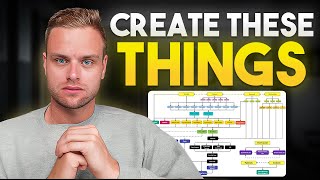
Matt breaks down seven components to scale an agency: an irresistible intro offer around $2,500, a frequent newsletter tailored to your audience, a YouTube channel posting tutorial videos 3-5 times weekly, a 50-200 page lead magnet, a 30-day email flow addressing one objection per day, a sales presentation stacked with proof, and a recurring service delivering at least $10,000 in six-month gross margin.
Chapters
Everybody, it's Matt. And in this video, I'm going to go over the seven most important things that I think you need to scale your agency. What I've done here is I have a mirror board in front of us and I have the seven different things and I just put a kind of a square or a rectangle over each of these things just so we don't get too distracted when we are talking about them. So what I'm going to do here is, is just try to make this video as simple and to the point as possible and just go over each thing and my thoughts on what it is and why we need it. So let's get right into it right away. So thing number one here is an intro offer priced around $2,500 that solves one problem and is low risk and low commitment for the buyer. So the best thing to do when you are trying to stand out from your target audience is to have an intro offer that's just irresistible. We've all heard of the topic of an irresistible or a grand slam offer. And it's very important to distinguish between intro offer versus recurring service in this case, because I am of the opinion and I've seen it happen with tons and tons and tons of different agencies. People will try to basically apply the concepts or the principles of making a great offer to their main recurring service. But the problem with that is there's not that much opportunity to distinguish yourself or to separate yourself from competitors with your main service. If you were to do E commerce email marketing, for example, you're going to have hundreds of competitors. Most of them can do just as good a job as you, if not better, and they could also do it for cheaper. There's no real way to distinguish yourself from email marketing in a way that you might be a lot better at it than your competitors, but there's not enough way to distinguish yourself from it in the sense that, you know in terms of the perception of the market. But it is very possible to make an intro offer that's 10, 20, 30, 40, 100 times as good as your competition. So that's why you want to focus on the intro offer, where it actually is possible to make something that's a lot better. I like to price the intro offer around $2,500 for the same reason that you don't really want to go over $100 if you're selling a digital product. Anything higher than 25, maybe 5k just removes the impulsive nature of buying. So a lot more expensive than it would Be if it was a product, but it's the same concept as, oh, it's just $2,500, I might as well try it. A lot of people will start pricing their intro offer as, you know, 10,000, 25,000 and say, well, it's still cheaper than my recurring service, or it's just a one time thing. $25,000 or $50,000 is kind of the opposite of low risk and low commitment. And it's just very important that it's not necessarily a hard cap, but we need to price it as something where it's easy to mentally justify that. You know, this might work one in 50 times, but if it does, I'm going to get a huge ROI. If it's $2,500 and the potential reward is a hundred thousand if you get it right, like if it was an ad creative or a landing page or something like that, it's very easy for them to justify it in that way, right? Oh, it's only $2,500, but the payoff's 40 times that. If it works, might as well try it out. The second thing that everybody needs is a newsletter that is inherently interesting to their target audience. And they should be sending this at least three times per week. Once people know about you through your ads, through your content, through your cold emails, through your partnerships, all of that kind of stuff, the next biggest problem is how do we convert them from just leads or people on a list to people who are qualified and people who book calls. And a newsletter is one of the two best ways to do that. It's a very intimate marketing channel that kind of goes directly from your thoughts to their brain in a way that YouTube, Twitter, Instagram and LinkedIn just kind of don't. The nice thing about a newsletter is it's the only channel that you really own yourself. Whereas if you're relying on SEO and there's an algorithm change, you know, you lost lots of your traffic and lots of your attention. Same with, you know, Twitter or Instagram or LinkedIn. When you post, it only shows to a very small percentage of your audience. Newsletter, you own it completely and you can reach your entire audience anytime you want. I have the term inherently interesting to your target audience here. A lot of people will treat their newsletter as an actual, like newspaper about what's going on in their business and their life. So not really how you should be doing it. You should be making a newsletter with sections that are inherently interesting to the target audience. So for example, if I had a Facebook ad agency, a Couple of my sections might be top Facebook ads of the week or, you know, top hook of the week or something like that. Or try this tip to improve your first 10 seconds of your video ad. Like, this is inherently interesting stuff that's interesting to the target audience. It's not all about you. The next thing that you want is a YouTube channel that has mural, board or slides videos that actually teaches them something. You don't need to do any crazy editing or scripting or stuff like that, but you should have a YouTube channel with videos just like these ones that you're watching now that you can convey a piece of value or some training from your brain. Record the video once, put it on the Internet and have dozens or hundreds or thousands of people watch it. This, along with the newsletter, is the other amazing way to convert people who already know about you into actual booked calls and actual leads. And posting three to five times per week daily, if you can build the habit to do so, is in my opinion, the number one thing that I would be doing if I was starting an agency from scratch right now. The fourth thing that you really need is a lead magnet that is sort of like a master training document that covers every step of your service. Maybe you have seen some of mine that you've downloaded from the description of my videos or something like that, but something that is 50, 100, 200 pages long, that's going to take a lot of time to create, but you only have to do it once, that you can trade in exchange for people's emails. So you say, go download my free training. They put their name, email, phone number, maybe website and revenue and they can download this and start consuming it. And by doing so you're going to get their contact information. So they're now a contactable lead. And number two, they're going to get the free value from your lead magnet and they're going to trust you way more. A good lead magnet is the only thing you need to get as many leads as possible. And I would really put a lot of effort into this lead magnet because although lead magnets are typically free in terms of money, you know, you're not charging for them, they're not free in terms of time, in terms of effort, all of that kind of stuff. If someone has been following you, clicks on your link, puts on their contact information, submits, looks in their inbox or their junk folder, or wherever your lead magnet goes, opens it and consumes it, and it's kind of half ass or it's not very good, that's Almost worse than having no lead magnet at all. A lot of people will just make their lead magnet 5, 10 pages and you know, think it's good. That's actually not going to do anything but make people hate you. So if you're going to make a lead magnet, put 20, 50, 100 hours into it, you only have to do it once and it's one of the most beneficial things that you could possibly do. Number five is a 30 day email flow that goes over one question and object and overcomes one objection per day for 30 days until hopefully there are none left. So when someone downloads your lead magnet, for example, they're going to have to fill out a form. That form should trigger this email flow. So there's always going to be objections about you, about your service, about whatever it is, right? So what we want to be doing is kind of taking 30 minutes or so and writing down and making a Google Doc, or you could use physical, like real paper, like a real notebook and brainstorm this stuff. So like, what are the objections of working with me, my service, that kind of stuff. So for me it's like, will this work in my country? You know, will this work for my niche? Is this too saturated? You know, I don't believe cold email works. I don't have money for paid ads, I don't want to get on camera for videos. And what you want to do is list out these things, one email per day for 30 days and write something thoughtful that's either a how to or a case study or an example or something where you can help them break these self limiting beliefs, overcome the objections, and by doing so, after 30 days, if you do it right, there's not going to be any objections left. It's kind of funny that, you know, people think that, you know, you got to really get into their personal life and you know, find their objections. A lot of people are going to have like one to two real objections to anything, but of course we don't know what those are going to be. So when we do this email flow like that, you know, maybe on day two you hit their objection number one and they're satisfied and then they keep reading your stuff. And on day 16, okay, that's the day you hit the other main objection and satisfied it. Day 16, they're going to be booking a call and that's really how it works over time. So the 30 day email flow is easy enough to create. It's just simple answering FAQs or objections or common questions. But it's a very important Part of the process that triggers when they download the lead magnet. And then in addition to that, they're also going to be receiving your newsletter. The sixth thing that we need is a sales presentation that answers most important questions and shows proof that this actually works. So when you get on a call, a lot of people don't even have a sales presentation. They just kind of wing it. And I'm sure that leads to some sales for some people. But there's a big difference between being in spite of something and being because of something. They're making these sales in spite of not having a sales presentation, not because of it. So you want to have a good sales presentation that you know, answers the main questions like what are we trying to do? What difference will this make? What's wrong with the way people normally do it? How long will it take? How much will it cost? You know, what are the risks or the negatives or the common FAQs? And you should be answering those and bringing them up like, yes, a thousand x leads is a lot of work, but we make it as easy as it possibly can be by having 120 day plan. Like that's an example. You don't just want to bring up, you know the risks and then just bring them up and put bad ideas in people's head. You know, yes, when you get a lot of leads your operations are going to be tough. But we have a full operations system that will install for your business and it'll make it easy when like that's another one. So the sales presentation is very important. You can also have it them redirect to this sales presentation and treat it as kind of like a sales presentation sales letter when they download the form. So when they download the form they'll be added to the flow, but then they'll redirect to the web page with the sales presentation. That's what I like to do. Because then they just know what we'd be talking about on the call. And then we want to stack it with as much proof as possible. Video testimonials, case studies, screenshots of wins, reviews, anything like that. The seventh and final thing that we want to have is some sort of recurring service that has at least $10,000 six month gross margin. And I put LTV in brackets because it's not really ltv, it's six months growth margin. But this would be an LTV like term. So a lot of people will say what's your ltv? You know, that kind of stuff. But LTV doesn't exist without A time frame. Like what's your lifetime value? I don't know. By the time I'm 70, I'm 28 now. Like this person could spend tons with me. Nonsense. But we can very easily measure something like 12 month LTV or 6 month LTV. Or if we know that we are selling a product high service that's worth 30k and they just have that, then our LTV would be 30k. But we need to have something that has at least a $10,000 six month gross margin. And this is after, you know, the cost of labor. Because that's what gross margin is in terms of, in the context of agencies. If you made a water bottle for $1 and sold it for three, you know, $3 is revenue, $1 is the cost, that's $2 gross margin. But in this case the product or the cost is going to be labor. So if we, this doesn't necessarily mean we have to have a high or a low price. But if we had $50,000 in revenue and $40,000 in cost, that is a six month gross margin too. That's terrible as a percentage, but that is still a six month margin. And the reason we have $10,000 is because we are going to hope that the intro offer at least will cover the cost of ad spend or customer acquisition. But we still need to make a lot of profit, especially as we're scaling because it's all fun and games when you're first starting. But eventually you have to hire people like hr. You have to hire people like, you know, your finance department, people that don't directly produce revenue. And we're going to need a lot of gross margin to pay for those costs, as well as software, as well as taxes, that kind of stuff. A lot of people will have, you know, a 3K a month service. They stay for four months on average. And even if they have, you know, that's $12,000 in revenue and if, even if they have 50% margin, that's like 6,000. Once you really get into the software costs, the admin costs, the finance costs and the HR costs and the cost of hiring and all that kind of stuff, the things that don't directly produce revenue. Without at least $10,000 in gross margin per client, there's not that much revenue left at the end of the day or there's not that much money left. So a lot of people basically need to raise their prices or reduce churn in this case. And you'd be surprised, of course, if you're selling to enterprise or you're just really good at what you do. You might think six month gross margin, $10,000 is not much, but it is a lot to some agencies and it's just something that we need to keep in mind. So with that being said, these are the seven most important things that I need or I think that you need to scale your agency. I hope this video was helpful and I will see you in the next one.
More from Matthew







Everything I Would Change About This Ecom Email Marketing Agency (3 HOUR LIVE AUDIT)

Everything I Would Change About This Meta Ads Training Business (3 HOUR LIVE AUDIT)


