The Simple Step By Step Process To a $1 Million Per Year Agency
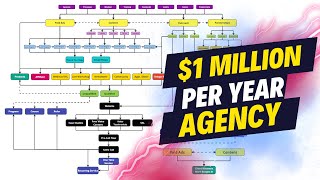
This content was created by valued-canopus. This content was uploaded by valued-canopus. This is a YouTube video titled "The Simple Step By Step Process To a $1 Million Per Year Agency" created on May 10, 2024, providing a guide on building a successful agency.
Chapters
Greetings, My name is Matthew Larson with a thousand X elites here and this will be a Miro board video. And this is going to be a video that's probably going to be pretty long to be honest, but it's going to be a very, very good training because even I have gotten away from, you know, how this would actually work in the real world where it's one thing to look at a diagram like this and say it's a nice marketing funnel, but how would you actually implement this for a real business? And I think these videos are pretty good and pretty valuable because it ties in, you know, helps you take the leap from theory to actual reality. And a lot of times stuff in theory doesn't work in reality. A lot of scenarios where you have like a sales trainer for example, where they're, you know, doing all of these very specific situations that don't actually exist in anything but a sales course. This is something that can be easily applied to the real world and I'm going to show you that right here. So the niche for this, because we have to choose some niche or some example. It's going to be a YouTube growth agency for agency owners, you know, little agency on agency here. So it's very important to have a niche. You know, YouTube for agency owners is going to be different than YouTube for, you know, short form video creators. So we need to have a very specific niche without being like crazy specific like YouTube agency for local SEO agency owners. That would be a bit much, but agency owners is good enough. So what I have here is, I have, you know, how exactly are we going to do the top of funnel, the middle of the funnel, the bottom of the funnel, the offers and then incorporate some leverage into this. And I have some, you know, space for other diagrams too, but I'm just going to go right into it here. So this funnel will work for any B2B business. Anything to suggest otherwise is just cope and a self limiting belief. Same thing with country or language. The principles and the fundamentals of marketing are not different from the United States to China to Germany to South Africa to Colombia. I'm will admit that there's cultural differences, but this will work for any single one that you could possibly do. It's going to work for any niche too. From like I said before, you know, the very, very specific to the more broad. It's going to work and you can make something like this in about 120 days if you have the right plan. If you don't, you know, it could take longer. But this looks Like a lot of work. And it is, but I think it looks like a lot more work than it actually is too. So two or more things can be true at the same. And I would say that is the truth here. So let's get into it and I'm, I'm gonna zoom in like this so we can actually see what I'm writing. So let's start with paid ads. Paid ads are gonna be very scalable, very scalable. But they come with the obvious downside that they cost money. Hence the term paid ads, not free ads. Right. Free ads would be content really, if you want to think of it like that. So I would want to choose one of four types of ad funnels here. And the four types of ad funnels that you can really use in B2B legion are the webinar and the VSL funnel. And don't you know, this could be a case study, a training, a presentation. Don't get too caught up in the term webinar. You can use a newsletter, one that's typically very good for things with a really long sales cycle because you can just stay in touch and nurture them over time. A group funnel is really good when they can see some results for themselves before they fully trust you. And then a paid product funnel is like you're selling templates or something. And this is a very good one, especially for beginners, because it's more. Less nuance involved, I would say. So of these, I would probably choose two, because you don't have to just choose one either. In theory, having all of them would be the best, but you usually start with one and then go to two and then whatever. I'm going to do a group funnel and a paid product funnel for this one. So the group funnel is going to just be a group that's focused, group focused on growing on YouTube. Paid product will be a hundred thumbnail templates plus winning title formats. And I think these would be a great way to make a product and group that's valuable to the person as well as something that can be scaled with ads versus, you know, not everything can be scaled with ads, but I think these two could do just fine for content. I'm going to post on LinkedIn, Twitter, Instagram. Well, let's go. I am going to create content for Twitter, then cross post the same thing to Instagram, Facebook and LinkedIn as carousels, as those kind of perform the best. Because I am a YouTube agency. It would be very, very logical, let's say, to have a YouTube channel, channel two as a rule of thumb, you should always engage in what you're selling. If you're selling Twitter services and you have five followers, that's not going to look very good on your end, is it? And it's the same thing here. I am going to take the highest performing tweets and turn them into short form videos with the same idea. So if I post something on Twitter and LinkedIn and Instagram and Facebook and that really works well, I'm going to take that as a sign, sign from the gods that I should probably turn that into a short form video for TikTok, for Instagram Reels and for Facebook would probably make sense for outreach. The most important thing is I can export a list of agency owners easy enough. But the most important thing is, you know, they're going to get a lot of cold emails. So I need to make a cold email offer that is simply a no brainer that would be illogical for them to say no to. And we'll go through that after. We're going to go through every single part of this. This is the main leverage point that will separate me from the hundreds of other cold emails that they get. Because people are going to get a lot of cold emails. And what's true with cold email, number one, they didn't ask for you to email them. Number two, they don't know who you are. Number three, they're probably not even looking for this at that time, you know, statistically speaking. And four, you know, they don't trust you. So we can't just do the same thing we would do with our friends, like hey, I'll do your YouTube for you. Not gonna work, not gonna, going to work. And partnerships, you know, when you get one client, you get one client. Obviously when you get a partner, you could get 10 clients, maybe 25, perhaps 50 or even a hundred over time. Most partnerships that you get will suck. It is the 8020 request rule for sure where 20% of partners will refer you 80% of the total referrals you get, sometimes even more dramatically than that. So the thing is that these things like the purpose of all of them, the partnerships, the outreach, the content, like what we're trying to do is get attention. And that's really it. We get attention through content, so we do posts and if it goes viral or we slowly build up our audience over time, that's kind of attention that's free but time consuming to create. Cold email is also free or close to it, but it can't be scaled. Like if you want to double Your clients from cold email, you kind of have to just send twice as many cold emails. It doesn't get easier over time. Partnerships, very good. But they take the longest to create and you know, it's kind of like playing the lottery in some degree where there's a huge payoff but it's unlikely, let's say. And then paid ads are example of us buying attention where, you know, it's kind of like the same as content, but we're paying someone else to get the attention. Usually Facebook, YouTube, all that kind of stuff. Right. So the goal doesn't change for these. A lot of people treat these as if there's an entirely different goal. The goal is to, you know, get sales calls. Right. Like that's what we're trying to do with these. It's more of that's the end. And these are all different means to an end. So let's get right into it. In this case, we're going to put an X and we want to make this X red. Of course, just because X's are always red. We're going to not going to do these two, but we're going to do the group funnel and the paid product funnel. So I'd run something like a Facebook ad to a lead magnet, you know, how to make good or like a lead magnet could be how to come up with good video ideas on the thank you page, plus inside the email flow, plus inside the lead magnet. I would promote this group. You know, here's the link to the group, you know, join. I would post daily in the group, probably a tip, plus get my employee to message everyone, trying to get them to book a call. Like that's essentially what you're doing. You're paying Facebook or whatever platform for attention to get them to download a lead magnet and then getting them into the group and then getting them to book a call. Three steps. It's just a three step process for paid products. You know, Facebook ad to a sales page, selling the paid product thumbnail, plus title templates, you know, over time. Well, let's say my goal here, oh my gosh, it's not yellow in here anymore. So we're going to go like this. My goal here would simply be to break even on this. If I was selling at $100, I would want my CPA to be $100 or less. Anything would be good. You can think of this as just another way to generate leads. Instead of it being free, it's paid. But the purpose is not to make a lot of money over time with Email flows, newsletters, all that kind of stuff. I would convert a percentage to actual clients. Typically you get, like, I would aim for something like 2%. So if I sold a hundred of these templates, or 100 units of them, rather, and what I try to get, like 1 to 2% of those as paying clients, you're never going to get all of them, and you're never going to get even a large amount of them. But if you're breaking even on that, it's kind of like you're getting leads for free. So it doesn't really matter. And that's like one of the main benefits of a paid product funnel with the other types, because you're not breaking even on the front end. Like, you're kind of floating that cash and hopefully you're going to make it back later. That's why if you can really crack at a paid product funnel is good, because it just doesn't matter. It's as long as you're breaking even, all good. So let's go to the content. Now. I would post everything for Twitter, like I said I would post. Basically what I would do is think of FAQs that have to do with YouTube. So how do I create thumbnails? You know, what are the best colors to use? How do I come up with video ideas? And I would answer FAQs as tweets. And I would do this probably about five times per day. And the purpose of that is to, like, just think of it as overcoming objections. Every FAQ is an objection in and of itself. And if I keep posting about this, people see it over and over and over and over again. That's a form of nurturing, you could say, I would also post maybe one graphic per day, explaining or simplifying, simplifying more complex concepts. So you can think of it like, these are all graphics. Imagine me trying to explain all this to you without these graphics. It's a similar with this YouTube agency or yours as the viewer. If you have these graphics, it becomes much more easy to explain and much more easy to resist. Resonate with them, and they're just going to be much more likely to hire you. I'm going to post one thread per. Maybe not one per day, but three threads per week. Let's do the three graphics per week, too. We don't need to go too crazy. And basically you can think of the threads, you know, explaining more complex concepts through writing instead of an image. It's very, very, very easy way to do it. And it's just as effective. Like If I was to explain something with an, with a single Tweet that's like 280 characters, I could go in a lot more in depth with an actual thread. So I'm going to do that a few times per week. We don't need to do it too much. And I'm going to post once per day, basically explaining posting once per day with an offer, whether that is paid product or lead magnet or whatever. This is to grow my list. If we're not pitching them, if we're just posting content for value, but we're not pitching them, you know, we're not going to get any clients that way. So that's what I would do. Cross post the same thing from Twitter as carousels. This will be automatic using something like Hype Fury and I'm just gonna basically do that too. I'm gonna consider Instagram and Facebook the same thing here. For YouTube, I'm going to make screen sharing Miro boards just like the one you are watching now. Going to post once per day focused on value, not tricks or editing. What I would do is I would brainstorm. Oh my God, it's not yellow. Brainstorm. 30ish video ideas. That would be good. You know, 30 different topics is not that hard to come up with. They're gonna be overlapped for sure. But after these are done, just restart, remake and just keep doing this. Basically for TikTok in short form. So you could say reels and Instagram shorts too. I would take the best performing tweets. You know you're gonna have five to seven per day. So just the best one or best ones and then re. And then turn them into short form content is what I would be doing here. If you have a tweet that's got like 10 times as many likes as usual, that'd be a good one. And I would just really focus on the hook, focus on making it super actionable. I would treat short form video as more beginner basic and top of funnel than perhaps a YouTube video. So we have a nice mix. We're getting people to learn about us, you, you know, the widest possible audience and then we're slowly getting more narrow. So the widest would be TikTok, Instagram, Twitter, LinkedIn would be getting more narrow. You could think of it as top of funnel, TikTok, middle of funnel, like this stuff and then bottom of funnel. YouTube, you can think of it that way if you want. Not a perfect way to think about it, but pretty good. So for cold email and cold DMs I'd probably do the same thing. I would export a list of agency owners that have three to 10 employees would be good for me because if they're less than that, they're probably, you know, that includes all the agencies who do no revenue at all or just too small over 10, harder to reach, more gatekeepers. So three to 10 would be a good size. I'm gonna probably stick to, you know, United States, Canada, uk, Australia, maybe New Zealand as the location and of course, you know, marketing agency owners. That's going to be mostly obvious but we're going to throw that in there. So the most important thing are the, the list. You got to have the right list. If you're just targeting the wrong people, it's not going to work. But then the offer is very important and then the script is very important. The most important, like you can't have any of, you can't be missing any of them. But the offer is the part that's going to do most of the, you know, heavy lifting. Let's just refer to it as that. So let's put that as the list. Maybe let's break these up too just to signify that they're different. I, you can't tell that much. So for the offer I would do something like 10 free video ideas or something of this nature because in general most, remember most of these agencies are not going to be doing YouTube at all just statistically speaking. So the idea is going to be the most important part. So I would do 10 free video ideas and I would fulfill this with AI using some, you know, prompts GPT I made, that actually is a good result. And this is very important because the problem with cold email is people don't do enough, you know, don't have a good enough offer just because making a good offer like that's going to take a long time to fulfill. So I spend a lot of time basically building this GPT that gives them the ideas. So if, you know, if they fill in three questions on a form, for example, it'll make it and spit it out. It's very possible these days with all of the emerging technology and you can make it quite good. It's a self limiting belief to think that AI is trash, garbage in, garbage out. It's a saying in tech. If you put crap into the AI, it's going to put crap result. If you put good stuff, it's going to get you a good result. And that's just a fact, not an opinion and anything, you know, saying that this isn't possible self limiting belief. Hopefully you get over that. And for the script, I would center it around sending them a loom about how you know about five things that agency owners can do to get clients on YouTube or something of this nature. It could be a quick guide, could be five things, but something to show them how it would be possible would be ideal in my opinion here. And that's what I'd be doing. So you have the right list, you have a great offer that's basically Risk Free, has 10 good ideas that they have the ideas now they might want to act on them. And then you center it around a video, a loom showing yourself. You know, if you, if they see your face, they hear your voice, you explain them something that separates you from the rest and now you're a real person, not just some random cold emailing them. Very, very good. I think this would work quite well. So I'm going to do the same thing here. Well, let's just go same as cold email because really the strategy would not be super different for prospecting. I'm going to spend 60 minutes per day and I'm going to put super tedious. But that's life. There is always a price to pay for success. I'm probably going to go on Twitter + LinkedIn and search for follow, connect, comment and message and play the long game towards developing relationships with agency owners. They, you know, even if I would think of this more of building a network and making friends, because even if they're not going to do it, they'll tag you in group chats, they'll refer you, they'll bring you up tremendous value in just 60 minutes per day of this. And one of the most tedious things you can do. But you know, unless you're soft, it's the only real way to do it. And if you're not willing to do it, probably not going to succeed in my hypothetical YouTube agency here where we'll be doing anything it takes to succeed, including prospecting. So let's go to the partnerships because in this case the white label, the referral and probably the joint venture partners are going to be the same person. It's more of a how would they prefer to work? You know, if they have clients that you could do like, you know, white labeling referrals, that's the same thing. It's just if they're paying you on behalf of their client or referring the client to you. So who would be some good partners here? You know, there's going to be other YouTube vendors that don't do it all. So you have editors, script writers, you know, thumbnail designers. What would be some other ones? You know, if someone has a paid ad agency that they want to basically, you know, their client wants something like, this would be a good one too. There's some other ones too you could have, you know, let's go to referral partners, you know, YouTube apps, you know, Sassy always are looking for kind of vetted vendors for their users, all that kind of stuff. So a combination of these is who I'd be reaching out to for partnerships and for media. You know, classic YouTubers about YouTube, YouTube newsletters, YouTube blogs, YouTube events, you know, speaking at them. That's what I would be going for here. And I'm just going to put joint ventures, same as white label plus referral in this case. But this is literally who you'd be reaching out to. And this is literally what I'd be doing for cold email and prospecting. This is literally what I'd be doing for content and literally, literally what I'd be doing for paid ads. Hopefully I've said that word literally enough. But this is not just some bullshit theory. This is what you'd actually be doing for your top of funnel in a hypothetical marketing agency such as this. It's very important that I bring this up because a lot of these YouTube videos that you see, a lot of advice is purely theoretical where this is actually how it would work. So I'm going to consider the top of funnel actually done here. I'm not going to start writing tweets and scripting out YouTube videos on this video, as it would be 29 hours along if I did all of this. But let's go on to the middle of the funnel. So the middle of the funnel we're really talking about. If we go back to the diagram, we talk about our lead magnets, our thank you page, our email flows, and I would throw the affiliate stuff in there because your affiliate links are going to be inside your lead magnet. That's a very good revenue stream. So what would we do for the lead magnets? What would we do for the email flows? And let's get right into it. I have some graphics here because you'll notice there's a ton of lead magnets and a lot of people will say like, do I really need all of these? And the answer is yes. And I have some graphics to explain why. So these are the problems with starting a YouTube channel. You need to set up your lights and camera, you need to set up your mic, create titles Thumbnails, scripts, video, ideas, all of that kind of stuff. These are all, let's go. Barriers to entry. With someone joining a. You're starting a YouTube channel and therefore someone hiring you, you need to make lead magnets because you know how to do all of this stuff. That's why you're in business. That's why I'm in business in this YouTube agency. We need. Or what I would be doing is creating lead magnets to address and overcome and teach them how to do every step of the way. Because when I do so, it becomes very natural for them to just say, okay, I'm going to hire this guy. He's already clearly knows what he's doing. All of that kind of stuff where people get into trouble. And the reason that I wouldn't just create one is I might help them with one thing and get their email address. But the rest of these problems still exist. And that's the key thing to remember if these problems still exist. They're not hiring you, they're not thanking you, they're not remembering who you are. They're wondering who can help them with these problems, and that's how they will find someone else. If someone has ever, you know, said they're interviewing multiple agencies or price shopping you or that kind of stuff, or saying, how are you different? It's a symptom of you not doing a good enough job here. And this is if you, if you did this successfully, they wouldn't be asking, how are you different? Or interviewing five different agencies and making the decision. And that's something that very important to understand. Let's go back. So what would I do? The easiest way to create all these lead magnets is to take all of those different problems or steps or categories and make the lead magnet to solve it. So, thumbnails. Let's go. Scripts. Can't forget about ideas. You know, production value in terms of video. So lighting and camera and stuff like that. Let's go. Production value in terms of sound. Let's go. How to speak on camera. Because that's a skill in and of itself. What would be another one? What did I put already? I already forgot titles. We need to do titles. What would be another one? Kind of YouTube, SEO, tags, descriptions, you know, all of that kind of stuff. And the final one, what would the final one be? I'd probably do one on short form because that is, you know, mostly we're thinking about long form with, with in this use case. But short form is probably one I would do or I probably do. You know introduction, how to get them hooked, and actually watching the video. Because my service in this case, I just decided now is mostly long form. It's not short form. Right. We're just going to differentiate that because it's very important. If you don't have the right lead magnets, if you don't correctly identify these problems, it doesn't matter if you just have a bunch of lead magnets. If, if these are the problems that are stopping someone and you misidentified them, it's the same thing as being in a scenario like this. You just have a bunch of lead magnets down here at the bottom that are useless. So it's very important, Very, very important. So what would I do? I'd be doing something like, with each lead magnet, there's a few rules that you should follow. And I typically will go value. Although the lead magnet is going to be free, would you honestly pay $50 for this lead magnet? The answer is no. It's not good enough. Hopefully you have some honest friends that will not, you know, be yes men and will actually tell you the truth here when you ask them to say, would they pay $50 for it? Would there be steps you know how to do this within 24 hours? Like, that's a good one, too. And is it readable? Is there one idea, an image per slide? We don't want to have a big wall of text. It doesn't matter how valuable and actionable our lead magnet is if no one's going to basically do it. So what confers value? So I'm going to do a thumbnail, you know, basically teach them the theory behind thumbnails. I'm going to have some, maybe some starter templates or elements that they can copy and use for their own. I'm going to have a swipe file of, let's say, winning ones, winning thumbnails and winning thumbnails. I mean, thumbnails that are like. If someone has, you know, x amount of videos on their channel and they get one that's really good, what was the thumbnail on that one? I know there's other aspects of it, but that would be valuable in and of itself here. So I'm always going to teach them the theory. I'm going to put that in all of them just because that is basically like, you know what, that's a core part of it, let's just say. And that's going to be true in all of them if they don't understand the theory. Theory is not enough, but theory is still required. So let's go and just put that in all of them quickly. You should think of the theory part in these. Like you should think of it. You're giving them away so much information that they have no choice but to view you as an expert. It's self evident that you're an expert just because, you know, look at how much you taught them. So scripts I would boot. This is kind of the same thing. I give like a framework instead of templates because you can't really have a script writing template, but you could have a framework, frameworks for different, you know, types of scripts. If we want to refer to it as that. Let's get this a little smaller. I would have a. Examples of, you know, let's go, let's just put examples, you don't need to get too specific of winning scripts from great videos plus the link to the finished video. And then I would have a before, verse, after, like kind of me recording a video versus like just winging it and then me recording a video with a script and then show like them side by side. I think that'd be really strong ideas, you know. You know, kind of swipe with. What's with this yellow here? Swipe file of winning ideas. I don't know about that. How to come up with winning ideas. I would do like comparison example of you know, between mediocre idea versus like high performing idea. Because I think if you can show someone like a mediocre idea and then like how you would make that better, I think that would be very strong. I anticipate that would do well for my new YouTube marketing agency. So production value, I would have like actual setup diagrams, actual settings on lighting, actual settings on camera. And I would have like side by side comparisons what the same setup looks like with different lights. So this one would be like more technical. Like this is an actual guide here. Probably don't even need the theory of production value, really. It's more of like how you set this stuff up. So that's what I would do here. So the same thing with the production value for sound, how to position your microphone when speaking microphone settings, what type of microphone to buy for different budgets. Different budgets and like plus use cases. If you're sitting at a desk recording it like I am, you probably get a different mic setup than if you're recording videos, you know, and walking around type thing. That's kind of what I would do. You know what lights plus camera to buy for different budget. I'd put that back in there too. That seems like a good one. How to speak on camera, how to literally sit in your chair in terms of posture. You know, the top three things that I've always been told when speaking on camera are your, your conviction plus your energy. Not going to put the word your plus your pace. And how to kind of do these things. A something like a checklist or review video on, you know, where you go. Not review sheet, not video review where you go after you record and give yourself a rating. And then before verse, after examples of speaking the same script properly versus not. Because that's just a lot of the time, half the value is in seeing it done correctly versus not because some of these things are abstract in your mind, but when you see it. And especially like if you get like real time feedback from someone, it's just, you know, someone literally sitting on the YouTube or sitting on a call with you while you're recording and saying no, no, no, no. And then just, you know, more energy, more conviction. I paid someone to do this for me and I think it worked. I don't know if you think I'm good at YouTube videos or not, but compared to what I was before that training, it's a lot better, trust me. We'll just leave it at that. So, lead magnet, in theory, I would have a list of winning titles that got more title formats. Let's go. That got way more views than normal, you know. And that's kind of what I would do. Like that's really the value here. Or and then I would do, you know, A versus B comparison of bad titles versus good titles. Like this is kind of what I mean with all this actionable stuff. Or listen, you know, in the. What makes them. This makes it valuable for sure, but it also makes it actionable. And the theory is important. You can't skip the theory, but you need the action step type stuff. Very, very important. How to choose tags guide how to write a description guide default uploads template and default uploads is what the description and tags are going to be when you do this stuff. Like when you upload a YouTube video, it'll just do it by default. Not much to say there other than because this is going to be very theoretical. Introduction framework how to script out the first, first 60 seconds of the video. 60 like video introduction scripting frameworks and examples. Because when you're doing a long video like this, it's already 37 minutes in and we're not super close to being done. You're not going to script out the whole thing. Like there's no way I would script out this video. It would just take days to script, but you kind of want to get the first 60 seconds pretty decent because that's what's gonna determine if people watch or not. So that's what I do for the lead magnets. That's basically for affiliate links. I'd have stuff I'm gonna list off, like very specific stuff. You know, editing software, YouTube, SEO software, recording software, you know, links to the camera plus lighting plus mic and like anything like that. If you, they buy it on Amazon, you could have an affiliate link like that. What would be some other ones? Maybe like stock footage licensing software like, like Pixabay or Storyblocks or something. Thumbnail editing software. Like if you do it in Photoshop or Canva, you could have an affiliate link for that. Anything that you can do to just get some stuff. On my thank you page, I would probably use this page to promote the group. So if someone submits a form to get my lead magnet, I promote the thank you page on the or promote the group on the thank you page. So they submit the form redirected to the thank you page and I promote the group. I can sell the paid products inside the group. I cannot promote. Well, I could promote the group inside the paid products, but it'd be easier to do it this way. And on this link I would ask for way more contact info to get access to this such as phone number, revenue, website, etc. On the lead magnet you might ask just for their email. But this is a great chance to get all of their information because it's perceived as more valuable. They've already committed to you once, you know, by doing the lead magnet it's a very good. We need to enrich the data. If I was downloading the production value lead magnet and I put my email address as matt123mail.com that's a start. You have now my, my email address but that doesn't tell you anything as if I'm qualified or not. So we really want to get as much information we can and to get access to the group is a good, basically a good thing to do, like a good place to do that. For my email flows I would have two sets. I would have my 60 minute email flows. I would send them four emails in 60 minutes. Lead magnet delivery. What problems I solve, why they need to solve these problems with a heavy emphasis on now and then, how I solve these problems. If you're crying in your head right now about sending six emails in or four emails in 60 minutes, it's just a self limiting belief. It's better for them to. It's way worse for them to not know who you are or not remember and not know what you do than it is for them to get annoyed and unsubscribe. Trust me, it's just one of those things and got to get over it. If you, if this frightens you. It's just, it's just an email flow. There's no need to be scared. Right. And then I would have a second one is my 30 day email flow. So basically this would be, this would range from essentially what would be minute 61 to minute or today 30. And I would send one email per day addressing an FAQ objection until hopefully there are none left. Hopefully. And then they buy. Yay. So that is what I would do for the middle of the funnel. So let's go back to our stuff here. We've got, I'm going to put check marks but I'm going to erase them after. So we got our top of funnel content, we got our middle of funnel lead magnets. Thank you. Page and email flows. So now we gotta go to this part which is the conversion mechanisms. So our paid products, we've already done this. They're gonna be those thumbnail templates. Cause these are a good ad offer to get people in. But they also in some ways qualify people on their own because if they're willing to spend $100 on them, for example, that's infinitely more likely to convert. As opposed to someone who doesn't spend $100. For my VSL, I'd probably do top five things. I do one of two things, maybe both. Top five things you need to do to get clients from YouTube as a VSL or webinar. And then I also do a case study how we helped X agency get Y clients in Z time frame. With YouTube. I'd probably do both of these because you don't before you try it, you know, there's no secret before you try it. It's glorified guessing at best. So I would do something like this. So for my live workshop I might, you know, every Tuesday at 12pm Eastern time, just an example, I would come up with ideas or scripts or thumbnails in real time on the call. Bonus. You know, I might, you know, take ideas from people on the call, you know, for a thumbnail, like they give me the title and the picture and show them what thumbnail I would create. This is a very good way to demonstrate my skills and very, very strong, very good way to Impress people enough where they're going to hire you. For my newsletter here, I would write a three times per week newsletter. One would be very theoretical, one would be a tip to grow on YouTube. One would be, you know, delivering the best thumbnails, titles, etc of the week. So I'd have a little bit of variety, you know, give people to a reason to open all of them now just kind of follow this schedule. I would get, get, get template or templates that I can just duplicate and use each week to make it faster. 3 times per week newsletter about YouTube or content creation. I'd probably go YouTube. In this case, my group would be what I did before, determined before. But daily posts, daily reaching out to book calls. I might try to get like exclusive discounts on popular gear, YouTube software. You know, if you have a big community you can say go to like Sony, maybe not Sony, that might be too much but a lot of the softwares and say, you know, I have this group, can you give us 10% off or something As a perk I would post successful examples in the group. Supposedly what I do, the group is you're going to have to do a lot of work on an ongoing basis in comparison to the other ones. And it's either the most effective if you do it right or it's the least effective if you don't do it right. So who would have thought, who would have thought if you do something good in life, it's the most effective. If not, it sucks. Just one of those things. At my YouTube agency, hypothetically in this video, we're going the extra mile. So we're going to use the group appointment setting. I'd reach out twice per week to everyone in my CRM to try to get them to book a call. And if that fails to join a conversion mechanism. So you'd really want to have all of these and you want people to take advantage of all of them. You want the people to buy, watch your webinar, come to your live workshops, read your newsletter, join your group. So that's what I mean. If they don't want to buy or don't want to book a call, okay, that's fine. Join my group or watch my webinar. I would post seven times per week on my own YouTube channel, educating them on all of the steps it takes. And if I am selling YouTube stuff, I need to have my own YouTube channel. It's just common sense and, and it's going to be a lot better if you don't, if you don't have whatever you're selling for yourself. That's like a big objection. If you're so good at YouTube, why don't you have your own channel? YouTube unique mechanism. I would create an AI and this would be the same as my cold email offer that I talked about earlier. That will create 10 great ideas, titles and scripts based on their inputs. And that's just a very good way to do it. They don't need to know it's made with AI, but it's just a very strong unique mechanism. So that is what I would do for all of my bottom of funnel conversion mechanisms. And these would solve two purposes. You know, nurturing them, you know, giving them more value. And two, what I said before about just to join the, the group or join the webinar, they got to give me more information and that will help me further qualify people. Very, very important. So let's go back to the top and let's just, just for mental purposes say that our conversion mechanisms are complete. Let's go to the offers and then we'll go to leverage. Wrap it up with that. So we kind of have a few of these done. So we're going to have the thumbnail templates and we're going to have, you know, YouTube software and camera gear or video gear. We'll just go video gear. For this one we'll just put camera gear, microphone lights because I don't want to put the yellow background in there. So for referrals, that is a big, that's a good way to get money too. Oops, terrible. If they can't afford us, I would refer them to a cheaper agency and get a fee. If they are too big for us, I would refer them to a bigger agency. I don't know if there would be any situations like that, but I'd have those contacts available. I would also have contacts that sell adjacent services. So like this, this what we're really doing. We're not really selling YouTube, we're selling lead generation and YouTube is how we do it. So I'd have like, you know, SEO, paid ads, things like that. As you know. This is great. Do you know anyone for paid ads? Yes, I do refer them, collect a fee for the course. I would repurpose my internal employee training and repackage it into a course for people, for people who either can't afford me or want to learn to do it themselves. And there's always going to be a percentage of the market who want to learn to do it themselves. It's just a fact. And you're missing out on people. These are people that will not hire someone to do it for whatever reason. The reason is not important, but they will not do it. And it's just one of those things that if you're, it's like 10, 15% of the market. So you need to have this stuff. For my program, let's say for 500 per month I will give people unlimited thumbnail feedback inside a community for this purpose. So the program is very good for people who are doing it themselves, but also people who, you know, there's different types of people who want to do it themselves. Those who can't afford it, those who just like it and those who are already successful on YouTube who just want another set of eyes. And I think this type of program would be very good. It's affordable, doesn't take too much time. You can get 100 clients in there and you know, it's very affordable for them. But 100 clients in there takes you maybe, you know, it's not like you're giving an hour of feedback, it's just, you know, a few minutes of feedback for 5 hours a week. You can make an extra 50k a month type of thing. The recurring service is going to be, you know, growth. It's going to be editing thumbnails, All that kind of stuff, scripts, ideas. So that's kind of set in stone and that's like the offer that everyone has. You always have a recurring offer, that's why you're in business. But for the one time offer, an intro offer, I would do something like work together on a package of three videos for X price. So typically you can sell a one time offer that has a specific scope and end date for a lot higher price for the same work as you could an open ended recurring service. And that's just how life is. So one time offer, yo, let's not really commit. Let's see if we work together, let's see how the videos perform. We'll just do three videos and we'll just, you know, here's the price and you like it's the same thing as doing three videos in a recurring sense. But it just sounds just so much easier to sell the recurring service after if you've done something like this. So you know, wow, these videos worked well. Let's, you want to do this for recurring, you know, we have a, you know, a three month package. Let's do it very easy as opposed to selling them a three month package at the start. So these would be my offers. Let's go back up and Mentally note that we are done the offers. Boom, boom. And now let's wrap it up with a few seconds, maybe a few minutes about leverage. Because how we make a big company is media leverage, capital leverage, labor leverage, and code leverage. And this is why it was good. Naval Ravikant Alex Shamozi talk about this a lot. It's very, very important. So media creating content is a form of media leverage. You create it once and then thousands of people see it. For example, this video you're watching right now, I'm not. If a thousand people watch it, for example, I'm not getting on a zoom call and manually reciting it to a thousand people. I'm creating it once, recording it, and then putting it into the world. That's media leverage. Ad funnels are a form of capital. If I have an ad funnel, if I haven't have an ad funnel and I spend $1 and I get $2 or more in return, that is huge capital leverage. Infinitely scalable money glitch. If I use something like overseas labor to do the thumbnails, scripts, titles, etc. That is labor leverage. An example of one too. I'm basically paying less that I would have to for the same result if I was really, really good at training people to make thumbnails, edit, etc. Oops. That is labor leverage. If I can hire someone for 50k a year and train them to do 150k years worth of work, that's labor leverage. And then code leverage would be my internal processes and tools that I build. It could also be that unique mechanism which fulfills with AI. All of these things are going to basically give us leverage and build as big a business as possible. In this case, if you don't have these things, you're gonna have to settle for a mediocre business. If you don't have any leverage, that's like you're putting in one hour of work, you're getting one hour of reward. If you put in, you know, 100 hours of work into an ad funnel and make it work, you could get tens and tens or hundreds of thousands of dollars worth of or hours worth of reward. You know, it's infinitely scalable. And that's what leverage is about, making it scalable. Without it, we're kind of screwed. So I hope this video is interesting at the very least, and you learned a thing or two. And it would really make me even happier if you implemented a thing or two. So I'll see you in the next video. Subscribe and take care for today.
More from Matthew







Everything I Would Change About This Ecom Email Marketing Agency (3 HOUR LIVE AUDIT)

Everything I Would Change About This Meta Ads Training Business (3 HOUR LIVE AUDIT)


