This AI Ad Workflow Will Help You Write 375 Ads Per Day
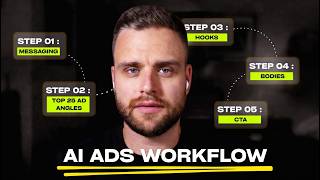
Matthew Larsen shows how to generate 375 ad variations per day using the Problem-Circumstance-Outcome framework and AI tools. Start with 15-25 ad angles, add 5 body copy versions and 3 CTAs each, then run them all, keep the top 10% by cost-per-call, and extract patterns to refine the next batch.
Chapters
If you are struggling to get your paid ads off the ground or struggling to scale past the $1K, $2K, $3K per day mark, this workflow is probably for you. So paid ads are definitely the best way to grow a business. Things like outreach habits, place content usually helps nurture the people from paid ads. Partnerships are great, but if you only had to choose one and you're trying to scale to tens or hundreds or billions of dollars in revenue per year, paid ads mastery is probably what you want to do. And there's a lot of different funnels. Of course, you have your just book a call funnel, webinar funnel, community funnel, DM funnel, low ticket funnel, you name it. But the process that you carry out all those funnels is typically the same. So in this video, I'm going to go over the paid ad workflow I use. To get a ton of high-quality book-a-call funnel ads in no time at all. So I'm going to talk about a few things in this video. First, we talked about paid ads being very scalable, but I want to talk about most people's situation with paid ads and how I've come to come up with the messaging for paid ads, how I've come up with a lot of volume and the style that I like to use for B2B. So in our paid ads workflow, We basically want to have a lot of different hooks that go into fewer bodies and fewer CTAs. And then we have a lot of different, you know, angles that reach out to every person in the target market. Right? So the problem that prevents most people from doing this is not that they don't have money to spend on paid ads or anything of that nature. It's that when they try, they either get no calls at all, or the calls they get are very bad quality. And they just kind of come to the conclusion that all leads from paid ads are terrible, which is not true. The problem that most people, you know, face and why this doesn't work for them is because their messaging is not right. So we're just going to write messaging on the screen. And the reason that it's not right almost always is, you know, at least most people know which their target market is. Most people have it. So the problem that most people have and the reason why their ads don't work is that they probably have the right messaging for the target audience, but it's for the wrong level of the target audience. So for example, historically, I'm making software and workflow videos now. Historically, I've made a lot of videos for agency owners because I sold a few agencies. That's what I used to do. And you're never going to catch me dead running an ad or creating a YouTube video, how to get your first agency client, how to get to $5K a month, how to start your agency. And the reason for that is because I have nothing to sell those people. But the problem is people do that a lot with their ads, especially. They're trying to target, you know, multi-eight-figure e-commerce brands or home service companies. And they start talking about stuff like testing your popup or how to set up ads. Like anyone who, you know, is at multi-ten, multi-eight figures a year in e-commerce already does that. They wouldn't even talk about it or wouldn't even do it. And you know, the roofing ones, for example, how to set up your CRM or how to do this. Anybody who they'd actually want to sell to already has basically a call center, an entire process. They don't need that kind of stuff. So the thing to do, remember, is always to go higher in your ads in terms of the messaging, because people below will still watch something that's higher, but people above will not watch something that's lower. So for example, if you Wrote an ad that was like, like a training for a case study. Here's how we helped this roofing company get to $30K a month. Very low results, right? No, no one above $30K a month is ever going to watch that. But if you did, this is how we got this roofing company to $30 mil, everybody below $30 mil and probably people above $30 mil will watch that. And it's the same thing with your ads. So. I recently, over the last, I don't know when, but let's say over the last year, started watching someone named Jeremy Haines in his YouTube channel. And he talks about messaging and talks about what he calls the problem, circumstances, and outcomes, you know, and this is a good way to brainstorm ad angles. So. The thing that we need to understand is, and this is why a lot of people fail because they don't really have too much experience in their target market. That's like a, definitely a big SaaS problem and a big platform problem where the people building the software don't have any experience in their target market. And to some degree, it's also true with agencies. That's why like the best agency owners probably used to work in that target market. The best e-com agencies used to, or currently have an e-commerce store. The best, like, construction agency owners used to work construction. It just happens that way because they much more, much better or much deeper understand the thought process, the problems, the circumstances and outcomes that their target market faces. So for example, let's, you know, just delete some of these here so we can start over. And I want to show you kind of like the good and the bad, because this is part of the ad workflow. You really have to kind of do this exercise. And I could go clear all here. So essentially, what are some problems that— let's go a low level and a high level. So problems, you know, I can't even get a single booked call with ads. You know, if I was, you know, agency owner, like that is a low-level problem, right? So versus, you know, when I scale my ads past $1K per day, My CPL, my cost per call skyrockets. See, like, this is an example of the kind of the same, same. It's both talking about ads. They're both agency owners, but you can see how one is, you know, a much higher level problem that's going to attract a much high level prospect than the others. So my ads, like, are you sick of every, you know, are you sick of every time you, you Try to scale your agency ads over at $1K per day, your cost per lead skyrockets versus are you sad that you can't book a single call with paid ads? Like you see, like if I put those into the hook with the ads, they're going to attract a very different type of person. I always say that the best type of ad angle and the best offer attracts the person you want to attract, but at the same time, completely gets rid of the person you don't want to attract. It's only obvious or desirable to the person that's the crème de la crème of ads. Most of them are not like that, but if you can get something like that, it's perfect. It's like, this is a problem to just my paid audience or my ICP, but you know, that wouldn't even make sense to, you know, someone who's not even running ads. They wouldn't even click on it, agency owner or not. Right. Versus the circumstance I'm in. Um, let's see, circumstance I'm in. I am currently struggling to make payroll versus I am looking to exit to private equity in the next 24 months. Can we see how those are going to attract a different quality of prospect in terms of revenue level, their ability to pay and so on? Of course. And then outcomes. I want to get my first client. I want to completely remove myself from my agency's client acquisition. So like, this is an example of, and this is like a real process that you have to go to if you want your ads to work. And this is really the step 1 in the workflow. So I have this tool of mine called HyperOptimal. You can sign up for a demo if you want, but you could also get Manus or some kind of thing to run this stuff for you. And you can decide if it's good or not. We can come back to this later in the video, but if you have your ICP and you hook it up to AI and you, you know, tell it the likes and the dislikes, your offer, your language and stuff, and you get it to do this, it will come up with pretty good problems, circumstances, and outcomes. And, you know, there we have it. What we really want to do is, you know, we get this here and then what we can do is like, we're going to have 75, right? We want to kind of narrow this down to the top 15 to 25. 15 to 25 is good because it gives you a lot of creative diversity in terms of your ads and the algorithms will, let's just say, like that. Right. But it also targets like a lot of the different types of the market. So like if I'm selling this software or I'm selling my consulting program, there might be many different parts of their software of it. Like there's workflows for finance, there's workflows for ads, for content, for outreach. For time management, for hiring, for training, for management, you name it. And if I just did one angle, like not everybody struggles with the same thing. Not everybody has a paid ads problem. So if those are the only ads that I was running, people would not like necessarily want that, right? Or they're not necessarily going to click on it because they just don't have that ads problem. Same with that. I said this was a finance software. Some people really just already track their stuff. They don't have that problem. So by having 25 different, 15 to 25 different ad angles, you can do a lot of testing. You're going to be rewarded by the algorithm for having creative diversity. And then you're going to be hitting every pocket of your niche because not everybody has the same problems. So I would say that when you're doing this versus writing your ads, cause that's part of the workflow too. I can't remember the quote was, but it's like, I think it, I wanna say Abe Lincoln for some reason, but could be a really stupid like quote attribution. Like I don't wanna look it up here, but the quote was, if I had 60 seconds to cut down a, or 60 minutes to cut down a tree, I would spend the first 55 minutes sharpening my ax. And it's like this too. You want, like if you're gonna write ads, you're gonna film ads, you wanna spend, you know, 5 to 10 times more time making sure that your angles are proper because it doesn't matter how good you write the ad or talk on Canva or edit the ad or whatever. If your angles aren't going to hit the right person, it's not really going to attract the kind of prospect that you want to get. So we're going to get to 15 to 25 different things. So, you know, the founder is the primary salesperson and account manager, creating a bottleneck. It's a high-level agency problem. High client churn because of inconsistent service delivery as the team scales. That's high level. Dealing with the founder's trap where the business can't function without them. That's high level. And you got it here. So the next step of the flow, once you do this, and I should say, you probably take 80, 90% of your time just on this. And the good news is you likely only have to do it once. The next step is to do the actual ads. So this is one that I think I got from Alex Hormozi. But I might've got it from one of the great advertising books. I can't remember, but it's to create even more variation. This is really good if you stack this onto AI ads, just because it makes the ads much faster. So my tool, or just manually, you'll import those problems, circumstances, and outcomes. And then what we can do is we can write like 5 or so different bodies. And then 3 CTAs. So if I just put like body number 1, body 2, body 3, body 4, you can generate with AI if you want. You don't have to, but then book a call, submit an application to see if you qualify, sign up for my free training, like whatever you want. Probably going to do book a call, like probably don't really need more than one CTA. But you can see we have 25 angles here that will become hooks. We have 5 different bodies. Let's just pretend these are full ads and then 3 different CTAs. If we run my AI tool here, we're going to basically generate 375 different ads. And that's really powerful when you can prompt it to kind of write it in a way that you can generate good AI ads from it. But this is really meant for like the talking head VSL ads, like this flow here. Is really to make ads like this, where you have your callout, you have the results or the hook, and then you're just talking with the thumbnails. Like, that's really, in my view, the best type of stuff you can do. But if we're just going to generate them here, you know, now my tool is basically taking the hooks, rewriting them with AI, taking the bodies, rewriting them with AI so that the hook flows naturally, and then it has the call to action, and then it's writing the call to action based on the hook. You can get this in this tool, probably do it in Claude projects. Usually you used to have to do this manually, but it's all part of the process. So that is basically like what we're doing. So step 1 is like the messaging, probably the most important part. Step 2 is going to be, you know, 25 times 5 or even 25 times 3 times 1 equals 75 ads. And then number 3, if you're doing B2B ads, VSL, you know, times 75. And I guess the 4th step of the flow is the review. So essentially what the review is going to be is eventually you're going to have all these ads, right? So we're just going to do 75 here, and I'm just going to— we're just going to pretend that we have 70 just to make this easier. So 5, 6, 7, 8, 9, 10. This is where you have a nice opportunity to use AI where you used to have to do it manually. So we have 7, 1, 2, 3, 4, 5, 6, 7, 8, 9, 10. Let's just actually, now that I think about it, 1, 2, 3, 4, 5, 6, 7. There we go. That's better. So we have 7. We're just going to pretend this is 70 ads. Actually, let me make it 70. 1, 2, 3, 4, 5, 6, 7, 8, 9, 10. So that's 70 ads, right? And we're just going to pretend because I don't want to draw. Let's just pretend there's 70 ads. What we're going to do is we're going to test all of them. And then we're going to basically cut off the top 10% by performance. Usually that's going to be cost per call, depending, you know, on how good your tracking is. You could track ROI if you have it back from the sales call and attributing. But you're going to basically, and this is why having like them as this is a good start because they're all very similar format where you can kind of attribute all of the success to, you know, the copy or the ad angle. You're going to take the top 10%. You're going to basically put them into AI. And ask what they have in common. And you're going to get a lot of learnings from that. And you're going to use those learnings to basically make your kind of the variations of your best performing angles over and over and over. And then you're basically going to repeat this process because that's really all there is to it. Right? So you're going to come up with that messaging, really might only have to do that once. You're going to come up with 75+ different ads. You're going to film them. You're going to run them. You're going to talk about the top 10% of them, see what they have in common, and make iterations and variations of that. So that's an ad workflow where you can use a lot of AI into. I hope you enjoyed this video, and I'll see you in the next one.
More from Matthew







Everything I Would Change About This Ecom Email Marketing Agency (3 HOUR LIVE AUDIT)

Everything I Would Change About This Meta Ads Training Business (3 HOUR LIVE AUDIT)


