This One Concept Led To a 90x Sales Increase
Activation points are milestone actions that push leads deeper into a funnel and dramatically increase conversions. One affiliate funnel scaled from $2-3M monthly to $20-30M monthly after adding a domain-purchase activation point. The strategy involves identifying candidate points, building about five with landing pages and email flows, then cross-promoting them.
Chapters
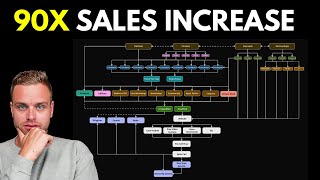
This one key concept has made it 90 times more likely that someone buys from me. And I am going to show you that today. So this concept is one called activation points. And it's a simple enough concept to understand, but it makes a big, big difference, especially in the content and the advertising funnels. And a lot of people just don't do it in an intentional way. And if they do do it, it's kind of like they got lucky. So activation points can be thought of as something of a milestone or like a key objective that if someone does it, they become so much more likely to convert and buy something from you. They're a way to push leads deeper into your funnel and you don't have to spend hours and hours doing outreach, follow up, that kind of stuff. So in this video, I am going to show you what activation points are, why you need them, and then how to implement them. Shouldn't take much longer than 10 to 15 minutes, but we'll see. I've been using this strategy for the last seven years, since my first big mentor showed up to me. And I have seen this do over $500 million in sales in a single funnel. So it's very, very interesting. And I'm going to talk about that in a few. So the problem and the reason that this is a good video idea is that some services are very, very hard to sell to cold traffic. So they might work in content, they might work through referrals, but once you get into mass outreach and a lot of ad spend, they become very difficult. And there's two kind of categories that this is true for. The first is a lot of consulting, a lot of coaching, those type of offers, a lot of info offers. And the second one is there's a lot of different services where even if it's done for you, technically speaking, there's a lot that has to go into it on the client's point of view. And YouTube is one of those. For example, you might do the idea, the script, the thumbnail, the uploading, the editing, all that kind of stuff. But at the end of the day, the client still has to be the one to film. So those are the two main situations where we might be using activation points. And for that describes you, you're going to want to pay extra close attention to this. The second problem is that sometimes if you grow enough, and I'm not sure that there's a specific revenue that we can attach this, you're eventually going to max out your tam, your total addressable market, the amount of people in your Target audience. This will always be a lot higher than most people think. But alas, you know, 500k, a million dollars a month in ad spend in some markets will max this out. So it's also going to be very valuable for that type of person as well. If you have something like a mass market cold email offer, or a mass market content offer, or you sell some kind of accounting stuff like your TAM is basically anyone and it doesn't really matter. But for those that just sell something that's very specific to a certain niche, this is going to be for you. So there's three examples and three different problems that I'm going to talk about here. And those are going to be real world examples that I've actually seen and been a part of. So the first one is my example. I run a variety of coaching programs and it's very difficult to sell that kind of stuff to cold audiences. They don't know who you are, they don't give a shit. Didn't even know what your philosophy is a lot of the time. Why would they care? So that's a very big problem for my type of business. The second one is one that I said before, where it's basically a YouTube business where you can do everything, it can be done for you, so to speak, but they still have to do something and then, you know, that's a big problem for you. And the final example I'm going to go over is the affiliate example. And that's the one where I saw it do 500 million in sales in about 18 months. And in this one it was a webinar funnel. And their big problem was just people not taking action. So it was a business opportunity, a biz op, you know, how to learn affiliate marketing and make a career out of it. That was the situation. And the problem was people were not taking action after the webinar, which was their primary tool to sell this. So if we go back here, this is the 1000x leads funnel and this is the funnel that I created. Not that I created the concept of paid ads, content, outreach and partnerships, but I created the diagram and the philosophy that puts it all together. So at the top we have our four main ways to drive traffic. Our paid ads, our content, our outreach, and our partnerships. Everything that we do to get clients is going to fall into one of those buckets. Realistically, there's not really anything that isn't going to fall under one of those things. In the middle of our funnel, we drive our traffic to our different lead magnets and email Flows and thank you pages and funnels and webinars and VSLs and newsletters and all that kind of stuff. At the bottom of our funnel we have a bunch of different offers to sell to people based on whether they're qualified or not. This is the thing that makes a world of difference in a good marketing funnel, because 99% of people are going to be unqualified and there's nothing that you or I or anyone else is going to do to change that. It's just the way it is. It's just like gravity. So instead of trying to fight gravity or come up with a way to get around gravity, we need to do something different for gravity. We make a plane or a rocket ship for this. We have different offers. So if they're very unqualified, we go to sell them some digital products, usually under a hundred dollars, but not always. We might stuff our lead magnets and email flows and newsletters and that kind of stuff with affiliate links that we can build up some nice MRR for tools that they would buy anyways, whether they actually pay us or not. We might also refer them away and collect a fee. We might sell them a course, we might sell them a program or a mastermind, or if they are qualified, which some people will be, of course, and that's our bread and butter. We will sell them our intro offer and then upsell them to our recurring service. Or we might just sell them our recurring service upgrade. So this is a very important stuff because the activation points, if we do it intentionally, are gonna be these lead magnets and email flows up here. So I say the word intentionally, which is very important because a lot of people will just willy nilly make this stuff with no real thought or anything. We will be doing thought in this video, of course, so we will show you exactly how these activation points come into play. So if we go back to our problems, activation points solve both of these. They solve the problem that some services are hard to sell and they also solve the problem of you maxing out your TAM because you're going to make your own with activation points, as amazing as that sounds. So activation points in the problem number one, they kind of act as stepping stones to move people closer to converting. So let's just say it's a river and you know, the river is too wide, it's the current's too strong for someone to essentially take the leap. But if you put a bunch of stepping stones and they can hop slowly over the river, eventually they'll get close enough to the other side where they're comfortable and the river is the gap between them where they are now and them buying our service. And the stepping stones are the activation point, if you want to think of it that way. The secondary thing is they also act as a way to create demand instead of just capturing it. Because think of it this way, if you are doing a YouTube agency, for example, basically your only clients are going to be the ones you know who are currently doing YouTube, currently recording, currently filming, currently comfortable with doing that. But if you have these activation points and you can basically bring someone from never even thought about YouTube to set one step, two step three, and, and you're essentially building up and creating more people in that total addressable market. And I'm going to go over that right here, right now. So the first example that I am excited to show you is one of mine. And I know that this is true because I'm the one who has lived it. It's not theory, it's not guessing, it's just how it is. And my activation points and the ones that I figured out here, the there's going to be five of them. So let's do the drawing and go MAT's activation points. We'll just go MAT's AP or APS here. And there's five of them. So let's go 1, 2, 3, 4, 5. So there's five things that if these things are true, people are 90 times more likely to buy from me. And you can actually measure that quite easily just by comparing your onboarding form information, your calendly book information, and then taking a look at your email flows. So it's actually easier to measure this than you might think. And these five things are, first, you got to do my work form system. So that is my system where every hour of work you fill out a form with what you did. This is a great way for accountability. The next is my project management system. The next is my CRM build, the next is my metrics, and the final one is my operations spreadsheet. We'll just put ops. If these people have these five things in their hand and they're using them before they ever get on a call with me, they are 90 times more likely to convert than someone who hasn't done any of these things. And you can measure that quite easily. So in my situation, instead of trying to think about, oh my God, how do I make a webinar, oh my God, how do I do X, Y and Z? My whole thing is how do I get these activation points into people's hands as well as how do I get them to use them. So those are the only two questions that you really need to do. Because generally speaking, if someone has all of these things, they're going to become my clients and that's all there is to it. So instead of how do I get more clients, how do I get more people to download or add, access and implement my activation points? Very, very, very important stuff. For a YouTube example, like we said before, some activation points might be. And think of it this way, if someone has never created the YouTube video before, even if they want to, it is still a tremendous gulf between them actually creating it and them becoming your client for script writing, editing, ideas, that kind of stuff. So the activation points in this situation would probably be something more like how do you even get them comfortable with this kind of stuff, let alone, you know, your client. So the first thing could be like, we're just going to put gear like production value, like lights, microphone, that kind of stuff. The next thing would be like, how do you come up with ideas? The next thing would be like an exercise to speak better on camera. Maybe that's a 30 day challenge, maybe that's, who knows? Another one could be like a YouTube metrics like what to track and what to get, you know, familiar with. And then another thing would be like a YouTube improvement sheet or something like that. We're gonna just put imp. So if someone has the correct camera stuff for their budget, someone knows how to come up with ideas, someone has done, maybe some practice speaking on camera to get them more, you know, used to it. Someone knows what metrics to track for and how to measure them and how to improve them. And someone has like a realistic plan to improve on YouTube no matter if they're an absolute beginner and just terrible at it and they kind of believe they can improve. Those are example of five activation points that will get someone closer and closer to actually becoming a client. So if we go here again and we go like, this is the river, just pretend there's a current here. And this is, let's say YouTube, you know, rookie, someone who's never done something before and this is the, you know, done for you service, for example, like that gap is just far too big for anybody to, you know, get by, get through on their own. But if you start adding stepping stones like activation point number one and then activation point number two and then three and then four and then five, it becomes a lot more manageable for someone to cross that river, so to speak. In this amazing metaphor. What's fun to note and funny to note is there might not be five, there might be one, there might be a hundred. And whatever there is, it's your job to find it. But a lot of the time like you don't really need them to get all five. Like maybe this person in this hypothetical examples, not really comfortable jumping all the way across, but they're comfortable like taking the leap Once they get to 40% of the way across activation point number two or once they get to, you know, more than halfway across the river, now they can comfortable taking the leap. It's not always a situation where you have to get them to do all five. But you want to plan for it or you want to plan for however many there are. And now I'm going to talk about the example of the one where there was $500 million in sales. So this was basically an affiliate offer and it was a biz op. So it was how to become a professional affiliate. This was many years ago at this point, probably six years ago, six to seven years ago. So basically there was a 15k course, it was a very big affiliate guru and it was a webinar. Like that was their method. So it was a believe 90 minute webinar, maybe even two hours. So they would run their ad spend, they would get to the webinar, people would show, people would learn, people would get indoctrinated, they would buy or they, they would schedule a call or buy or they wouldn't type thing. And there's a big problem of people not really taking action after the webinar. It's not like that's uncommon. That's going to be. Most people don't take action. But that was the constraint in this funnel where their show or their show rate was fine, their close rate was fine, their economics were fine, their cost per webinar signup was fine. They just needed to fix this. So what they did is they looked at all of their data and their call calendar and their onboarding form and their Typeform responses. Maybe Typeform, if that was the thing back in the day, I don't know their form responses and, and they looked at it and they're like what is the one thing or what are the things that basically from the webinar to actually, let's just say getting on a sales call, what is the one thing that we could do that makes them more likely to get through this river? To stay with the analogy. And they found that the number one thing that determines whether or not someone moves forward or not more so than Anyone else is if they buy their domain name right after the webinar. So domain name, because they are starting a business right here, right? An affiliate business. So that is the number one thing. So now their activation point, their offer is all about how do we get people to basically buy this domain name? How do we do that? And what they did is they said in 24 hours after the webinar, if you send us a screenshot basically of your GoDaddy or Namecheap or Google domain purchase of your domain, we will send you 25 to cover the cost of it. And that that was their offer. So it basically overnight they were doing about 2 to 3 million dollars per month in sales when, you know, I got involved or I was like fortunate enough to be a part of it. Not that I really did anything at this point. This was pretty early in my career. And just imagine like this line here is like 2 to 3 million. So let's just say 2 to 3 million on there. I think it was Brain Tree because I couldn't use Stripe. After they implemented this, it literally went straight up like almost like a hockey puck to like 20 to 30 million per month. Literally just. Or a hockey stick. Just literally crazy. And that really is the power of finding the right activation points. When you find them, you will get an increase in sales if you do it properly of an order of magnitude. Not just 10%, 20%, but like 500%, 1,000%, maybe even more. So if we want to get to the implementation of all this kind of stuff, the first thing we really got to understand is it's way easier to implement good activation points looking back and connecting the dots as opposed to just guessing. And this is why I don't really recommend Eric or I always recommend it, but I don't talk about it. For people who are not doing several hundred thousand dollars per month or more, it's just under that you're kind of just guessing. You don't have enough data sales experience to really understand when you're at this point. What you really want to do is brainstorm or try to identify 10 different ones, create five of them and then create five landing pages, email flows, deliverables, like everything you need and make sure each one links to the next. So that's very important. So they finish one. In my case, they finish their work form. The next one is to do their project management tool that's linked right in there. You want to have basically like an interconnecting web of activation points. So like we have one here, two here, three Here one, four, here, five, here. We really want it to be like connected all the way through where there's no real separation between any activation points. They're just all part of like one different system. And that's really what is going to make you a lot of money as opposed to, okay, I got the number one, now we have a separate campaign for number two. You just want it to be a big endless web of activation points where there's all cross promoting each other, they all lead into one another. That's the best way to get people to activate because even if they don't need to activate all of them to actually become a client. Let's plan for it, right? Plan for the worst, hope for the best. Then we have that in our newsletter, our email flows, in our communities, we have retargeting ads for each of them. And we're just basically trying to get people into this whole system where we have all of our different activation points. When we do this, you know, basically what's going to happen is we're going to get a steady stream of people flowing into each. Our market is going to be growing because we are actually building it ourselves with getting all these people who weren't in our market before and now they are. And after they hit enough activation points all automatically as part of our overall, you know, lead generation funnel, all, all of our sequence, we are going to be getting nonstop calls out of nowhere. That's what I always hear when I tell people to do this and they do it. Just randomly getting calls? Yeah, no, we're not randomly getting calls. We are doing the system to perfection. I hope this was valuable and I'll see you in the next one.
More from Matthew







Everything I Would Change About This Ecom Email Marketing Agency (3 HOUR LIVE AUDIT)

Everything I Would Change About This Meta Ads Training Business (3 HOUR LIVE AUDIT)


