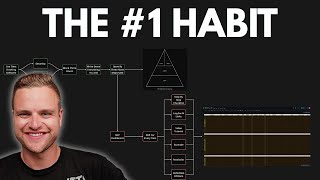
A short YouTube talk by Matt describing the "rule of three" (from Brian Tracy) as a business habit: identify the three highest-leverage tasks that produce ~90% of value and spend ~90% of working time on them. Matt explains how to identify these tasks using time-tracking, classify leverage (labor, capital, code, media), and operationalize work via SOP dashboards, checklists, tutorials, and definitions of done so owners can delegate low-value tasks and free time for high-leverage work.
Chapters
Hey there, it's Matt. And in this video I'm gonna go over one of the greatest business practices that I don't know could be responsible for about 75% of my success. And it's called the rule of three. And this is from a book written by a, we'll call them a self help author or a business author named Brian Tracy. And basically what it means in the book and what the rule of three is is that no matter what you do or how many tasks you do, it could be 10, it could be a hundred, or it could be a thousand. Only three of them are going to add up to 90% of the value for your business. It's kind of like an even more extreme version of the 80, 20 rule. And I have found this to be very true in, in both myself as well as my clients. And the thing to understand here is these are not just static, these are changing as your business grows. They're going to look very different when you are, let's say at 0 versus at 100K versus at a million versus at 10 million. I've never been more than, you know, 18 million in an agency in a year. So, you know, it could be way different when you're at 50 or 100. I wouldn't know, but I can only assume so. So essentially what this means is you need to be able to identify what your highest leverage tasks are and then identify what else you're doing besides those tasks and then how to get those off your plate so you can do this as much as possible. So it should be saying that three tasks lead to 90% of your value. So if we're just going to take that at face value, 90% of your time should be spent on those three tasks because you can't spend 100% of your time. You, there's always going to be stuff to do and then 10% of your time is going to be spent elsewhere. So let's just say you work 50 hours per week because you're a business owner. It could be even more, but let's just say it's 50. It should be about 45 hours should be spent on these three tasks and five hours throughout the week should be spent on other stuff. If you're just purely like trying to wrap your head around it. So the way that you implement this is what I like to do starting off is to use a time tracking software on both my phone and computer throughout the week. It's not that perfect, I guess you could say, but it kind of helps me in an automatic way to see what it is I'm doing. Because there's certain time situations where you do stuff and you're not really even consciously realizing it. So what you really want to do is get a list or a general list of everything you did during the week and a time tracking software and show you what sites you were on. And you could kind of infer what you were doing based on that. And then what you're going to do is you're going to every Saturday and Sunday, block out three hours. And these are kind of the only three hours that you may be working on the weekend. Let's just say that's true. Let's play devil's advocate and say you should be spending time with your family and stuff, which I believe in. Of course, you're going to block three hours Saturday and Sunday. So I usually do that in the morning so I can do other stuff, see my family, all that kind of stuff. You know, maybe I did this, wake up at seven on Saturday and Sunday, and I blocked this off from 8 to 11. Then you have the rest of the day to do whatever you want. You're gonna write down everything you did. You're gonna identify the three most important things. So for me lately, this is developing more products to sell and making them better. This is making YouTube videos, and this is making ad creatives. Those are the three most important things for my business, bar none. When I was just starting, those three things were different. A year from now, I'm sure they might be different. Ten years from now. I would certainly hope they're different. But those are the three most important things for me right now. When you're going to identify these three most important things, you're going to want to kind of decide what gets you the most leverage in your business. This diagram is basically one from someone named Naval Ravikant. You probably know who that is, or you may not. If you don't, you can search them up. And it's basically these are the four kinds of leverage that if you have these in your business, allow you to go a lot further. Leverage can be defined in this context as the difference between what you put in versus what you get out. So there's four types. There's labor, capital, code, and media. And basically these are kind of in a pyramid of importance. So labor leverage, you know, either you are either hiring someone for cheaper to do the same job, or you are hiring and training someone and you pay them X amount and you get Y amount of value. Like those are both forms of labor. Leverage, there's obviously a lot just in general hiring to free up more time is labor leverage in a certain point of view. Capital leverage in the context of, you know, maybe advertising, you put in $1 to your advertising funnel, you get $2 out. Capital leverage is also investing that kind of stuff. But in the context of this service based business that we're talking about here, usually going to be ad funnel and just, you know, reinvesting in the business. Then you have code and media leverage. So media will be like making your YouTube videos, writing your newsletter, developing your social media content, developing media partnerships, speaking at events, guest blogging, going on podcasts, that kind of stuff. And then code leverage is going to be all your internal processes, automations, et cetera. Think of just Facebook for example. That is a very real thing of code and media leverage. Obviously has capital leverage, investment obviously has labor leverage with employees. But just think of how much code and media leverage that is. It's the number one visited site, it's all basically run with code. It's not like there's individual people, like being an operator, like you message someone, they, you know, connect you to the person. It's all with code. And in General, like the three most important things hopefully should be developing one or more of these three pieces of leverage or four pieces of leverage. So I said mine is making YouTube videos, media ad creatives as capital and developing products as code. You could also say my fourth thing on here or 3A and 3B. 3A is making ads, 3B is training employees, or you're training employees to make ads, training employees to write code or develop product. You know, it's all of this kind of stuff. So in terms of action steps, once you identify those three most important ones, you're going to want to make an SOP dashboard. This could be in Google sheets, it could be an airtable, it could be in notion, it could be in ClickUp, any project management, anything you want. But it should exist. And we're going to have an SOP for every task, standard operating procedure. So a good SOP in my view has a few different parts, a step by step checklist that will show you how to create the task. So what this should be is like someone should be able to log on to your computer, open this checklist and complete the task, knowing nothing previously about it and just nothing else. No supplementary information besides the checklist. If they can do that, it's an excellent checklist. If they can't, probably leaves a lot to be desired. You're also going to want to have the links and logins necessary to do the task. You're going to want to have a video tutorial of you doing it, assuming it's a, you know, one hour task or less. If it's like a multi step project, maybe not. You want to have a few examples of what it looks like when it's done or what it should look like. You want to have a reminder for them to do it. And then you want to have the definition of done. This task is not done until A, B, C, D, E, etc. Are true. And then you're going to want to put them in like this. So you'd have, let's just say for this example, this is just a screenshot, but you have your lead generation tasks, you have your client work and fulfillment tasks, you have your employee hiring and training tasks, and then you just have the action when time required, the role, all of that kind of stuff. You have your sop, your video training, your checklist, your examples, your definition of complete and all of that kind of stuff. And, and this is very important because the rule of three buys back time or creates more time for you. When people say they don't have time to do X, Y and Z, let's just say I don't have time to make ads or YouTube or develop my product or service, it's because they're doing all of this other stuff. 90% of your time needs to be spent on the stuff that drives the business forward. And it's not possible to do when you're wrapped up doing all of these little micro tasks. So what we really need to do is put this into our Saturday and Sunday schedule, put in six hours of work per week to do that, and then next week you won't have to do that work anymore. And then as you progress more and more, you're going to have more time to do these high leverage tasks and then you're gonna have other stuff that pops up. You do this next week, now you don't have to do those tasks and you can free up more and more and more and more of your time to do the stuff that actually matters. And it's one of the most important habits that you could do in any type of business, especially ones that revolve around leads. And so I hope this is valuable and I'll see you in the next one.