Want To Grow Your Agency To $10 Mil Per Year? Follow This Daily Schedule
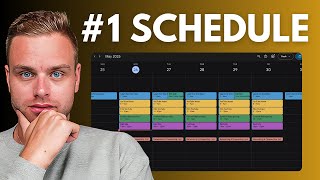
YouTube talk by Matthew Larson presenting a prescriptive 12-hour daily schedule (7am–7pm local time) for agency owners aimed at dramatically increasing revenue by optimizing time use. Larson claims he built a $900,000/month agency and taught this schedule to over 550 agency owners in the prior 12 months. The schedule divides the day into: a 1-hour morning wellbeing routine (three 20-minute blocks: chores; treadmill walk while reading at 3 mph, 6% incline; journaling with 10 goals, 10 gratitudes, 10 "identity votes"), a 4-hour client-acquisition block (8am–12pm focused on YouTube content, written content, paid-ad funnel work, outreach), a 7-hour afternoon block (12pm–7pm) for project management planning (30 min), employee training (60 min), systems/automation/checklist creation (30 min) plus up to 3 hours of focused work on the most important task, and 2 hours of buffer within the 12-hour window. He recommends executing the schedule six days per week for a year and claims it can 10–20x agency revenue if followed correctly.
Questions this video answers
$900,000 per month
Over 550 agency owners
7am to 7pm local time (12 hours)
10 hours of actual work and 2 hours buffer
Three 20-minute parts: chores; treadmill walking while reading; journaling (10 goals, 10 gratitudes, 10 identity votes)
Chapters
I was able to build a $900,000 per month marketing agency after using the daily schedule I'm going to talk about in this video. It is the same daily schedule I've taught to over 550 successful agency owners in the past 12 months. And it's honestly everything in my opinion, because time is your most valuable resource, even more so than money, because time is finite. You can make exponentially more money as you get more leverage, have a better offer and just get more reputation and proof. But you can't get any more time. You have just as much time in a day as Elon Musk, as Donald Trump, as the most successful people throughout history. And it's never going to change for anyone. This video is going to show you how to make the best use of your time as an agency owner, preferably to make more money. That's hopefully what we'll be able to accomplish here. And if you don't know who I am, my name is Matthew Larson and I have been a part of three agency exits in the past 12 years, all in the e commerce space. There was Facebook ads in 2019 or 2017. Sorry, there was Amazon in 2019 and then there was landing pages and CRO in 2023. I have 12 free agency trainings that are going to be in the description. If you want to download them, they're free. They're all about how to grow your agency. And with that being said, let's get started to how I think we should set up our day. The number one thing that I usually hear from agency owners is they just don't have time to do X, Y and Z. Could really be applying to anything. Content, paid ads, you know, hire and train. I don't have time to hire and train is kind of an oxymoron, but it's a typical one you'll hear. While this is normally just an excuse, it is technically valid because it is technically true for them. They don't have enough time because they don't set up their day and their daily schedule properly. And that used to be me as well. Like that's why I know this for a fact. And that's why I can kind of talk about it and be sarcastic and a little mocking about it because that used to be me. I went from working 12 hours per day on my agency to basically still working 12 hours per day with the schedule but making 10 times more money. So sounds a lot better, right? So let's go to it step by step. But before I do, I want you to know that this is a lot of work. It's not going to be for people who don't want to do a lot of work. But if you execute this schedule six days per week for 365 straight days, which is one year, you'll be able to work half as hard because you'll have so much more leverage. You'll be much better set up and everything will be just perfect. So I'm going to break this schedule down into 12 hours and in those 12 hours it's going to be 10 hours of actual work and then there's going to be two hours that are going to act as a buffer period which will give you lots of time to do things like admin work or changing between tasks or putting out fires or just those random things that you have to do as an agency owner and so on. This schedule is going to be from 7am to 7pm local time. So if you are in somewhere like Australia or Bali, you know, move to Dubai or move to Europe. But first of all, but if that's not an option for you, you probably have to invert the schedule because you're going to be waking up at the same time that you know your actual American based clients are there. But besides the point, besides the point, it's going to work for 95% of agency owners. Don't make any excuses. So the first thing that we're going to do is we are going to get a sunrise alarm and that is going to start lighting up 20 minutes before our day starts at 7. So it's going to be set up to start lighting up at 7 or 6.40am you could find these on Amazon. If you have absolutely no idea what I'm talking about, just put sunrise alarm on Amazon. Most of them are going to be circles in like shape and basically they start lighting up to mimic, you know, you waking up to the sun like your ancestors did type shit. So this is going to be a lot better start to your day than getting verbally assaulted by a loud alarm clock and going into a flight or fight response or fight or flight whatever. And then once we have successfully woken up, hopefully with this sunrise alarm, the first five hours of our day. So the first hour and the first four hours after that are going to be on basically our physical, mental and financial well being. So we're gonna break the first hour into three 20 minute parts. The first part is going to be chores. So we're gonna make our bed, we're gonna brush our teeth, we're gonna drink one liter of water, we're gonna take our vitamins and just do whatever we normally do in the first 20 minutes to wake up. We're gonna call that the chores period. It's not very enlightening, I'll admit, but that's what we're going to call it. The next is going to be the treadmill period. You know, hopefully if you don't have a treadmill, you can afford one. That's about it. We will spend the treadmill period walking at a 3 mile an hour pace and a 6% or a 6 degree incline. And we're going to do that for 20 minutes. And we're going to do this while reading on the Kindle app, on our phone, on actual Kindle, or if we must, a physical book. And we're going to read a business book in that time period. 3 miles per hour in a 6 degree or 6% incline, depending on what you call it. It's the same thing is going to be challenging enough to where we probably will break a sweat and we're going to burn about 120 to 140 calories depending on our size. And it's challenging and meaningful, but it's not so hard like sprinting, that we're going to make excuses to ourselves to avoid it. We're also going to read and stack those habits of 20 minutes to make the treadmill less boring as also to get the benefit of reading a nice business or whatever book. Hopefully it will sharpen our skills in some way, such as a copywriting book, a webinar book, a content book, ads book, who knows? Then for the third 20 minute period that's going to be journaling and you can do whatever you want, but we're going to do at minimum three things in our journal. We are going to write down 10 of our goals and we're going to cap it at 10 because that's a good amount. But it's not so many that they dilute the number of goals and we lose focus. After that, we're going to basically write down 10 things we're grateful for because in the midst of running an agency or doing anything in life, it's hard to, you know, we gotta take a step back and think our life's actually pretty good. And 10 things will do that. And then the final thing is we're gonna do 10 things that are gonna act as votes for, you know, things or reactions or reminders to do during the day that kind of reinforce our identity as the person that we wanna become. So if I'm a good example for me is I am going to not order any baked goods at the coffee shop when I go because I'm trying to have a better body and I'm someone who's fit and that those have a lot of calories. Same thing. I'm only going to drink black coffee for the same reason. Another one would be. What would another one be? If I pull up my phone or I open up some random tabs when I'm working, I'm going to shut them immediately and get back to work because I am a person who can focus and oh, a really good one. I'm going to take count to 10 and try to understand before I absolutely blow up because I'm trying to have a better personality. That's a good one. So you're gonna do those three things. You're gonna do the chores, the treadmill and the journal. And that's gonna be your first hour. And after that first hour is up, we're gonna go to the second part which is going to be four hours. Not exactly light work. But these four hours is all gonna be client acquisition. So this local time is going to last between 8am and noon. Everything in this four hour window should be focusing on paid ads, content, outreach, partnerships and likely a mix of all four and everything that goes into that. You know, making a funnel and a form and email flows could be part of paid ads as in addition to actually media buying and making the creative content. You know, hiring and training someone to help you. Newsletter, uh, short form, LinkedIn, Twitter outreach could be a lot of things. It's all of the above type thing. I believe that in this four hours the perfect way to spend it on average is two hours on YouTube. One creating some sort of asset that you can screen share like a Miro board or some slides and then one hour filming. Then spend 30 minutes on the written content such as Twitter posts, threads, long form for LinkedIn, Instagram carousels and a newsletter. Then one hour on improving your paid ad funnel. So that could be anything, your actual ad creatives themselves or your appointment setting sequence or your funnel or your forms or email flows or whatever. And then 30 minutes focusing on outreach to your potential clients and then also potential partners. And I think that like the following up aspect in the CRM should be part of that outreach. If they're like current leads who haven't closed yet. Every day will be different but I like to stick to this structure as fast or as close as possible. These things. The one hour to kind of wake up and get our mind right and get our body right. And these first four hours all on client acquisition are going to be the first five hours of your day. From 7am to 12pm, which is noon. These should be completely blocked off from your calendar. That sounds scary to a lot of people. You should see when I suggest that you should just block 7am to 12pm on people's calendar and you, you'll never see hear so many excuses as you suggesting that. And the thing is that nothing is going to happen. It's all in your head. You can just do it. I know that would be awesome. So that represents the first five hours of your day and these are stuff that agency owners need to do. Get your mind, body and right and do your client acquisition. Client acquisition is the lifeblood of your ent entire business. Next, from 7:00pm to or 12:00pm to 7:00pm that is the second half of the day, if you want to call it that. Because Remember this is 12 hours a day in terms of time. You have a lot of time for sales calls, for meetings, for client work, for everything else an agency owner needs to do. But I think that at least two hours of specific habits and you know, things should be done in this seven hours and you can fit them in wherever the first is. You want to spend 30 minutes brainstorming and planning tasks for your project management tool. You need to rank every single task in terms of its importance and its priority because trust me, your employees are not going to be able to do that for you. I read this amazing quote one time that I've never been able to find again and it said I can train a man to do everything but two things. And one of the things, I can't remember what it was, but it was obvious like flawed or something. And the second one was to train people to think in order of importance. And it's so true. So you're going to have to rank it in terms of priority. You're going to have to assign it to someone and then give a deadline and then some training if needed, link it, description if needed, link it, loom if needed, link it. And you just do that for 30 minutes. Then you want to spend 60 minutes training employees. The best way to do that is to have a checklist for the task. You do it in front of them on Zoom using only the checklist. Then they do it in front of you using only the checklist. If either of you have to use more than the checklist, it's not a proper training checklist, sop. And the second that they're able to do it in front of you with the checklist, you have essentially trained them. When people say you need to train your employees, that's what it means, that is transferring the skill to them. This 60 minutes spent on training could be a lot of different things. That could be six 10 minute sessions, if it's relatively minor tasks with different employees, or it could be one 60 minute session. Priorities, you know, you need to prioritize for yourself, or it could be anywhere in between. You know, one 30 minute session, one 20 minute session, two 5 minute sessions, whatever you're going to know best. And training your employees is, you know, very, very important. That's how you duplicate yourself, that's how you are able to have this daily schedule. Because they're going to be taking care of the tasks that don't belong in the schedule. So that is a 30 minute session and a 60 minute session for this training period. And the final 30 minute session should be on creating systems automations, checklists, whatever that usually means. One per day. If you can get one system, one new automation that does a task or one checklist per day, you know you're well on your way to being successful in this 30 minute period. These are things that you're going to need to do to systematize the operations for your client acquisition for your client work, for employee hiring and training, all of the above type thing. So as you can see, like the things that we need to do really are one hour of that, well being four hours of client acquisition, two hours working on like basically on the business. People say on the business versus in the business and that is seven hours of this 12 hour period. I said that we want to get 10 hours of real work in that 12 hour period. The final three should be spent on whatever you think your most important task is. You might have a hundred tasks that are important, but just by, you know, the dictionary definition, one of them will always be the most important. And just focus on that. If you have a bunch of crap that you have to do, just basically do five minutes here, five minutes there, 10 minutes there. It's definitely not the best way to get something done or focused. But you gotta be realistic as an agency owner as well. A lot of stuff happens. Do as much as you can for the rest of the day. If you can fit three focused hours, you know you're just blocking it off. Great. If you can't do 15 minutes here, 30 minutes there, 45 here, 15 there, in between meetings, you just have to do it and you can't make excuses. So all in all, no matter what happens, you should always be spending that 10 hours per day working on the business. And the most important thing, maybe in this video is if you find yourself thinking as you're watching this that I don't have time to do this, that means there is something that you need to either hire, train or systematize. That doesn't mean you just don't do it. It means that there is something prohibiting you from working 10 hours per day that you have to basically unprohibit you by hiring, training and systematizing and then you can do it. I know that seems to be lost on a lot of people. Oh, I just don't have time. I'm like, oh great. And then that's just the end of the conversation. No, you hire, you train and you systematize and then you can do this. So like, what will happen if you follow this advice for a year? If you do, I believe that you really can 10 to 20x your agency revenue in one year. It's very hard to believe for people who've not done it before, but it's happened to me and does this in my clients when they do it correctly. If you want to work with me, I have a program for agencies called Scale youe Agency. I know, kind of an obvious title. The link is in the description. I hope this video is valuable and thank you for watching.
More from Matthew







Everything I Would Change About This Ecom Email Marketing Agency (3 HOUR LIVE AUDIT)

Everything I Would Change About This Meta Ads Training Business (3 HOUR LIVE AUDIT)


