Episode 13: Toxic Positivity: What It Is, Why It Happens, and How to Shut It Down
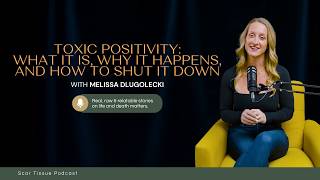
Melissa Dlugolecki breaks down toxic positivity, the well-meaning phrases that bypass real grief, and three ways to shut it down: non-response, setting a boundary, or teaching someone how to actually help. She also explains how to build a supportive team with listeners, distractors, doers, and exers who honor your feelings instead of forcing false cheer.
Chapters
There's wisdom, there's knowledge, there is opportunity in the scar tissue that surrounds our deepest wounds, our deepest pain. So every single one of you listening to this, you have your own scar tissue. You have your own stories. This is why you see people have breakdowns years after a loss. Why does that happen? Well, it's because we often don't know what to say, or we're told to just be strong. Toxic positivity is when we mask positivity or growth mindset in a toxic way by trying to bypass it or gaslight it. Okay, you guys, welcome back to Scar Tissue. Today is going to be what I call a sprint episode. If you know me, I love sports. Sometimes we go endurance, we go long, we dive in. Sometimes they're short little workouts, and those can be just as effective. So today is a sprint episode on what one of the most asked about topics that I have spoken on, written on, and that is a huge component of my book Scar Tissue, and that is toxic positivity. Now, if you hear that and you're like, ooh, yes, do we even know what toxic positivity means or where it comes from? So we're going to break down briefly what it is, where it comes from, and how to respond. My belief and my mission of my book Scar Tissue, which you can grab at scar-tissue-book.com, is to understand how to navigate our challenges, our traumas, our losses without toxic positivity, which is so prevalent in our culture, particularly if you grew up in the age— I think we're getting better at it as a society, but for generations we didn't talk about anything, and experiencing anything that wasn't pleasant or wasn't joyful was considered bad. So we don't want to grieve, we don't want to be sad. Think about it, when a child cries, it's, don't cry. Right? But that crying is actually an expression of a need or a hurt or a pain or confusion or an overwhelm that they just can't verbalize. And so we have been programmed as a society to kind of stuff down, right? To whack down these seemingly negative emotions or experiences. But first, I want to open you up to the fact that they don't have to be negative. They can be unpleasant. They can be uncomfortable. They can be not desired, not preferential for sure. But they're not actually bad. And so first, to let go of toxic positivity, we have to let go of good or bad thinking. Not everything has to be labeled as good or as bad. Uh, there's a lot of gray and there's a lot of different ways in which things have opportunities for us. I call it hidden gold, hidden opportunities, all woven within scar tissue, which is the idea that there's wisdom, there's knowledge, there is opportunity in the scar tissue that surrounds our deepest wounds, our deepest pain. And I know I am not alone in my particular loss that I write primarily about, though I've endured many, as many of you had, is the loss of my daughter Layden, who passed away in 2014. Everyone's carrying a story. So every single one of you listening to this, you have your own scar tissue, you have your own stories. And my guess is whether internal toxic positivity, or you have toxic positivity yourself or external, other people have done that to you, usually subconsciously and unintentionally, right? The desire is to be supportive. Um, we're gonna get rid of it because it's not productive, uh, and we can't grow in it. In fact, we can't grow in anything if we just stuff it down. There is a chapter in my book, again, Scar Tissue, called Whack-a-Mole, where it's this idea where we take something that we don't necessarily like the way it's working, or it's not feeling good, and we just whack it down. But if we don't take care of it, it's gonna come right back up. This is why you see people have breakdowns years after a loss or complete rage years after not maybe managing things in a childhood trauma. Um, it could be stuffed down grief that comes out and, and you see this all the time. And so we gotta talk about it. We get to do the work, we get to be in the burn. So toxic positivity, what is it? Well, toxic positivity. Is when we mask positivity or growth mindset in a toxic way by trying to bypass it or gaslight it. What do I mean by that? Well, it could be instead of honoring that somebody's feeling sad or somebody is grieving, we try and just brush by it. We try and sweep it under the rug. We try and tell them to look on the bright side. These are not helpful because the feelings that are coming up, whether your own or somebody else's, they are real. Now I always say, is this real and is this true? And what can be really real is the way someone's feeling. What's true is the story— true or not, most likely not— are the stories they're telling themselves about what they're feeling. But the feelings are real. And so we get to manage those and navigate those and, and hold space for those to clean and clear them and move forward. Not to sit in victim, not to drown ourselves in sorrows. There's no— we don't do victim mentality here, right? It is very growth mindset, progressive mindset. So understanding that toxic positivity and this muscling through is actually not a growth mindset. It's, uh, it's bypassing, it's avoidance. It's, it's actually a huge manifestation of avoidance. So toxic positivity, why does it happen? Now that we know what it is, why does it happen? Well, it's because we often don't know what to say, or we're told to just be strong, or that if we're feeling sad, we are broken, there's something wrong with us, we're not going to move forward. And so with that, we want to really be able to understand the ways in which there is gold, there is power, there is leverage in moments, in these experiences. Look at toxic positivity, if it happens to you, as, uh, really someone's lack of tools. So if they don't know what to say, their default, their discomfort with your pain, with your grief, with your struggle, is going to be to try and get out of it. Think of fight or flight. Toxic positivity is a way of flight. We just try and get out of it. So The person, or you doing this to yourself because we can toxic positivity ourselves, or people doing this to you, look, don't take it personally, right? Don't take it personally. Understand that the need— every behavior is exhibiting a need. And so the behavior is exhibiting a need to get out of the discomfort where they feel powerless. They don't know what to do. They don't know what to say. And that's really uncomfortable. So see the humanity in that. Oftentimes we get angry when people don't know what to say or they don't say the right thing, but don't take it personally and see the humanity of the person who just doesn't know what to say. Then you learn how to educate them if you choose. So the reason in which toxic positivity will come about isn't because people don't wanna help, it's because they don't know how to or they don't have the tools to. Uh, there's two things I like to break down when I talk about this. It's willingness and ability. And so you can't get water from a rock, okay? You can try and get water from a rock all you want, but you're just going to keep beating that rock, beating that rock, beating that rock, trying to get water, and it doesn't have the ability to give it to you. There will be people in your life who you're going to want to support me in this way, support me in this way, support me in this way. They don't have the ability, so you don't want to keep beating them down for it. Other times it's a matter of willingness. Toxic positivity can often come from people who have the willingness, but they don't actually know what to do and they don't have the actual tools. So some examples, some things I heard in my own journey: your daughter wouldn't want you to be sad. Well, that's not helpful because now not only am I sad, now I feel guilty for feeling sad because my daughter wouldn't want me to be sad. So on top of my sadness, now I have guilt. Um, God wouldn't give you something you couldn't handle. Well, now I'm wondering, like, well, did I ask for this, right? Everything happens for a reason. Well, what could the reason be for— am I being punished? Is that the reason? So there are going to be so many ways. At least, friends, almost always a giveaway for toxic positivity is at least, because it is completely bypassing somebody's experience, right? So I got at least she wasn't older. Well, that's not really helpful, uh, and that's really kind of, uh, you're, you're telling me that I shouldn't be as sad as I am because she wasn't older, or look on the bright side, or just be happier. So all— there's a million examples of these. In fact, in my book Scar Tissue, every single chapter breaks down a toxic positivity statement. And what I'm going to give you here before we wrap this sprint episode are 3 different ways to respond. All of these apply to any statement, and write these down. The first one is a non-response. This is going to be for people who you don't really want them in your life, you don't need them in your life, or maybe you're not in a place to even handle a response because you are just holding it together. That could be a smile, that could be walking away, that could be a deep breath, but it is a complete non-response. The second is a boundaried response. Now really, these are all boundaried, but for example, it could be something along the lines of, that's not very helpful for me right now. Another could say, you know, another way of saying that is, um, you know, that, that doesn't serve me in this moment, or I'm not able to feel that right now, that doesn't resonate with me. Boundaried responses are not offering an explanation. It is just simply drawing a line in the sand as to what is an okay way to engage with you and what is not. Then the third, the last one, is going to be what I call an educated bounded response, which is these are gonna be people in your life that you actually want to support you and you want to train them, you want to coach them, you want to teach them. And you might have a conversation as I did as to why do I have to coach the people in my life how to show up for me? Well, we do. Oftentimes we do because people don't know what to say. They don't have the tools and they're not mind readers. They don't know how you're feeling. And so they're reaching for whatever they can. And so here's where we have a little bit of compassion, right? We have a little bit of grit and we let go of the why me, why do I have to do this? And instead we choose to be the creator of what we want, the creator of the relationships we want, the creator of the way people show up in our lives. So a boundary educative response could be taking that boundary further. For example, if somebody says, uh, Layden wouldn't want you to be sad, and I wanted to educate them, I would tell them how I was feeling. So that's not super helpful for me. I know you're trying to help, but when you say that, now I feel guilty for feeling sad, which makes me shut down. So, uh, I understand again that you're trying, but would be more helpful is X, Y, or Z, and you're letting them know an alternative. And that could be just listening or asking how to support me, or maybe taking me to the movies to distract me. Now, teammates is a whole chapter in the book Scar Tissue where I teach you how to build your team and your teammates on who can do what. We have distractors, doers, listeners, and exers, and that's all broken down for you. And that will come into these educated boundary responses where you're one, drawing a boundary, two, educating them on why you're drawing the boundary so they don't shut down or they don't think like, oh, I guess I shouldn't say anything, right? Because that could happen too. What happens when that, um, and that evolves is we're actually creating more distance within pain. And so grief, Trauma, loss, it's already isolating. The last thing you wanna do, and this is why doing this is not necessarily about everyone else, it's also about you. The last thing you wanna do for yourself is create more loneliness and more isolation and an already lonely journey. So then when you educate them and you let them know why that doesn't feel helpful, and then give them an alternative of this is how I would love for you to show up for me. People innately want to be helpful. They want to be someone positive in your life. And so they are going to more likely than not appreciate when you teach them how to support you. And so I hope this helps as we break down toxic positivity. This is one of many sprint episodes coming your way. Again, you can grab the book at scar tissue book.com and we'll see you on the next episode.