303 - Nonviolent Communication in Practice with Ranjitha Jeurkar
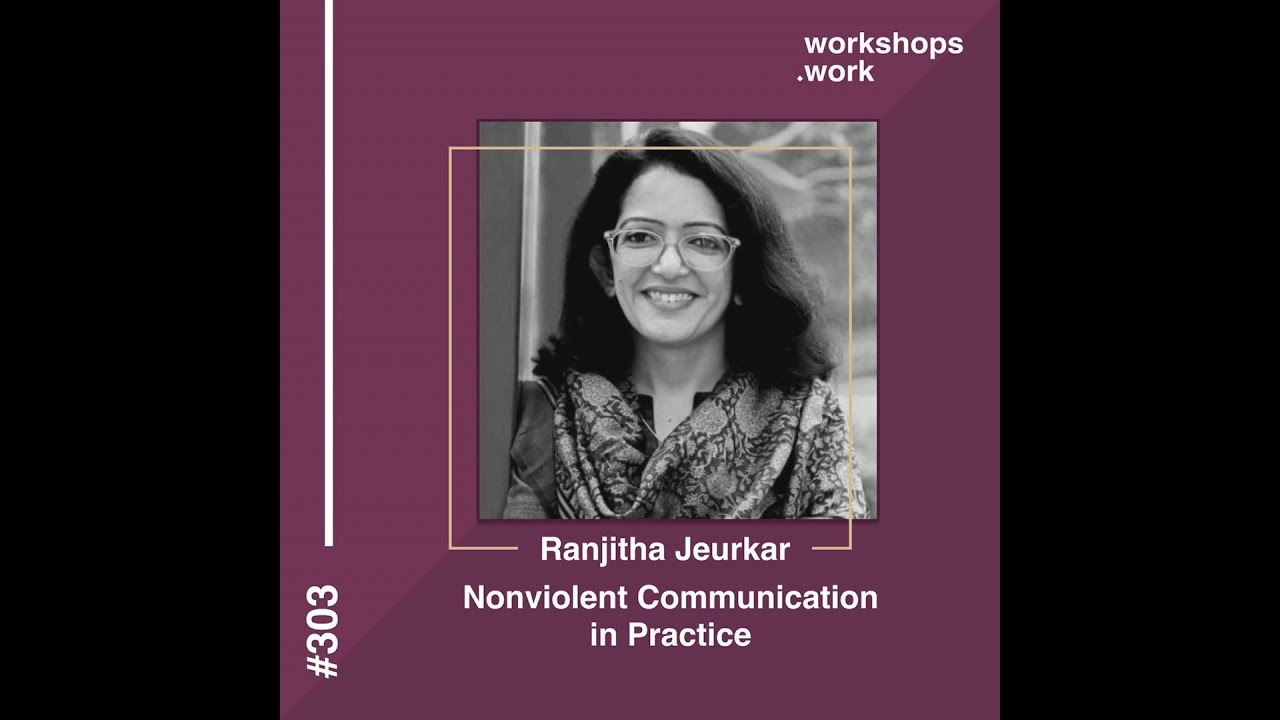
Ranjitha Jeurkar, an NVC practitioner, walks through nonviolent communication tools like self-connection, noticing bodily signals, and making clear requests. She uses a micromanaging manager as an example of shifting from criticism to empathetic curiosity about underlying needs, and discusses managing anger and the balance between empathy and honesty in workplace relationships.
Chapters
What does it take to make workshops work? And how can we facilitate collaboration that sticks and leads to results? My name is Miriam Hatnes, and with the Workshops Work podcast, I'm on the mission to find the magic ingredients that make workshops work. Today with me on the show is Ranjita Chirka, and we speak about nonviolent communication and an entire new world opened to me. Although I've heard about it and I read about it, I, through this conversation, found more understanding of how nonviolent communication can help us to better connect to ourselves and to deal with situations that feel so unpleasant, maybe toxic at the workplace, and how to create hope for a better situation and how we can step into our power. So stay tuned and don't forget to scroll to the show notes to find more information and to subscribe to the podcast if you like it. Thank you for listening.
Ranjita, welcome to the show.
Thank you for having me here.
I'm delighted to speak with you and to learn more about your work with nonviolent communication and empathy.
I came across your work, Myriam, a few months ago, and it was like really stumbling into this treasure chest because there's so many tips for facilitators that's actually, that's not just about do this and do that, but that also brings in the being of it. So I, yeah, I appreciate being here and being able to have this conversation with you.
Thank you. And yeah, and I think that was maybe my biggest discovery, that facilitation is actually not about the doing and the activities, but about the being and the inner work.
Yeah, and I resonate with that because, uh, one of the, I think some of the most meaningful pieces of feedback that I received for my workshops is when somebody says, you know, the way you facilitated, the way you were with us today is so congruent with the content that you were sharing with us. And for me, there's no other piece of feedback that I enjoy so much more than that when it comes to some sort of an assessment as a facilitator.
Yeah. So tell me, when did you start calling yourself a facilitator?
I started calling myself a facilitator rather reluctantly. I started learning nonviolent communication. This was way back in 2011, 2012.
12.
And when I did, uh, so Marshall Rosenberg, who was the founder who created this framework, is from the United States. And over the '80s, the '90s, the early 2000s, it made its way across the world in America, in Europe, and in India. At that time, around 2011, 2012, when I began learning nonviolent communication, there were just a handful of trainers And I went to this event. There was an annual event that trainers would come to, and it was a 5-day residential program, and we'd learn from them during that. And after that, I'd go back home with no connection to this beautiful world and the practice itself. And a couple of years down the line, I started really wanting to have other people around me who were familiar with nonviolent communication, who had some commitment to bring it into their lives. So I invited a couple of trainers to come and do something in my town. And then, you know, and of course, that's not enough for a community to build. So I started hosting programs myself. Some of them were really short programs. And then gradually, I discovered that I enjoyed sharing what I'd learned with other people. So I began not because I wanted to facilitate, but because I wanted to gather a community of people around me. And then I ended up becoming a facilitator along the way.
Beautiful. And for those who are not familiar with nonviolent communication, how would you put it in a nutshell? What is it?
For me, nonviolent communication is a couple of different things. One is, of course, it is about the way we communicate. How can we communicate in a way that has more empathy for ourselves and others? And even as we work on that level, the level of language, we're working on something far deeper, which is How do we see ourselves and other people? What kind of consciousness are we bringing to our interactions and to our communication? And this, for me, is the deeper, you know, if you speak to a nonviolent communication practitioner, one of the things you'll hear is probably nonviolent— NVC consciousness, which is, no matter who we're interacting with, and no matter what they're saying, or what their actions might be, do I have the capacity to look at them and go, I wonder what need this other person might be meeting? And this is powerful because it invites us to step out of ideas. Usually we're told that the way to relate to what's happening outside in the world is to either look at it through the lens of good or bad, right or wrong. Do I agree with you? Do I disagree with you? And sometimes we also have neat little explanations for why people do what they do. Oh my God, this person is a troublemaker, and that's why they're doing this. And NVC is something that helps us to step out of that paradigm and into a far deeper way of looking at ourselves and other people. Which is what is actually up for this person when they're doing something right now. And that, of course, is where empathy is born.
Yeah. And what I hear is this connection between language and being. So we're learning a new way of communication, which then impacts our way of being and seeing the world.
Yes.
How does this connection happen? Is it And maybe you can share from your trainings how other people step into that space, because I can imagine, so they have a desire to, to communicate in a different way so that they see better collaboration, better connection with other people. And I would assume that rarely they come into the space to think, oh, I need to change my way of consciousness because we are so self-righteous.
Usually.
It's a default.
All of— many of us, maybe. It's also, I think, one of the things that we do acknowledge in Nonviolent Communication practice is this is probably how many of us were educated to see, to relate to other people. I mean, you go to school, you're taught how to assess things a lot of the time, right? Is this good enough? Is this bad enough? And we're not only taught explicitly, we're also taught implicitly. This is what we've been seeing around us even as we grow up. And yes, so someone who comes to a workshop is probably not thinking, I want to find a new way of seeing myself and other people. They're probably not thinking that. What they're probably thinking is, oh, I want to find a way to get along with my coworkers, or I want to find a way to have more meaningful relationships with my family, or maybe even I want to find a way to be able to communicate with those who are closest to me without fighting with them.
Hmm.
Or, as was my case, I want to find a way in which I can actually, you know, be more honest in my relationships, and I'm so scared to do it because I don't know how. So this is what often leads people, and because of the name Nonviolent Communication, people think it's all about how do I say a certain thing, what are the words that I can use. So often a lot of people will say, can you help me, what can I tell my manager about XYZ? And I have a little chuckle at that because, you know, yes, this was what I thought it was in the beginning as well. And at the end of the day, of the day, how we communicate is really based on how we see things. It's not happening in a vacuum. And so the most sustainable thing to do is to go into how we see things and start shifting that perspective.
Hmm.
Because the risk is also otherwise, if I still think you're, you know, you're a monster, or you're a troublemaker, and I'm saying all the— using the loveliest words in the dictionary, you're still going to pick up on it. People do.
Yeah, because facial expression, body language.
Yeah, people pick up on your energy. So we want to come from that shift in our thinking first, in how are we seeing people.
So basically, if I take the example of someone who complains about their manager who's a micromanager, so how can I tell them to stop micromanaging me would then be How to look at this micromanager from a perspective of empathy. What is it that they need to be able to relax and not micromanage anymore?
Yes, exactly. And even before that, it begins with understanding our own reactions. And it's a bit like this: until I listen to myself, this noise in my head is not going to go down. And when I listen to myself, I get in touch with what's up for me here. What is it? Is it that I'd like more trust? Is it that I'd like more autonomy in how I do my work? And once I'm able to understand that, oh, I'm feeling frustrated because I want more autonomy in how I'm doing this work, and then it gives me some clarity, and I can make a choice based on that understanding. Because what I've just done is tried to identify how I'm feeling about it, and then dropped a level deeper to ask, what need is this feeling pointing me to? And then once I know what my need is, I'm much more likely to make a choice That's more likely to have that need met, that's possibly more effectively going to meet that need, as opposed to if I didn't do this and I told my manager, you know, buzz off, I'm perfectly capable of doing this by myself. And then can you imagine, it's not really an effective way of addressing my need when I do that.
Yeah, or the, you don't trust me, and stop micromanaging, you're not trusting me, then they feel offended and will be reactive. And so when we understand what it is that activates us or that wants us to change the situation, then we connect to our own needs, then it's also easier to communicate it and for them to receive it. This makes a lot of sense.
And once I've connected with my own needs, something in me gets a little curious, you know, what's up with my manager? Why is this person doing this? And then I can go and have that open conversation with them. And maybe I'd say something like, hey, you know, manager, are you wanting some trust that things will get done, or some reassurance that when we make certain agreements, it's going to be done the way we'd agreed upon?
Yeah.
And then this is really so different from saying, stop micromanaging me, because I'm trying to step into their world. I'm trying to step into my manager's shoes. And Something very different happens when we can relate to each other in this dynamic, because, and you used the word before, we start collaborating rather than competing for which of us is right.
And it also opens the opportunity for both being right, because we both have our own perception of the world, our own realities.
Yes. And this reminds me that Marshall Rosenberg often quoted Rumi. You know, Rumi has a very famous quote from one of his poems, I think, which says, out beyond right and wrong, there is a field, and I'll meet you there. And what if we weren't looking for who's right at all? What if we were looking for, yeah, I wonder why this person's doing what they're doing? What needs are up for them? What needs are up for me? And how can we find a way to address both sets of needs? Yeah.
And it sounds beautiful. And I can see how this works, and I can also see how it goes wrong when we're in these activated stages of fight, flight, freeze stress. And I wonder, don't we first have to calm down our own nervous system? Because I think that— and it took me personally a while to actually calm down to listen to what it is that I really need. And to be curious, to look beyond the anger. I'm so angry. Oh, why am I angry? What need is not satisfied? Do I want to be heard? Or— And I have the impression that many are stuck in this anger and making everyone wrong. So what would be the first step to actually calm down, but to develop this curiosity and this connection to oneself to feel?
So there's a couple of things that I could say in response to this. First of all, I think anger is so complicated because there are so many messages we hear about anger, including that anger is bad for you. So sometimes when I feel angry, I catch myself telling, you know, saying in my mind, I shouldn't be getting angry, you know. So anger is like a complex emotion in that way. And so what we learn to do, and it's exactly like you said, we want to, when we're activated, when we're in fight, flight, freeze mode, We want to spend some time in self-connection, we want to spend some time listening to ourselves. And that has the quality of bringing us back to some extent into a more relaxed state, if not relaxed, at least calmer and more connected to ourselves. So and that is usually the difference. That's in my experience, that is the difference between reacting and responding to something.
Hmm.
Reaction is when I'm leading with my thoughts, And those thoughts could include opinions or judgments about who's right and who's wrong, or what should not be happening. And when I'm leading with that, I'm most likely reacting. When I take the time to tune into myself and say, why is this so important to me? There's obviously something in here that matters. Then I start responding. And the way we do it is, yes, of course, this can be challenging for somebody who hasn't practiced this. I know it took me quite a while to get used to this, and there are still occasions in my life where I don't remember to take a deep breath and come back and listen to myself. I'm reacting, and then I have the awareness a few moments later, or maybe once I open my mouth. So a lot of this is also about consistent practice. It's about starting to get familiar with and comfortable with our feelings.
Mm-hmm.
It's also about unlearning a whole bunch of ideas around Oh, you know, some very popular ideas that in our culture, positive feelings are good and negative feelings, you shouldn't be having them. And to, you know, relearn this by saying, actually, every single one of my feelings is telling me about something. So instead of resisting my feeling or pushing it away, because I've been told it's inappropriate, can I take a moment to just check in and say, what need is my feeling telling me about? What might this feeling be trying to bring my attention to?
Yeah, yeah. And I also think that we often forget our body in all of that, because usually our emotions, they start somewhere in the body, and then our mind interprets them. And very often our mind gives us maybe a wrong interpretation of what's going on. And then if we rush into doing and speaking, it goes wrong. Yeah.
What comes to mind is, you know, the number of times I've had a little bit of a raised voice and a look of anger on my face, and the other person says, Are you angry? And I've gone, no, I'm not angry. And, and that's what happens when we're paying attention only to the mind, because, because it's very easy to just sort of go with the pace of the thoughts in our mind. And so I, you know, one of the invitations with this practice is to take a deep breath. And when we talk about how we're feeling, it's also about noticing that feeling in your body. And with practice, I mean, when I first heard this, I went, how exactly does this work? Because I was so unfamiliar with connecting with my body. Like, you're telling me my body's telling me about my feelings? Where exactly? How does that look? And gradually, I started realizing that for me, you know, anxiety, you know, the phrase butterflies in your stomach, that tells me I'm anxious. When I'm angry, my face gets hot. And my hands and legs are shaking, and there's a sort of restless energy to it. So there's a whole bunch of cues that we can look for. And I think also coming back to the body in that moment is another way of grounding ourselves because it helps us be more aware of how we're feeling.
Yeah, and get out of the mind.
Yes. And I don't know if this has happened to you, but for me, this is so familiar because once I have a thought, it feeds another thought, and it feeds another thought. And then there's— it's almost taking a You know, this momentum, and it's really hard for me to extricate myself from it once it reaches a certain pace. So when I can come back to my body, it gives me like a moment's turning inwards almost, so I can start that process of inquiry. How do I feel about this?
I just came back— well, it's a month ago— I did a 10-day Vipassana retreat where this is all you do, right? Connecting to your body. And observing how the mind just goes crazy and makes out of a small idea a huge problem. And it is hard practice. And I was just thinking when you mentioned the example that someone asks you, are you angry? And you're sure, like, I'm not angry. And I wonder whether even there, connected to what you said earlier, that we have the distinction that unpleasant feelings are bad and we shouldn't have them. And then if someone asks us if we're angry, It almost sounds like a judgment because, oh, we are not the person who is angry and we shouldn't be angry and it's not good to be angry. And then this activates again, this defense mechanism.
It's possibly that sometimes. And sometimes it's also just the not being aware. So I might just go, no, I'm not angry. Wait a minute. I think I am. Yeah.
And because I can imagine that there's also a part then of co-regulation. So, okay, we are in the practice and we are using our skills of nonviolent communication. And then it's how the other person receives it, because it has an element of slowing down the conversation and pausing the doing, the rushing into the next step. What is a good way to co-regulate or to help the other person to also slow down so that they can actually be open for our way of connecting to them?
That's a great question because I think it's not just about what we bring. We want to be aware that we are in relationship with other people and how we show up impacts others. And a lot of the time, people who come to my workshop say something like, all this is fine, but what if the other person doesn't know NVC? So then does it work the same way? And this is what I've discovered. I think what happens when we're in conflict or disagreement especially And this is where we notice this dynamic the most, is both of us sort of pulling the conversation into 2 different directions. That's often what's happening, where we're saying, I'm right, or, and I'm right. And it's really about who is able to pull the hardest, who is able to convince the other person towards their point of view. And I think, and this is how I experience it, I think we do it because we don't have enough trust that if we were to stop holding our perspective so strongly, it would not be considered. And it's, in a way, it means I am going to stand up for this just so it doesn't disappear from this conversation. I'm going to hold on to my ground because I'm so scared that my perspective is not going to be heard.
Hmm.
Or that you don't, you know, my perspective won't matter enough in this conversation. And so both of us are trying to force our perspective on each other or trying to force the argument towards our direction.
Yeah.
And so the tip is where I'd say, if you're noticing yourself in a dynamic like this, take a pause and make an attempt to do one of these things that sounds so simple but can be hard in the moment, which is to just give back to the other person a recap or a reflection of what they've said. And something as a small move like that can transform the dynamic, because all of a sudden this person says, oh wow, you've been listening, you're actually receiving my words and giving them back to me. And so with every action or every move like that, we start building more and more trust. And when that trust is built, we don't have to push so much anymore.
Yeah. And have you observed then the situation Where the other person, yes, feels good. Oh, you're listening, you're giving it back to me, and then confusing it with agreeing.
Yes, that can happen because I think that's also one of the common ideas we have about empathy is when somebody is empathizing with us, that means they agree with our perspective. And it doesn't have to be that. It can be, I see where you're coming from.
Yeah.
And this is also where it becomes so important for us to have not just empathy but also honesty in that relationship. Because if I'm only empathizing, it might be very easy for you to think that I'm agreeing with every single thing you said. And when we are able to put across our perspective honestly— and honestly doesn't mean saying something like, you're a jerk, it means speaking from that space of understanding our own responses and coming from that understanding rather than reacting.
Yeah.
When we can put our point across to the other person, I think that's the other half of this equation.
Okay, so the first step would be to ensure that the person feels heard, so paraphrasing or giving back, and then adding our— so this would relax them and maybe make them a bit more open, and then adding our perspective for them to see potentially also the opposition.
Yeah.
And one thing I've learned to do is to really break these 2 units into 2 separate pieces. A lot of us might do something like, I hear you, but I have a different perspective. And that is like a yes, but. It's a yes, but. Exactly. So can we break it into 2 units? Can I do the hearing in one part? And then maybe I might follow that up with something like, and I have a slightly different perspective on this. Are you open to hearing me? Which indicates that I've moved from— Asking for permission. That's one part of it, because that gives the other person a chance to let me know if they've been fully heard. And the second is also that it makes a clear distinction of, you know, that move from empathy to honesty. It makes a distinction. So when we do this, we're actually— and it's just like you said, when you said, yes, but— but has a very polarizing effect. And this has the way of— it's something like instead of having 2 opposing views, we have now 2 views that may be different from each other, They don't have to fight each other out. They can coexist.
And then we're more open to, to collective or to find a solution together.
Yes, because now we're moving beyond it has to be this way or this way. We're moving into, okay, here's this concern, or here's this concern, or this is what's important. How can we take into account all of this and then find the way to go forward?
Yeah. And I'm loving this because working with groups, especially in the corporate sector, we often come and we speak a lot about the yes, and versus the yes, but, and how the yes, and opens the opportunity for conversations. And I realized 2 things. One is the conditioning on, but we have to make our point, as you just said. And we are so afraid that by adding an and instead of a but, We won't be heard, or it will be confused with us agreeing. And the other thing that I often hear is speaking about our own emotions and how we are affected, and then the confusion between emotions and actually evaluations or judgments. Like, because we use the wording, I feel disrespected, For instance, and then we assume, oh, that's a feeling, and you laugh.
So I think you talked about these as safe emotions on one of your recent newsletters, if I'm not mistaken. And I very much agree with, yes, when we use one of these words, we're still hiding behind something, we're not being vulnerable. Because when I say I feel disrespected, I'm still pointing it back at you and your actions in some way. You disrespected me is the, you know, the fine print of that line in a way. So we do have a tendency sometimes to confuse feelings with these words that we call faux feelings with nonviolent communication, their evaluations, because at the end of it, it's still— for me, a feeling is something I experience in my body.
Mm-hmm.
And it's connected to my physical sensations. I notice it within me. But disrespect, on the other hand, is something that's pointing me outwards rather than inwards, because it says somebody did something, and often it means somebody did something wrong.
Yeah, it's— they are lacking respect, but I don't know because I'm not in their mind. So how do I know that they're not respecting me?
And there's no way of knowing unless they confirm it to me. So a more helpful thing to do is, and this is the question that I ask, that I coach people into, uh, you know, with, is when you think you're disrespected, how are you feeling?
Hmm.
And the answer is probably I feel hurt, I feel sad, I feel angry, all of those. And now we're starting to get in touch with how we're feeling rather than referring To the other person and their actions.
Yeah. Yeah. Feeling small.
Feeling small.
Sad. Yeah. And how safe is it to speak about these emotions, these true emotions? Because I think that's the underlying fear, that the moment that we reveal how we really feel, that it will be used against us.
Yeah.
Or that we will be considered as weak. Not capable to do the job.
This is, again, you know, one of the things that's been really heartening for me to see is the conversation around vulnerability that's been happening in the last few years. And I think that's very promising because it— and, and of course, organizations are now talking more and more about bringing your whole self to work, creating psychological safety. All of these are promising. And at the same time, I do want to acknowledge that Many of us are probably not in environments where we receive a lot of encouragement to do this. You know, I've heard people say things like, but if I say this, and the next time my boss gives the assignment to someone else because he thinks I can't handle the stress, what then? So I do believe it's a bit of a context-specific thing. And it's about taking small steps. Now, there's 2 parts to being emotionally aware, I think. One is about connecting with our feelings. The second is about expressing our feelings. Now, expressing our feelings— we might choose to express our feelings depending on the context because we might have a sense of how it's going to be received. We might choose to express some feelings and not others. We might choose to express our feelings sometimes differently. For example, if I'm at work, I might not say, I'm actually so afraid of this. I might say, I'm very concerned about this. Because sometimes that tends to be a little more the way the people around us speak, because we— the goal is also to be within our context, and to apply this learning in our context, right?
Mm-hmm.
So I can experience my feelings, I can connect with it. And then it's a choice, do I want to express it? And I might not always want to express my feelings, we make that decision based on our sense of how things are around us. Sometimes it could be because we have some fears about it. Sometimes it could be a realistic assessment based on some historical evidence that somebody who's spoken up like this has received some kind of pushback. So it's not a magic pill, unfortunately.
Yeah, because I— when I started reading a little bit about nonviolent communication, I always thought that it is through the expression of our feelings that we can actually create the connection to the other person.
Mm-hmm.
And there's a big part of me that believes that. And there's another part who sees reality where some are also not able to receive this kind of openness. Because I think for someone who's not connected to their emotions, it might be also difficult to handle and then can feel manipulative. Why is this person talking about their emotions?
Do they want to make me Emotional, or the word emotional blackmail comes to mind.
Yes, yes, yes.
And I think especially when we're talking about organizations, this is where culture becomes so important. Because I think there's a difference between me learning nonviolent communication as an individual coming into my team and trying to say it, then it's a little bit like me, everybody else subscribes to a different way of thinking. or seeing the world, and I'm trying to apply it. And then it might be— I might be much more hesitant to bring in my feelings and expressing them at work. What if my whole team did a training like this one? What if my whole team had this kind of feelings literacy? Then it gives me a little more permission to start working with it. And then what if this, you know, this culture change came from the top? And what if our leaders modeled this kind of showing up And then it gives a lot more permission to all of us, to those of us who might not be at the top, to bring in this sort of vulnerability into how we work together.
Yeah, yeah, 100%. And I think it often goes wrong if it doesn't come from the top, because then it's great that everyone has received this training and has the literacy to deal with it, but if they still feel the pushback and the lack of psychological safety coming from the top, There's only that far that they can go with it.
Exactly. And I think we're always scanning our environment for cues that say, is this going to be received or not, no matter what we say. And we can pick these up.
Yeah, which makes it then also difficult. It seems as, um, once we go through such a training, then suddenly we see all the violent communication around us. That before we've been blind. That's for me, for instance, with these false emotions. It's only once I started to pay attention, or to the yes, but once we start to pay attention, we see it everywhere. And then it becomes even more difficult to actually soak it up.
Yeah. And a part of that difficulty is the frustration of, oh, there's a better way that exists. So there's a way that exists that could make life easier for so many of us. Why won't you try it? And it often comes from that, but it's a little bit like, just because I've learned nonviolent communication, I cannot expect everyone in my life to respond to me in the same way that I've learned to. And so if I say, I won't listen to you until you tell me what you need. Yes.
Yeah, it reminds me so much once we We start learning a skill, so we have this hammer and then we want to apply it constantly. And I remember my early days, earlier days, learning about facilitation, trying to facilitate my family. Yeah. And I got so much pushback. And when I think about it today, I'm like, oh, wasn't maybe the best way.
And this is one of the things that I like to remind participants in my workshop is you signed up to come to this training. They didn't. And that's an important thing to keep in mind.
Absolutely.
Because, you know, I've been there when I started learning, and I went— and I've been there with this huge temptation of, let me tell you how to say it more empathetically. Maybe if you didn't express your evaluation, but you expressed an observation instead, the other person wouldn't react like this. Or why are you making a demand? Make a request. Tell me what your needs are. And I, and of course, when we teach people without them signing up for it, there's, it skews the equation, I think, because they can interpret it as you think there's something missing or wrong with how I'm doing things. And that doesn't lead to favorable results.
Yeah. And there's something clearly air quotes violent in telling people to express themselves better and in an unsolicited way.
Yes.
Yeah.
And so what I found is it's much more powerful when we can integrate the practice and bring that into our relationships rather than holding people accountable to standards they never signed up for. If I can say, what's one way I can bring in a little more empathy to this difficult conversation that I'm having? And that can make a much bigger difference than me pushing back on the other person and saying, no, I didn't say that 100 times, be more specific.
Yeah, that's the hard work, right? To remain empathetic towards someone and holding our own feelings for what they are.
Which is also why it's wonderful, as with any inner work, to have the support of a community, whether that community is somebody else who went to the same training or workshop with you, you know, somebody else who you've discovered also practices the same thing, to have that so that you can go to people like this when you're stuck, you can go to— and because NVC is about empathy, very often, most, many NVC practitioners, I think, will have someone called an empathy buddy, somebody we can call up and expect not advice, not storytelling, not suggestions, but to be heard. And that is also the co-regulation that you were referring to earlier. So if I don't have the capacity to listen to myself because I'm so activated right now, I can reach out to someone who will then listen Listen to me, and then that can help me regulate myself.
Because they would basically reflect back what they heard. That helps you to understand what's actually beneath it, underneath it.
Exactly. And in a way, I'm borrowing from them for a little while because, well, my experience is it is easier to be more empathetic or be in empathy space when we're not activated. So if I'm listening to you and an experience you've had, it's likely I'm not as activated as you are. So I can lend you this capacity for a little while, while I listen to you. And then the self-connection starts happening once the regulation kicks in.
Yeah. Beautiful. Earlier, you mentioned that empathy and feelings is one part of the equation, and the honesty is the other one. What makes it so difficult for us to To actually be honest.
Honesty can be a tricky one. I don't know, in India I hear people saying things like, I'm brutally honest, I am very frank. And often what people mean when they say that is that they speak without filters.
Yeah, not only in India, I can assure you.
And for me, honesty is, you know, I've seen certain kinds of honesty. I believe that there was either you, you didn't speak up at all Or you let loose in the way of brutal honesty. And that is, you know, it's not helpful for either person when that happens, either the not speaking up or the brutal honesty. The thing about not speaking up is then I, you know, I don't bring my needs into the equation at all. When we're brutally honest, we are saying what we think, but we haven't taken a moment to reflect on what we're saying. And the way, you know, it often has that energy of blaming, criticism, telling someone that you're wrong. Brutal honesty usually sounds like that. I often say that it's more brutal than honest.
Yeah.
And yeah, yeah, go ahead.
It sounded as if, yes, you're speaking what you think, honestly think, but you're not saying what you honestly feel.
Exactly. And what, you know, The mid-path is really to express our honesty with some vulnerability, because as long as I'm saying you're wrong, you shouldn't have done that, you're a horrible person for doing this, you're a jerk, there's no vulnerability involved. It's all about you. But when I bring in my vulnerability, when I'm talking about, hey, I didn't enjoy that thing you did, I felt really sad, I was longing for some connection, and I was hoping to hang out with you, that's so different from Oh, you call yourself a friend? You didn't even come to my party the other day.
Yes.
And this is because I think brutal honesty is a lot more about our evaluations, our judgments, and that has the quality of alienating the other person. And we're also alienated from what we're experiencing when we say that, because we're leading from our thoughts. So then if I can take a moment to connect with myself and say, why am I sad about this? What needs of mine were up, and I can express that, then it no longer becomes, you're a bad person. It becomes, here is my experience, and I'm sharing that with you.
And by sharing your needs, you're also facilitating it for the other person to actually be able to meet that need. Because if we're accusing the other person of being a bad friend because they didn't come to the party, What is our need underneath it? Is it really the party, or is it them to listen more, to hang out with us? And then they know what we expect from them.
And this is where, with nonviolent communication, we learn the skill of making requests. So once we express our needs, we also make a specific invitation to the other person to have that need met. So I might say, do you want to go get— go watch a movie together next week? Or shall we meet for lunch next week? And then that gives the other person a very concrete idea of how they can contribute to my needs, rather than leaving it hanging in the air. I need connection. I miss you. I need connection. And then what? And then I can let— if I can let the other person know what I'm looking for specifically, it becomes a lot easier for them to respond to it.
Yeah.
And there's this Connotation of, yeah, it's vulnerable because of a fear of rejection, I can imagine. Because the most— and I, I can speak from my own experience— I became much better in expressing my needs and being explicit. And I remember times where I would not because I would be so afraid of rejection. If I state that I want to hang out with you, what if you don't? And then I Yeah, I seem needy. I will feel bad about myself.
And yeah, so it can be challenging for us to put ourselves out there and hear the other person say no. And they say, I have some other plans for Friday, I can't make it. And it's disappointing. I get that. And one of the shifts in thinking that I've made with nonviolent communication is to say, if, for example, if you were to say, do you want to hang out with me next week? And I said, no, I have an important project I'm working on. I can't make time until Friday. Then that's really— something transforms when we stop seeing that as a rejection of us and start seeing it as this person's choosing some needs of theirs. And this distinction is, it's to know that our needs matter. And at the same time, our strategy probably doesn't work for the other person.
And as much as our needs matter to us, the needs of the other person matters to them.
And it's quite likely that your needs matter to the other person also. It's just that they're not able to respond to you in this specific way at this specific point in time. And so the creativity is in— and this is why the focus is on understanding each other first, because then when we can understand each other's needs, we can come up with a different way that's outside of either the party or the hanging out together on Friday that kind of takes both of us into consideration.
Yeah, beautiful.
I mean, I might just say something like, uh, I can't do Friday, Sunday is absolutely fine because I'll be done with my project by then. So it's all about being flexible and trying to find different ways to meet needs than— yes, there might be that one way of attempting to meet my need that might be the sweetest or the most preferred, and sometimes that may not work. So can I stay open to other ways of having that need met?
Yeah.
And I, what I also hear, because I think the story behind all of that that often happens is, oh, what if this person doesn't want to hang out with me at all anymore? And I think once we can trust that the person is honest with us, so they would tell us if they don't want to hang out, then it's also easier to accept, oh, Friday doesn't work, but maybe Sunday will.
Exactly.
And I think this is another piece that often is missing, especially now in the— what I see a lot is a culture of ghosting. Oh, you just don't reply anymore, and I hear this even from colleagues who get ghosted by clients because there's a lack of— I don't know if it's honesty or courage or commitment.
You know, the thing you say about being ghosted by clients, that hits a spot for me because sometimes you send a proposal to a client or you say we can do this together, And then they say, sure, we'll get back to you. And there's a follow-up and they don't get back to you. And, you know, from the perspective of the person who's not hearing anything back, I'm planning my months ahead and I'd like this clarity. Are you in or not? And even to hear the no is very helpful because at least I know it's not happening.
Yes.
And, and I also get that it can be a little bit challenging to be the person that says, I know we engaged with you for this amount of time, and it's a no-go from us. So perhaps they don't want to be the person delivering the news. And often I try to make an attempt to understand, is it something about the proposal? Do you have some feedback on the content? Do you have some feedback on the finances and how we work that out? Or is it about the logistics? Can you give me an idea what you're thinking? And some people do respond to it when we get more specific. And yeah, with some others, it's still, I'll let you know. So it is hard saying no, I think, for many people. And I heard this quote by Brené Brown, and she says, clarity is kindness.
Yes.
And it strikes me as especially true in these contexts and others, of course, to let the other person know, I know we spoke, we've changed our mind, maybe next time. And okay, I'm not getting the contract, but at least I know I'm free to go forward and do something else, and that's helpful.
Exactly, incredibly helpful, because there's a learning in that, especially when it becomes specific. And the sugarcoating and the trying to be nice instead of kind, it doesn't give us any information about what's not working.
I'd appreciate it if a client actually said, what you're proposing doesn't match the content we're looking for. Because like you said, there's an opportunity for some learning there. Or if they said, you're asking for something that's not within our budget, that's learning too.
Yes.
And then both of us can look at whether we want to make it work, knowing what the constraints are. But without that, there's really no opportunity to work together on this.
And I think even if the energy doesn't match, sometimes it's just a— I'm German living in the Netherlands. I can be very straightforward, very direct. And if my energy doesn't fit for a client's needs or desires, I would also rather hear that. And I hope that now I'm in a stage where I'm like, okay, I don't want to please everyone. So it's not a rejection of myself.
It's just, it's a sort of mismatch. Yeah. And it's more fun to do work where there is an energy match, right? It's more enjoyable.
Absolutely.
So why not let me know?
Yeah, I would be curious to hear your experience of doing the work in India. So what is the cultural component of nonviolent communication and the honesty part? Because as you mentioned, it took 15 years to travel from the US to India.
It took some years, yes. I'm not clear on the exact chronology, but it did take some time. And I think as with any movements, it did make its way across the globe. Here's the thing I've noticed. I think at the heart of it, no matter who we are, all of us human beings are wired similarly in a way. We're all trying to meet the same needs. All of us respond to empathy. I mean, I haven't heard a single person up until now who says, I don't like empathy, or I can do without it in my life. And of course, there is the context that different places have different contexts. And There is, of course, a need to acknowledge that. In India, for example, for me as a younger woman, when I started learning NVC, I wasn't used to speaking up for my perspective. I was told, yes, if someone's older than you, or if someone's in a position of power that's higher than yours, then you just say yes. So a lot of the time, questions that come up in workshops can be around, how do I tell my boss that what he's thinking of is not going to work? Because challenging hierarchy is a big one here. So of course, there are cultural components like this one. So these kinds of roles, power roles, familiar roles, all of these can keep us from actually looking at each other human to human. And it takes a bit of work to say, yes, I can be aware of this. And we can apply what we're learning in this context. I think it also takes some inner work on our part to say, if I want to give my boss feedback, then as long as I see my boss as someone to fear, as long as I see my boss as someone who's on a pedestal, it's going to be incredibly hard for me to offer that feedback. And so I want to humanize them, and we do that by connecting to their needs, because all of us as human beings have the same needs. And then we do it from a connection to our own needs. Why do I want to give this feedback? Can I do it in a way that's really a contribution? And so it also requires looking at some of our own beliefs.
Yeah, that's so true. And very often our feedback is a means to make ourselves heard. Oh, we don't feel heard, so we have to give you— I need to give you the feedback so that you finally hear me. Although feedback, I think, in its essence must be to help the other person.
And this is a distinction I heard from a senior NVC trainer, Miki Karstan, and she says to differentiate whether your feedback is actually something that's a personal trigger, in which case it's my job to work on it if it's a personal trigger, or is it actually feedback that's going to help us with our shared purpose as a team, in which case it is a gift when it's offered.
Yeah, and feedback that is not a gift or not a potential gift can be very harmful or is usually harmful because then there's some judgment, accusations, evaluations involved.
And the point of feedback is to support growth. When feedback, like you said, when there is criticism, when there's accusations, what that can bring up is it can bring up a lot of guilt and shame, and we know they're not the best motivators for growth. So for people to grow, what we probably need is gentle, caring feedback, honest, not to compromise on the honesty, but to do this in a way that really centers the person we're speaking to. Yeah.
And what I also hear in the— as a maybe not side product, maybe one of the main contributions of NVC, I can imagine if I'm preparing to give my boss feedback in a way that is actually helpful, Because something is not working and there's a hierarchy and there's fear. The moment where I connect really to the human part and to my own needs, I might also be more open to really sense the boundary, the hard boundary. Is this actually still okay for me? Mm-hmm.
Yeah.
Is it a situation that I can work with? Or when are my needs so neglected by myself and the environment? that it's time to find another solution or to step out.
And this is, I think, when we talk about empathy, one of the common questions that can come up is, then if I'm empathetic, does it mean I've got to be okay with everything someone does? And a part of being empathetic is also learning where our boundaries lie or learning what doesn't work for us anymore. Because when I'm talking about empathy, I'm not just talking about empathy for other people, I'm also talking about empathy for me. And when I prioritize empathy for other people at the expense of empathy for myself, there's an imbalance there. And so I want to be aware of my own needs. I want to be aware of when I can gently and firmly say no, and leave a certain situation. I might decide that working in this team isn't for me anymore. And it's fine, we can quit. And when we do that, I think the important thing is, am I doing it out of a reactive, you know, reactive thinking mode, or am I doing it from an awareness of what needs of mine are not being met here, or what needs of mine are being met here? Because that's the bigger picture.
Yeah, I'm thinking of the scarcity versus abundance mindset. Am I not quitting because I try to hold on and I, I'm afraid?
Yeah, sometimes we hold on because we're afraid. Sometimes we throw something away because we're afraid.
Yes.
And neither of those is likely to be a well-considered option, in my experience. So the more I can connect with what is working for me here, what is not working for me here, it gives me a fuller picture. And it says, okay, maybe I want to leave, or maybe I want to find a way to make this work. Either way, it's a much more informed choice.
Yeah, yeah, this makes a lot of sense. What remains your facilitation challenge? Hmm.
I've had a little bit of a journey as a facilitator. I think I started off a little more as a teacher, teaching what I'd learned. And over the years, I've been experimenting and learning how I can make it more learner-led in a way. And of course, the challenge remains that while doing workshops on something like nonviolent communication, there is a theory and a core principle. And there is also participant experience. I find that people integrate much more when there's enough space to absorb, apply, practice, digest, reflect. And also, there needs to be space for the theory itself, because that lays the foundations for a cognitive understanding of what's happening. So I guess for me, the challenge currently is, how do I balance that effectively?
Hmm.
Not to miss out on either of these aspects. And often to do it in a limited span of time.
Yes, and I think it's something that takes time because you're basically reprogramming not only the language we are using, but as you said in the beginning, how we relate to ourselves and to others.
Yeah, and it takes time, and it's often not, you know, a lot of the time it takes some application and practice for something to change. It's not something you learn and immediately something shifts. So it requires some amount of attention from the learner as well.
Yeah.
And then the challenge that you described for yourself in the beginning, that if you learn it just yourself, you quickly feel like an island, that you are lacking the opportunity to practice because to get the feedback. I mean, in the beginning, I can imagine we get it wrong all the time and we fall into the situation where we want to apply it to everyone and then teach everyone.
Yes, I read the book before I went to workshop, and attending a workshop was a different experience altogether because it touched me more deeply. Being able to do small group activities, being able to do role plays with other people actually helped me see what it might look like in action rather than a very passive receiving of information. And we are talking about relationships, so I think it's most apt to do it, to have some element of practice with someone else. So Like you said, to get this feedback, for someone to say, hey, you've been pushing me to change how I'm speaking.
Yes.
Whatever that feedback might be, that of what we're doing. So yes, though it can get lonely when we learn by ourselves, and when we learn with other people, there can be a lot more support, there can be a lot more inspiration, and there can be a lot more comfort in knowing that If I'm stuck, I can reach out to someone and they'll be here.
Yeah, absolutely. What is it that you wished you had known before, or what would be your advice to your younger self?
My advice to my younger self might have been trust that your needs matter, trust that you have something of value to contribute to the world, and go ahead, try it out, take risks and experiment. And try not to be scared of failure. It's not the end of the world.
Thank you. And I can imagine that these are the big things that also get in the way of maybe teams or professionals, air quote, to hold back to learn it. The, do my needs actually matter? Do I have permission to express them? And what if I get it wrong?
Yeah. And I think not just for learning nonviolent communication, but also with life. I've been led by fear for a long time, and, you know, I didn't know my reactions were coming from fear. So I'd automatically say no to opportunities that came my way because, oh, what if I mess up? And then to actually say yes opens up so many new possibilities, and I've been learning to do that over the last many years. And it can be possible even within teams. Like, are we saying no to something because we're afraid of the worst-case scenario?
Or the best case.
What if we tried— or the best-case scenario, yeah. What if we tried something different? Yeah, um, whatever that might be.
Yeah, what I really take away from your sharing about nonviolent communication is this empowerment piece. That the moment where we allow ourselves to connect to our own needs and to our own feelings, we step into this power that we can take decisions based on integrity and awareness and not driven by any feelings like fear.
And that's been such a big part of my growth since learning NVC, because it was only after I started learning NVC that I realized how many things I was doing because I was told that was the right thing to do. I didn't know what to do with my feelings. We don't always talk about them. So I had no idea what to do with them. And I started discovering, wow, I can actually listen to my feelings, I can start understanding my needs. And once I understand my needs, I can find ways of having them met. And I can start making choices that are likely to meet my needs. So for that, I talk about it as bringing the locus of control within that instead of making decisions that are led by what will people think, or what is the most appropriate thing to do. I can start asking, what do I need? And what do I want to do, knowing what my needs are? And that's very empowering, because you're not depending or relying on something outside of you to tell you what to do.
Yeah.
And I think that gives me also just that kind of connection with understanding my own needs also gives me a lot of clarity. It gives me a lot of conviction in the choices I'm making. Yeah, even if sometimes it's a choice that other people would not agree with.
Yeah, but it's coming from within. And I also see that it's not a given for many. I think many of us grew up in a world where our needs were just— or we didn't grow up with the sense that our needs matter, for all different reasons, and sometimes just overwhelmed parents. And then there's again the cultural aspect. Where also there are cultures and corporate cultures where the need of individuals doesn't seem to matter. And then to really step up and to acknowledge they do for me, and I have the right to, to get my needs met, I think can be revolutionary.
Yeah, it's also very freeing once you get past the, you know, it's a little bit like when you get on a roller coaster and it's going up and you have pit in your stomach, and then you start enjoying it.
Yes.
And it's a bit like that for me.
Yeah.
And it reminds me of a book that I read twice now, The Courage to Be Disliked. So once we, once we're okay with being disliked, and that people don't agree with our needs and our decisions, then it's empowering that we can also express them and follow them more clearly.
Absolutely. I think there's a— this is something I can still struggle with sometimes, and then, well, I can just remind myself, well, this doesn't work for them. It doesn't necessarily have to mean that my needs don't matter. It's, it's just that this doesn't work for them, and that's fine.
Yeah.
What would be your advice to someone who's listening and thinks, oh yeah, I have such problems with my supervisor? Or with my team, and I would like to make it a better work environment or safer for myself.
I think maybe a couple of things. One is to start looking at what can I do in this situation. The tendency of the mind in a situation like this is to focus on all the ways the other person could make things better for us. And sometimes, and, you know, I've come to realize that we can't make sure other people do something. What we can do is put our energy into figuring out what we can do and attempts we can make. So what is it that you can do? The second thing would be, try the next time before you speak to the supervisor, try and check in with yourself so you're not responding with judgment or criticism, but you're responding with some awareness of what you need in this context. So to be very specific when you're speaking about it, And to connect whatever's happened to your feelings and your needs, rather than saying, I don't like this working atmosphere, it's toxic.
Mm-hmm.
Instead of that, can you say something more specific? I noticed that, you know, this person tried 3 times during our last meeting to bring up a certain point, and we quickly moved on to someone else without hearing them out fully. And I'd like for this team to be a place where everyone's voice is heard. There's a huge difference between those 2 expressions. So to really take the time to reflect on why is this important to me before I speak about it can be very helpful. And the third is when you're in a conversation with someone and you notice an urgency to jump into finding a solution, can you take a moment and check if you've understood what they're saying?
Maybe ask a question to clarify.
Maybe ask a question to clarify. Is this what you're saying? Is this what you mean? Have I heard you?
Yeah.
Thank you. It's very useful.
And thank you for your generous sharing.
Thank you for inviting me. I've so much enjoyed this conversation with you.
Me too.
Thank you for staying tuned and for listening until the very end.
I hope that you found the inspiration and the wisdom that you are looking for. And I hope that you will subscribe to the show so that you never miss any of the interviews with another inspiring facilitator from across the world. I'm devoted to continue this podcast and to deliver weekly an episode that maintains the quality that you expect and you deserve. And if you would like to help me to maintain this quality and to keep the podcast free, Please help us visit workshops.work/support to make a small donation to keep the podcast free.
Thank you so much.
I hope to be in your ears next week.
More from Myriam


Did Social Media Make Us More Unprofessional? Unprofessionalism EP 035 with Kate Raynes-Goldie

The Costume That Got Me Promoted with Moh Guissé - Teaser of Unprofessionalism Episode 28

Unprofessionalism Vodcast Episode 027: Why This Podcast Makes Us Uncomfortable with Myriam Hadnes






