322 - The Courage to Facilitate Without Fixing with Parker J. Palmer
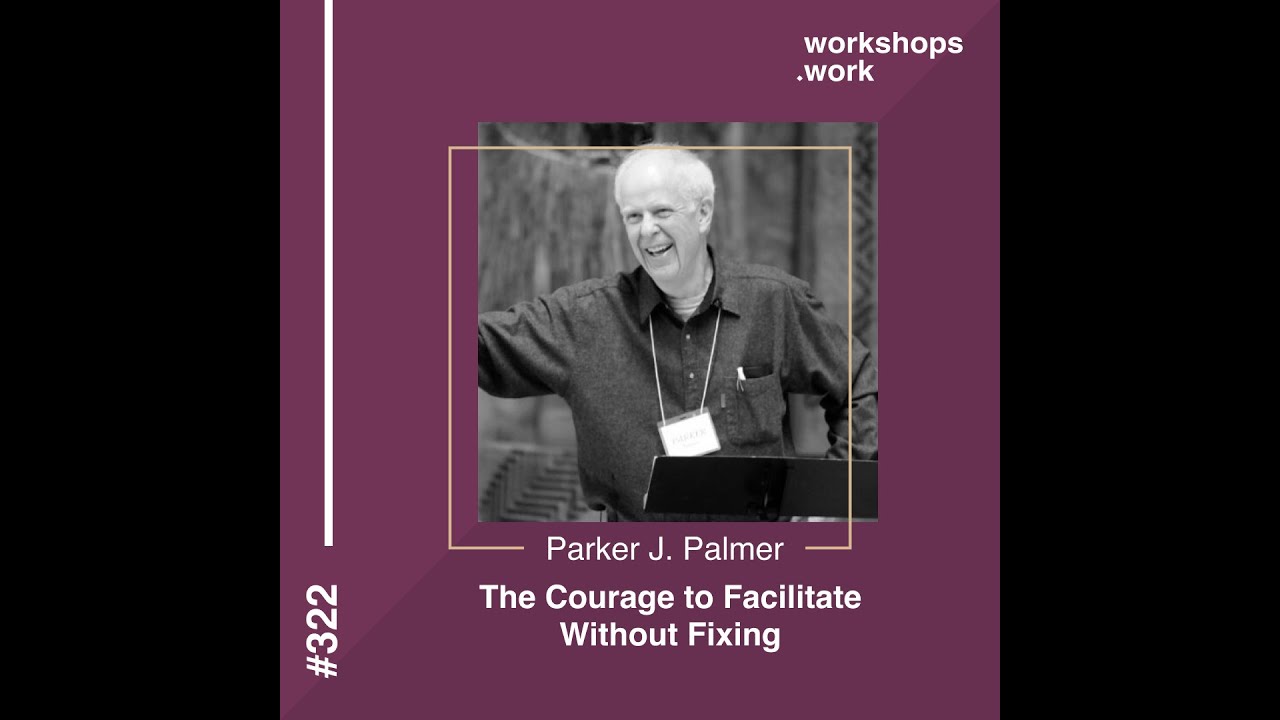
Parker J. Palmer explains his Circle of Trust model, which protects participants from being fixed or ignored by centering each person's inner teacher. He contrasts this with the banking model of education, arguing facilitators should ask powerful questions rather than supply answers, and outlines a three-step method for handling conflict through shared listening and personal storytelling.
Chapters
What does it take to make workshops work? And how can we facilitate collaboration that sticks and leads to results? My name is Myriam Hadnes, and with the Workshops Work podcast, I'm on the mission to find the magic ingredients that make workshops work. Today with me on the show is Parker Palmer, and he takes us back to Berkeley in the '60s and where he has learned How to not do circle work and what he has learned from Quakerism and over 40 years of writing, educating, thinking, facilitating his work. And I'm sure you'll be as inspired as I've been. So stay tuned and keep listening. And please scroll down to the show notes to find all the links to contact Parker and to subscribe to the show if you enjoy it. Thank you for listening. Hello, Parker. Welcome to the show.
Thank you. Good to be here.
Yeah, very much looking forward to this conversation about facilitation and what it means, what it may mean. And I always start with the same question. I'm very curious about your answer. When did you start calling yourself a facilitator? And actually, do you?
Yeah, well, first of all, thank you for having me on your podcast, Myriam. I much appreciate it. I'm very interested in the work you do with facilitators around the world. So I was the first person in my family to go to college. And so I didn't have any fancy title for myself for a very long time. I was sort of swimming in academic waters and trying to figure out whether that was a survivable environment for me. So I did a Bachelor of Arts degree at a good college here in the American Midwest, and then I did a PhD at the University of California, Berkeley. And that was in the '60s, and I think most people know that Berkeley in the '60s was a pretty interesting place.
Wild.
On the globe. And just incidentally, I can come back to this later. There was a lot of group work going on at Berkeley in the '60s, circle after circle after circle. I had experience of some of those, and it influenced me down the road. It actually influenced me rather negatively in ways I can explain later. By the end of the '60s, when I got my PhD, The cities were burning and I felt called to use what I had learned as a doctoral candidate in sociology, to use it on the city streets rather than in the classroom. So I went to Washington, DC, and I became a community organizer. And in community organizing, you have to do a lot of circle work and you have to call yourself something. I was calling myself a community organizer at the time, and it was wonderful work. 5 years of very intense work in the midst of all kinds of conflict, you know, trying to push back on white supremacy and racist practices and help create healthy, diverse, pluralistic communities. After 5 years of that, I moved on— I'll shorten the story here— to more than a decade at a Quaker adult living-learning community near Philadelphia called Pendle Hill. The Quakers have been majoring in circle work for a very long time, since the middle of the 17th century in England. The particular form of Quakerism, for those who don't know about this, is one that has no clergy. So there's no designated leader. There's simply the Quaker meeting, the gathered community. And from the beginning, Quakers had to figure out how do we do the stuff that gets done in a typical congregation without a minister? How do we do it in community? And so that automatically led to different forms of what we would call facilitation. So with that background, which is a little unconventional in terms of a path toward the work I ended up doing. I'll just say this: I think for a long— when I started claiming a title for myself, I, I think at first it was teacher. And then as I got more deeply into my life as a writer, which has really been the red thread running through my life for 60 years— I'm 86 now, so it's been A long path as a writer. I started thinking of myself, okay, you're a writer, but then I think I came upon the realization that to write is to teach. So I'm back to teacher. And then eventually, when I had an opportunity to, in the early 1990s, to work with a foundation and create an organization called the Center for Courage and Renewal, which is now 30 years later actively at work sponsoring what we call Circles of Trust around the world, and facilitator preparation is a big part of our work for those Circles of Trust. Then I thought, okay, I'm a facilitator, but I wish there were a word to mush all of that together. Teacher, writer, facilitator— these are sort of distinctions without difference. to me. And I see facilitation and teaching certainly as very closely allied. I think teaching at its best is facilitation, and I think facilitation at its best creates contexts in which people learn, which is supposed to be the outcome of teaching, right? Even though it often isn't. So that's, that's, that's my story and I'm sticking to it.
I love it. Thank you. Thank you so much. And I, um, took some notes because there's so much to unpack. And I would love to start at the beginning, a question that popped up in my mind when I heard you speaking about learning to facilitate at Berkeley in the '60s, and that it was all about circling. And I wonder What you have learned there from— about facilitation as a grassroots movement with a very clear purpose and a goal that was bigger than the sum of its parts, as opposed to today where we go to a classroom or we attend a training to learn this abstract thing that's called facilitation.
Mm-hmm. Well, my experience of circle work, as I call it, at Berkeley had a lot to do with work that was being done that was psychological therapeutic or quasi-psychological quasi-therapeutic. The movement for social change that got launched in Berkeley, in which I was also engaged, was really more combative and politicized than what was going on in, in these circles where fundamental issues in human life were being raised up and people were being invited to wear their hearts on their sleeves, to, to sort of bare their souls in, in order to wrestle with issues of identity and integrity, vocation, purpose, and meaning in life. Those were the kinds of issues that I came to associate with circle work in Berkeley as contrasted with the more contentious political organizing efforts. And what I experienced in those Berkeley circles was, was invasiveness. People were promised safety and then they didn't get it. People were promised, you can bury your soul here, you can wear your heart on your sleeve, And they did that, and then they got invaded, they got critiqued, they got taken to task, they got criticized. And there was something very, very fundamental in me that just rebelled against that, that thought, if, if this is what circle work is like, where we sit down in a circle and some, some poor soul says, you know, I'm feeling miserable about my life, and the next thing that happens is a whole lot of people are saying, well, you should feel miserable because that's a crappy way to live your life. It was confrontational. And in this country at least, that is not an uncommon thing. There have been movements even in theological seminaries. Clinical pastoral education went through a phase where Folks got abused and the movement got tarnished. And so I came out of Berkeley fascinated with circles, but really rejecting the model of facilitation that had been presented to me, because it seemed to me, as I said, that a facilitator in, in the settings that I experienced was someone who just let anything go. You know, bring it on, bring it on, bring it down. Let's really get to the nitty-gritty here. And so my quest after Berkeley was to find a way to do circles in a way that was not invasive.
And I would be curious what you came up with, because what you describe as back then happening in the circles for me sounds like the opposite of facilitation. It's like not creating, not holding the container.
Yeah, it, it was exactly, um, you know, we, we wrestle with the idea of safe space in our business, right? It's a complicated idea, and we can talk more about that later. But the space being created in Berkeley in the '60s was not safe, period. So what, what happened was that the next step, as I said, was community organizing in Washington, D.C. And in those settings, you're dealing with a challenging and even combustible mix of issues around race and ethnicity and social class. And while there are models of community organizing that say you just have to dive in there and bust it all up. The Saul Alinsky model of confronting power in very direct and dramatic ways. There's another model that involves— we, we see it in Latin America, for example— bring the grandmothers together, as they did in Chile and Argentina, to stand in silent protest out on the streets holding placards with pictures of the disappeared loved ones in their lives, bring the grandmothers together, these women who are full of love and who care deeply about the rising generation of their own grandchildren and are willing to take the risk of, of standing out in front of public buildings in view of authoritarian leaders. Because why? Well, what I'd say at age 86 is old is just another word for nothing left to lose. And, uh, you know, that's a different model of community organizing that is rooted more in love.
Hmm.
And upbuilding the lives of people like the grandmothers who otherwise are lost in, in a kind of existential isolation and loneliness, mourning, grieving the loss of their children and their grandchildren. So what happened in, in community organizing moved me in the direction of a different model of facilitation. Where I learned the most about that, what that different model was meant to look like or could look like was at Pendle Hill, the Quaker Adult Study Center, which drew on 250 years of Quaker practice around how to create a community that needs a facilitator, not a traditional top-down leader, needs a person who can create and hold safe space for people to show up as who they really are with what they really care about. And here's a phrase that has come to mean a great deal to me: can create and hold and protect a space in which people can show up as who they really are without fear of being invaded or evaded.
Hmm.
In other words, We know what invasion feels like. I share a heartbreaking passage in my life with you, and you maybe critique it, or you rush in with all kinds of fixes which make me feel unheard. We also know what evasion looks like. I share a heartbreaking passage with you, and you say, okay, whatever. and walk away, which happens a lot in our ordinary social discourse. So what I learned at Mendel Hill was a model where to, you know, to the best of our ability— and nothing is ever perfect, right? This isn't about perfection. This is about trying to take a next step in the direction of possibility— where to the best of our ability People can explore deeply meaningful issues and be held in such a way— and now I'm going to go beyond what I just said— be held in such a way that they're neither invaded nor evaded, and have a very rare opportunity to have a deepening conversation with themselves, not just with each other.
Hmm.
But my model of a circle of trust has always been Like this. This is a circle, a community, in which the, the main action is not going to be around the perimeter where we turn to each other and say, what about this, and what about that, and yeah, I like that, I don't like this. Instead, it's going to be a model of community where we each go to the center of ourselves and thus to the center of the circle as best we are able. And we meet in the center of the circle in a way that allows everybody to have a deepening conversation with what I call the inner teacher, which is a phrase borrowed from Quakerism. But it's not Quakerism alone. I mean, Socrates said the unexamined life is not worth living a long time before Quakers invented anything.
Hmm.
And, uh, I, I think for Socrates, there was definitely an inner teacher that you need to talk with. And examine your life. My own, my own motto, now that I'm old enough to amend Socrates, is, if you choose to live an unexamined life, please do not take a job that involves other people. You're going to do a lot of damage.
Yeah, yeah. And I think, and that's what we're observing. a lot at the moment, especially in managerial positions where I think it's mostly even unaware. And maybe that's where the problem comes from, because I think most of the evasion and invasion that you refer to comes with best intentions.
Sometimes it does, yeah. I think when friends are together and somebody shares a problem, And a friend who genuinely means well says, well, well, listen, I had the same problem, or I had an uncle with the same problem. Here's what they did, and you should try that. Try this diet, read this book, go on this retreat. They mean well, but it doesn't really help.
Yeah.
And in fact, I've— well, I have great— I have empathy for that. I have a name for it also. I call it drive-by helping. Which is, you know, not unlike a drive-by shooting where you do the deed and then you just get out of the room as quickly as possible. It's a way of checking somebody off your list.
Mm-hmm.
You know, okay, I've given you my best advice about how to handle this problem after listening to you for 5 minutes. Either you, you will take it and you will get well, or you won't take it, in which case I have no more responsibility.
Yeah, and it sounds almost as if this transition from the teaching mindset to the— or fixing mindset to the facilitation mindset must come in, where the teacher thinks that we need to fill someone else's cup.
Yes, exactly. It's the banking model of education or the top-down model of education. The problem here And what that leads to is a definition of teaching as being done by the person who has all the knowledge, while the students are empty vessels. And the teacher's job in this model is to fill the students' empty vessels with the knowledge that the teacher has achieved or attained through hard work. That's also a model that is much at work in religion, in congregational life, where the priest or the rabbi or the pastor or the imam has the knowledge and the people in the pews are empty vessels, and the expert's job is to fill them with knowledge. And of course, in my mind, that's an extraordinarily distorted model of what it means to teach. I wrote a book called The Courage to Teach in which I basically argue for 250 pages that good teaching looks a lot like good facilitation. Because, you know, to trot out an old saw, if you look at the word education and go to the etymological root of that word, it means to lead out the knowledge. Educare, to lead out the knowledge. that is inherent in the human experience. And so a good teacher has no business looking at students and saying, you folks are just empty vessels, I'm here to fill you up. You have to— a good teacher looks at students and says, I know you know a bunch of stuff because you're alive on the face of the earth. You have human minds and hearts and souls. My job is to somehow engage you in, in the connective exercise of weaving together what you know with what I know with what the needs of the world are, and to do that in light of a discipline that, like physics or literature or history, that's going to frame and hold us accountable in everything we do. So it's a, you know, the teaching rightly understood and facilitation, I don't think they're that different from each other.
I agree. And what I hear is it's courageous to educate in that way because the educator can no longer hide behind the knowledge as a kind of wall. This is correct and I'm going to teach you. But by leading through questions and leading with the assumptions that the students already know a lot, We're letting go of the control and the process and the routine, and we're engaging basically in a dialogue with the students.
Absolutely, absolutely. And, you know, to, to get really down and dirty about this, to, to cut to the nitty-gritty, every teacher who has ever walked that path knows that there's a lot in students in most settings, certainly here in the US, that doesn't want to play that game. They're going to sit there with their arms folded and, and yeah, exactly, like, like, like squinty eyes and skeptical looks on their faces, basically saying, wait a minute, I'm paying big tuition here for you to tell me the score so I can get a good grade and get a good degree and then get a good job and get out of here. So stop playing games with asking me and Susie and Johnny what we know. Just tell us what we need to know. And of course, there is a rational and well-grounded response to that, which is, if I did that, I would be doing you an incredible disservice, because in the kind of job market that now exists, you are going to be asked to answer questions that aren't in the book. You are going to be asked to think on your feet. You are going to be asked to engage with others, and not just with others in the abstract, with a diverse community of others, um, who— whom you need to learn to be part of in order to do the work of a modern society.
Yes.
So do you or do you not want to be prepared for that, that kind of job market, that, that kind of life. If you don't, well, good luck to you, but you're gonna, you know, your, your little boat's gonna sink. Uh, if you want that kind of education, this is the place where you can get it. And incidentally, and at least in American colleges and universities, that's a message that needs to be delivered not only to students but to their parents.
Hmm.
Who are in many cases paying the bills because it's not widely understood.
Yeah.
How— what a disservice the traditional model of education does to students.
And I wonder whether it comes from a very binary thinking, going back to the courageous educator, where if there is no courage, it means there's Right and wrong. And if we are living in this assumption that the teacher is there to teach me, this means there is this one thing to teach, and that is the truth. And on the other side, that's wrong. So there's right and wrong.
Yes.
Which then brings me back to the circle work you described, where you basically learn to sit with different perspectives that are all true at the same time, although they might oppose each other. So it's basically sitting in this non-binary world and in discomfort.
Yeah, it's— I think, I think a way to put it Um, I mean, it's— this is tricky ground we're on now, right? Because a big issue in our current world, certainly in US politics, is the difference between fact and fiction.
You know, I'm glad that you— yes, that's what I had in mind. Yes, go on.
The difference between an actual verifiable piece of information and a conspiracy theory that, um, you know, somebody believes just because Well, it's just—
someone told you so.
That's about— that's all. Yeah, that's all you can say about it because the cult leader said so. So let me put it this way. I have a definition of truth since you mentioned the $64,000 word or whatever the value is these inflationary days. Truth is an eternal conversation about things that matter conducted with passion and discipline. And let me tell you why I use that definition. And when I think about teaching, and then separately about, or additionally about facilitation, you cannot name a discipline in the academic curriculum where the conclusions don't keep changing. It just, it's the way it works in a life of inquiry. What, what physics students are taught today is very different from what they were taught 50 years ago. Same thing in literature, same thing in history. And the reason for this is that what we regard as truth are the conclusions of the moment that come from a community of inquiry that's gathered around a subject like literature or like physics or like economics, and all kinds of things are going on in that community gathered around, which follows a discipline that is prescribed by the various guilds and academic subject matter experts. There's a discipline in science, for example, as, as we, as we all know, rules of evidence, protocols of testing. And if you want to be in the truth, it's not enough to hold the conclusions of this moment. You have to know how to be in that community of inquiry. So it makes no sense if I'm teaching sociology to say, here's what sociologists in, in 2025 believe, just write it down, memorize it, and you'll be fine.
In—
because in 2026, '27, '28, '29, they're gonna think something different because new voices keep coming in on that conversation. I mean, classic case in point, in every circle of inquiry these days, there are women's voices, there are the voices of people of color, there are LGBTQ voices, etc., etc., which weren't there 50 years ago. And these perspectives yield different insights, all, all of them still held to the protocols of the discipline in question, the protocols of science, for example. But the conclusions keep changing. What we think of as the truth keeps changing. So that— I like the definition because it says that my job as a teacher, if I'm, if I'm now in an academic setting, is to prepare students to participate in that very complex and conflicted conversation. I want to teach them— if I'm teaching sociology, I want to teach them how to do sociology, not how to memorize what sociologists currently believe. I want to teach them to get into that complex and conflicted field called the great conversation. And make a contribution to it and learn from it, but, but not to drown in it or run away from it, which so many people are doing.
Yeah. Thank you for, for adding some nuance and some depth in that. What came up for me is the— some sort of a compassion for those who are then left with Because what I sense, and I find this shocking and scary, is an increased almost disrespect for science and scientists. And what you just described now makes me understand where it might come from. Where if we cannot even— so in a world where there's so much uncertainty and so much change as a constant, It feels good to hold on to something that we consider truth. So now if even our scientists tell us something new every day about the truth, this means we cannot even trust them.
Right, exactly. Because truth is supposed to be immutable, carved in stone.
Yeah. And that's where conspiracy comes in. If we believe, if we agree that the world is flat, That's a truth that will stay like that.
Yeah, yeah, yeah, bingo. I mean, let's, let's take COVID-19 as a perfect example. We all know the conspiracy theories that have sprung up around COVID-19 and the very toxic politics that have sprung up around it. Well, what was COVID-19? It was what the scientists called a novel virus. It had never been seen before in human— at least expressed in human beings. And the best of scientists with the best of intentions and the best public health officials with the best of intentions were on the cutting edge of trying to figure out what this novel virus was, how it operated, how it might be stemmed or stopped, and were doing the very best they could. But The great American public, and I'm afraid much of the international public, isn't used to being in a novel situation where the answers aren't at the back of the book.
Yeah.
Because the— our educational system never prepared them to swim in those waters, right? And so out of that, out of that fear of the new, the novel, the unfamiliar, and lack of experience with the emergence of every discipline in the curriculum, not fixed and frozen 100 years ago or a year ago, but emerging always through lives devoted to inquiry. Out of fear of all that, we turn to conspiracy theories, toxic politics, and, and we elect, you know, some of the worst people among us who represent our fears and know how to tweak them for the sake of gaining wealth and power.
By basically masking or pretending as if all these uncertainties and insecurities didn't exist. Because what I'm just thinking is, you mentioned that with C-19, it was the first time that the world was exposed to something that hasn't been there before and nobody had an answer. And at the same time, I have the impression that we are exposed to this novelty and complexity almost on a daily basis. Maybe not individuals, but even as leaders of companies with the rate of change and technological advancement, they are in new situations almost on a daily basis. And then what I wonder is what's missing is To admit it.
Right, right. Yes, exactly.
And maybe we're just not used to someone admitting that they don't know to have an answer because it was so novel, although it's happened all the time.
It, it does happen all the time. And, and it's so interesting, Myriam, that, you know, a leader can lose his or her job by saying, I don't know, I don't know the answer to that. In When in fact, that's the leader we ought to reward and hang on to if that leader is also willing to say, I don't know, so let's get together and figure this out. Let's get together in a space where it's safe for everybody to express a viewpoint, an opinion, even though they may disagree with each other, as long as we're working within some agreed-upon protocols. That's where truth is an eternal conversation conducted with passion and discipline. There always has to be a discipline around this kind of open inquiry to keep us from just flooding the zone with more baloney.
Yeah, because, and this brings us back to education, where in order to learn, we we must first admit that we don't know. So if there's nothing that we don't know, then there's no space for learning. So if the leader doesn't admit that they don't know, there's nothing that they can learn. So there's nothing new that they can explore. And then why would we need leaders in the first place?
Right, right. Or, or why would we need people inquiring into anything, really? Yeah, I, I think you're exactly right. So saying I don't know is the doorway to getting educated. Saying I don't know is the doorway to learning. And yet, if you look at our school system, I don't know is the, is the answer that gets an F, right?
Yeah.
In a classroom, teacher turns to Johnny, what's the answer to this question? I don't know. You get an F. You know, go home and come back and do better next time. So we, we are formed in this, in this mentality of, uh, you know, you better know the answer or you're going to get penalized. And if you don't know the answer, fake it, right? And there's a, there's a lot of faking it going on.
Yeah. And I And I'm just wishing for the, for the test where instead of saying I don't know or asking for an answer, asking for the right questions to ask. Because I have the impression that nowadays we have more answers than we can ever digest. What is missing are actually the right questions.
Yeah, I agree. I totally agree. A good question can just open up the world. All kinds of ways.
You said something about your writing, and I love that and would love to dig a bit deeper. You said, to write is to teach, and to write is to facilitate. So I wonder, how do you do that?
As a writer, teacher, facilitator, how can the writing become the vehicle Well, let me, let me, um, it's a great question and, and, um, I'm going to try to answer it even though that's a fool's errand, I think. So let me, let me start by contrasting 2 kinds of writing. There is on the one hand the textbook, which purports to tell students exactly what they need to know chapter by chapter by chapter in order to get through introductory sociology or introductory whatever. That's a book that raises no questions, right? That's a book that does not engage the imagination. That, you know, that's a book that, that shuts down inquiry and really encourages this notion that you, you either have the right answer or the wrong answer, and you better get it right when called upon in class. Now, there's also another kind of book called a great novel, which, you know, which is a story. And stories are the way the great teachers of history have always taught, because the story carries the mystery. The story has boundaries around it, and yet it embodies enormous amounts of ambiguity. The story, a good story, a great story allows the listener or the reader to enter into it and kind of wander around in an imaginal 3-dimensional space and sort of ask, you know, parts of this feel like my story. What am I learning about myself and my journey as I enter into this, this world of lit— that created by a literary work of art. Now, I think the reason I wanted to go to those 2, those bookended examples which are so very different from each other, is that I think there's, there's a possibility of writing, kind of writing I do, the kind of writing you do, that is somewhere in the middle, or a transcendent third maybe, from both of those. Where yes, there are things we want to say, there are, there are truth claims we want to make, There are facts that we want to put a stake in, given the subject that we are trying to explore. But we also want to write all of that in a way that invites the reader in. And sometimes that involves telling a story. I mean, in a lot of my books, I've, I've talked about my own struggles with facilitation or with teaching or with life itself. I've told the story, for example, of several descents I've made over my 86 years into clinical depression and what it's like to, you know, to dwell in that sort of darkness. And I don't try to resolve the story. I simply say this is where I learned some stuff that I'm now going to try to name. But having told the story, I've given the reader a chance to think about ways in which the story might intersect with his or her own life, and then to check out whether the insights I've drawn from that story might also resonate with him or her. So I think there's a way of writing prose that's more evocative, that has one foot in both worlds, that sort of holds the paradox of, you know, truth-telling to secure some kind of perimeter, to set some boundaries. And, and, and at the other— on the other hand, imaginative, um, or, or stories and poetry— I use poetry a lot in my writing— that evoke imagination. And incidentally, in facilitation, I use a lot of poetry because that's such a rich space for imaginal wandering.
The ambiguity, to keep up the ambiguity that you mentioned.
Yeah, you know, everybody brings their own ambiguity to stuff if they're honest about it, if they're given space and time to feel it and to acknowledge it. And when I use a poem, in a circle of trust in a facilitated session, I, I never take the academic approach of, okay, what did the poet mean by this when, when he or she wrote this or that? I flip that over and say, how does this poem intersect your life? What does it mean to you? What does it evoke in your experience that might be instructive to you? And when you get 25 people, which is the normal size of our circles of trust, exploring a poem or a question like that together and doing it in a way that, that disallows folks from fixing, saving, advising, or correcting each other— that one of our ground rules: no fixing, no saving, no advising, no Correcting, you're suddenly creating a tapestry of insight that is based on the poem and on people's personal responses to it. That gives everyone in the circle a rich array of possibilities to draw on, and somebody will say something, and I'll be thinking, well, that's— I'm glad that works for that person. It doesn't work for me. I don't say that. I'm thinking that. And then somebody else says something, and I— and my response, and my inner response is, wow, I hadn't looked at it that way, but that shines light on something I'm wrestling with.
Yeah.
So it's— it, to me, it's a very remarkable process when we can create that imaginal space for people, you know, around a piece that has boundaries.
Yeah. And the beauty is that Speaking about this piece of art makes it easier to speak about oneself without being so explicit about it.
Exactly, exactly. People— I mean, we, for example, one of my favorite examples, May Sarton, great poet, has a poem called Now I Become Myself, and it starts out something like this: Now I become myself. It's taken time, many years and places. I have been dissolved and shaken worn other people's faces. It goes on from there, but just those opening lines speak so deeply to people who know what it is to be dissolved and shaken and to be searching for what's my face, what— how do I want to show up in the world? And also know that there are times when we put on a face that isn't ours.
Mm-hmm.
You know, maybe the face of a parent or the face of a teacher, the face of a friend, until we can find our own face. Well, if I just asked a direct question, okay folks, tell me about a time when you were dissolved and shaken and wore somebody else's face, I— right, I think somebody would say, my mother's calling, or I need to go to the restroom, or it's time for lunch, out of here. But with that poem, you can say all kinds of things about yourself without Talking about yourself.
Yeah.
And, and the more comfortable— I mean, in our circles of trust, part of our goal is to let people step into that pool at the shallow end and keep going until they realize this is a comfortable place in which to talk about myself more directly. And then they can start doing that. The poems just lay a wonderful groundwork for that.
Yeah. And I, I wonder how to then use this technique and the circle way to then maybe discuss things, because it's what I have in mind is it's one thing to help to facilitate each individual's personal development and personal inquiry to find their own truth, and then to learn to be open-minded enough to Sit in the discomfort that everyone has their own truth that might contradict my own. And then I'm thinking back to the circle work back in Berkeley and all the potential circles that there are nowadays, hopefully at universities with all the controversy that exists. So how then to actually facilitate a mutual understanding about a topic that might need A shared understanding or shared outcome.
Yeah, that might involve conflict on the way to a shared understanding or a shared outcome. Absolutely important question. And we do use our approach in settings of that sort as well as personal growth settings. And I, I think one image I can, I can offer is this. I think you have to go stepwise into the kind of conflicted situation that you're talking about, where the hope is— is what? Is it to reach consensus? And I hope not, because in a lot of the situations I'm familiar with, we're really not there yet. Would it be instead to reach enough mutual understanding That we can say we have now created a container that's strong enough to hold an ongoing dialogue between the conflicting parties that might eventually take us somewhere. I think it's really important to focus not on reaching agreement, but on creating a container that will continue to hold us as we try to make progress in mutual understanding, which is really, really hard to reach in a lot of the issues that confront us now. So suppose session number 1, or 1, 2, 3 maybe, with these conflicting parties were a circle in which you had a very strong ground rule. that was enforced by the facilitator. The ground rule is we name the issue, and anybody can say anything they like about their personal stance on or response to that issue. The ground rule is that nobody may confront them about what they've said.
Hmm.
The only legitimate way of speaking is to lay out what you believe, think about this issue without in any way posing it as a rebuttal of somebody else. Suppose we just had one, maybe 2 or 3 meetings where we listened to each other at that level where the only thing we're allowed to do is listen and then go home and let it percolate. My experience is that some amazing things can happen When we are disallowed from immediately trying to rip each other's throats out about the words that are coming out of them.
Mm-hmm.
And then as a next step, okay, with all of that understanding— well, let me, let me interrupt myself and say, suppose that were sort of step 1. Suppose step 2, and we do this kind of thing in our work, was a session or a couple of sessions in which people are invited to tell the life story, their own life story, that led them to the position that they hold on the issue. So if you take step 1 and step 2 and you put them together, people have now heard what— where folks are on the issue. They have now heard the life story that accompanies that particular position. And those life stories, as you well know, are just illuminating and revealing, and they bring people closer together, in part because people find that they can identify with another person's life story, even though a similar journey took them to a different point, right? So there's something deeply humanizing about telling the life stories rather than going immediately to justify your belief. You know, a lot of our beliefs don't yield to that kind of justification. They come out of a life experience that helps other people understand us. And as the old saying goes, the more you know about another person's story, the more difficult it is to hate them. And then step 3 is a more direct approach to the issue at hand and the question, are there ways in which we can now reach consensus on at least parts of this larger issue? That to me is a formula that is rarely tried but is, is promising, and I've seen it bear fruit.
And I can perfectly see how it works. Just because of the— how human brains work and how we first need the connection and the trust to actually be able to listen and then to stop projecting our own fears and our own beliefs on the other person.
Right, exactly.
So why do you think is it that it's rarely tested? What's missing?
We're impatient, aren't we? It takes time, and, uh, we always feel like we don't have time. I'll tell you a story, speaking about stories, from the Quaker tradition, and it's a very instructive story to me. Quakers make decisions by consensus, rightly understood, which is much richer than the normal understanding of consensus, um, and some Wonderful books have been written about it. Anyway, consensus is often criticized as being just too slow. Let's take a vote. Let's take a vote right now. Let the majority rule. That's the way to get things done efficiently. That's that's how the standard cultural argument goes. Well, back in the day, early days of of this country, all the white folks who came. to these shores depended heavily on the labor of enslaved human beings. We all know that, but we all know that it was America's original sin, and we're not alone in that, I think, but we certainly are guilty of it and have never really atoned for it. So in the early days of this country, there was a Quaker named John Woolman who just could not tolerate the fact that Quakers who purport to believe in what they call that of God in every person also owned slaves. And so he, a tailor who did not own slaves, gave up his business and started walking up and down the East Coast of this country talking to Quaker slaveholders about the absolute moral necessity of freeing their slaves. And he was rejected roundly, often with embarrassment, by these good Quaker folk who were trying to maintain a pretense about who they were. Rejected not just for a day or a week or a month or a year, but for 20 years. He walked up and down, rode horses, buggies, wagons up and down the East Coast, visiting his fellow Quakers and proclaiming the wrongness of slavery. After 20 years— and this is why people say consensus is so slow— Quakers were finally convinced as a religious body to free their slaves. And in fact, in Washington, D.C., at the Capitol, you can find a plaque commemorating this fact because— here's the punchline of the story— Quakers were the first religious community in the United States to free their slaves, and they did so 60 years before the Civil War was fought. 60 years before the Civil War was fought. So when people talk to me about how slow consensus is, Yeah. I say, how about getting 60 years ahead of the Civil War? Would that satisfy your, your demand for effective results now? Because even the Civil War, with 850,000 Americans killing each other, didn't resolve the question of slavery. It led to Jim Crow, the new Jim Crow, etc., voter suppression right now, etc., etc., etc. I think, I think the Quakers have a pretty good record on that one.
Yeah, it reminds me of the slowing down to speed up.
Absolutely, absolutely. Yeah, you know, there's that great, a great teaching story which I often use when I Prepare facilitators for our work about this master surgeon who is teaching her students about this critical moment in open-heart surgery. And she says— she looks around at them and she says, at this moment in this procedure, you have exactly 60 seconds to tie off that artery before the patient dies. So you had better take your time. And when I heard that story, I thought, that's a real-life story. That's the surgeon I want— somebody who's not so traumatized by time that his or her hand shakes and I die. I want someone who knows how to enter that 60 seconds as if he or she had all the time in the world. I, incidentally, I also want that in airline pilots.
And in facilitation.
Yes.
When I teach facilitation, there's usually this one trick. If we don't have time and there's too much content, slow down.
Yeah. One of the things our facilitators are always learning is less is more.
It was interesting last week. I was training, a 2-day training program on facilitation in French. So German is my native language, my mother tongue. My English is pretty good, so I usually speak and train in English. And my French is decent, but I'm not as sophisticated as in English. And what I realized was that when I explained a concept, I had one take. I would explain it and then make a full stop and give the voice back and speech back to the group and ask them to rephrase it or to find, to explain it in their own words. And realized how effective that is because it forces me to slow down, to make a full stop, and then to revert ownership basically to the group.
Yes, exactly. They own it now.
Yeah.
That's great.
And it's something that I wouldn't have expected as a learning from, that sometimes the boundaries we have, not having enough words, not having enough comfort of, uh, with oryx could actually be in benefit of the group.
Yeah, I think that, I think that's so true. I, you know, it has to do with good teachers and, and good facilitators having that kind of vulnerability that invites the group in, just, just as we were talking about good writing inviting the reader in, right? So you're You know, you're not so smart, you're not so totally on top of everything that there's no room for anyone else to breathe. That vulnerability, which should come naturally to all of us if we're honest about all that we don't know alongside all that we know, that vulnerability invites other people in. And it's tricky with a facilitator because in addition to being vulnerable, you have to have the authority to hold the space.
Right.
Right. And that's an art that is— I think sometimes it's caught rather than taught. It's a hard one to teach. It has a lot to do with how you feel, how you're feeling about your own presence, your own capacity to hold both your authority and your vulnerability.
Yeah.
You can't be a good facilitator if people in the group look at you and say, oh, he or she is just holding themselves above everything here. They're not one of us. They're, they're not in here learning with us. And so every opportunity, you know, that you have in a legitimate, authentic way to say, this is, you know, this is a question I'm wrestling with, or to present what you want them to do in a way that acknowledges You're in progress on this yourself. That creates the kind of vulnerability that works and that does not give away your authority to hold the space.
Yeah, that is so true and so tricky. I'm thinking of the distinction between an educator who— you spoke about the courageous teacher. So they can show vulnerability and still they have the authority because of the body of knowledge that they have. And that's why they're in front of the class. That's why they're in their position. As a facilitator, we have to hold that authority that does not come from a content perspective in most of the cases. But it comes from knowing about the process. It comes from maybe the inner work and being able to stand with our demons.
Exactly. I totally agree. It's a beautiful way to put it. I was going to say it comes from being at home in your own skin and, you know, being able to say to yourself, I am all of the above. I am my strengths as well as my weaknesses. I'm my darkness as well as my light.
And then the authority comes, is almost unspoken because the participants or the audience, air quotes, will sense it without it being articulated.
Yeah, I think authority, I'm very interested in the word itself, Myriam. So I believe that authority comes when people perceive you as authorizing your own life. You know, that you're, you're not drawing on external authorization.
Yes.
You're not saying, hey, I get to facilitate you because I have a PhD.
Yeah.
And I've written 10 books. But instead, people perceive you as authoring your own life. You're not phoning it in. You're speaking your own words. Um, I remember in my years of asking students to talk about their good teachers or facilitators to me. One young woman said, well, I can't— they're all so different from each other, the good ones, but I can tell you about the bad ones because they're all the same. I said, well, what do you mean? She said, with the bad ones, their words float somewhere in front of their faces like the balloon speech in cartoons. And I've always adored that image. You You know, which came from this like 21-year-old young woman. Like this, in a balloon speech, this disconnect between the self and the words spoken, people pick that up.
And, um, you don't embody, you don't embody what you're saying. There's no congruence, integrity. Integrity, yeah, the integrity between the words and the person. And in a different context, you spoke about guilt. I think it was in the context of those who hold— it was in the context of truth, speaking the truth and developing the truth and knowing that we'll never be there. And with this group of facilitators who have a big responsibility in this work, who can embody this authority, but there is no paper, there is no certification and qualification that would ensure that, oh yes, we arrived.
Right.
And there are a lot of bad facilitators around.
Yes.
Because they're lacking this innate authority. So where are, or who are the guilds In this profession?
Who are the guilds? G-U-I-L-D-S, right? Yeah, exactly. Well, it's a great question, and you're absolutely right that there's way too little along those lines. I can mainly speak to the work of the Center for Courage and Renewal. We have worked very hard for 30 years to cultivate a collegial community of facilitators who get together online or in person with some regularity. I've always seen our work as depending not so much on a handbook of techniques, but on cultivating a community and a shared culture. And, and part of that shared culture is high standards for the work that we do.
Mm-hmm.
And, you know, modeling those high standards in front of each other. Always understanding that all of us are works in progress, that, you know, nobody ever gets it right finally and forever. And certainly in the last 30 years, a lot of social change here in the United States has asked us to come back again and again and again and strengthen our game. As it were. And the community is absolutely key to that. I don't, I don't think you can write a handbook as to, for example, like, how do you do trauma-informed facilitation in this day and age? I know books have been written about that and they are helpful, but when the rubber hits the road, what you need is a community of facilitators, a guild. where people are free to talk openly with one another about their struggles and also about what they've learned about doing that, doing trauma-informed facilitation well. So that's the best answer I have. We need those guilds. You were right on to point to that.
And I, yeah, and I would even say we need them not only to speak, and I love the example of trauma-informed facilitation because It's one of those domains who continuously evolves because we know so little and every day we learn more. And I think what we need are the spaces to speak when we have not done it well.
Yes.
So to share best practices and the 1, 2, 3 steps list, so easy, but all the times we touched on a trauma and didn't realize it and it blew In our phase.
Yeah. And, and here's one— here's another thing to say about why I respect this set of questions around, you know, in, in facilitation so much, is that if you look at the academy, the guilds have nothing to do with teaching. They have nothing to do with best practices in teaching. They are all about best practices in doing historical research. Or in the protocols of physics. I mean, it's all shop talk, right? It, it has not— there, it's rare, it's almost non-existent, I think, for a college professor in this country, a university-level professor, to have been taught how to teach or to be held to any sort of accountability around how well you're teaching. All the accountability is about the community of scholars to which you belong and whether your research and your writing is up to snuff. So I think, you know, we're ahead of that model, even for all the flaws in facilitation.
And I think it's— that's because of where the fame comes from, and that's where the gatekeeping comes from, where the protection is of the fame, of the glory.
Yeah.
It's because of the academic rewards and not the craft of teaching.
That's where the goodies are. Yeah.
Very curious how this will change. But that's— yeah, just shows me the relevance, especially nowadays, of strong communities, communities of practice.
Yeah.
And reputation.
Very important.
What is it that you would advise your younger self or that you wished you had known back in the '60s, maybe?
You know, you know, I give my younger self a lot of slack.
Good.
Yeah, I just think, you know, I was doing the best I could back then. I, I was, and, you know, whatever I got wrong was in service of what I needed to learn. So I have no complaints about that. I had a really interesting experience. Uh, I, I have no advice for my younger self because he had to do what he had to do. In order to learn what he needed to learn. And that includes, of course, a lot of screw-ups as well as getting some things right. So forgiveness— I forgive myself. But I had an interesting experience, um, a few years back. I wrote my— I think it was my first— yeah, it was my first book, 1979. A publisher came to me and said, we'd like to issue a an updated version of that book, like on its 40th anniversary or something. And, um, I said, great, of course. And, and he said, okay, we're going to send you the manuscript and see if you want to do any rewriting or any editing. So I looked at the manuscript and there were some places where I really felt cringy, you know. Like, really? Did I say that? Did I write, you know, like, that's such a contorted sentence, or that's such a dumb thought, really? And I, and I thought, okay, I better get to work editing this thing. And then I had a second thought, and I wrote an extended foreword, and I left the manuscript exactly as it was when I got it. And in the foreword, I said that I had wrestled with this question. of embarrassing myself with, you know, publishing 40 years later something, stuff that I no longer would say that way or even believed. But I said, I believe in free speech, and I believe that my 40-year-old self has as much right to free speech as my, as my 80-year-old self, or whatever it was at the time. And so I'm going to leave it stand exactly as it was. And I, I feel really good about that, um, that, that, that, that's the life journey, and I'm comfortable showing up as, as that person because that's who I am.
The word that comes to my mind as I listen to you is wise. For me, that's where wisdom lies. It's the life experience to see, okay, we have evolved, we have learned from our mistakes, and this makes us the person we are.
I think so. I think so.
And that's something— yeah.
Yeah, I don't know how else I would have learned if I hadn't made mistakes. I would have just kept patting myself on the back.
Yeah. And what I— there's so much to unpack in this little anecdote you just shared about the book. Because what evokes to me is that by stating that, that you might no longer agree with everything you've said back then, you're creating the space that you referred to earlier in our conversation where the reader can think for themselves whether they agree or not. So sharing the burden, so you're not only the educator, you're not claiming that this is the truth. But everyone feels maybe more, more of the permission. Oh, I can actually question this and I can have my own opinion because even the author changed their opinion about it.
Yeah, exactly. Thank you for making that connection. It does offer a kind of permission, and, and also it offers the reader a permission to look back on their own mistakes with more kindness than perhaps they've had before.
Yeah, and it gives you the permission to just write a new book, because instead of revising everything that has changed since then, I think it would have been a new book anyway.
I can't imagine anything more tedious than trying to revise my life.
Yeah, who wants to do that? Is there any facilitation challenge that remains for you?
Oh, I think it's always a challenge. Yeah, that's one of the things I love about facilitation is you never step into the same stream twice, right? One of the things we work with, with our facilitators is, you know, watch out, watch out when you have a highly successful retreat and you, you've used this set of poems or what we call third things to evoke conversation, and you've done this and you've done that, and people just loved it, and they, they visibly grew. They all, they all got in touch with their inner teacher in a new way. You're now at a point of danger because when you meet your next group, you are going to be under the illusion that all of that is going to work just as perfectly with them. And believe me, it won't. So So read the room, you know. The room keeps changing, and you have to— and you keep changing. And, you know, don't go in there with the hubris that says, I've got this thing locked and tied. Keep that beginner's mind that says, here I am in a whole new situation, and we're just going to work together. Stay alert and see what we can grow communally that will serve all of us.
Yeah, beautiful. Be aware of the hoopers. You spoke for almost 1.5 hours.
It's been a delight. Thank you so much for all your wonderful questions.
Thank you. Is there anything that you wanted to share that we didn't touch upon yet?
Uh, no, I, I think, um, I think we've, you know, covered a lot of ground, and I'm, I'm very grateful for it. I, I'm always in mind at the end of one of these of what my grandfather used to say when I would visit him, uh, on the farm, as it were, in Iowa, and, um, it'd be time for me to go home. He would bid me farewell by saying Just write if you get work, which was an old Depression-era saying in this country, you know, people moving off with no, no job and no place to go. I think he was worried that I didn't have a real job because what I do is so— to his eyes, it's so unlike farming. Actually, what I do is a lot like farming to me, but that's a topic for a different conversation. So So I'll just say, write if you get work, to all the good people in your audience.
I love that. Thank you. It is indeed a lot like farming, and I think that's something that many facilitators can relate to, that our parents and family don't really understand what we are doing.
Right.
My mom would also always, every time that I had a new client, she would say, maybe they're gonna offer you a job. Yeah, right, right.
Yeah, my mom was a lot like that too. Yeah. Oh, I could tell stories. I bet we both could.
Yeah. Wow. Thank you so much for sharing your wisdom, Parker. It was—
Thank you very much. It's been a delight and an honor to be with you, and I wish you all the best with your important work. Take good care.
Thank you. Thank you for staying tuned and for listening until the very end. I hope that you found The inspiration and the wisdom that you are looking for. And I hope that you will subscribe to the show so that you never miss any of the interviews with another inspiring facilitator from across the world. I am devoted to continue this podcast and to deliver weekly an episode that maintains the quality that you expect and you deserve. And if you would like to help me to maintain this quality and to keep the podcast free, Please help us visit workshops.work/support to make a small donation to keep the podcast free. Thank you so much. I hope to be in your ears next week.
More from Myriam


Did Social Media Make Us More Unprofessional? Unprofessionalism EP 035 with Kate Raynes-Goldie

The Costume That Got Me Promoted with Moh Guissé - Teaser of Unprofessionalism Episode 28

Unprofessionalism Vodcast Episode 027: Why This Podcast Makes Us Uncomfortable with Myriam Hadnes






