337 - From Webinar to Workshop: Rethink Corporate Training with Myriam Hadnes
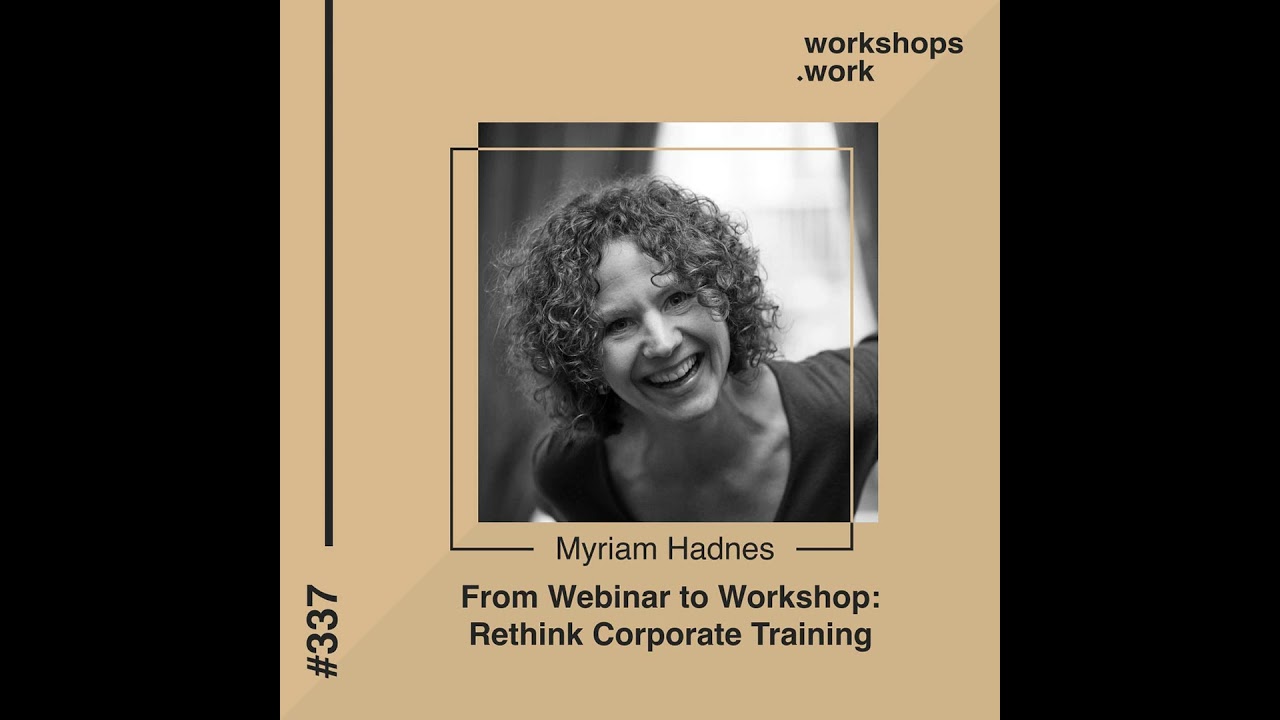
Myriam Hadnes explains why most corporate training fails: it ignores participants' mental state and treats workshops like webinars. She shares concrete rituals to reset attention, techniques like turn-to-your-neighbor breakouts to build connection, and how role-plays let people practice difficult conversations safely.
Chapters
What does it take to make workshops work? And how can we facilitate collaboration that sticks and leads to results? My name is Miriam Hatnes, and with the Workshops Work podcast, I'm on the mission to find the magic ingredients that make workshops work. Today with me on the show is just me, myself, and I. And we speak— I speak about corporate trainings and the big misconceptions and the fact that we must stop treating corporate trainings as if they were webinars, because they're not. They're amazing learning opportunities. And in this episode, I walk you through my best practices as the founder and lead of a corporate training agency and some tips and tricks behind the scenes on how to scale corporate training and still make it feel as if it was individualized, personalized, and a unique experience independent of how many participants and how often you have repeated this session already. So I hope you enjoy it. And don't forget to scroll to the show notes and to subscribe if you enjoy the content. Thank you for listening. What comes to your mind when you hear the words corporate training? Maybe very little excitement. Maybe the first word that comes to your mind is webinar or PowerPoint karaoke. I want to address today one of the big misconceptions around corporate training, because whenever I hear friends or even colleagues speak about the online training they get from their employers, I get the shivers. And I wonder what it would take to change the conception and the approach. Because what these people tell me are that they're bombarded with PowerPoint slides, great content, but ways too much. But the effect is that everyone is multitasking, replying to emails, coming there already with a mindset that, okay, they will be leaning back, becoming passive consumers of content and get a little bit of time to go through emails or to update a document or to do whatever they couldn't do in the normal working time. And I think it is a disrespect to our time, to the format, to the opportunity. It's such a wasted opportunity for learning, and even more than that, for Connection. So today I want to address a topic that is very close to my heart because I am actually running an agency for corporate training. So we have delivered hundreds of workshops for multinational companies, for— to very busy managers and employees. And the feedback we have received and the impact we have seen was ways beyond the content, but went to the connection not only between the participants, but also towards themselves and to the content in a very different way. So in this solo episode, I would like to share my perspective on what I think is going wrong in the world of online corporate training and why It's paying a disservice to think that we can outsource it to our e-learning platforms or ditch it all the way because it doesn't have an impact and it's not engaging. And then I want to share some insights and maybe tips and tricks that can turn corporate training into something that is more engaging, more fun, And without compromising on the learning experience, on the depth of the content. And I would like to share some experiences of scaling this because one might think that, yes, of course, a single workshop, a single training can be engaging, but how does it look like if it's done on scale, if it's over and over again the same workshop? How can you actually create an experience that still feels to the participant as if it was uniquely designed for them, as if it was designed with not only the culture and context of the participants but also of the company in mind? So I would like to share the experience of my boutique training agency, Workshops Work, and the amazing work that my associates are doing delivering workshops over and over again in up to, I think we're delivering them in 15 different languages, and what they have learned from the process and how it actually contributes the clients and the participants. So let's start with the beginning. What's wrong with corporate training? I believe that most trainings are delivered to participants and not for them. And we underestimate the context or the headspace from which the participants join. So usually the very first thing that I do as I arrive and welcome the group, there's always some music which creates a smile on the face of the group because they realize, oh, there's something different. And then I invite them to just take a piece of paper and write down everything that might distract them in the next 90, 120 minutes, 3 hours, or however long the workshop will take, and to put it away, and then to close all the tabs. And I'm very blunt to them. I say, listen, this is not a webinar. If you came here to answer to your emails or to do some research while listening to me blubbering and sharing some content, I have to disappoint you. This is not a webinar, it's a workshop, and I need not only your attention but also your participation. And then they feel a little bit intrigued usually. So at least I catch their attention, their curiosity, and I invite them to close all the tabs because they won't need them anyway. And these are potential rabbit holes. And then I get them out, get them to stretch their bodies. And I must admit that in the beginning, I felt weird to ask a group of corporate leaders, managers to get off their chairs and stretch their bodies. But the more I do it, the more rewarding it is. And I give them the choice. If you don't feel comfortable getting off, or if you cannot get off your chair to stretch your body, you might stretch your mind. Or stretch in your mind, at least get into a different position so that they can really land in their bodies. Because all these people usually arrive right after a previous meeting, or they worked on a specific task until the very last minute, and then they jump into the workshop. So their mind is still somewhere different. And just by ignoring it, it won't help us. And if we don't acknowledge this, the difficulty in this transition between whatever they've done before and the workshop itself, we'll lose them immediately because their mind will still be hanging on to something. Ah, I forgot to do this and maybe I need to do that. And these first minutes of any training and especially online training are precious because we either win them or we lose them. And if someone gets into a rabbit hole, or starts their emails or opens a tab in the first 5 minutes, there's a very high likelihood that we won't get them back. So I think one of the biggest traps in online corporate training is to not acknowledge and design for this transition moment. So once they did their stretching and sat down again, or Then it's time to, to start the workshop, and only then. And then it's a second reminder that it's not a webinar. And for it to not become a webinar is not only my responsibility as a trainer, but also the responsibility of the group. So what I would say is that I might share a content-heavy session, so there will be many slides. And for it not to turn into a webinar, what I need from them is interaction. And there are different ways they can do that. They can turn their camera on and nod into the camera or shake their heads so that I can see that they're with me and thinking with me. Or they can share their icons, so their reactions that we can use on most of the online video platforms. They can use the chat. Or they can unmute themselves and speak to the group. So I give them different options on how to interact. And that even if they don't feel that they want to share words in the chat or out loud, that their visual clues, their facial expressions are important to me. Because only if I am in conversation with them, even if it's nonverbal conversation, Then I will be at my best and it will ensure that it's not a webinar but a conversation. And when I share that, I often see that people start nodding or using the reactions or typing something in the chat. And then I give them positive feedback about that. And the next step to avoid an online training to become a webinar or waste the time and money because it's a PowerPoint karaoke that nobody can follow is to connect the participants to each other. And this is— has nothing to do with touchy-feely, hunky-glowy, woo-woo stuff. It is again to help them to use their vocal cords very early in the process and to reduce the awkwardness of being a lonely individual in this big group. Because very often in these online trainings, it's not teams who sign up, but individuals. The clients I work for are usually multinationals, so which means that participants come from different divisions, different countries, sometimes different continents. So they might be in different time zones. And if they then show up And see the grid of all these unknown faces, it can be slightly intimidating, especially when we speak about topics like leadership, like giving and receiving feedback, or psychological safety. These are quite vulnerable topics, or how to deal with conflict. We have to ensure that everyone feels at least comfortable in the space, not yet safe, but at least comfortable. So what I would do, and if you listen to the podcast and me speaking, have come across that already. I will start with the turn to your neighbor moment. And this is, it started in the community that I hosted, Never Done Before. We, that was our ritual. We started all the sessions with the turn to your neighbor moment. And now obviously the boutique agency that I manage, we brought that as well to the work we do. So we start, we always start with a turn to your neighbor moment, although it comes for corporate sessions later in the process. Because you cannot just welcome people and throw them out to have a one-on-one conversation because this can also be very scary and unsettling for some. The question can be very close to the topic of the training to help them connect to the theme and to find a reason for them to make it useful because in adult learning, The most important thing is the intrinsic motivation. So why am I learning that? So this turn-to-your-neighbor moment or first reflection to help them identify the reasons for them to be there can be very valuable and then increase their attention and engagement later on. So why are you here? What can you take away from this? Or what has been your recent experience with the topic? And let them share with one or two other participants. And even if they wouldn't speak about that exact topic, the fact that they're in the breakout room with one other person, that they can connect to someone, use their vocal cords, already creates a little bit of a community and showed them immediately that, okay, this is a session that needs to be interactive. So It sets the ground. What I sometimes do in order to avoid the sudden stress, which can lead to the fact that people just log off, they're scared, oh God, I will have to talk to another person. I'm not prepared for that. They log off. What I would do in order to frame it is say, That we'll engage in a thought experiment. Let's imagine that we are not sitting behind the screen in different countries, different offices, but that we all came together in the headquarters of XYZ in such and such city, and you just walked into a workshop space. You found a seat, and what would be the most natural thing that you do once you sit down? You turn to your neighbor, you smile at them, maybe you give them a handshake, and you exchange a little bit about your reasons to be here today. And we'll do exactly the same thing. The only difference is the Zoom gods will decide who your neighbor is. This little introduction usually creates some smiles and reduces the stress because it reminds them that is the most natural human thing to do, to have a short conversation with another person. Important is not to make this too long. So this is a maximum, very maximum 4 minutes. Usually it's 2 or 3 minutes, just long enough for them to become curious and to start speaking, and short enough to avoid they run out of topic. So imagine 2 introverts who don't like to speak that much, they will be done in 1.5 or 2 minutes. Speaker sharing their names, where they're calling in from, maybe answering the question. The moment it becomes too long, you increase the probability that they will feel awkward. If we feel awkward, we'll open another tab, we'll take the phone, we'll drift into a rabbit hole, and you don't want that for a group. The effect you want to have with this very first breakout room is that they come back and say, It was too short. There wasn't enough time. And this is usually the comment or the response you want to seek when a group comes back from a breakout room. Always. There wasn't enough time. Obviously, unless you're in a different sort of workshop or group coaching where you are seeking deep conversations, then you do need to give them more time to really get to the depth and the core of it. But for these kind of Lighthearted explorations, make it short and crisp so that they come back and they will bring this curiosity and this warmth to the space. And then I listen to a few voices just to hear, how was that? To whom was it comfortable, uncomfortable? What did you learn? And by that, within the first 10 minutes, I create an atmosphere that is welcoming, warm and sets the tone of, okay, it's not only me speaking, we're doing this together. So if you want to make a small change to your corporate trainings to make it less like a webinar and more like an interactive, engaging session, these would be my tips. The second misconception is that it's all about the content. Of course, we are delivering training and participants are joining to learn something. The problem is that we won't learn or retain everything that we've heard. Just because it's written on a slide and someone has read it out to us, or just because we discussed about the content on the slide with someone in the session, doesn't mean that we remember it. So we have to slow down to really make sure that everyone has at least time to absorb and reflect upon it, and to try to cover less. Because in the end, it's not about the amount of content we have delivered, but the amount of content they have retained. And not only that they have retained, but that they know how to implement after the workshop. And in order to do that, we need different touchpoints. So first of all, we need to know why is it important for me? How is it relevant? How can I apply it to myself? And then help them to really sit with it. So self-reflection can be one way. Ask them to use a piece of paper and to write down something or We often prepare Google Docs that they can copy to take notes, to take digital notes, or of course put them into breakout rooms to have a conversation about it. What I often observe is the goodwill of trainers to create a group conversation, and then they ask a question to the entire group, and then nobody answers. Nobody Replies, because it's scary. There are 2 approaches to that. Either you're patient and you can, as a trainer, sit in silence, and then you just wait. Someone will say something because there will be at least one person who cannot sit with the silence and will break it no matter what. And the second option is to first give them time to speak with a small group, 1, 2, or 3 other participants, before then coming back and sharing, because then they can make sure that it's, um, not totally stupid what they're about to say. Remember, everyone has a little imposter syndrome in them, so a moment of reassurance usually helps. And it also gives everyone the opportunity to hear different perspectives, so not only to have their own or the one perspective of the brave one. That, uh, dare to break the silence. And actually breaking the silence reminds me, at the very beginning, as they're coming out of the turn-to-your-neighbor moment, I asked them, how was that? I would wait until someone says something. Because maybe I see some thumbs up or people nodding. If nobody speaks, I wait, or I point out someone who is in nonverbal conversation with me, showing me their thumbs, and ask them directly. Because it shows them that I trust that they will speak, and it also shows them that they have permission to speak. Very often the problem with asking for engagement or inviting the group to speak is that we don't give them enough time. We ask a question and then we continue, and it almost feels as if it's a fake permission. And if the group is not sure whether the invitation to speak is genuine, they won't. It's just too risky or too much effort. And then it's easier to open another tab and engage with a different rabbit hole. So what I'm trying to do for— in terms of content and to make sure that the content really lands with the group is to have them engage with it in different forms to maximize the opportunity for them to take something away, assuming that they won't be able to remember everything. But if we create small experiences, if we help them to, to connect through emotions or through humor or through anecdotes, this will help them and also speak to a wider range of personality types or ways to process information. Speaking about neurodivergent. Participants. One way to help participants engage with the content and make it application ready are role plays. And I know that many facilitators— no, everyone has a relationship with role plays. Some love it, some hate it. From the perspective of a trainer, what I have experienced is that Role plays can be very impactful because even if they're rehearsed, even if we're role playing a situation that is not 100% realistic, it still somehow feels real when we speak out and when we take on a role of someone. The problem in online training is that the moment the group steps into a breakout room where there is no one to supervise, air quotes, The temptation is there for at least one person to say, ah, instead of the roleplay, let's just discuss it. And then they go on, on a meta-level discussion about how in theory they would have this conversation. And I found that the best way to avoid that is by naming it. So what I would do is, okay, in a minute we are going into a breakout room for roleplay. And with a 99% chance, there will be one of you suggesting that you can, instead of role-playing it, you can discuss the content on a meta level because it feels uncomfortable. And this is absolutely normal. The thing is that this is a one-time opportunity to really practice it before they have to do it in real life on Monday morning. So you showed up to this workshop, you're already here, you went through the training. So this is your opportunity to get uncomfortable and to speak out the words before you have to speak them out in real life. And it turned out that especially for trainings on topics like feedback, having difficult conversations, any type of conflict or leadership performance reviews, these kind of things, it's really helpful. And then reminding the participants of their responsibility and the unique opportunity. If they knew everything already, they wouldn't be there. And the more vulnerable, maybe risky in terms of personal risk, a topic is, the more I would really speak to the participants in the way That I remind them there's a reason why you're here. If they show up to a workshop on solving conflict, I would remind them that if they hadn't conflict, they wouldn't be here. So there's one thing everyone has in common, and nobody really wants to talk about that because admitting that you're in conflict with a colleague is vulnerable as such and might be a taboo. So let's use the opportunity that we're all in the same boat on this. And take it and get real with each other. And it's also important that I, I as a trainer would never go into a breakout room without being invited to it. And that's what I tell them. It's your safe space. It's like in Las Vegas. Whatever happens there stays there unless they call me and ask me to join if they have questions. So yeah, so I hope this gave you maybe some new ideas on how to redesign your corporate trainings or how to clean up with some of the misconceptions. Corporate trainings don't have to be dry, don't have to be webinars, and don't have to be PowerPoint karaoke sessions. And they don't have to be overly vulnerable and sharing from the heart. All of this can be very lighthearted, that it speaks to different audiences and invites everyone to engage at the level that they want to engage. And what I would like to share next is the opportunity of creating a community of facilitators or trainers who deliver these workshops. Because as I mentioned, my clients are multinational organizations, so we would deliver workshops hundreds of times to really reach all the different employees. The benefit of that is that it, since these workshops are usually open to anyone, it creates little bridges between different departments, between hierarchies, between countries, between cultures. So participants learn a similar language. So for instance, when we work on psychological safety, then we create a shared understanding of what psychological safety is. So that they can communicate with each other. And the similar thing is when we work on company culture or values. So how can you create the same understanding of what the company values mean to different parts of the organization without being a dry PowerPoint call, OKR, again, that tell participants? instead of inviting them to reflect and co-create. And I think that's a big risk because we lose especially the high-performing, the talented participants and employees if we are not giving them the opportunity to co-create and to contribute to these learning moments. So this is one side. We're connecting the participants. On the other side are all the trainers, and by connecting them to each other, we have a feedback loop so that we can learn from the different cultures, from the different groups of participants, and on the one hand find more and more anecdotes and examples that come from the organization itself, but we can also reflect on the different sessions or differences in culture across the organization, which points out maybe blind spots, but also curiosity that if in some regions they would take something for granted, realizing that it's in their bubble and around the corner in the same organization, things might be different. And I've heard from many other agencies that facilitators, whether they're internal or external— actually, these can even be internal facilitators for the same company who get the content, they got the slides, they get the session design, and everyone delivers their own workshop, which could be fine because it's standardized anyway. But it only becomes an experience if These trainers also have a sense of belonging and— sense of belonging is one word. But we can increase the depth and the impact if the trainer understands the different layers of the organization through this content. So what we do with our associates is— and this is a relic of never done before, obviously, because most of the facilitators who associates for me, they came through the Never Done Before community. So I know exactly how they facilitate, and we share the same values and the same understanding of what facilitation is. But even if you don't have that, to bring a group of trainers, facilitators together so that they can exchange on best practices, what has worked for this type of organization, what hasn't. Because just because something works well for one organization, Doesn't mean that it always works. Maybe we can learn where the cultural differences lay and also encourage the trainers that if something doesn't land, to help them see how to improve them, how to get better, or also sometimes just to understand that sometimes they don't land. And it might not— it doesn't necessarily mean that they're bad facilitators. It is easy when we deliver the same content over and over again, it is very easy to fall in the trap that we are bored by the content. And then we become this PowerPoint karaoke that we never wanted to be, but it's just stronger than us. And I remember well a time where, because of different circumstances, I delivered the same workshop, I think 17 times over 4 weeks. Something along these lines. So it was very repetitive. Sometimes I hosted the same workshop twice in one day. And the only thing that made it— that kept it alive and relevant for me was the interaction with the group. Because every group was different. They would bring different questions, different reactions, and I would be able to bring one anecdote of one group into the next. And although my case is obviously an extreme, we do the same in the training with the associates, that they can keep the joy of delivering, of hosting these sessions by learning from the others and sharing also further resources, reading. So that we continuously enrich ourselves and bring more different perspectives to the group. And by connecting the facilitators, trainers, with each other and creating this community, not only it makes it more interesting for them, so they will give it back to the group as I just discussed, we also create a knowledge base for the client. Because we see connections, we see different groups and conversations, we hear a lot of things that are shared of what's happening in the organization that can be very valuable for the client. So we'd have regular check-ins, feedback sessions where our facilitators meet the client for question and answer, for sharing best practices and maybe major changes in the organization that we have to be aware of because they may impact the group dynamics and the general maybe emotional load. So what I want you to take away from this, if you're either part of an agency or you're delivering corporate trainings or you're in charge of these projects, to not only think of connecting the participants but also to connect the facilitators and trainers, because there's a huge potential for them to grow, to re-engage with the content, to bring the content more alive and to collect insights and learnings for the organization as a whole, which then also helps to keep the content alive and to review and see what works and what doesn't. Because at the end of the day, everything moves on very quickly, and we have to keep the content relevant so that we treat our participants and learners with respect for their time, for their attention that they deserve. So yeah, so that's my experience. I hope that you found some new insights and inspiration, and I hope that you're taking away that corporate training doesn't fail because the content isn't good or people are not taking it seriously or not putting on their Cameras, or— but because we forget that we are human. We join the training from a very specific mindset, so we have to help the group and the learners to learn in the space and to actually open their minds, to connect them, and then also help the trainers to remain connected to the groups as well as to the content, because it's in the benefit of all of them. I hope you found this useful. If you have questions, let me know. And obviously, if you would like to just revolutionize or just change the way you approach your corporate training, please feel free to reach out and I'd be happy to help or collaborate. Thank you for listening. Thank you for staying tuned and for listening until the very end. I hope that you found the inspiration and the wisdom that you are looking for. And I hope that you will subscribe to the show so that you never miss any of the interviews with another inspiring facilitator from across the world. I'm devoted to continue this podcast and to deliver weekly an episode that maintains the quality that you expect and you deserve. And if you would like to help me to maintain this quality and to keep the podcast free, Please help us visit workshops.work/support to make a small donation to keep the podcast free. Thank you so much. I hope to be in your ears next week.
More from Myriam


Did Social Media Make Us More Unprofessional? Unprofessionalism EP 035 with Kate Raynes-Goldie

The Costume That Got Me Promoted with Moh Guissé - Teaser of Unprofessionalism Episode 28

Unprofessionalism Vodcast Episode 027: Why This Podcast Makes Us Uncomfortable with Myriam Hadnes






