Writing a Book in Public: Accountability Calls with Gustavo & Myriam – Episode 6
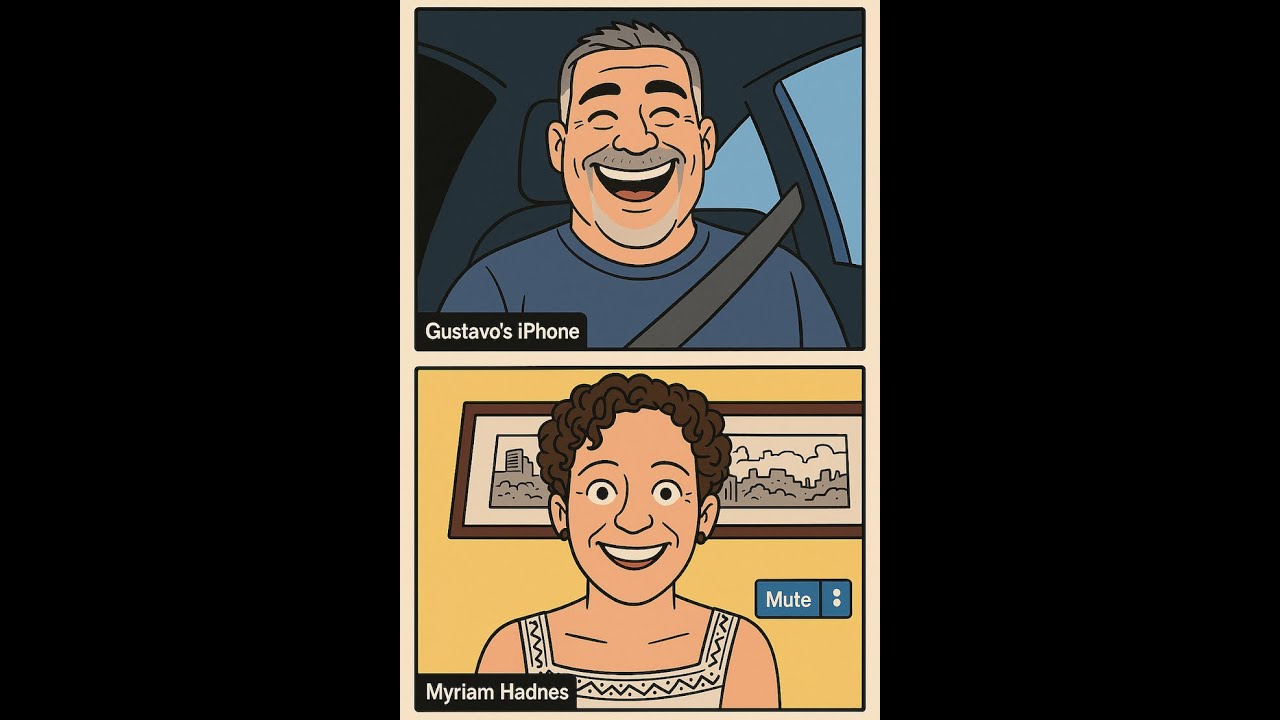
Myriam Hadnes and Gustavo discuss why scripted workshops kill spontaneity, how fear of blame makes leaders hire worse staff, and whether AI is a collaborator or threat. Myriam shares her book process: colored flashcards to organize ideas, then choosing raw voice over polished AI text.
Chapters
We were already in the middle of a conversation and forgot to hit the record button.
So people lost the best part. Yeah, yes, they have to buy the books and find out what they missed.
Um, do you want to share the story we just started?
Sure, but now it feels— it's a kind of a paradox because I was not necessarily complaining, but being a little bit critical of the need to prepare ahead to rehearse. And now it feels that we're doing exactly that.
We rehearsed a bunch.
For the audience, we're going to repeat something that I was telling, that I'm on my way to my son's graduation from college, and I'm not going to be able to see him until tomorrow because today he has an exam right before graduation, and then He's going to spend a couple of hours with all the other people, like doing exactly the same ceremony that's going to happen tomorrow because they need to make it perfect. So they are practicing. And with Myriam, we were saying, hey, is that the way it should work? What about spontaneity? Is that the notion of professionalism? Everything needs to be perfect and controlled.
Yeah. Imagine we would do the same for workshops, that we are practicing the workshop with a group before so that it's Perfect.
That's my approach. I don't know if I told you, but I usually practice everything ahead.
Yes. And then make sure that it also happens by the script. And that's then the problem. If clients want to have the agenda and the script beforehand, it won't happen like that anyway.
Yeah. No, no, I really don't like to do that. Yesterday I got into— I'm doing, um, a webinar. I usually wouldn't do webinars, I do it on my own. In this case, a company-sponsored webinar, right? So they wanted to check the content. So I say, okay. So when we got in the call, say, well, are we checking the tech and all that stuff? Because usually they want to do it like a run-through, like to make sure everything— no, want to see the content. Okay. So I give them like a 2-minute speech.
Okay.
Can we see the slides? Sure, you're gonna get them after the presentation next week. Oh well, but we thought— you thought what? Like, uh, and they say, well, but you know, we wanted to make sure that— and so I say, like, exactly what you said before we started recording, like, so you don't trust that I know how to do my job? No, no, that's not what we meant. I say, okay, so what really do you mean? No, no, don't worry, we're good, we're good, this is gonna be okay.
Yeah, because for me it's, yeah, it says a lot about the company culture. To what extent can you trust the person that you hired and that you're paying a lot of money to? And what does it mean to your own people and how much you trust them?
Yeah, and if they don't trust you because you're an expert and they're paying you a lot, to your point, that means that they don't trust Their teams.
Yeah, exactly.
Which means they don't trust themselves, which is for me the ultimate issue.
Yes, yes.
And usually we're brought in to build trusting relationships, to know, and we need to start— I would tell my client, like, you want me to get people doing stuff that they're not doing, so that requires taking risks. that requires improvisation, that requires a lot of stuff. So it starts with the approach to the workshop.
Yes, yes, we can learn so much from that. And I think what we often underestimate is the negative impact of people not trusting themselves. And I don't know where I read this I think it was a study that showed that people who don't trust themselves, they are hiring people who are not the best ones because they are fearing the competition. So it's like B players don't hire A players, they hire C players.
So you mean when you have a B leader, You need to play dumb until they hire you and then surprise.
Yes, yes, if you sit in an interview with a B-player, make sure— yeah, and isn't this shocking? Because I think honestly that's the reality. If you're in an interview with someone who is afraid that you might be better than them and who is afraid to lose their job, To you, they won't hire you. And then how can a company—
They won't or they might not? So can we change that? So it's a fact that they won't, or maybe we need to approach it differently?
They may not unless they feel secure enough or confident enough, because clearly there are different their different competencies. So I think a manager who trusts their managerial skills and leadership skills will hire someone who is better than them technically, trusting that they can help them to grow in that role. A manager who is suffering from imposter syndrome Um, or is doubting themselves, or, um, is a B-player, is not a good manager and leader, they might be afraid to hire someone who's better than them, um, because they might point out that they're not good enough, um, and might become a threat.
But the threat is not a threat if there's no fear.
Yes.
So what we— what I try to do is try to understand what's the fear. I was thinking about a client. I'm going to say that he's Dutch. So I know you live in the Netherlands, but if he's not, it's for a country right next door. So you've got to figure it out. And he has a very, like, interesting personality, so to speak. And when we I was brought in by one of his team members that was in charge of finding a guy or a gal, whatever, that could help them like bring their shit together. I mean, they didn't put it that way. They say, no, we want to improve our culture, collaboration, blah, blah, blah. But I could tell that they— so the guy at some point become to be really open about his boss and all the challenges and blah, blah, blah. So when I met this Dutch, but not Dutch, So he's looking at this and saying, that's me. Um, I saw a lot of that, no, the need to control, the need to control whatever. And at first I felt, oh, I'm wasting my time, I don't want to work with this guy. And actually, even if I would, he would never hire me because I'm the opposite of what the guy is looking for. And not only the A/B player, whatever, but he's gonna look for someone that he can basically So for whatever reason, I didn't plan that, but then ask him, okay, what are you afraid of? And it was weird because the guy was— he told me like, uh, I don't like to talk about emotions, blah blah. He was very like, like, you know, don't bring me all that bullshit, you know, and vulnerability bullshit, he said. And when I asked that question, the guy said like, uh, he replied like, do I look like I'm afraid? I said, no, I didn't mean that you're afraid. But we're humans, so fears are like emotions. They're like a— you're like driving, there's a red light that indicates that if you don't stop, you're gonna get into an accident. So, ah, okay, that's a great way of putting it. And then he started saying, well, I'm afraid that if we do all this and then things don't improve, then they're gonna blame me.
Hmm.
And I told him, look, that's— I have a different way of looking. I always tell clients that if sessions like this go well, usually people tend to think that, why did we hire Gustavo? We didn't need him. But if they go wrong, they're not going to blame you, they're going to blame me. So don't worry, I'll take the blame. So they can say, oh great. And then he changed it completely. So it was a random thing, you know what I mean? Like, yeah.
And it's, um, it's again very interesting. It says a lot about the culture in general, because if he's, if he's afraid to be blamed, it means that there is generally a blaming culture. Because you're not a— usually your fears come from somewhere. It's not that you're seeing ghosts.
Yeah. Let's say companies with a legacy culture. So think about Fortune 100, hundreds of thousands of employees. Many people have been born and raised in that kind of culture. Maybe it's the only place they worked and they were trained by their bosses. And so there's a— but it's not just in them, it's what— it's the only thing they know. And maybe we need to stop blaming these guys or treating them like, oh, they're stupid or whatever, and trying to understand they are the result of a larger system.
And then it comes back to psychological safety, right? So what does it take for this person to feel a little bit more safe so that they can take the risk and stop blaming? Stop blaming their team or overly controlling their team.
Or not. Or not. Maybe we don't need safety, we need courage.
I think we are— it sounds as if we already had this conversation, didn't we?
Yeah, I know.
I think we need safety to have courage. And by safety, I don't mean that we're all No, I know, I know. That we are nice to each other and that we pamper each other. By safety, I mean that we trust that we won't— our heads won't be chopped off so that we can be courageous.
Yeah. So tell me about your book.
Oh, um, my book turned into flashcards.
Oh, wow. Um, I feel humiliated now. But that's—
I, it— I went through a very interesting process where I, I hired a book coach. Okay, we haven't started, we haven't started working together yet, um, because I realized that I'm turning in circles and I have no idea how to do it, um. And then every time I start to write and every time I post something on LinkedIn, there's a new piece of the puzzle that comes. And then I stand there with my new insight and try to find the way in these pages I have written where it can stick it in. And then it's a house of cards that just seem to collapse every time. So I decided to take 5 steps back and bought flashcards in 4 different colors and have the green flashcards for my— for the ideas and concepts, and then a different color for economic theories. I realized that I'm using so many economic theories in my book.
Wow.
And a different color for resources and books that I'm referring to, and a different color for the case studies. and my own experience and all these anecdotes. And then it's like a big mind map. And today I spent the day sitting outside in a cafe going through my flashcards and putting them in order, finding themes, adding the resources, the economic theory, my ideas to the themes, and then see how the themes actually fit together into a narrative. And now I think I'm still not there yet, but I think soon I'll be able to start writing again. Okay.
Why that face? Come on. I love it. I love the process. And I'm thinking, like, I don't like voting as a way of choosing ideas, no, but I— but in this case The voting, instead of using color dots, could be the coffee stains. So you're gonna keep working on those notes, and the ones that have more coffee stains, that thing that seems are the ones who went through the testing process, you know, you can throw them away and you keep referring to them because—
Yeah.
And I was thinking about the, the— I was just reading a an interview, I don't know if it was real or fictional, I couldn't check it yet, but between Elon Musk and Keanu Reeves.
Hmm.
And Elon Musk basically building the idea or selling the idea that Hollywood as an industry is going to disappear because AI is going to be making perfect movies. And Keanu Reeves talking about people don't like perfect things, they want imperfection and the mistakes that we make and that humanity is what people connect with. versus picture perfect. And I love it. And then I think about instead of computer and software, you're using old style flashcards and in a cafe, and then they get with all these stains because, or they, you write on there and that stuff. And that's part of the magic, right?
Yeah.
Of writing.
Yeah. And I, um, and it's to, I think the process of finding my own uncompromised voice I totally stopped using— I got so annoyed with ChatGPT because whenever I put something in there and ask it for refinement, it sounded too polished. And at some point I said, damn, like, how can I— how can I look in the mirror with integrity when I'm writing a book about unprofessionalism and wanting to promote the unpolished and the human, and at the same time falling in the trap of trying to be too polished and too professional. So I have the impression that this book process is like, it reveals all my shadows, all my insecurities, all my imposter syndromes. It's like therapy.
Oh, you make me feel so bad. So maybe I'm, I'm still scratching the surface of my writing. I'm not going that deep.
You're, you're more professional writer, and it's the second one already.
I'm, I'm a professional of being an unprofessional writer.
Ooh.
So I have the experience of doing stuff in a shitty informal, like, uh, you know, like, uh, I throw stuff there without filtering much, and then—
I love it.
People think that, oh, you've been putting like months behind that. New articles. I always sleep with Post-its and a marker right next to me. So at some point I wake up because I'm thinking about something and write it down or whatever.
So, yes. Yeah, my entire apartment is plastered in Post-its, and every time I have an idea, I have to stick it somewhere. But now I have my flashcards and I can take them with me.
That's fantastic.
That's the one thing that now always comes with me.
Wow. So yeah, no, I'm more chaotic. Sometimes I'm having a call with a client, like I have a computer in an office which I used to write and also do the day-to-day work, but then another place in which I run the workshops, right? And there I have a monitor that's full of Post-its because sometimes I'm having a session with a team and they say, oh wow, That's good for the book I'm writing about. And so give me a second, I need to write something. And, and often I tell them, look, sorry, but, uh, but I thought that this idea could work for my book. So I'm being honest like that. Yeah. Yes, yesterday I finished part 2 of my book.
Congratulations, milestone!
And it was a ChatGPT written part of my book, right? But with my ideas.
Okay.
So basically, ChatGPT doesn't think for me. He basically does the hard work and I keep— so there were some parts that I have a lot of content that I created. So I was really clear about what I wanted. But I was thinking about your experience with AI. I like to turn AI into basically a more of a challenging partner than a perfect partner. So I started to scream at AI, treat him like a little bit disrespectful from being very polite to, and see what happens, but also tell that you don't need to accept my ideas. You don't need to tell me that I'm right. So now he's becoming a little bit more of a—
Yeah, because—
Because it's just my AI version of me. He's becoming a little bit more like that.
You're like annoying. I agree that it always— Miriam, that's a brilliant idea. Oh, yes. And it always yes-ends everything that I say. Very annoying.
Yeah. Okay.
So is your AI now obeying and challenging your ideas?
Yeah.
Great.
Because I've been to it. But the point is, I spend a lot of time without— it's funny, I told you that not this week, but the following, I'm going to spend 10 days alone in a cabin in the middle of mountains in North Carolina. No work. I'm gonna block everything. I have already everything blocked. And I thought, well, when I get there, it's gonna be more of a making, more of editing and polishing and what— and as time started to go closer and closer, I say, well, but it seems that I'm gonna have to start because I wasn't doing much progress. And then one day I woke up And I say, now I know what, how, how it looked, the part 2 to look like, and started writing on my own and putting things together. And then I asked AI to help me like connect some dots, and it was a back and forth for hours and hours and hours until past midnight. And then boom, there it is. Now I have a draft that I can— I don't know if I told you, I started running a survey as well. And I got lots of answers from people, hundreds and hundreds of them. So really great because now starting to see some numbers to bring to life some of the concerns. And one thing that's interesting, I asked a question about why people— why do you think that people avoid difficult conversations or run into shallow agreements, blah, blah, blah? And then I asked the same question, why do you do that?
Mm-hmm.
And I'm still working on the findings. But one interesting thing is that when people think about others, they think people avoid conflict, people do this, like they look into the negative side. But when it's about why they avoid, it's either because they want to hurt relationships or because they think it's not worth it because of the other person. So I'm never going to be able to get anywhere because of them, not me.
Yeah.
So that's something I've been observing in my research, that many times, most of the times, it's not that people don't want to do something, it's not fear, it's not everything that we— it's more about people don't have hope on the outcome. And that's one of the biggest things I'm finding, that people avoid stuff because they're hopeless. So we need to Give them hope. Not hope in the sense of blah, blah, blah, but hope that, hey, maybe there's a way to get resolution.
But there might be an impact. Yeah. And maybe to find compassion back.
Yeah.
Because I also realized that in the trainings I have on difficult conversations and conflict, it's very often that they don't even realize that maybe the conflict, the origins, could have to do with something that is outside of them.
Yeah.
Or that, um, if they admit and show some vulnerability and that they care, that it won't be abused.
Yeah.
So there's— yeah, back to fear. Fear of being misunderstood, being taken as weak. Very interesting finding. It also reminds me of— there was another study, and I cannot get the exact wording together, but when we, um, when someone is coming late, we often assume bad intentions and laziness. But when we come late, We see all the reasons behind. So there's also an aspect of cognitive dissonance.
Yeah. But that's exactly the point. It's like I do things for one reason, but then I assume people do them for another. So if I'm afraid of the 2 things that I shared different types of conversations and where we're from, very easy to very difficult, right? And the 2 most difficult, I thought that feedback was gonna go there, it wasn't difficult, but the 2 hardest so far are addressing conflict and sharing personal things at work.
Why is that, do you think?
I'm, I'm working on qualitative data to go there. But it feels that on one hand, that's why I sent you the other day a piece that some— we talk about, hey, be vulnerable at work, but people feel that when they open up, hey, to your point, I need to— I'm going to miss this meeting because my kid— I need to take my kid to the doctor, whatever. That at some point that was cool and now it's becoming not so cool. And it becomes weaponized. Ah, you're prioritizing your life versus work. Hey, what?
Yes.
Well, but it's using against people, right? Like, and also one thing with AI, which is AI has a lot of great things, but I think the conversation has been focusing a lot into AI as a productivity tool. Like Shopify saying, hey, if you cannot, before hiring someone, show me that you can do this with AI. Like, no, like, And even though that's great, there are other aspects. And actually, we're not seeing AI as a team member that can collaborate with me. We're seeing it as a team member to replace humans. So we're getting back into competition, the human resources. No, we are becoming a resource.
Yeah.
And not talent. So resource, you want your machine to keep producing products. So the machine cannot break. And if it breaks, you want to fix it. So if you have something personal, they're not empathetic. They see, oh, you're broken, you're not producing.
And it's interesting because it can backfire as if you're seeing your colleagues as competition instead of collaborators, you treat them very differently, right?
Yeah.
And the same is true for AI. If AI, you see AI as a competitor instead of a collaborator, There's a huge missed potential for the company as well.
Definitely. Because what happens is the same way that if you feel, hey, Myriam is going to take my job, I'm going to withhold information, the silos, people do that, then they're going to start doing exactly the same with AI.
Yeah.
They're gonna stop sharing certain data with AI, right? Because AI can help companies make better decisions. But if you don't share the data, if you share wrong data, then AI is not gonna get better or it might get you in the wrong path. And then people can say, look, AI missed it. Look what we found. You know what I mean? People can boycott AI. Yeah.
Yeah, very interesting. And then on the other hand, that's something that I'm, I'm seeing and I, I address in the book, is that the moment if you have too much information, you can connect everything with everything. And that's what AI often does if it doesn't have directions. And that's something that we cannot outsource. Yeah, because with big data, if you have data on everything, how do you know what to prioritize and what questions to ask and what to exclude?
Yeah, but I think that building on that, even the creators or people like are developing the tech are not realizing what they are getting into.
Hmm.
And technology is new, right? Think about the Industrial Revolution. At that point, basically, oh, people are going to lose their jobs, and the future was no people working. When we invented the calculator, when Microsoft invented Office and Excel and blah, blah, blah. So there's always— and then the internet, and then Google, and then The thing is, instead of thinking what can we use humans' capacity and capability for, what's next, because that's how the world— like in the past, many people produce the clothes that we wore. Well, not maybe we didn't see that, but you know what I mean. And then machines started doing that, but people weren't— didn't stop working. They started working on something different. So I think that companies need to think about, hey, how can I reutilize that human capacity versus how can I replace people by AI? And I think we still are in that infant phase, which is understandable but super myopic.
Yeah, yeah, leaders are not seeing the real picture because they're operating within a framework that is already not working anymore.
Um, because they're working on the short—
yeah, the short term.
Yeah, because if I'm getting valued as a CEO on quarterly earnings, I only care about the quarterly results. That's the paradox. Everyone talks about innovation. How can you innovate, which innovation is a long-term game, when you're going to be depending on your earnings?
Like And that's exactly— that's the big puzzle I have at the moment with the professionalism, is professionalism is usually about the measurement, it's about the KPIs, and you cannot be innovative while following the rules of professionalism. If you hire a CEO who's supposed to lead an organization out of the next big crisis, this CEO must be able to break the rules. Because following the rules will not get us out of a crisis, not in a creative way. So if we are promoting those who always follow the rules and who stick to the professional standards, these are not the ones that will help us in the future.
We get the same outcome.
Exactly. So yeah, and then I wonder what the post-professional— what are the If we do need— because we do need some sort of KPIs or standards to measure progress, see whether we're on a good track, and then how to do that in a way that it's aligned or promotes and enhances innovation and creativity instead of killing it.
Mm-hmm. Yeah, I think that we're living in an era where everyone's talking about creativity and innovation, but I think we're living in one of the most mediocre eras in—
Yes.
When I was close to when I was born, we were sending the first crew to the moon. That's a huge innovation and breakthrough experience. How many breakthrough experiences like that have we had since then? Like inventing a self-driving car, which isn't yet there. We're still— it's not like, oh wow, of course. I mean, in 2025, why wouldn't we, right?
Yeah.
And is that really breakthrough when we talk about— like people talk Uber. Well, but Uber simply created an app to capture what in many countries was already happening. In a more organic way. And is that really disruption? Like, you know what I mean? Or just using technology to make something more efficient? But the idea itself, is it really revolutionary?
Yeah, no, AI is disruptive and revolutionary.
Is it? I don't know.
Still, The Web 4.0, what was it? Web 2.0, Web 4.0, Web 2.0 revolutionary. You could actually— so there are a few things that were revolutionary, and I think this is what is scary. Okay, another puzzle I'm facing when I look at the traits or characteristics that we need in order to have these breakthroughs. The figures that will stand out are the Elon Musks, the Mark Zuckerbergs, and the Trumps. Those who break things, those who are not afraid. And then, do I really want to promote them? No, because at the same time we want the compassion, we want the care, we want the integrity.
Mm-hmm.
So what does it take then?
So you say a leader— sorry, is it about breaking or building?
And sometimes you have to break something to build it.
Definitely. But the point is when people think that breaking is the goal.
Okay.
So you know what I mean? Like, yeah, you mentioned a lot of people. I'm not going to repeat. They're breaking stuff, but then are they ending somewhere better or just making many people's lives miserable and complicated? You know what I mean?
Yeah. And maybe the question is, uh, when they derailed, because I think Facebook started with best intentions. I think the initial idea of Facebook was great. And now I'm reading the book, um, Careless People about the story of Facebook. Shocking, a shocking example.
But it started like a dating app, so it wasn't about checking. So, um, it was gossiping and it didn't even gossip. So I think my point is, I understand that AI might feel like a— I haven't seen yet the disruption. It's really new, but I'm trying to see innovation not through the lens of our current time, but through humanity, right? So when the first vaccines were developed, those were breakthrough, you know what I mean? Like, uh, yeah, they were life-changing. They saved lives and stuff. And what happened is those breakthrough moments, going back to NASA sending someone to the moon, those were collaborative efforts.
Mm-hmm.
Today we are rewarding people who are the innovator, who are selfish, who are arrogant. And breakthrough innovation always has been a huge team because complex problems require collaboration between a lot of crazy people. Yeah, weird people, you know what I mean? So it's collaborative.
Yeah, yeah. And solving real-world problems. The washing machine is another example. Yeah, um, that freed up so much time of For women.
Yeah.
So that was a real disruption as well.
And it was revolutionary. Not only that it freed up time, it wasn't just the productivity, it was that it opened the door for women to think, hey, I'm not just a cleaner, I can do better things. I can become, you know, like a— so it opened the door for professional women too.
Yeah.
The other day I was talking to a guy and I came to this conclusion. He asked me a question like, I mean, Apple was revolutionary. When they invented that easy-to-use stuff. But then he said, what has the biggest breakthrough that Apple brought to the market in the past decade or even 2 decades? Tell me.
Yeah. Yeah. And then I wonder whether it's because of the lack of competition. There's too much monopoly in the tech sector.
Sure.
Um, so there's no— not— there's— if there's no— that's the economist speaking, right? If there's no incentive to, to innovate, um, but to just play it safe, and if you buy all the potential competitors too early.
Yeah, like, yeah, like the first Macintosh, that was revolutionary. But then there were— we see optimizations of an already existing product. That's not true innovation.
Yeah.
But when they are, to your point, because there's no competition, then everything feels innovative because we're used to that. But that's what I'm saying. When we talk about innovation, we need to step back and see what are things that really change people's lives dramatically, not things that, oh man, It wasn't the new gadget that I bought and then 2 years from now became obsolete.
The printing press.
Mm-hmm, yeah.
Translating the Bible to English.
Mm-hmm. You see, those are turning points.
Yeah.
So I'm not saying the other things aren't important, but we also need to say, hey, what's the bar? Because if not, that's what I'm seeing. I think we're living in a very mediocre time because the bar is super low.
And I think one reason for that is because we don't have any capacity. In order to have breakthrough moments, we need, as you said, we need the collaboration. So we need the input from several people who work on the big problems together, and we need time to actually absorb, to read, to see, To think what the problems are and how to solve them.
So we need to invest, whether it's money, resources, collaboration, risks.
Yeah, and I think, yeah, and we have to, to lower productivity, so to lower the pace.
True. Yeah.
Because I think the maximization of time to squeeze too much work, we're not doing the relevant work anymore. I think that's the biggest part. When I look at all the clients and the craziness in the corporate world, nobody has time to think about anything that they're doing. So they're doing mediocre work and working on the wrong priorities.
Let me, for example, I'm not going to— I'm going to think about a client in particular, about many. So if someone's watching this recording, it's not about you. There are many large corporations that have these performance review systems, right? And they complain about it first because there's a lot of politics involved, because your bonus, your career depends on how people rate you, how your team rates you, how your manager rates you, and so on and so forth, right? So one thing I decided to do, because if you attack the system it backfires. And people say, no, this is how we work, we need these metrics. But I say, can you tell me how much time do you invest in running the process? And how much time you invest in discussing, attacking people, writing the plans, reviewing the plans, and blah, blah, to fix those metrics?
Mm-hmm.
And it can go from anywhere to 10 to 15, even more of their annual That's scary. And because it's a game, what happens? Season leaders train their people to answer in a way that's going to make them look good. And so people start gaming the system.
Yeah.
And they spend a lot of time gaming the system. But are we getting better?
Is that going to really And I think we have to, to go back to first-order principles. Because what are— and there's a law, I forgot the name of the law, that if, if the ambition becomes to increase the metrics, so if that becomes the goal instead of solving the real problem, you're using the wrong metrics.
Yes.
And I was— so one thought that came today in a post-professional world, the KPI that actually would make sense is a KPI on— you will hate me for that— on psychological safety. Because if we know that psychological safety improves, increases the likelihood of having high-performing teams, Then we have to measure and increase the numbers that would support teams to become high performing.
Yeah.
So this is what we measure and not their performance as such, because if we're just measuring their performance, they will try to trick the system.
Like what you were saying before, like we reward— you get— you become what you reward. There's a company I use a lot in when I work with building a culture of ownership. One of the things, the key steps that people need to do is reward the behaviors that are going to move the needle.
Yes.
Not the metrics that are going to say, hey, we're doing okay, but are not building the right culture, the right team. So to your point, Whether it's psychological safety or it's experimentation. So what are those behaviors? Because in the end, if people do the right thing, so it's focusing less about how fast are you running and more are you training and eating healthier and whatever, and then the rest is going to come. Exactly.
Yeah, train the form. Do you have the muscles and do you have the form? And then the fast running will come automatically.
Exactly. But when you're timing people obsessively, people don't have time to do the right training or following the right diets or whatever needs to happen.
Yeah.
Yes. And that's because we have short-term thinking, and that's because we have a culture of mediocrity. Big thinking.
I read that— oh yes, I read that in an article in the German newspaper about the fact that especially US American companies would not invest in their people in the training to use certain machines because they're afraid that once they got the training, they will leave the company and work for the competitor.
Yeah.
So With this kind of mindset, how can we ever expect people to actually perform?
Yeah.
So professional. Mm-hmm.
Yeah.
And now we spoke about everything. Well, we kind of spoke about our books.
Well, I think that we're talking about the content, not the writing process. They go hand in hand though, right?
Yes. Um, you mentioned in an email that you were thinking about whether going with a publisher or self-publishing. Have you come to a conclusion?
No, but I'm running an experiment and then that might help me decide. So I reached out to an author She connected me with her literary agent, and I'm on the process of writing the letter, the stuff, and reach out and see what happens.
Great. Yeah.
So I'm not— so I'm, I'm not saying that's the way to go. I'm gonna go through that conversation and see where that takes me.
Yeah.
And learn.
And, and I think taking the decision once you If you have the potential to have a publisher, to take the decision then whether to use it or not is, I think, a smarter move than saying, oh, I don't need a publisher, which could just be an excuse of either going— avoiding the difficult path or getting rejection or whatsoever.
Yeah, and rejection not in the sense of a no, rejection in the sense of They want your book to become more professional than you want it to be.
Yeah, yeah. So it can be any sort of rejection, but I think to, to take an informed decision is a— yeah. Excited. I'm excited what will come from it.
So I'm excited. And also, since the last time we talked, I also ran another experiment. I mentioned I ran a workshop on the book that it's not written yet. But it went really well. I tested some of the tools, the insights, the approach overall. So it wasn't testing the good, it was testing the foundation of it, the principles, and people really love it, especially the world professors. So, you know, don't take it personal, but academia tends to be a bit of a tough crowd, tough cookies, and it went really well.
So, and the good thing is now that you can even say that you're speaking about tested methods. Yeah.
So, and, and actually it was super upfront. I told the guys, look, I'm gonna talk about conversations that get us stuck and not whatever. I say, well, but you know what? I wanna be honest. This is the model of a book I'm still writing. It's not proven. So you are the guinea pigs. And the people say, oh, great. And I told him, I want you to be really critical and fierce. And so I'm not saying that this is work in progress for you to be soft, on the contrary. So, and then one of the participants said that it was the best conversation they ever had across the whole executive team of that university.
Congratulations.
And it wasn't— no, it wasn't because I told them, maybe because you're not even making time to, you know what I mean? Maybe it's not what I brought, it's just you create the opportunity to.
And maybe you can also just accept the compliment.
Oh yeah.
That you facilitate.
But I think also what was interesting, they were able to bring up issues that were super deep.
Hmm.
And for example, one of the things that came out was, hey, what are we going to do with diversity? And one person said, hey, we've been talking and spending a lot of time about what we cannot do any longer. Why don't we start focusing the conversation on, okay, we know that limitations, we know the government, blah, blah, blah. What can we do? Yeah, why don't we start talking about what can we do instead of what we cannot do any longer?
That's a very important shift.
That was like, yeah.
Congratulations, that's a win.
That's a win. That was a, I mean, more than that was a great experience. So I, I think that you were talking about confidence. And the other day I was working with a team and I realized that maybe we need to stop looking for confidence on what we do and we need to focus on the joy of what we do. And when you're feeling joy, when you facilitate a workshop in French, you stop thinking about anything, you just have fun.
Yeah.
And then you become good because you enjoy what you do.
Yeah.
So great artists and athletes, they enjoy what they do. That's why they're great at that.
Yes.
They don't care about being confident. They don't care about being accepted or judged or approved by someone else. They go with the flow.
Yes. And I think, um, also sensing that we are doing the right thing. Right. Joy and integrity. I think it's— yeah, if there's only the one thing that we can do because it feels like a calling, of course, whatever it takes. We'll fail, we'll make mistakes, and it will get us to the goal.
And that's a very good point. When there's a lack of integrity, you never enjoy. Look at those leaders that you name a few. Those guys are not happy. You can see them, they're always fighting someone. They're not that they're fighting the enemy to improve the world. They're very angry because they are not enjoying. It doesn't matter how successful they are. Yeah, financially, innovative, whatever. They're not enjoying that. They're miserable. Yeah, because they lack integrity.
Yeah. Yes.
I love that.
Gustavo, I cannot believe that, uh, time is over here.
Yes, it is, but well, we always can schedule a follow-up. Yes, beautiful.
Um, when are you leaving for your— when are you leaving for your retreat?
Uh, Not that suite, but the following one.
So, so, uh, yeah, let me know when, uh, we have the follow-up.
Sure, I'm gonna send you when I land somewhere now because I'm traveling on the road again. I'm gonna send you some options, or you send me your options first, whatever, and then we—
Sounds good.
Is that great?
Yes.
But I think so, no net diff, 2 weeks from now I can definitely connect. And if not, I can make a pause when I'm in that writing place and, and talk to you about this. Okay.
Sounds good.
Beautiful. Thank you so much. Have a good one. Bye.
And happy graduation party tomorrow.
Yes, I'm gonna rehearse attending a rehearsal of a graduation party.
Good luck.
Take care. Bye-bye.
You too. Bye.
More from Myriam


Did Social Media Make Us More Unprofessional? Unprofessionalism EP 035 with Kate Raynes-Goldie

The Costume That Got Me Promoted with Moh Guissé - Teaser of Unprofessionalism Episode 28

Unprofessionalism Vodcast Episode 027: Why This Podcast Makes Us Uncomfortable with Myriam Hadnes






