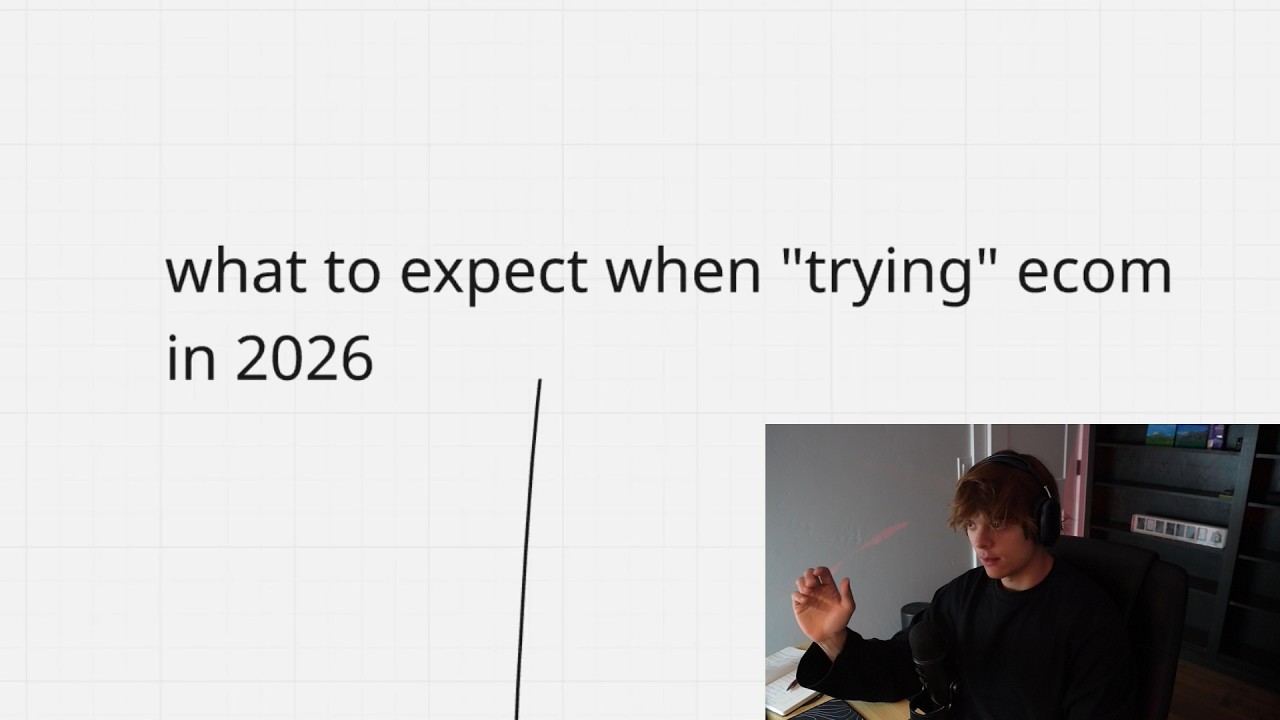
In this monologue Nathan Miller explains why the overwhelming majority of new e‑commerce entrepreneurs abandon their stores within the first three to nine months. He illustrates a revenue‑vs‑time graph that shows an early modest hump (often around $50K) followed by a sharp drop he calls the “Valley of Despair.” Using his own experience of a $80K month selling a Filmroll/Fimo keychain, he describes the euphoria of early success and the psychological crash that follows. Miller argues that most quit because they either mistake a lucky spike for a sustainable model or refuse to adapt when performance falls. The antidote, he says, is relentless commitment (often three years or more), a learning‑oriented mindset, and continual iteration on ads, products, and operations. Those who persist acquire “irreplaceable” skills—team building, ad creation, supply‑chain management—that give them a lasting competitive edge over the constantly churned pool of newcomers. He estimates that reaching true, lasting success typically takes about 12‑18 months, after which the survivor enjoys exponential growth and a near‑immunity to bankruptcy.
Chapters
Alright guys, so now we're going to be talking about why most people quit e-com within the first 90 days, right? Or the first year or the first 6 months. This is a great example and this applies, I swear to you, to the overwhelming majority of people who do e-com, right? This right here, this diagram that I just made applies to almost everybody. Okay, so I want you guys to make sure you know that. And so on the left side here, on the, on the Y-axis, we have money. On the X-axis, we have time in the form of months. So this is 3 months, 6 months, 9 months, and so on. This is revenue right here. So $50K, $100K, $250K, $500K, and $1 million in revenue, right? The numbers aren't going to be exact, like for everybody as well. But this is a general idea of what happens. And so obviously, the first thing you guys see probably when you look at this chart is that it starts kind of slow. Obviously you can see right here in the 3 to 9 range or maybe the 0 to 9 range, you have a little success, right? So this is what happened. It happened to me. It happened to a lot of my other friends. And this is something that's very, very real, right? You have— you always like probably in the first year once you're doing e-com at some point, sometimes people, it's in the first month, sometimes it's in the last month, like It isn't, there's not a guarantee on that. It really is up to you how fast you work and the skills you already have and skills that you have, you know, able to actually apply to this game. Um, but there are always going to be a little success, a little hump usually in year 1, right? And this is, for whatever reason, I put it at, you know, around 3 to 6 months. Okay, so this little $50K in revenue, once you're at this point right here, the top of the top, right? You are going to feel like you're on top of the world. This happened to me. I was actually selling something called a Filmroll keychain. So if we look at that, I'll show you guys, right? This thing, this literally exact product. I wonder if anyone's running right now. I'm kind of curious. They kind of are, but doesn't look like anyone's actually got a real brand. But yeah, this was my first winning product, guys, right here. Fimo keychain, right? And I found it probably almost a year after like starting dropshipping, even though I started with organic. So with actually running paid ads, it was like 6 months in. And, you know, multiple, multiple product tests, whatever. I finally found this and was able to do like $80K in a month. So if we go back to our diagram here, where is it? It's on Miro. This is— let's just pretend like this is my $80K month, right? I had this high at the time. You know, you're doing like, you know, $3K days or whatever, $2K to $3K days, $2K to $3K days. And at that point, I felt like I was on top of the world. And the adrenaline, the dopamine, the fulfillment. You're like, dude, I did all of this work. It's finally going to work out. Everything from now on is going to be perfect. I'm going to drive a Lambo next month. I'm going to move into that dream home, right? I'm going to do all these crazy things and my life is basically complete. Wrong. That's not how it happens. That's not what happens at all. What happens is what you see here. You have this high and then you go into something called the Valley of Despair, which is not the most pleasant place to be in. And why is it the Valley of Despair? Well, Nate, I already, you know, was at a low point, right? I started with nothing and now I'm back to nothing. I should have some bread left over. Why is it the Valley of Despair if we started at zero and we're back to zero? Like we're just at baseline, right? No, because your baseline, you've seen what can happen. You understand, you felt the euphoria of literally on your phone scrolling through your Shopify notifications, right? And hearing the cha-chings and getting all this fulfillment, making profit, posting on your Instagram story, whatever you do, and you're getting all this hype. And then now you're back to square one. And you're like, what the heck? What did I do wrong? This happens to everybody. Okay. The Valley of Despair is a real thing. It happens to everybody. Everybody I know has gone through some sort of high and then a low, and then they had to push through the low to get back up and go even further. Right. And so this is why most people quit is because this is a very— it's honestly, it really defines who you are as a person. As an entrepreneur, this valley of despair. What you do in this time defines you more than what you do, you know, when you're at a high. And the reason why is because a lot of people will quit here. And why do they quit? One, either because they got lucky and they don't think they can do again, so mental thing. Number two, they're not willing to actually adapt. So they did something wrong clearly if the store fell off, they did something wrong, but they're not willing to adapt. They're going to continue, you know, testing products like they always have been, or maybe trying something very similar, but they're not learning. They're not trying to actually adapt. They're not trying to evolve. And so they're constantly going to be stuck in here and then they're going to quit. Right. But how do you actually get out of the Valley of Despair? What do the people look like that actually get out of this and go on to see the success? Well, one, simply the people who stick around, like most simply, that's literally all this game takes. It takes your time. It takes, it takes your commitment. If you're committed to this and you're like, okay, I want to do this for 3 years, you're going to succeed no matter what. You're going to succeed. Like, I don't know anyone who's done e-com for 3 years and not had success. Like, seriously. And I've met a lot of people who've done it. And so as long as you're doing that and then also you're learning, you have an abundance mindset where you're like, okay, there's always more things I can learn. There's always more things I can do. I can always improve this, that. And you try to be constructive and really find the places where you're lacking and try to excel in those areas and actually go through and watch videos and go through and maybe listen to podcasts and stuff like that. That's how you get out of this is simply by just pushing through and then also having a learning mindset because that's literally success in itself. If you always stay committed to one thing, doesn't matter what you're trying to do. It could be any business model, it could be any career, it could be anything. If you stick to it and you're always constantly learning something about it and you're constantly evolving, you're going to see success. That's the recipe of success for anything in life. You will see success if you do that. So that's literally all you have to do. And then once you do it and you hit this high, then you'd be okay. I gotta make sure that I don't make the same mistakes I did here when I get up to here. And then that is what's going to fuel this exponential growth, which everybody sees. And then you're just going to blow up and act like you don't know nobody. Not really. But that is basically why people quit in the first 90 days. And sometimes people don't see results in the first 90 days. That's true as well. But it's the same concept here. Even if you don't see results, if you stick to the thing and you continue to learn and improve and continue to find new ways and new edges and just think and be creative, you're going to eventually find success. And so this is how everyone that I know, this is how I, like I said, this is the model of success in e-commerce. This is how it happens. And then once you get to this point and then eventually get up here, you just have irreplaceable skills. Like you will never go broke again because you understand how to build a team. You understand how to make ads. You understand all these different parts of running the business. So you just have irreplaceable skills that almost make it impossible for you to go broke. The only way you could go broke is if someone chopped off your arms and your legs. Literally, that's the only way that can happen. And maybe not even then, because we have like voice-to-speech now, so you could do that on your iPhone. So that is why people quit in the first 90 days. It's why the majority of people, most people quit. And like I said, 99% of people won't make it to here. 99% of people won't make it to here. And so by making it to here, by giving yourself, like, if you look on average, it's probably like a year and a half, maybe a little bit less. Let's say it's a little over a year is the average to make it to this point where this is where you find like real success, real success, real longevity, etc. It's only time. And the reason why this happens, you guys might be like, this is just some BS graph that he made. The reason why this happens, yeah, like pushing through the valley of despair. Yeah, yeah, yeah. But it's experience, but also like, right, if all these people are quitting in month 9 to 6 or 6 to 9, if all the people are quitting then and you make it to here, you're going to have 15 months of experience, right? And you're facing your competition is sure the people who have experience and who've already done this before you, but 99% of people quit, right? 99% of people quit. So it's going to be 1%, you know, over maybe a couple of different times. But like the most of your competition are going to be these people who are in the 0 to 9 months range, the new people in e-com, because it's current, like it's consistently getting churned. And so basically you have 50, 15 months of experience and you're going against people who have a lot less. And so that is how you win. That is why it's important to stick to things and that's how you don't quit.