In this presentation Negar Riazati argues that hiring strategy is the most critical component of an organization’s overall strategy because the people hired execute the board’s plan. She defines strategy as a carefully devised plan of action and outlines four tactical pillars: attraction, screening, engagement, and compensation. Riazati introduces a workforce taxonomy—20% Performers (self‑driven high achievers), 60% Doers (productive with guidance), and 20% Undoers (counter‑productive). The speaker critiques traditional resume‑matching hiring, which she says selects candidates based on appearance rather than actual productivity, leading to costly mis‑hires. Instead, she proposes a productivity‑based screening system that rates candidates on a 1‑to‑10 scale (1 = Undoer, 10 = Performer) using tools developed by Performia. This system enables organizations to attract and interview only high‑productivity candidates, reduce wage inflation, and focus subsequent evaluation on cultural fit, training needs, and knowledge/experience. The overall message is that a strategic, data‑driven hiring process—centered on measurable productivity—delivers superior execution of corporate strategy.
Chapters
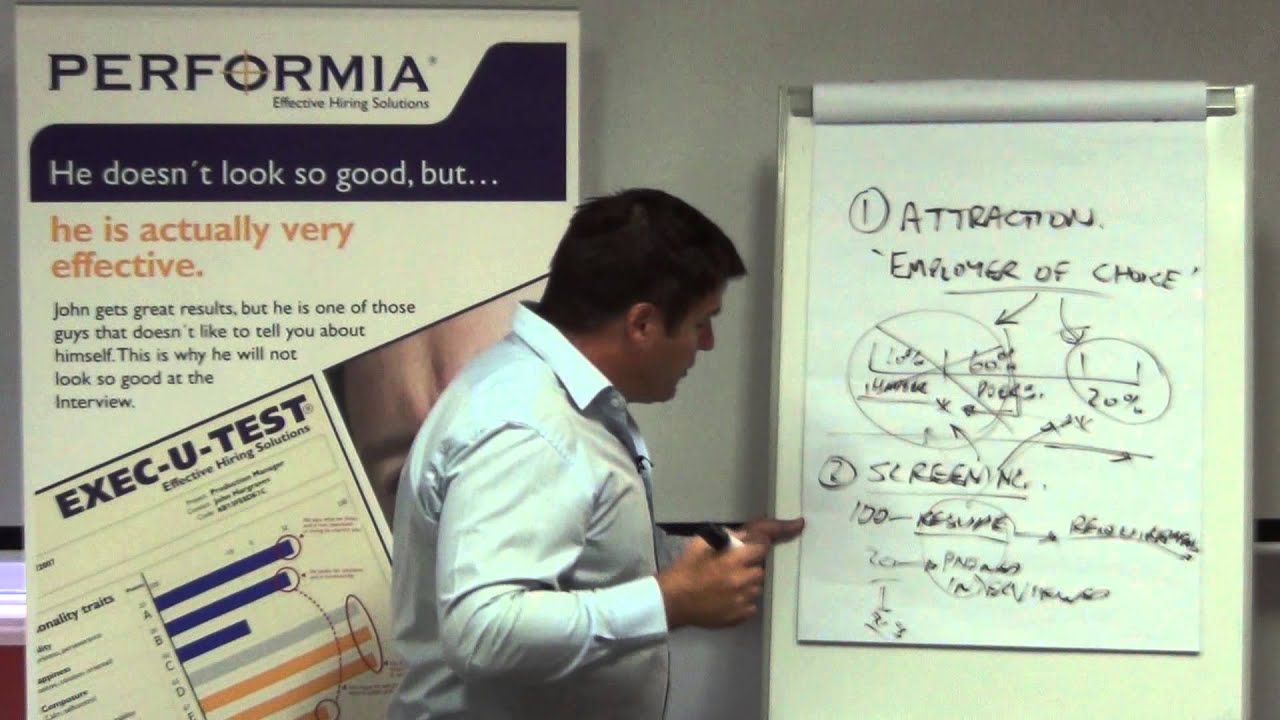
Alright, so when we look at hiring strategy, obviously the strategy comes down from the board of directors create the strategy for the organisation. But each part of the organisation needs to have its own strategy, and the hiring strategy is actually one of the most, if not is the most important part of the strategy. Because when the board puts a strategy there, the people that are going to actually fill the positions to execute the strategy are going to be the key parts. And so when we talk hiring strategy, we're not just talking about how many people or, you know, what the wages are going to be, or not necessarily just how people are going to be paid, but really the strategy comes down— one of the most important things is how are people going to be selected. Because you'll see in one of the other topics we cover, when we look at, you know, the difference between a good hiring and a bad hiring, we map it out. You'll see that when the person is selected, the pay becomes insignificant. Because when they're selected and they're the right person, they're going to create huge leaps forward to achieve that strategy. When you select the person and they're not the right person, even if there's a very low pay, they're not going to create the forward progress. In fact, they may slow down the progress towards the strategy. So I think it's important we should just look quickly at what strategy is. So we have here in the dictionary, it says here that strategy, you know, planning for a field. It says carefully devised plan of action to achieve a goal, or the art of developing or carrying out such a plan. That's the strategy. So, you know, it should be carefully worked out. So if we look at strategy, it starts off with, you know, how are we going to attract the sort of people we want? What are the sort of people we want? Who, you know, do we want to come and work in our organization? What should they look like, feel like? But more importantly, how productive do they need to be? And then how do we know how productive they are? So that's the attraction. Then there's the screening. How do we screen people? And then it's like, well, then how will we pay the person? Do we going to attract them across on high salary? Are we going to attract them across because it's a tough challenge? Or are we going to attract them across because they can earn an equity in the business, or it's a career path or a career step? All these things are very important and they all need to be really worked out and come up with for each one what we call a tactical plan. And the tactics is really the steps that are taken to reach an aim which is part of the overall strategy. And so each one of these areas, tools are going to be required once they're worked out. And this at Performia is where we're very specialised. We have a strategy. We can help your company with the strategy. And then for each one of these steps, the attracting, the screening, the engagement, the ongoing pay, we can give you the tools so as you can actually achieve each one of those, those points. And so I want to look at it a little bit here because You know, some of the areas where I see there's not a lot of thought goes into the strategy is this first step of attraction. And you may have seen that, you know, there's a lot of employers or a lot of large organisations, they try and be what's called the employer of choice. And so basically this means that they want to be the company that when someone comes out of university or someone that's good at what they do comes out of a job, they're going, I want to go and work at that company. I want to work at Company X. And this makes them the employer of choice. But it's really interesting. And we know a lot about this at Performia because we have very specific measuring tools for people's productivity and really how destructive some people could be in the workplace. So we can measure this. And so what we know is that pretty much 20% of the workforce are what we call Performers. They're people that can actually get the job done without any need for external orders or pressure. You put them in a job, you set them up, off they go and they achieve the result or even better. 60% are Doers. You know, people that go from basically being totally not productive to unbelievably effective and they want to help, they want to get the job done and they want to see the organization, an area of the organization do better. But they need some help and guidance. Sometimes they need pressure. to get that done. So we also have this last 20% which we call undoers, and these are people that if you put these guys in the organization, what's going to happen is they're actually going to slow down and undo things. So it doesn't matter what their wage is, it's like because they're costing more. If you're paying them $100,000 a year, they're costing the company more than $100,000 a year because they're undoing things. And sometimes it's very obvious they're undoing it, sometimes it's not obvious at all. You can't see these guys gnawing away at the organization for years and years and years, if ever. So with attraction, we don't want to attract these people down here, these ineffective doers. We want to attract the effective doers and the performers. And in the interview, these guys quite often look so much better. Their resumes look better. These guys are going to become professionals at finding jobs. Because their results aren't really there. These guys here, they never even thought that they need to be professional in finding a job because they're too busy working and doing a good job. So becoming the employer of choice for here, easy. Just tell everybody how nice you are, how great it is to work, put wages up. You know, to become the employer of choice for here is a whole different strategy. But these are the people that you want to be attracting. Okay. Then knowing if you have them becomes the second step. It's the screening. You know, how do I know if I've got this person sitting in front of me or this person? And so you need specific tools. And you'll see in another one of our workshops we go over in a lot of detail how the screening operates. But As an overview, traditional hiring uses, we could say, resume matching. 100 people apply for a job, resume comes in, and the resume is then matched to the requirements. And then from there, maybe 20 people stand out and they're phoned and talked to and they're interviewed and maybe they're given all sorts of different knowledge tests and they're given all sorts of behavioural interviews and all sorts of things. And these 20 come down to being 2 or 3 and then there's more interviews done and finally decide, okay, we'll hire this person. The problem with this is it still doesn't necessarily tell us, are we in this region or this region? And so the steps here go like, let's look at what the person Looks like. So this is for the traditional method, that's their resume. Let's look at them again to see what they look like in the interview. And now everything looks good and they have credentials and they have all sorts of training and university degrees and they have all sorts of great experience. And when you reference check them, it's like, yeah, you know, he was such a nice guy, everyone loved him, you know, we transferred him into many different departments, he was Loved everywhere. And say this person gets hired and now the person starts in the job and now we find out if the person's productive or could be destructive. That's when we find out. So in screening you need a system that can allow you to turn this backwards. Okay, let's start off with step 1. Is that person productive? And you don't need to, in fact you can't look at a resume to find this out. Very few resumes will indicate whether the person is productive. So you need some tool to be able to screen this. How the ad is written to attract people is one. And the second thing is you need to have some method, some interview method or online testing system that tells you straight up how much, how productive is this person on a scale of 1 to 10. 1 being an undoer, 10 being a performer. And if this can be done really fast, then these 100 resumes come in and instead of resume matching, we just— they can be just scaled down with most productive at the top, least productive at the bottom. And at Performia, we have this exact tool. And in fact, this tool is what allows Performia to put in a very key hiring strategy of only allowing productive people to come into the organization. So not only do you get more productive people to talk to, these guys can also be cheaper to hire. Because when it comes to resume matching, it's like this is the way that most people in the industry do their hiring, and so the same 5 or 10 people float to the top of this of the pile. The same 5 or 10 people are being fought over and headhunted and Dutch auctioned. And so the wages get pushed up. This person that's really productive up here, it's like their resume may be just an email. And we have many, many, many examples of really productive guys that would get passed over time after time when they were hiring, looking for jobs on resume checking. And so this is what allows it to turn around. So instead of going how the person looks, how, you know, they tell you all the things they do, and then you find out after you hire them, you know, if they can get results, how productive they are, you can turn the system around. Let's look at it. Let's see. Okay, let's see results. Okay, we can test and screen out all the people that can't get results. And screen in those people that you could normally pass over about what results they get. Then we look at, okay, great. Let's tell us about how you do that. You know, let's look at your personality and your match to the job, the corporate fit. You know, how easy it is to train you. So you need a specific test here or an evaluation system so you know who you've got in front of you, how easy they're gonna be. To groove into your organization, become productive, and also as part of the team allow others to be more productive as well. Very important point. And then lastly, okay, let's look at knowledge and experience and, you know, training. Let's look at the person's background in these things, and if they have these sorts of things, this is a great bonus. But quite often if the person's results-driven, they can get results wherever they go. It's just how long it might take them to pick up this knowledge depends on your organization, what the job is, what the statutory requirements are, and those things have to be weighed up. And this now becomes a strategy. Okay, strategy is not just numbers of people that are going to be hired. Strategy is not just how we pay the people. Strategy is not just, oh well, a person in this job needs to have this qualification. Or this training or this much experience. Because those sorts of strategies are just borne out because an organization doesn't have a tool to screen firstly for results. And this is where you need to have this so you can have only productive people that you talk to to come into your organization.