Intro BYT - 8. defining product
In this seminar, the presenter (Speaker A) introduces a practical framework for defining a "product" for any job, role, or personal activity. A product is described as a completed deliverable that has exchange value either inside or outside the organization. The concept of "completed" is role‑specific (e.g., a salesperson’s product is a signed contract or collected money; a receptionist’s product is "cheerfully and swiftly handling connections"). The talk stresses the need for organization‑wide agreement on what constitutes completion, because misaligned definitions cause waste and conflict. Exchange value can be monetary, attention, tolerance, or other rewards. The presenter walks through concrete product statements for many roles – receptionist, managing director, HR manager, quality manager, personal assistant, property developer, student, politician, investor, parent, spouse, child – showing how each can be reduced to a single line that captures the outcome the organization pays for. He also discusses hiring and compensation strategies that tie pay to product milestones (e.g., a general‑manager ad promising huge bonuses for 300% growth). Measurement ideas are offered (e.g., % of staff improving weekly for HR, average revenue per staff for quality). The broader argument is that a product‑focused organization aligns incentives, suppresses unproductive behavior, and improves health (e.g., retirees have higher hospital rates). The session ends with a brief Q&A and audience interjections, reinforcing the need to articulate product statements for every role and personal relationship.
Chapters
And so the thing we need to realize here is that we need to look at this thing called a product. You know, this production, productivity all comes from this word product. And so we really need to have a very clear definition of what a product is. And, you know, like you said before, it's like, you know, the person buys the bread. This is actually a very important part of this definition. And so if we look at this definition of product, a completed thing that has exchange value within or outside the activity. We need to look at a couple of words very carefully or closely here. The first one is completed. It's like this, apart from, you know, really everyone in your organization firstly needs to realize that it's like it's the product we pay for. You know, and this can include a delivered service. We could say a delivered service is also a product. But we don't pay for your position. We don't pay for your activity or your action. We pay for the result you get, the product. And the second thing that every person in an organization needs to understand is that this thing completed. And for every job, the definition of completed has its own definition. If it's a salesperson, completed is when they collect the money. Or in another organization, another job, the sales could be when they get the signed contract. And so defining completed becomes very important, and every job should have its own product definition, which is really defining what is completed and then getting agreement through the organization on what completed is. Because if you look in many organizations, a lot of problems occur because the person doing the job has a different idea of what completed is to what the management might have. And so this starts to cause, create problems, a lot of discussions and a lot of unnecessary activity. And the other thing is it must have exchange value. So someone, it needs to have some value to someone else inside or outside the organization. And of course, if If it has exchange value, what are some of the things that you can receive? Like if an employee is contributing a product, what exchange do they get? Do they get money? It's like you pay an employee for actually producing their products. I guess so. Yeah, sometimes it's salary. They get paid for their time. And, you know, sometimes it's actually, you know, they get paid for their contribution directly. It's like, okay, this is your agreement. You do this and you do this many of them, we give you this much money. And obviously when, for those people, it's a lot easier to focus on what the result is because the result's usually clearly defined in their contract when they first start. But there's other things too that an employee gets exchanged. One of them is attention. admiration, tolerance. You know, have you ever had an employee that's like you wouldn't really go down to the pub and drink beer with them, but you tolerate them because they're so productive? And so productive people earn tolerance. So if we look, every part of an organization has its different products that go inside or outside of the organization. If we look at this in more detail, We already looked at this, the product of a salesperson, didn't we? Which was sold products or signed orders or sold products. But if we look at it, it gets a bit harder when we say, look, what's the product of a receptionist?
You can measure that pretty well. Yeah. Yeah, I can. It's pretty easy to measure.
Yep. So we can measure, but what's the product that we would be measuring?
Product is a service or a delivery of a service.
Yeah, so how can we nail that? Like, the really— so you just— let's say we hire a receptionist and go, okay, in one line, this is your product. They go, okay.
It's a list of tasks.
There's definitely a list of tasks, but what's the result of those lists of tasks? Customer satisfaction. Can be, yeah, it'd be part of it. So, you know, these— we're going to go through a few of these, but these are just definitions I've put down. They can be different for you and your organization, so Don't necessarily run with them. They've got to be something that's true and works for your organization. But for me, it's like one line is cheerfully and swiftly handle connections. The receptionist, look at what they do. They receive phone calls and emails, faxes, people coming into reception, all this whole transaction of people and connections. They've basically got to hook them into where they need to go in the organization. And also there's the outbound mail and all different things and they've got to make sure they go out. And so they're really, they're the switchboard of the organization. And of course it can be much different. If you ring a bank and you get an automated receptionist, is it like, do you think this really covers it cheerfully and swiftly? So of course if the bank writes this down as their product and then does this other thing, it's like now we have a bit of a problem. And so, but it might be the right thing for you. You might want to have an auto attendant. Okay. Have an auto attendant. So, you know, for sure it's just like handled connections. Okay, managing director. Who here owns their own business? So if you own your own business or you're going to hire a managing director, what is the product? What's the thing that you can pay for? Yeah, they do a lot of things, don't they? You know, they gotta manage the team and execute the strategy and, you know, handle sales and finance and that, you know, all the different divisions of an organization. But what is it you pay them for?
Productivity.
Results? Yeah, but what results? So let's say I hire you to be my managing director. In 3 years' time, what results should you achieve?
Well, I hope that I can at least continue 20% profitability each year.
Yeah, and growth. Yeah, yeah, that's right. So we could say a viable and expanding business or organization. And it's really simple. It's actually, you know, if you want to hire these people, you just write an ad, you know, say, you know, general manager, and, you know, we're looking for you to come in and expand our business by 300% over the next 5 years while, you know, increasing profit even more. And it's going to be a really tough job. You're going to find it really difficult. We're not going to pay you so much salary, but we're going to give you a great reward when you make the milestones. So if you're tough and you reckon you can do this, you should apply. This is pretty much a general manager ad. You'll get about 10 applications off this ad. The thing is, I only want the 10. I only want the 10 people that read it and go, wow, that looks so tough and not much pay, but oh, big rewards. Hmm. This is who you want. And they come in and you just You show them the job and normally it's like, you know, you can pay. We've hired, or our clients have hired many general managers for say, where they should be getting paid $150,000 to $200,000 a year for the size of their organisation, they're paying $50,000. But you know, these people can make, you know, half a million, a million dollar bonuses, you know, after their second and third year by making the company 10 times that money. And these gentlemen come in and go, you know, generally if If a general manager needs salary to survive, you don't want to hire them. It's like, because, you know, if you're running an organization and the person can't run their own finances, it's like, how do you expect them to run yours? And so it's simple. You say, okay, so here's the deal. And normally what they'll need to do is they normally will come and spend a week in the organization and investigate it for themselves to see if they can make the bonuses, if they can actually achieve The milestones. And if they don't do that step, then it's already a warning sign. Because it's okay, if this person's willing to take this risk on and not even know what it is, then what are they going to do with my business? What about a human resource manager? Which, you know, a lot of companies have human resource managers. No one really quite knows what they're meant to produce. Well, so we can say ethical and productive staff members. Ethical, as a very raw definition, is like, you know, you make an ethical decision, it leads to something better. You make an unethical decision, it leads to something worse. And, you know, the good human resource managers, they know this product, but quite often it's hard for them to really monitor it because they, you know, to know whether the HR manager is doing a really good job, they need to see every individual in the organization and how productive they are and whether they actually improve their area each week or not. And this is actually the true measurement of an HR manager is like if I have 100 staff, what percentage improved their area that week? Okay, 93 did. Wow, I'm really pumping. 93%. Next week it's 67. Oh wow. But you know, of course there's other measurements, retention and other things, but ultimately, yeah, the HR manager is responsible for the productivity of the individuals in the organization. Interestingly enough, the Quality Manager, his job is to make— is actually his result is not just the quality of the product, but the whole quality of the organization. And really measure a Quality Manager off how much each person is producing in income as an average. So if there's 100 staff, they produce $100,000 in a week, it's $1,000 per staff member. And the Quality Manager's job is to see the quality of the organization improves all the time and it increases all the time. And next one. Oh, personal assistant. So not many of us in Australia have personal assistants. Go to China and there's heaps of them. But—
Resilience.
Sorry?
Resilience.
Resilience. Yeah, that would be a quality, wouldn't it? Part of the beingness. But you put on— let's say you hire a personal assistant. Why are you hiring them? What result do you want?
Reduce your workload.
Yeah.
Reduce— Less important tasks.
Exactly. And so what result does that— what result, or how could you say to your personal assistant in one line, this is your product?
To reduce my time on menial tasks.
Exactly. Time for the executive. And so you hire your personal assistant and go, okay, your job. So I could give you this big fat manual, but let's just throw that in the bin. I'll just give you this one line. You need to produce time for me to do the important, so I can actually carry out the important things. Okay boss, I got it. You know, off this person runs and then, you know, next thing you know, 2 weeks later you have some appointment with someone who wants to sell you some multi-level marketing system. And it's like, how did this person get in here? You just get your personal assistant and say, listen, that didn't get my product. Go sort it out. And it's amazing how much you can reduce the amount of having to talk about issues when the organization is product. Focused. And it's quite interesting too because the more product-focused an organization is— remember that we had the categories of workers— the more product-focused the organization is, the less the people down this end, the suppressive people and the troublemakers, can survive in the organization. It's harder for them to. But when there's not much attention on productivity, let's say it's some government department put there just to help the unemployment levels, it becomes a breeding ground, a hotel for these guys. And so the more you can put attention on productivity, the more you can get your staff focused on the product they're meant to produce, the more you can measure it and pay people by that, you know, the more naturally you'll just have performers and effective doers in your organization. What about a property developer? This is actually more of an organizational
Build homes.
Yeah, it could be build homes. You know, it depends really on the organization. But, you know, we say desirable and functional accommodation that sells for more than it costs. But if you're building, say developing, you know, in Western Australia and Karratha for the mining towns, it's like, you know, desirable probably wouldn't be part of the product, would it? And so how you word products for each job, each department, the whole organization, actually becomes quite important to get a good alignment. And so you start off with what's the product of the organization, and you can work back up through the organization from there, and everything needs to align. And so every person's product or products that they produce should actually end up with the company's product. And the company itself, or the organization itself, should really only produce or take on things that fit within that product. So if you're a property developer, it's like, you know, going out and selling chewing gum doesn't quite make sense. Doesn't fit into the product. But we can also look at these outside of the organization. Because it's like everything that a person, every action should lead to some sort of product. And so we can look at, say, the product of a student. Which per that, it would be you right now. So what would you say the product of a student is? Like, what's your product for being here today and, you know, wearing the hat of a student?
Education.
Sure, yeah. So I could, I don't know, give you the phone book and give you some education on phone numbers.
Like your business schedule and work schedule.
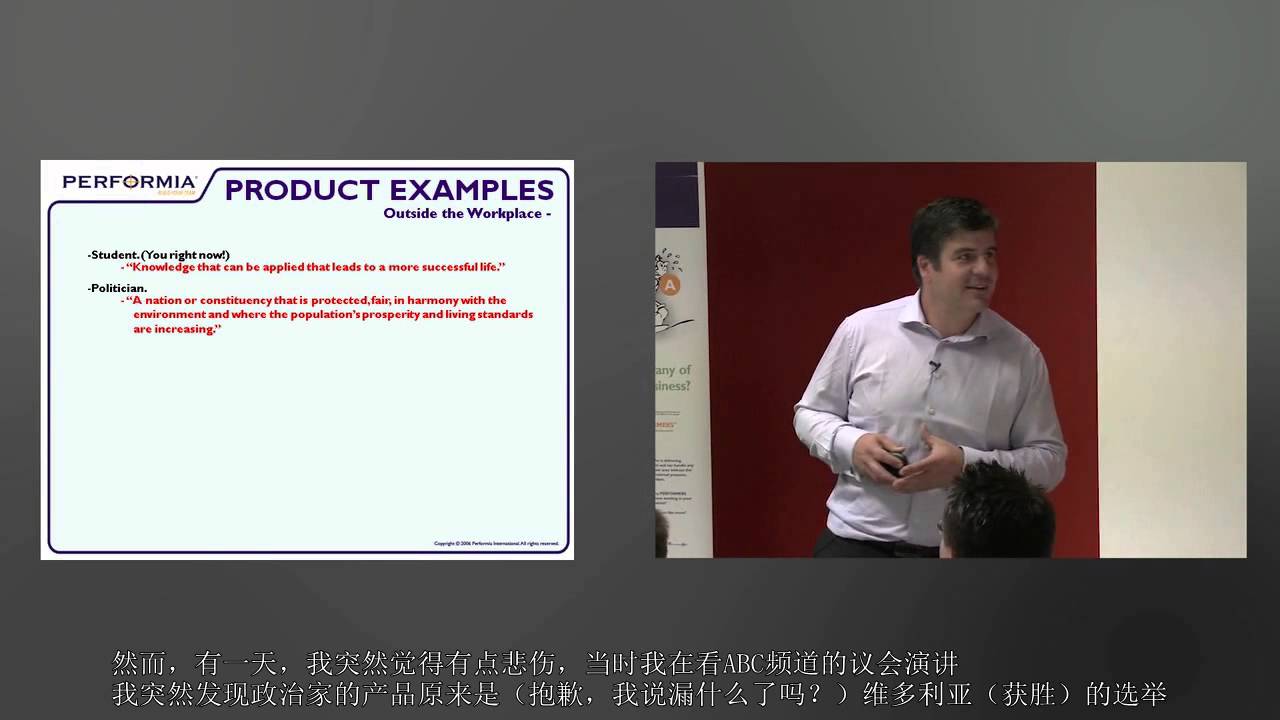
Yeah. And if you look at it, you know, really as a student, all we wanna learn about is actually, we wanna learn about how, you know, here's a goal. You know, most people have a goal, right? Especially business owners and executives, they have a goal. But to reach that goal, there's something in the way. There's usually these things called barriers. And so really any training or education is really on how to overcome these barriers, more easily. And so as a product, we could say, we could say that it's knowledge that can be applied that leads to a more successful life. Does this make sense? And so if someone's doing a course or they're going to school or they're going to kindergarten and, you know, they should be getting knowledge that leads to a more successful life. Unfortunately, I look back at my schooling and I think, wow, If I'd known, really applied this back then, there's probably a lot of subjects I would have just gone out the back and, you know, not attended. I probably could have got more benefit, you know, playing tennis or footy. And what about a politician?
Bullshit as many people as possible.
That's the product. Yeah. You know, it was quite interesting. I made these slides a few years back and You know, this is the product ahead of the politician, which is a nation or constituency that is protected, fair, in harmony with the environment, and where the population's prosperity and living standards are increasing. And then one day I was feeling a little bit like, you know, masochistic, and I turned on the ABC and I was listening to Parliament. And I realized that it's like, you know, as a politician, the product is actually Actually, I don't know if I have it on this one.
I think you changed the product.
The product is actually a victorious election. And I realized that, you know, when you listen to Parliament, it's like this here is a product of government. And the product of a politician is just to win the election. And, you know, if you— for some politicians, that means taking out the person you're meant to have allegiance to. So you've got to be quite ruthless and, you know, to some degree quite unethical people. But the problem that I realized, like listening to Parliament, was that it's like these guys hardly ever take their politician hat off. So they sit in Parliament where they're meant to be doing government, and I hate to work out the hourly rate of Parliament, but it has to be like a million bucks an hour or something with all the— what it costs to run the building and, you know, everything else. And they sit there and, you know, they have Question Time. Has anyone ever listened to Question Time?
It's worse than a schoolyard.
You realize why it's called Question Time, because they can't call it Answer Time because there's no answers. But I realize it's like, you know, in our political system within Australia, there's no time. There's really very little time to govern. These guys are constantly got to have their politician hat on. And, you know, it's a little bit sad in some ways. What about an investor? A person invests, you know, what's the result they're going for? Profit.
Yeah. Return on investment.
Yeah. But you know, look at it, it's like why does a person go out and start investing? It's like the profit's not really the result, the profit's the score, isn't it? So you could say that investor is basically a financially secured future. No, I invest here so that later on I can, I have to have less and less attention on having to get money each week to survive. What about a parent? Who's got kids? Yeah, so what's the product of a parent?
To raise a child.
Sure, that would be the doingness. You know, raising a child and—
A product, a good person.
Yeah,
I'm not going to try and define good.
Yeah, we shouldn't. Why don't we look at defining good? Because we're gonna—
That's a lecture in itself, isn't it?
Yeah, how about this? Again, these are mine. They don't need to be necessarily true for you. So I'm happy for you to disagree. That's more fun. But yeah, for me, I've got a productive and independent person or people that add value to their community. So is this leading towards the definition of good?
Yeah, it's a much better definition than I had in my head.
I had more time to think about it. I prepared these earlier. And so as a parent, it's like, you know, even if you're having fun with your kids or you take them to the beach or, you know, take them snowboarding or you put them in school or piano lessons or, you know, lock them in their bedroom for a month, it's like it should be to lead to this product. Would you agree? And so it makes it much easier to be a parent when, you know, you know that, okay, my, what I do should lead to that. And then what about who's married?
Not me.
Yeah, maybe you will be in a
minute. Oh, I hope not.
But what would be the product of a husband or a wife? So you have a couple get together. You know, they, they have some attraction, they enjoy each other's company, it's really fun getting to know each other, and you know, there's all the lust and the romance and everything else, and then, you know, then it's like, okay, maybe we should get married. So, what changes?
Don't look at me, I'm the wrong person to ask that question to, I'll tell you. Absolutely the wrong person.
So, you know, you have a wife. Obviously you don't look like you're married yet. And so what's the product?
It's supposed to be happiness.
Yeah.
A relationship is supposed to be happiness.
Sure. Then happiness, it's like, actually it's a pity because I used to have the whole section on happiness here, but we cut back the time on the seminar. But if you look, happiness has something to do with goals, right?
Totally.
If a person's achieving their goals and yeah, they're usually quite happy. And it's actually, we know that it's actually the overcoming of the obstacles. It's not actually reaching the goal that makes someone happy. When they reach the goal, if they don't create a new goal really quickly, they get unhappy. Have you ever noticed that? That's why you have these stupid terms like post-sports success syndromes and Semi-retired.
Hey? Semi-retired.
Yeah, you know, when people retire, it's normally the first— it's a quick step towards death. It's true, you know, even statistically I can show you. Statistically I can show you that people, retired people, are twice as likely to go into hospital as working people between 50 and 80. Including workplace injuries and everything else. So if you want to stay healthy, you'd keep working. It's like you have half the chance of actually ending up with some— having to go to hospital.
That's why they've increased their retirement age domestically.
Yeah, well, that and the fact that we don't bring enough people in the country to support the productivity or the production we need to get out of it. Hence why you can't find mechanics and it's hard to find fridge mechanics because we have this whole mining industry that's just taking hundreds of thousands of staff, but there's not new staff to come and service the industry. But anyway, if we look at this husband and wife thing. This again, my definition is I've got here. You and your spouse reaching your individual and common goals faster because you're in a relationship. You can see here the first step is you need to know your spouse's goals. And especially for business owners, quite often the business becomes more important or can take a lot more attention than the family or the wife or the husband. And you know, it's like, I've got to make this work, got to make this work for the family. I've got to make this work for the family. But you know, you need to know really what each family member's goals are because per this, if it's true, your job is to actually furnish, you know, everything you can so the person, the people in your family can reach their goals. And you know, quite often when I sit down with business owners and I go, do you know what your wife or your husband's goals are? It's like they don't know. I go, oh, I don't know. Sometimes, oh yeah, well, I suppose it's to look after me so that the business can do better. And this creates a few issues in the marriage. And so this is actually the same product for any relationship. I'm sorry, any sort of partnership. You take a business partner on, it's no different. But the thing is, so you go take a business partner on, it's the same thing, isn't it? You take this business partner on because it's like you You figure that personally you'll reach your goals faster and the company or organization reaches goals faster because of this partnership. Would you agree? Yes. And so if a person goes out and they go, okay, I'll make my wife my partner or I'll make my brother a partner because I want to help them, I want them to be part of it. It's like it's a different product. And this is why quite often, you know, it creates some problems 5 years down the track when they say, we've lost so much money and my brother doesn't work. Yeah, but you know, okay. So what was the original intention you went into that relationship, that partnership? And the last one, a child. What's the product of a child?
Cost.
To be happy.
They're pretty good investment though, kids.
Are they?
Yeah. I think I get a good return on investment from mine. So, but as a child, it's like, you know, they have a product and it pretty much has to align with this a little bit, doesn't it? Yeah. And so, you know, for me, what I worked out is there's contributions to the family and the community. And, you know, this happens when a child's first born and they pop their first smile. It's a pretty good contribution. They smile and go, ah, look, ah, he's so cute, ah. And as a baby, they're going, wow, that worked really well. I might do that again.
I don't know, everyone seems to be having babies in our organization. Everyone's very, very tired.
Yeah.
So I don't know how much they're contributing at the moment.
Sure, but you know, that's probably because they need a little bit of training too on how to, you know, get children through the night.
The poor guys are just not getting any sleep.
I never had that problem, never had that problem with my kids.
That's why I'm afraid of having children. I had
a great mother-in-law and within a week, within a—
Sent her home.
No, no, she stayed with us and as much as like, you know, we have an interesting relationship between us, but I'll tell you like within a week she got our kids sleeping through the, right through the night. It's amazing.
You better get another one, I'm gonna give it to a lot of people.
Yeah, so it was really amazing. It's like from after a week that was pretty much it. They would sleep, you know, 8, 9 hours. But obviously you break quite some rules because nowadays you're meant to feed them every, wake them up and feed them every 3 or 4 hours and All sorts of crazy stuff. But I liked her idea. You never wake them up if you wanna sleep. Yeah. But the thing is, you can actually measure this and you can play games with your children and, you know, as they get older and older, they can contribute. And, you know, from a very young age, at 15 months old, they start walking and they see you clean the table up and they run over and they wanna try and help and they pick a plate up and, you know, the thing is, let them contribute. Even if they smash the plate, it's much cheaper than when they're a teenager and they do nothing. And so wherever possible, let them contribute. If they want something, you know, try and make it into a game. Go, cool, you know, you want that? If you can contribute these things, it's for sure you can have whatever you want. But it's, you know, it's a very interesting and actually one of the most fun jobs. I mean, it's the best part of my life is being a parent. So, you know, don't be put off by the horror stories because the horror stories are just, you know, very easy to observe. But they're very minor in the whole scheme of things. So we know, and exactly like you said, but the first thing is we know that we have to be able to name a product and be able to measure it. So if we can't name the result of a particular job or a particular activity, normally that job or that activity in the organization is not valuable. Or you just haven't tried. The person hasn't tried hard enough to be able to actually work out how to really nail the product. And you can see how simple the naming is, like for receptionist. And as you start to drive down and down and down, it's like it becomes simpler and simpler. And it also makes the job simpler and simpler for the person. And then also you have to be able to measure it. Like you said, receptionist is quite easy to measure. Yeah. If you can't measure it, it's not the right product. Again, not the right name. So if a salesperson goes, yeah, my product is to make customers happy. Well, okay, how do we measure that? And actually, what's the value in that? Because quite often, you know, you can have one salesman that makes many unhappy customers and then you have another salesman that all the customers are happy. But this guy could be selling 20 times more. And the reason there's unhappy customers is because he just doesn't waste time with guys that waste time. And so they, they're going, oh, you know, he left and he was so rude. He just like, I said I wasn't gonna buy and he just left. Okay. It's like, comes down to not, you know, so much happy customers, but what the result is. And it's easy with a productive sales guy. Okay, we'll give you a little bit of training to— this is how you depart from a customer so there are no unhappy ones. Might take 5 minutes to train a guy on that, but it could take you 5 years to train this guy to get his sales up.
More from Negar




Episode 2: Building a Games Culture: How to Turn Your Business Into a High-Performance Team

How One Dental Practice Owner Stopped Managing Staff And Built A Team That Just Produces

Performia Intro Seminar - Get the tools to create productive, fun, safe teams