8 Reasons AI Won't Ruin The Ghostwriting Industry
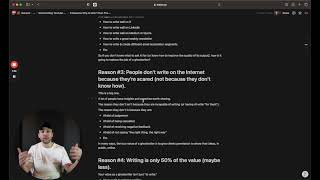
Nicholas Cole, a high-paid ghostwriter, argues that AI won't replace ghostwriters because the job is about more than writing. Client relationships, content strategy, and building confidence matter more than the words themselves.
My name is Nicholas Cole. I'm one of the highest paid ghostwriters in the world. And one of the questions I get asked the most is why should I start ghostwriting? Or why should I build the skill of becoming a ghostwriter if AI is just going to take all the jobs? And the answer is, because AI is not going to take all the jobs. All right? Whenever I hear someone say this, it's just a signal to me that they're really uneducated about both AI and ghostwriting. Okay? Because if you understood these things, and I'm going to walk you through eight reasons why AI is not going to ruin the ghostwriting industry. If you understood these things, you would realize that AI is going to unlock 100 times more opportunity. It's not going to replace ghostwriters. It's going to make ghostwriters more efficient. Okay, so let me walk you through why AI is not going to ruin the ghostwriting industry. The first is you need to know how to use AI in order for it to replace a job in a business. So when people see this technology, they jump to the conclusion, oh, well, this is just going to take all the jobs. AI is just going to do everything. Well, that glosses over the fact that the business owner or someone on the team needs to know how to use AI in order to replace a job. And the, the metaphor I like using is that 99% of the population doesn't even know how to create a basic filter in Gmail. So if they don't know how to create a simple filter in the same email system that we've been using for 20 years, what makes you think that just magically overnight they're going to understand how to use ChatGPT and Claude and how to connect it to Zapier and how to create automations and how to. Like, they're not. They don't know how to do that. Okay? So your job as a ghostwriter is not just to write. Your job is to use this technology to make yourself more efficient and to help these business owners accomplish things in their business. And it's a tremendous misunderstanding of your value. If you just think, oh, the business owner is just going to use it themselves. They're not. It takes time to learn how to use these tools. It takes time to use the tools and then clarify the output, get better and better output. Right. It's not enough to just go to Claude and say, write me a LinkedIn post. That's not enough. You have to ask Claude something else. How do you know what to ask it for? Do you have the time to sit there and play with it and go, actually, what you gave me isn't quite right. Could you add a stat? Actually, that stat isn't what I want to use. Can you source it from somewhere different? All of these things take time and they require skills. So it's a severe misunderstanding to think that people are just going to open Claude or open ChatGPT for the first time and then magically you don't have a job anymore. Okay, there's 34 million small businesses in the United States. Again, the vast majority don't even know how to create a filter in Gmail. They don't even know how to do a simple automation where you take information from an email and upload it to an Excel doc. Right? So what makes you think that they're just magically going to understand how to create an entire content strategy or how to automate their, their email flows or how to connect different email systems to like, they don't know how to do any of that. Okay, Reason number two, uneducated inputs lead to low quality outputs. So everyone thinks that just because AI writes it in front of you, that that's the output. And that's not true. If you give ChatGPT or if you give Claude or you give any of these AI platforms a weak input, it's going to give you a weak output. Okay? And considering that most people, they don't know what makes good content on X, they don't know how to write well on LinkedIn, they don't know how to write articles versus tweets versus threads versus carousels, right? They don't know what makes a great weekly newsletter, they don't know the different sequences that you should have in a newsletter. They don't know the different automations, they don't know how to send different things to different segments. Right? And the misunderstanding with AI is that you can just go to ChatGPT and go, not only do I want you to create it, but I want you to create the whole strategy and I want you to talk to all the different platforms and I want you to create the cadence and I want you to fill in the blank. And it doesn't work that way. Right? So yes, AI can help you streamline some of these things, it can unlock some efficiency, but we are a far, far, far ways away from being able to just tell Claude, I want you to create an entire content strategy for me and I want you to talk to all the platforms and I want you to do it all for me without Me lifting a finger, that's not how it works. And if you think that's how AI works, then you haven't played with it enough. Right? Reason number three, people don't want to write, or people don't write on the Internet because they're scared, not because they don't know how. This is a really important one. I have ghostwritten for a tremendous amount of people at this point, hundreds and hundreds and hundreds of CEOs and Silicon Valley founders and bitcoin billionaires, like everyone across the board. And over and over and over again, one of the biggest issues that I ran into and why they saw value in working with me, wasn't that they didn't know things. It wasn't that they didn't have value. Of course they had value. Of course they had valuable things to share. They had insights, they had frameworks. They had worked in this career for 10, 20, 30 years. They had all this knowledge accumulated. One of their biggest problems as a client was that they were afraid to put themselves out there. They didn't have confidence in their ideas or in their frameworks, or they knew something really valuable, but they didn't want to put it out into the world because they were afraid of criticism, Right? They were afraid of judgment. In some cases, they were afraid of being canceled. They had a strong opinion on something. They were afraid of receiving negative feedback. And a lot of the role that I played as a ghostwriter was giving people that confidence. And how I gave them that confidence was through our conversations. So my process was we would get on the phone and we would talk with them, and we would ask them questions, and we would record the conversations. And it was through those conversations that I helped them clarify their ideas. And when they would say something, I would go, that is actually a really valuable insight. I think readers would find a lot of value in that. And I can't tell you how many times the client would say to me, really, I never would have thought that that was valuable. And so by me mirroring that to them, that gave them the confidence that helped them clarify their ideas, that made them want to share what they knew in public. The fact that you can use technology to help streamline or accelerate the writing only solves one of the problems. It only. It's a small part of the equation. The much bigger problem is that the person sitting behind the computer isn't confident in their ideas. They haven't thought through them, they haven't clarified them. They need someone else to go, that is a great idea. Or they need someone else to go. Don't worry. I've been doing this for a long time. You saying that not a big deal. Like, it's not. You're not going to get canceled, right? You would be shocked at how many small, smart people I've worked with that had every faulty belief you could possibly think of. I can't tell you how many times a client said to me, I don't want to share my insights in public because I don't want to become famous like Kim Kardashian. Okay, another faulty belief. You really think if you just write two things on the Internet, you're just magically going to be one of the most followed people on the entire planet? Of course not. Right. So your role as a ghostwriter goes way beyond just the writing. It has a lot to do with the relationship with the client and helping them overcome all of those faulty beliefs. It's not going anywhere. People. People have been people for as long as people have been on Earth, right? And we always have the same problems. We always get in our own way. We always adopt these faulty beliefs. We always find excuses not to take action. And I promise you, the smartest, most accomplished people in the world, they all struggle with it, too. That's why they hired me. Because they needed someone to help clarify their ideas and in many ways mirror back to them that what they wanted to and what they could share out in the world was valuable. Reason number four, writing is only 50% of the value. More and more, I'm of the belief that it's actually less than 50%. Your role as a ghostwriter is not just to write. It's to do all the other things that surround and wrap the writing. Right? It's to audit and optimize the client's profiles. What is their bio like? Do they have a pinned asset? You know, like, are they naming their target audience? What tech stack are they using? Do they have automations? You know, like, how. How is the algorithm changing? Maybe there's a new format that's going vi more often. Maybe you should use that. You should change the strategy. Are they responding to comments? Are they engaging with followers? Are they doing cold outreach? Like, there are so many other things that wrap around the writing that it really devalues the role to think that your job as a writer or as a ghostwriter is to just write. And a great example of this is all of the people who think that's the role. They're on upwork, they're on fiverr, and what they're doing is they're raising their hand and they're saying, I'm available for hire. I charge $15 an hour, $20 per hour. You tell me what you need and I'll write it. And the reason why all of those writers struggle to make good money is because they think that their entire job is I just write. And they don't realize that the reason why everyone else makes so much money, like why I was able to charge 3,000, 4,000, $5,000 for a single 800 word article, but people are charging $20 for an 800 word article on Upwork. Right? Why? Why that difference was because I built all of the other skills. I built the skill of going out and finding clients on my own. I built the skill of interviewing and being able to extract content. I built the skill of, wait, your profile's not optimized, we should optimize that. I built the skill of free consulting. Let me tell you all the other things that we could do together. Let me tell you all the other problems that you could solve, right? So it's not actually just the writing. And anyone who thinks the way I make more money is by just becoming a better writer. You have a really flawed understanding of how the game works. Okay? If you want to get better at the craft of writing, you get better at the craft of writing. If you want to get better at making money as a writer, then you have to build all the other skills that surround the writing. Okay? And so because of this, you can look at platforms like ChatGPT or Claude and Go, all right, well, that's, you know, that's going to make the writing 10 times easier. It probably will. I love using ChatGPT and Claude, but I'm not worried about it replacing any of the work that I do because so much of the value that I provide or that you would provide as a ghostwriter isn't the writing. It's all the things that surround the writing. And that's the part that AI is not. I can't take that away from you, at least for the time being. I think we still.
More from Nicolas



What Every Writer Gets Wrong About Their Audience #writing #creator #writingtips




