How To Build A Digital Product That Actually Delivers Results
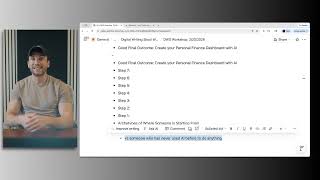
Nicolas Cole explains how to build digital products that deliver results instead of just information. Start with a specific end goal like creating a personal-finance dashboard, then reverse-engineer it into actionable modules. Pick one audience archetype—beginners, intermediates, or experts—because trying to serve all three dilutes your product.
Chapters
How do you build the perfect course module? And, and, and really you can extrapolate that as how do you structure the perfect low-ticket digital product? And the first big idea that I think is really helpful to internalize, and I have it here— oh, I just realized I'm not sharing my screen, sorry about that. There we go. Okay, so in here, Module 4, Low-Ticket Launchpad. The first big idea, and this is really important to understand, it took me a long time. I, I, we whiffed it on a bunch of different digital product drops 4 years ago, 5 years ago, because I didn't understand this yet. Learning is bad, action is good. The most effective info products and the most effective educational products are not about Here's all the interesting things that you need to know. It is not about learning. The most effective digital products is about pinpointing where does the person want to end up, what questions do they have along the way, and how do you reverse engineer from where they are to where they want to end up into a series of action steps. Okay, not understanding steps, not theoretical steps, action steps. And so the easiest, the easiest way to understand this framework is to think of each module as a task. What is the person going to do? Okay, not what are they going to understand, not what are you going to have them hear for the first time, like quite literally, what are they going to do? And if you don't have clarity over an action, then chances are you don't have the, the clarity of what that module should be. And if you don't have a list of actions, then you don't know what your product is really solving. And so this is, this is the first big idea, okay? And so if you're thinking like high-level outline, high-level outline of a product, First, we want to start with the final outcome. So let's, let's use an example. One I've been thinking about a lot is like personal finance. Okay, now what most people would do with the topic of personal finance is their final outcome they would make about understanding. So they would be like, your final outcome is you're going to learn how to manage your finances. That is not tangible enough. That is not specific enough. That is not an outcome that we can measure. Because if I ask 10 different people, do you know, or did you learn how to manage your finances, or what does it mean to manage your finances, I'm gonna get 10 different answers, right? So we do not want our final outcome to be open to interpretation. We want our final outcome to be something very specific, tangible, objective, measurable. And measurable doesn't necessarily mean like, I guarantee you XYZ result. Measurable just means how do we quantify it? How do we objectively quantify whether or not we did the thing, right? So for example, this is a bad final outcome. A good final outcome might be something like, Like, create your personal finance dashboard with AI. Why is this a better outcome? Because creating and having a dashboard is objective. If I ask 10 people here, do you have a dashboard, yes or no? I get a binary answer. Did you build a dashboard? Yes or no. Do you now have a dashboard? Yes or no, right? The objectivity of it is what makes it work. It's also tangible, right? I can hold a dashboard, I can save a dashboard, I can bookmark a dashboard, I can share a dashboard. I can't bookmark or save or share learn how to make a dashboard. Manage. So that first idea, does that, does that make sense for everyone? Because if this is actually the thing that dictates every other decision, and so if you don't have that, you know, tangible, objective, measurable final outcome, then every other decision you make is either amplifying the fact that it's a bad subjective vague outcome, or it's amplifying it's a good objective specific outcome. Okay, and don't overthink this. Like, you're just thinking like, what are objects? What are like— like, here's how to save an extra $800 a month by cutting unnecessary expenses. That's very objective. We can— did you save $800 a month doing this? Yes or no? Can you hold $800 a month? Yes or no? Can you measure $800 a month? Yes or no? So you're always thinking in those terms. Okay. Now here, everyone, that makes sense? Good? Great. Okay. So from here, the outlining process is about taking this and reverse engineering this into steps. Okay? And the steps are fairly arbitrary. The number of steps is whatever, but this would be like, you know, Let's, let's just say we have 7 steps. We have step 7, then we have step 6, we step 5, 4, 3, 2, 1. Archetypes of where someone is starting. So this is where we want everyone to end up. There is going to be steps that get us there, steps that help us accomplish this objective final outcome, and then It's, and where is everyone starting from? And the reason that I put this here is because this, this decision informs two things. One, it informs the content of the curriculum, but it also informs how you speak to the content of that curriculum on the front end. So a very simple example would be here we're saying create your personal finance dashboard with AI. The archetypes of where start, someone is starting from might be someone who is very proficient with AI versus someone who has never used AI before to do anything. Like, it— depending on which one you're trying to speak to, your front-end marketing is going to be different, and the, the things that you put in here are going to be different. If you're speaking to someone who's very proficient with AI, then do you need to create like step 1, here's what ChatGPT and Claude are? No, because you're speaking to a specific type of person who is already proficient in those things, right? But if you're speaking to someone who has never used AI before, maybe step 1 is here is what ChatGPT and Claude are, right? So this is actually a very important piece of the puzzle. Who are we speaking to and what is their level of proficiency? Okay. And I'll tell you the mistake that everyone makes. The mistake is they go, I'm going to try to speak to every possible archetype. And in reality, like, it's usually one direction or the other. Okay. So is there a middle person, Candice? Yes. Yes, there is. I think the most helpful way to think about this, though, is to think in terms of experience level. So you have beginners, you know, intermediates, and you have experts. Okay. And this gets translated into 3 different archetypes. The 3 different archetypes are: I haven't done this yet, but I want to. I've started doing this, but it's not going very well. I'm not seeing the results that I want, or I've been doing this for a while, but something about my process isn't working, or I want to stay on the cutting edge. 9 times out of 10, these 3 archetypes are the 3 that you're gonna speak to over and over and over again. Like with Ship 30, It was, do you want— have you been wanting to start writing online but you just haven't yet? Or have you been writing online but you just aren't seeing the results that you're looking for? Or maybe you've been a writer for a long time but you want to upgrade your skill set for the digital world, right? Those three archetypes are like— I can speak to the same sort of person. Right? Where things would get muddy is if I said, hey, Ship 30, maybe you've been wanting to start writing on the internet, but you don't know where to start. Great. And also, hey, maybe you're an expert, like one of the top writers in the entire world, and you wanna know cutting-edge tactics that are gonna, you know, keep you on the forefront. Those two people are kinda too far apart from each other. It's too hard to speak to those two at the same time. So you can look for different archetypes, like these, 3 tend to pair well together, but you want to sort of think like, okay, but directionally, am I speaking more to people who are learning how to do something new, or am I speaking to more like experts who are like looking for that last 1% little tweak? And I'll tell everyone the answer, it's almost always the first one. Almost always speaking to, this is something that I want to do or I've been trying to do, but I'm just not doing very well. Which then leads to, okay, so we have that decision, we know where we want to end up, and we know where people are starting from. Candice, your question, is it generally 7 steps? Not necessarily. It could be 10, it could be 20, it could be 5, it could be 3. The, the number of steps is not what's important. What's important to ask is what does the person need to not learn? What does the person need to do in order to accomplish our final outcome? And how many steps does it take for them to successfully accomplish that final outcome and not have questions along the way. So, for example, could I explain how to do this in 2 steps? I could, but chances are I'm probably going to skip over too much material and, and people are gonna get lost. So it's not about the number of steps, it's about what are the amount of steps that are necessary to move someone from where they are to to where they need to end up, okay? So for the sake of our example here, we're just gonna say 7, okay? So before you even start creating any content, before you start doing anything, you want clarity over the final outcome and you want clarity over where someone's starting from. Then the outline is quite literally just a bulleted list, and the bulleted list is not what's all the information. The bulleted list is what are the actions? Okay, so let's, let's make up some actions. Step 1, create a— let's, let's just say we're going to do this in Claude. Create a Claude account. And this is going to be like a crash course on Claude. Okay. Step 2 is connect Claude to Excel. Okay. And then step 3 is use this prompt to pre-populate the template that I built for you. And then step 4, compile all of your, uh, personal finances from the past month, AKA just pull like credit card statement. And then step 5, upload credit card statement to PromptHub that I gave you. And then step 6, double-check, you know, any miscellaneous expenses in Personal Finance Dashboard. And then step 7 is use Personal Finance Dashboard for 2 weeks, see what breaks, iterate. Does everyone see how, like, all we're doing is thinking in steps? You need to do this first, and then you need to do this, and then you need to do this, and then you need to do this. And so again, the number of steps is arbitrary. It's, it's a— what are the necessary steps to move someone from where they're starting to where they need to end up? By the way, if you're brand new to writing online and want a really easy place to start, I recommend reading The Art and Business of Online Writing. I wrote this book after I'd been writing online for over a decade and accumulated over a billion views on my work, monetizing my writing in all sorts of unconventional ways. And I wrote this book to give other writers like you a way to skip all the lessons that I had to learn the hard way and start seeing success from your writing a whole lot faster than I did. So if writing online is something you're thinking about or something you're actively practicing, I recommend picking up a copy of The Art and Business of Online Writing.
More from Nicolas



What Every Writer Gets Wrong About Their Audience #writing #creator #writingtips




