How To Find Your Voice As A Writer
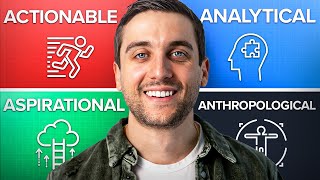
Nicolas Cole breaks down his 4A framework for finding your writing voice: Actionable, Analytical, Aspirational, and Anthropological. He walks through how to match what you enjoy writing with what readers actually want, then experiment until you find what sticks.
Finding your voice as a writer isn't as hard as you think. In fact, some writers spend their entire lives trying to figure out what their writing voice is, and it drives them crazy. Maybe you've been struggling with this. You write and you write, and then you journal about your writing, and then you talk to your friends and family about your writing. And the whole time you just keep asking yourself, who am I? Who should I be in this world? What should my writing sound like? Okay, well, if you give me 15 minutes, I will save you from asking yourself this question for the next 330 years of your life. And I can show you how you can find your writing voice using this one simple framework. And if you don't know who I am, my name is Nicholas Cole. I'm one of the most read writers on the Internet. I've racked up over a billion views on my writing. I wrote a book about it called the Art and Business of Online Writing. And after selling over $10 million worth of writing related digital products, I can tell you from experience that finding your voice as a writer is very easy if you use the framework that I'm about to give you. It's called the 4A framework. And this is a core idea we teach in our beginner writing program. Ship 30 for 30. And to show you how powerful this is, let's do a little exercise. It'll only take 10 seconds. If I asked you, what's your favorite book on finance or personal finance, chances are one of these books is going to pop into your head. It's either going to be I Will Teach youh to Be Rich by Ramit Sethi. Maybe it's the Changing World Order by Ray Dalio. Maybe it's Rich Dad, Poor dad by Robert Kiyosaki. Or maybe it's the Psychology of Money by Morgan Housel. Now, it doesn't have to be one of these four books, but chances are one of these books just popped into your head. But do they all have the same voice? Not Even close. The 4A framework reveals that every nonfiction topic can be categorized in these four voices. So there's actionable, like I will teach you to be Rich. There's Analytical the Changing World Order. There's aspirational Rich Dad, Poor dad. And there's Anthropological the Psychology of Money. And in some way, all four of these books are writing about finance, but they're approaching the topic in very different ways, which is what gives them different voices. And as readers, we're super aware of this. You know, if you've ever had a Friend say, oh, you have to read this book. You'll love this book. And they give it to you. They give you this strong recommendation, and then you start reading it and you can't get through the first page. Well, why is that? It's almost always because there's a mismatch of expectations. Your friend might love actionable content, and then they tell you to read this book. And you don't love actionable content. You love analytical content or you love aspirational content.
Right?
So it's not really that you didn't like the writer's voice. Chances are you didn't like the approach they were taking to that topic, even if it's a topic you enjoy reading about. So let's go through each of the four A's, describe a little bit about them, and then show you how you can figure out which one you are. So the first one is actionable. This is how to do something. And if you notice, actionable content is almost always broken down into step steps. Step one, go do this. Step two, go do this.
Right?
And as a reader, if that's what you're looking for, you want the writer to break it down into steps. That's why you are buying the book, or that's why you are listening to the podcast. That's why you are taking the course, right? You want someone to tell you how to do something. And Ramit Sethi's I Will Teach youh to Be Rich is a great example of a very actionable book. He literally tells you, call up your cable provider and renegotiate your monthly bill with this script. I mean, it is about as prescriptive and how to as it gets. But what he doesn't do is maybe explain the data behind why certain people achieve certain goals in their careers or with personal finances.
Right?
There's nothing analytical about it. There's nothing anthropological about it. Maybe there's a little bit aspirational about it, but for the most part, you're buying it or you're buying that book as a reader because you want to learn how to. How to path number two, analytical. So this is why something works based on data. Now, Ray Dalio's book the Changing World Order is a great example of this. It's essentially one long argument based on historical data. And there's nothing actionable about this book. You don't read this book and then go, oh, now I know the seven steps I need to take to go achieve XYZ goal. There's also nothing aspirational about this book. You're not reading it to get motivated to change your financial standing in life.
Right?
And so that's what makes his voice analytical, is he's just digging into the data. And if you love reading analytical content, then this quote unquote voice is what appeals to you. Path number three, aspirational. AKA I did and you can too. Or if you're curating other people's insights, it's they did and you can too. Right? It's success story. For example, rich dad, Poor dad isn't telling you actionably how to do something. And it's also not giving you a bunch of data rationalizing why something works the way that it does. Rich dad, Poor dad is basically one long fable giving you a success story to point to so that you can imagine what it will be like to go from poor to rich.
Right?
It feels good to read, it's entertaining, but it's not giving you the prescriptive how to that, you know, Ramit Sethi's I will teach you to be rich gives you. And it's also not explaining global economics like the changing world order does.
Right?
So with this type of content, a lot of the quote unquote voice gets mistaken as the voice and not really the approach. It's the approach that makes this quote unquote voice resonate with people who like aspirational types of content. And then path number four, anthropological. So this is usually the underlying psychological reasons why human beings or society as a whole does something and you know, hence a book title like the Psychology of Money. Again, there's nothing actionable about this book. There's not a lot aspirational even about this book. And there's nothing analytical about this book. It's just pure psychology like why do human beings treat money the way that they do? And so if you're not interested in that approach, that voice isn't going to appeal to you. But if you are interested in that approach, then you're going to look at that and go, oh, I love this writer's voice. And whenever I explain this framework, the first question people ask is, well, can you combine them? Can a voice be both analytical and aspirational or actionable and anthropological? And the answer is yes, you can. However, there's usually something that gets misunderstood here, which is it's not that you should think to combine them, it's that there's always one voice that takes the spotlight and then you can have another voice that sort of adds to it. So chances are, as a reader, you prefer reading one of these four types of content. And you really want to know that that's what the writer's going to give you. Now, are you okay with the writer giving you a little bit of another voice? Sure.
Right.
If you love actionable content and the writer is always also a little aspirational with you, you're like, that's great, love that, Right? But if you love actionable content and then what you end up getting is more aspirational with a little bit of actionable. Now there's a mismatch. So there's always one of these four voices that takes the spotlight for the reader. And your job as the writer is to figure out, well, what is the reader looking for? And what do I enjoy writing about the most? And you want that to match up with each other, which leads to the final question of how do you figure that out for yourself? And I can tell you a foolproof, 100% guaranteed way you won't figure it out is by sitting in your apartment or some coffee shop down the street, staring out the window, going, I wonder what my voice should be as a writer. That is not how you figure it out. The way you figure out which of these four approaches works best for you is by writing lots of different things on the Internet and experimenting with these different approaches and then looking for what's resonating with readers.
Right.
What do they enjoy reading from me and what's resonating with me? What do I enjoy writing about the most? And what you're looking for is that combination. You want it to be something you enjoy because otherwise it's going to be hard to sit down and write if you don't enjoy it. But also you want it to be based on something more objective. What are readers interested in?
Right.
And the overlap, wherever there's an overlap, is your voice. And yes, this works for every type of content. I mean, let's just use a simple example. Like imagine you're sitting down to write about 10 minute yoga routines. Okay. Well, everyone always asks, can you really write about every single topic with each of these four different approaches? Yes. Actionable. Here's how to do a simple 10 minute yoga routine between Zoom meetings in your office. Super actionable content.
Right?
But same topic, different approach. Analytical. Here's why. Doing 10 minutes of yoga each day will make you live longer. Or aspirational. Here's how 10 minutes of yoga each day helped me cure my depression. And how it can help your mental health too.
Right?
Or anthropological. Here's why human beings have become obsessed with yoga over the past hundred years.
Right.
So you can literally take any topic and run it through these four different approaches, and you will get very different voices. And every time I dig into this topic, there's always the group of people that thinks, no, I'm a special flower. My voice can't be categorized this way. My voice is super unique. I think I need to do something completely different. Okay, by all means, if you want to take the road less traveled, you know, you and Robert Frost can go after it. But I'm telling you, in nonfiction, pretty much everything can be reverse engineered into one of these four buckets. And this is the easiest place to start. So instead of just sitting there wondering, what is my voice as a writer? It's almost like, what is the magical spell that I can cast on my writing? You're never going to find an answer, but this is a very, very objective way to begin the process of learning what's resonating with readers and what do I enjoy writing about the most. And again, wherever there's that overlap, there's your voice.
More from Nicolas



What Every Writer Gets Wrong About Their Audience #writing #creator #writingtips




