How To Write The Perfect Course Module
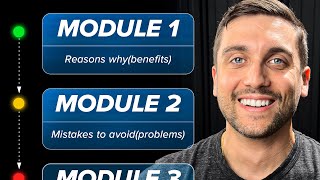
Nicholas Cole breaks down his five-component framework for course modules: why it matters, common mistakes, actionable steps, FAQs that handle objections, and worked examples. The structure keeps students engaged by addressing mindset, action, and the doubts that stop them.
My name is Nicholas Cole and I've sold over $10 million worth of digital products on the Internet. We've had over 12,000 students go through our programs and courses and over the past few years building all our different course modules and curriculums. I've probably written over 3 million words. So if you're creating an online course or thinking about building an online course, or maybe you already have an online course but want to know how to make it better, how to increase student success rate, how to increase positive word of mouth because your curriculum is that good, and how to make sure people absolutely love your product. Then grab a cup of coff, grab a pen, piece of paper, because today I'm going to give you my perfect course module framework. Every single module in your online course curriculum needs to have these five components. The first one is reasons why, otherwise known as benefits. The second one is mistakes to avoid otherwise known as problems. The third is steps how to. So this would be action. The fourth one is commonly asked questions, so. So objections. And the fifth one is some sort of walkthrough example, AKA proof. And the reason you need all five of these components is because if you leave some of these out or if you only give one or two of them, you're going to leave too many open loops in your student's head. Okay? So they're going to finish the module and have too many questions. They're either not going to know what to do next, or they're not going to know why they should do it, or they're going to go do it, but they're not going to know which mistakes to avoid, right? Or it's all going to make sense to them, but they're going to go, eh, I don't know know if it's going to work for me. So there's all these different things that keep people from taking action. And the whole secret to building a really great online course is constructing your modules in a way where when the student finishes consuming the module, almost always some sort of text and video combination. The goal is when they finish the module, they know exactly what to go do, they know why they should do it that way, and they have no more faulty beliefs keeping them from getting in their own way. That is the goal. And if you can achieve those three goals at the end of every one of your modules, your student success rate is going to skyrocket. All right, so let's go section by section and walk through exactly how this works. So the first one reasons why before you even begin telling someone, here's what you should go do. You have to first ground them and help them understand. Here's why I'm recommending this, right? And within that, why? There's always a handful of questions that the person has. It's like, why should I do this instead of this? Why are you telling me to go in this direction instead of that direction? And if you don't take the time to address maybe all of those questions or all of those faulty beliefs, you're going to start from a flawed place of understanding. Okay? So you can't just jump straight to action steps. You have to start with here's why. So, for example, in ship 30 for 30, which is our beginner writing program, one of the first things we explain to people is, here's why you shouldn't start a blog. Here's everything that's wrong with starting a blog, okay? Here's why it's so important to start writing on social platforms instead. And we have to get them to buy into that point of view first before we can tell them. Yeah, and here's how you go set up a profile, and here's how you make your first post, and here's how you write an atomic essay, right? Because if they don't buy into the here's why, then we could give them action steps all day long, but they're not going to go do it because the starting point wasn't established. So in every single course module, usually, and there's no, like, one perfect answer here, it could be a paragraph, it could be a section, it could be a module before the module, right? All that matters is that you address the why first and more importantly, you explain the benefits of this why. Okay? So you don't just want to say, here's why you should go do something. You want to say, here's why I'm recommending that you go do it this way. And here are the benefits of doing it that way. Here are all the good things that are going to happen if you just trust me, if you listen to me, if you just believe that the direction I'm pointing you in is the right one. Here's all the good things that are going to happen in your life, right? So it's not just here's why, it's. And here are all the benefits that come with listening to this why. All right, the second section is mistakes to avoid. And this is almost always tied to problems. So first you want to say, I encourage you to go in this direction, and here are all the good things that are going to happen. If you go in this direction. But beware, right? But beware. As you start your journey. Here are all of the things you're probably going to run into. Here are the mistakes that most people make, right? So a lot of this is almost like the value before the value. It's. Before I tell you exactly what to go do first, I'm going to tell you, here are all the things that you should avoid in the process, which immediately makes the person trust you more. They go, oh, not only do I buy into this new direction, but I also buy into the fact that I believe that you're going to educate me and tell me to avoid all of these other things that I might get caught up with along the way. Right? So again, going back to ship 30, here's why you should start writing on social platforms instead of starting a blog. The benefits, right? You got to establish this first. The benefits are you tap into hundreds of millions of readers that are already there. You have a much faster feedback loop. It's much easier to understand what's working and what's not. Allows you to gather data, allows you to improve faster, allows you to tap into networks of people that you would never tap into on your blog. Here are all the good things that are going to happen. The next step, though, is. And here are the mistakes that most people make when they start writing online. Well, mistake number one, they get too caught up with virality. They're focused on the wrong thing. Which is why I'm going to show you how to not do that. So all you're doing is you're pointing out, okay, if you buy into this new direction and you take one step in this new direction, chances are you're going to get confronted with a bunch of options. And I want to tell you up front, those are all mistakes, okay? AKA problems. And so that's the second thing you need to explain to someone and you need to help by pointing out very tangible problems. Don't do that, don't do that, don't do that. That's a mistake. That's a mistake. Okay? So they buy into the direction and then they trust you more deeply when you say, and you want to avoid all of this stuff in the process. The third section, and this is really the meat and potatoes of any online course, is all of the action steps. It's how to right, step one, step two, step three. But notice you can't just dive right into the steps. You have to first establish the thinking and direction. Here's why. Avoid these mistakes. Don't do some of those things, right? And only once someone has bought in to the mentality and the approach, then can you give them the, and here's tangible, tangibly what you should do. And if you notice a lot of times, you know, online courses have a horrible stuff stigma and reputation attached to them. And I believe it's because a lot of people will create courses that don't have all five of these components in all of the modules. So what they'll do is they'll dive right into, well, here's how to do the thing. And they won't address the well, which direction are we buying into and what are the mistakes to avoid? There's so much of the mindset mentality component that goes into education and if you don't prime the person, then you can give them the action steps all day long, but they're not going to do it. The next mistake that people make when they're building these course modules is they will get actionable and they'll give steps, but in a very surface level way. So they'll skip over so many of the nuances. So they'll say something like, you know, step one, if I'm using ship 30 as an example, step one, you should start writing online, but they won't tell you exactly where and they won't tell you exactly how. Right? And so a really good question to ask yourself as the creator is what is every single piece of information that a robot would need in order to execute this? Like ChatGPT is a great way of stress testing this for yourself. If you aren't able to instruct ChatGPT to do a task, you're probably not being specific enough to instruct a human. And that is the level of depth that you need to go into in the action steps where it's literally every single thing. It's not just start writing online, it's here's the platform. And then it's not just here's the platform, it's here's how to set up the platform. And it's not just here's how to set up the platform, it's here's how to write a bio and pick your profile picture and fix your banner image and pin your first thing onto your profile and write your first five posts. And then it's not just that, it's here's how to write each of the posts, here's a template for each of the posts, right? You have to go seven layers deep in the action steps where you remove every single piece of friction possible. And if you don't do that. And if you're just giving people like high level, yeah, you just got to go do these couple things. You're leaving too many open loops and the person's not going to go do it. And because they're overwhelmed with questions, they're not going to know what to go do themselves. Which ultimately leads to the negative word of mouth of, yeah, this course didn't really teach me what I was looking for. So the first two components are very mindset, thinking, oriented. And then the middle, the meat and potatoes, is the action steps. But the action steps are where you have to get so, almost painfully so tangible. Which leads to the fourth component, which is some sort of I love an FAQ section. And the reason that I started adding in this FAQ section is because I started to notice that it's not that people had additional questions, it's that people had objections. And objections are often disguised as questions. So, for example, if in ship 30, we're explaining like, hey, you know, you should start writing on LinkedIn, you shouldn't start writing on your blog. Well, an objection that someone might have is, yeah, But I think LinkedIn is really saturated. I think too many people are writing on LinkedIn. Or a different objection might be, I don't think my niche is on LinkedIn. Right? But these objections get masked as questions where someone will ask, you know, but is my niche on LinkedIn? And you have to actually kind of pull back and understand that, yes, it's a question, but actually it's an objection. And so whatever you're explaining in a course module, as soon as you're finished explaining it, 10 objections just popped up in the person's head, right? Is this really going to work for me? Does this work for my niche? Is it going to work if I don't have X, Y, Z years of experience? Right? And so something that I have found to be an amazing upgrade for all of our curriculums is after I go through reasons why mistakes to avoid, and then action steps is then I pause and I do another section that is all. It's an faq, but every question is really an objection. And all I'm doing in that section is addressing every single objection that I've heard someone say where whenever I explain this, it's like I can hear it back to me. And when you start creating more and more of this type of thing, as you build more digital products, as you launch more online courses, you will learn, you'll just hear it in your head. You will explain something and you'll immediately Hear the objection. And so all you have to do, and this is my process, is I just keep a list of all the objections that someone would have whenever I'm explaining something, and then I just dump them all into that section of the module where I'm like, all right, I explained it all to you. Now you're probably wondering, you know, or you're probably asking yourself, and then I just go question by question or objection by objection, and I explain it. And I have found that that is so, so helpful for dismantling people's faulty beliefs, because it's really not that people don't know what to do. Especially if you build a great course module where you explain the thinking, you give really clear action steps, all of that can be great. But the primary reason why someone doesn't act on it is almost always because of an internal objection. And so you have to bake into your course module an entire section that does nothing but address objections. And then lastly, component number five is some sort of walkthrough example. So this is where things can get a little meta. But if you take the time to do this, I promise every person who ends the module, they will know exactly what to do, and they will no longer be telling themselves, oh, this won't work for me. Or, yeah, that worked for you, but I don't think it's going to work for my niche or whatever it is. And the way that you dismantle those faulty beliefs is first you have that objection sort of FAQ section, but then you give them some sort of walkthrough that shows exactly how you did it or exactly how another student did it. And really, the whole goal here is just establishing proof. It's not just, hey, I can explain this to you. It's actually showing them visually, hey, this works. And I want to drive home a nuance here. This is not a testimonial. This is a very tangible example. Ideally another video that shows them, hey, when you do this, this thing works, right? So, like, for example, in our PGA curriculum, in one of the modules, I'm explaining how to do free consulting via loom. So how to find prospects, how to find ghostwriting clients, I walk through, here's exactly how to do it. Here's how to do free consulting. Here are the problems to point out. Here are all the things that you need to know. Here are all the objections. I address all of them. And then the last thing I do is I go, now watch me do it. And there's something so powerful about going, I'm not Just going to explain it to you. I am going to literally show you a version of me doing it so that you can start to build the pattern recognize and go, oh, I'm seeing it in front of me, right? And then I took it a step further and feel free to, you know, steal this framework if you want to. But then after I showed myself doing it, and what I did is I recorded a mock, basically a mock loom, free consulting pitch. So I was like, if I was pitching someone, here's exactly what I would do. Let me. I'm going to show you the loom that I would send. Then I created another video of me rewatching the thing that I just used as an example and paused all throughout it, pointing out, here's why I did that, here's why I did that, here's why I did that. So I actually took it multiple layers deep going, here's how to do it. Here's a video of me doing it. And now here's a video of me watching the video of me doing it, critiquing myself, pointing out all of the things that I did and why. And that's the level of depth that you have to go to in order to make each course module accomplish those goals. Because again, the measure for success isn't really, does the person understand what to do? The measure for success is, do they understand what to do? Do they understand why it's important? Do they understand what mistakes to avoid? Do they understand that all of their internal objections are probably wrong? You've educated them on why those things aren't correct, and you've given them something tangible to watch or look to to go, oh, and I can see how this actually gets played out. I can watch you do it. That instills a lot of trust in me. And the final goal is for them to get to the end of the course module and go, I have no other questions. I know exactly what to do. I know why to do it, I know what to avoid. Right? And I am not going to get in my own way. I believe that this will work for me because you've successfully educated me and dismantled a bunch of those faulty beliefs and objections that I have in myself. And if you do that, then you've built an amazing course. And if you don't do that, then you have more work to do. And I think, just a point I want to end on here is it's really important to internalize that. You probably won't get all of this right. The first time I didn't get it right the first time. Every time we launch some new product, I always see room for improvement. The question is whether you're going to go through the hard work of improving it. Ship 30 for 30. I rewrote that curriculum probably 20 times. Top to bottom PGA. I've rewritten that curriculum. I can't tell you how many times. Top to bottom, thousands of hours. Okay. And so you have to embrace the fact that an online course is not. It's not what everyone says it is. It's not, oh, I just build a couple modules, I record a couple videos, I put it up on the Internet and then I make passive income and I can go live the four hour work week just like Tim Ferriss told me I could. Right? That is not what it is. What you're doing is you are helping someone achieve a specific goal. Learn how to do something, dismantle all the faulty beliefs surrounding that thing and doing it to such a degree in depth that by the time they finish consuming the thing that you built, they no longer have any other questions. They should be fully confident in their ability to go execute. And more importantly, they shouldn't get in their own way with some sort of faulty belief. And I often find that the courses that have the worst reputations are the ones that lean too far in either direction. They are either all mindset, not enough action, or they're all action and not enough mindset. And so you really have to grok that. You need both. You have to really help and dig into why the person should listen to you, why they should trust you, why they should move in this direction, and why all of the faulty beliefs that they have and how do you dismantle them, but then also give them very tangible action steps and leave no stone unturned. So I love building digital products. I think if you can write an amazing course module, you can pretty much write anything in the nonfiction world. If you want an amazing forcing function for being able to write nonfiction books, okay. Books are really just full text versions, like nonfiction books especially are just text versions of an online course. That's all it is. And if you're really, really good at compressing your thinking down into the perfect course module like this, you can write anything in nonfiction. So I love building these types of products. I think very hard and thoughtfully about how we can continue improving these for our students. But this is a framework that's been crystallizing for me for a while, so I wanted to share it with you here. This is the perfect course module.
More from Nicolas



What Every Writer Gets Wrong About Their Audience #writing #creator #writingtips




