If I had to start over: my 30 day plan to get $3,000 writing clients ASAP
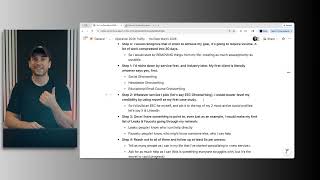
Nicolas Cole outlines a 30-day plan to land $3,000 writing clients from scratch. Start by cutting time-wasters, pick one service to master, then spend an hour daily on personalized cold outreach with at least five follow-ups per prospect. The real work is managing self-doubt and maintaining volume until you land your first premium client.
Chapters
If I was starting over, this would be my 30-day plan to land writing clients ASAP. So if you don't know who I am, my name is Nicolas Cole. I'm the author of The Art and Business of Ghostwriting. I'm also the founder of a program called Premium Ghostwriting Academy. I built the first ghostwriting agency for founders and executives and scaled that to millions of dollars in revenue. But if I was starting over, if I lost everything tomorrow, and I no longer had an audience, I no longer had an email list, I no longer had credibility, I no longer had books I'd written that I could point to, what would I do? How would I go about getting writing clients? So that's what I'm gonna walk you through today, okay? I'm gonna walk you through the steps that I would take to land writing clients ASAP. And the goal would be not just to land any old client, the goal would be to land clients paying anywhere from $3,000 or more per project or per month. Now this is something I educate writers on often, you should never be charging less than $3,000 for a project or per month. If you are charging less than $3,000, that means on some level you have a faulty belief around how much you can charge and/or your relationship with money is flawed and you literally can't fathom charging more than, you know, and then whatever you're charging, $1,000, you know, $500. I promise for any quality writing service, and I'm not talking like you have to go be an expert with 10 years of experience. If you are providing a valuable writing service, which I'm going to talk about here, there is no reason why you can't be charging $3,000 per month or per project. Okay. So if I was starting over, here is what I would do first. Before I even begin, I would have a little conversation with myself and I would go, okay, I am essentially trying to pull the future forward. I am trying to do what a lot of people say takes a long time in a very short amount of time. And in order to do that, that is going to require volume. I am going to have to put forth a lot more effort than I normally do. And I think this is an important thing to remind yourself is whenever you're trying to achieve a goal in a compressed time period, You don't achieve the goal just by saying, "I want to accomplish this goal in a compressed time period." The more compressed the time period, the more effort you have to deploy. That is how you pull the future forward. You ramp the effort up. I would remind myself, "Okay, this is going to take a lot of volume, and I got to just wrap my head around that and be comfortable with that." The first step whenever you set a goal is to not just make a to-do list of all the things that you need to go do. Anyone can make a to-do list. The hard part is creating a removal list. Okay? So in order to deploy more effort, what do you need? You need time. How do you create time? You remove things that are currently taking up your time. And so the very first exercise is going, what am I willing to give up to achieve my goal? I am going to give up maybe watching TV at nights. I am gonna give up spending 4 hours a day scrolling on social media. Check your screen time. Okay, it'll be very honest with you on your phone. What are you gonna give up? Maybe you don't see your friends once a week or twice a week or every week, okay? You have to make a list of what are the things that you're willing to give up so that you can create time so that you can fill that time with increased effort, all right? So a lot of people skip this step. That's why it's step 0. And then they start and then they wonder why they're not making progress. And it's because, well, you haven't created enough time, enough capacity And if you create the capacity, you're not filling it with effort. What most people do is they create the capacity and then they go, they're like, well, now I have time. Let me go. And then they insert some new hobby or they fill it with some other coping mechanism, you know? And that's the problem. All right. So step 0, what are you going to remove from your life? How are you going to deploy significantly more effort in this compressed time period? Then the first step, this is where all decisions come from, is I would niche down. I would, and whenever I talk about niching down, this opens like Pandora's box of an existential crisis with people, okay? I am not talking about I gotta sit down and do a 7-hour what's my niche, what's my identity in the world exercise, okay? First of all, this is not your forever niche. This is your first niche, all right? And the easiest way to think about your first niche is quite literally what service are you gonna provide and who's the first person who says yes. It almost doesn't matter what industry you pick in the beginning. Your goal is I just want a client, right? So the answer is literally whoever is willing to pay you money first. And then once you have that, then you can decide, oh, I really like this person. I like this industry. I like this topic. Let's go get more clients like that. Or you can decide, I want to pivot to something else. All right. The more important decision and the easier place to start is to focus on which service do you want to specialize in? Forget industry for a second. You— the goal is to eventually specialize in a service plus an industry. But it's much easier to just start from a place of what is the service that you want to provide. And the reason that's so important is because a big thing that influences your ability to charge a premium is by picking a service. Okay. When you specialize in a service, you know things about that service that the average person doesn't know. Okay. If you are, if you're a social ghostwriter, there are nuances to social ghostwriting that are different than newsletter writing. Or newsletter ghostwriting, which is different than building high-value opt-ins like an educational email course, right? And so the goal is for you to go, I am gonna pick one service and I'm just gonna focus on getting really good at that. And when you pick one service, everything else moves faster, okay? Now, of course, the follow-up question that everyone asks is, okay, Cole, that makes sense. Which service is the best? There is no wrong answer here. You could build a 7-figure ghostwriting business just doing social ghostwriting. You could build a 7-figure ghostwriting business just writing newsletters. You could build a 7-figure ghostwriting agency or one-person business just by building high-value opt-ins like educational email courses. I know because in 2017, when I first started my ghostwriting agency, we did one thing. We specialized in one thing. We wrote 800-word thought leadership articles. That was it. We didn't write landing pages, we didn't write emails, we didn't do social content, we didn't do anything else other than write 800-word thought leadership articles. And fun fact, at the height of our agency, we were ghostwriting more thought leadership articles for CEOs and founders per month than Inc. Magazine and Forbes combined. Okay, so that is what specializing looks like, is you go, I do one thing. And I scaled that agency to multiple millions of dollars in revenue. We had a whole staff, 23+ full-time employees. Like, it is such a great example of you do not need to offer every service to every type of person. So there is no wrong answer here. And the way that I like making this decision going into step 2 is this decision of which service you pick should be a reflection of something that you enjoy doing yourself or you are actively doing yourself. So step 2 is whatever service you pick, I would power level my credibility by using myself as the case study. So what does this mean? This means if I want to offer social ghostwriting, I should be writing on my social platforms too. If I want to offer newsletter ghostwriting, I should have a newsletter of my own. If I want to ghostwrite educational email courses, I should build an educational email course for myself and I should pin that to the top of my social profiles. You want to be able to point to yourself as a case study. This is the easiest way, by the way, to be able to speak confidently to clients without needing to have some big portfolio or have a gazillion testimonials or case studies. You can point to yourself as a case study. And again, I am not just sharing this in theory. This is literally what I did when I was going to land my first ghostwriting clients. I pointed to myself and I pointed to my writing on a website called Quora. Okay, it was a very niche question-answer social site. Back in like 2016, 2017. And I would get on the phone with a client and I would say, you're an industry leader. You should be putting out thought leadership articles. I can help you do that. And they would go, do you have any case studies that you can point to? And I said, yes, myself. I would pull up my Quora profile. I did not have millions of followers. I had like 8,000 followers. Okay. I'd pull up my Quora profile. I would say, look at how much I'm publishing on this platform. Look at— I have articles that are performing well. I can do this for you. And that is quite literally how I landed my first client, then second client, then third client, 5 clients, 10 clients, ended up scaling into a full-blown agency. I— all I did was point to myself. I didn't build my agency with case studies. I didn't have testimonials. I didn't have— I didn't point to anything else that was like, oh, all these people say I'm great. I landed hundreds of clients by pointing to myself as a case study. And I did not achieve some monumental outcome. This is a really important thing for you to understand is that the fastest path to landing clients and getting paid a premium is to A, practice on yourself. That is how you build the skill. You're the guinea pig. The client doesn't want you practicing on them. The client wants you practicing on yourself and then take all the things that work for you and just apply it to them. And then second is, as you build yourself, that's gonna reveal the thing that you enjoy doing. I loved writing articles on Quora. That's why I provided it as a service because I was doing it for myself. I could point to myself as a case study, but also I was doing it a lot and I was getting good at it and I enjoyed doing it. And so I wanted that to be the service that I provided. So how you decide which service to specialize in You do not make that decision from a place of what is the best service. They all work. You could do social ghostwriting. You could, you could ghostwrite short-form video scripts. You could ghostwrite long-form video sales letters. All of them work. The question is not which one is the best. The question, the question is which one is the best for you? And the answer to that is whichever one you enjoy doing. Because the one that you enjoy doing is the one that you're gonna stick with the longest. It's the one you're gonna practice most often. It's the one that you're going to do for yourself, which means it's the one you're going to be the most competent at the fastest. Okay, so that's how you make that decision. Then once I have something to point to, even just as an example, right, I wanna point to my own social content. I wanna point to my newsletter. I wanna point to my own educational email course. And by the way, I'm not saying you have to do this for like 7 years and then go pitch clients. You can power level and do all of this in a week. In a week, start creating a ton of social content on a platform. In a week, start your newsletter and publish a newsletter a day. No one's even on your list, just like populate your newsletter. In a week, you can build your first educational email course. So if you're talking like how do you pull the future forward and how do you start landing clients ASAP, yeah, you gotta put in a bunch of work, but you can do all of this. You can power level yourself in a week. You just need something to point to. Okay, then once I have something to point to, even just as an example, it doesn't even have to be performing well. You can just be like, I built this for myself. Okay, then what I would do is this is a little exercise that I walk writers through inside our premium ghostwriting academy. Okay, so if you're at all interested, you want me to be your mentor, you want to learn directly from me, you want to workshop things with me, I highly encourage you to check this out. We have had thousands of writers go through our premium Ghostwriting Academy. You can go to premiumghostwritingacademy.com. You just hit join PGA today and fill out a little, fill out a little application. Helps me understand where you're starting from. Okay, so this is the exact exercise that I walk writers through inside our Premium Ghostwriting Academy. You already know your first client. You already know your first 5 clients. They are in your life right now. You just take them for granted. And so the first exercise, before you even worry about going out into the world and pitching people and being like, oh, let me go contact and, and pitch and try and get clients of people that I've never talked to before ever in my life? Why would you do that? You can, but why not start from a way easier place, which is just look around your life. And so the first exercise is making a list of what I like to call leaks and faucets. So a leak is someone that you can help directly, like their faucet or their bathroom is leaking. You can be the plumber. You can go help them directly. Okay, so a leak is someone that needs your help. A faucet is someone who might not need your help directly, but they can bring you other opportunities. They might know other people who need your help. And like I said, you already know your first 5 clients. They're in your life. It's the uncle that you see once a year at Thanksgiving who's always complaining about how his small business isn't growing or how he doesn't know how to use social media. That's a client. It's your random college roommate who now works for a company that you feel like you could help. Great. Hit them up. It's your neighbor who you see runs a local business and maybe you've had a conversation or two with, and one day you should go strike up a conversation with them and say, "Hey, I checked you out online. You could use some help with this thing." You already know your first 5 clients. I know that probably feels a little uncomfortable. You're like, "Oh my gosh, I couldn't imagine going and talking to someone." That is the game. Welcome to being a small business owner. Okay? This is how it works. This is how every business on planet Earth works. You want to start a car wash company? This is what you're doing. You want to be a personal chef? This is what you're doing. It doesn't matter what career you're in. You are going to have to knock on some doors and pound the pavement. It's no different for writing. It's no different for ghostwriting. So I would make a list of leaks. Who are people I know that I could help directly? And faucets, who are people that I know that are connected. Like when I was first starting out, I thought of, I remember I met a family friend when I was growing up and he was a successful hedge fund trader. And I wasn't super familiar with the family, I didn't have some close relationship with him, but we connected once or twice just because he was around as I was growing up and stuff. And as I was starting my ghostwriting agency, I reached out to him and I just said, hey, I want to let you know I'm getting into ghostwriting. I actually just quit my job. I'm looking for some clients. Do you happen to know anyone who could use some writing help? I did that with like 10 people, anyone I could find. Just, hey, I'm trying to build my ghostwriting business. Do you know anyone who could use some writing help? That's a faucet. And a leak is, hey, I checked out your business. I checked you out online. I noticed that you have a problem. I can help you. So this is the place to start, and I would exhaust, like, not I did it for 2 hours and then gave up. I would exhaust this list first, and I would reach out to, step 4, I would reach out to all of them however is most natural to communicate. If I have a relationship via text, I would send them a text. Maybe it's via email if we're less close. Maybe if it's via DM, if it's someone I haven't talked to in a while and I gotta track them down on social media, Whatever, they all work. And I would follow up with them at least 5 times. This is like the biggest missed opportunity for writers is they think, first of all, it's like they can't even get themselves to send the first message. But then if they do, they talk themselves out of ever following up. And it's all just faulty beliefs. They think, oh, if I follow up, I'm gonna be seen as annoying. If I follow up, this person's gonna get mad at me. These things are not true. You have made them up, alright? When you're approaching business owners or you're asking people for help, a lot of people actually want to help you. You would be surprised how many people in the world want to be helpful. And when you're reaching out to business owners, they view you following up as helpful. I'm a business owner. I have a gazillion things going on right now. Even as I'm recording this video, I've snoozed my notifications and I know the moment that I'm done here, I'm gonna step back into 100 Slack messages and probably 15 missed text messages, and I'm gonna walk outside my office and my wife's gonna ask me for something, and then my dog's gonna start barking and she needs to go outside. And like, that is the life of a business owner. And so it is naive of you to think, "Oh, I send one message and this person should either give me their full attention or they hate me." That neither one is true. They're just busy, and so you need to follow up with them kindly and just remind them. Go, "Hey, I'm sure this got lost in your inbox. Just bumping this back up." "Hey, I'm sure you've been swamped. Just want to make sure you saw this." There's nothing annoying about that, and if the person gets upset at you, that's more of a reflection of them than it is on you. Following up is crucial. All the money is in the follow-up. All of it. All right. And I bet you from those efforts alone, just those first handful of steps, I would land 1 to 3 clients. Now, obviously there are subskills in what I'm talking about. It's like, first you have to get out of your own way. You got to uproot all of the faulty beliefs that you have. And then it's like the little nuances, you know, how do I reach out to people in a conversational way? How do I follow up in a natural way? Yeah, these are little skills to build, but this is I'm not saying you gotta go learn, you know, like how to build a rocket. This is like strike up a conversation. It's not, these are not hard skills to build. And so I imagine that just doing those steps, 1, 2, 3, 4, is how I would land my first 1 to 3 clients, all right? But let's pretend, let's say it doesn't happen. I go through, I do all of this, I treat myself as a case study, I practice on myself, I power level assets that I can point to, I do a ton of, outreach to people within my network. I build my list of leaks. I build my list of faucets. I follow up with everyone 5 times. Let's pretend none of it works. All right. First of all, does that mean that ghostwriting or writing services is dead? No. Does that mean AI has taken all the jobs? No. There is no other conclusion than, A, there probably is some sort of skill deficit there. Like there's some component of that that needs to be improved. And/or you need to do more volume. You need to deploy more effort than you think you do, all right? Because I promise, the service isn't broken. It's not like magically all of a sudden no one needs writing services. Writing is quite literally one of the most in-demand services on planet Earth. Look around you. Everywhere you see words, someone got paid to write them. And if now with AI, if someone didn't get paid to write them because they used AI to help with the writing, someone got paid to oversee the of it. Writing is one of the most in-demand services on the planet. So I promise it's not the service, it's you. You have some sort of skill that needs to be built here. All right. But let's pretend I don't land any clients. All right. I would then move on to cold outreach. So step 6, I would block 60 minutes every single morning, every single day to do high-quality outreach. What does this mean? Whatever type of person I feel like I can help. And again, in the beginning, you're just picking a service. So you could actually pitch different people in different industries if you want. But it's even better if you have a service plus, you know, an industry. I want to pitch people in the finance industry. I want to pitch people in the health and wellness industry. What do you do? You go on Google, you go on Google Maps, look locally, you go on X, LinkedIn, Facebook, Instagram, all of these platforms have hundreds of millions, if not billions of people. I always love when writers go, I don't think my audience is on Facebook. Really? Like 2 billion people are on Facebook. You don't, you don't think the person that you're trying to reach is on Facebook? I don't think my target client is on LinkedIn. Really? LinkedIn has 800 million users. You don't think out of 800 million people there's like a handful? And again, this is what's so great about services. You do not need 10,000 clients. You don't need 1,000 clients. You don't need 100 clients. You need like 2 clients. Okay. So over and over again, I have to keep reminding writers, if you think, oh, my niche is too small, it's not. If the niche exists, exists, I promise you won't even be able to capitalize on 1% of that niche. 'Cause you're just you. If tomorrow 10 people all said, "I wanna work with you," you wouldn't be able to do it. You would have a panic attack. You couldn't onboard 10 clients all at once. So you do not need the world. You need like 2 people, okay? And so it's really important to internalize. The niche, it doesn't matter. The industry, it doesn't matter. If the industry or niche exists, that means opportunity is in there. And I promise, all of these social platforms, anywhere you go on the internet, you will find a person within that industry or within that niche or someone that needs the service that you're specializing in, and you can reach out to them, all right? So I would expand from my network to cold outreach, and the big emphasis here is this is not about spray and pray. This is not about creating a message and copy-pasting and just going, oh, I just need to reach out to a gazillion people. No, no, no, no, no. That is not the strategy that I teach inside our premium ghostwriting academy. The strategy I teach is called free consulting. You are much better off doing more quality outreach for a smaller number of people rather than really surface-level, general, broad, vague outreach to lots of people. Okay, so what does this mean? This means you got to do your homework a little bit. So you poke around online, you're like, I think I can help this type of person. You do some searching on social platforms. Let's say you want to help personal trainers with their newsletters. Okay, you go into X at the top, you type personal trainer, you sort by people, and then you have a long list that you could reach out to. And before you reach out to them, you should spend 15 minutes doing your homework. Click on their social profile. What are they doing well? What aren't they doing well? Are they creating content consistently? Yes or no? Where does their link in bio go? Oh, it goes to their website. Okay, go to their website. Do they have an email opt-in? If yes, type in your email. See if you get a welcome email. See what their flow looks like. See what their funnel looks like. If they don't have an opt-in, what a missed opportunity. They're not collecting emails. You want to spend 15 minutes doing your homework so that when you reach out to the person, you can speak really well, you're educated to, "Hey, I noticed these problems in your internet presence or your internet funnel and I can help you solve them." You will be so much more successful if you take the time to do that for a smaller number of people rather than putting together some sloppy copy-paste message that you send to 1,000 people. And this is one of those things where I tell this to so many writers and it goes in one ear and out the other. They're like, "Yeah, yeah, Cole, I understand," and then they try to take the easy way out, and then they wonder why no one's responding. It's not that cold outreach doesn't work. It's that bad cold outreach doesn't work. Good cold outreach is when you take the time to actually figure out how you can help this individual person, and you do that for each individual person that you reach out to. That is how you do cold outreach well, and that is how top-tier people in every single industry land premium clients, not just writing. Take any industry you want, any industry that is doing cold outreach, which, a.k.a., is all of them. That is what they do. They take a high-quality approach to outreach. They do not take a spray-and-pray approach. Okay. And I would— last step, step 7— I would repeat this every single day. No matter what. And I would follow up with every single person 5 times. So every morning I'd block an hour. I would do 4 or 5 high-quality outreach to people that I find that I can help, and then I would follow up with them in 24 to 48-hour increments at least 5 times. And I would do that every single day. And you know what? Maybe I don't land a client in 2 weeks. Maybe I don't land a client in 3 weeks. Maybe I don't even land a client by day 30, but what happens if day 31, 3 people come back to me and they all go, "I'm in, let's do it." Does that mean I failed? No. Sometimes it happens sooner, sometimes it happens later, but this is what I like to call the idiot genius roller coaster, okay? When you're doing something and it's not working, you think you're an idiot, but the same action, change nothing, The same action, as soon as it starts to work, you think you're a genius. And I think this is something that's really important to internalize, which is the mentality, right? I'm an idiot, I'm a genius. The mentality is what shifts back and forth. The thing that doesn't actually change is the action. And as long as you are doing the right inputs, the outputs take care of themselves. And so you have to, like, something that has taken me a long time to learn is that managing your own psychology through that idiot-genius rollercoaster is a skill. The fundamental reason why so many people fail with something as simple as, "How do I go land my first writing client?" This is not a difficult thing. The reason so many people fail is because they are not aware of the fact that managing their own psychology is a skill. What happens is they start and then this little voice in their head starts convincing them, "You're terrible at this. This is never going This works for everyone else except you. Who's gonna wanna work with you? You can't charge that much money. You have no credibility. You're not good at this, right? That little voice in your head, you have not yet built the skill of learning how to put that voice in timeout. And so what happens is that voice creeps in and you listen to it. You give into it. It's not that that's real. It's that you haven't built the skill of ignoring that voice. Okay, and, and that is such an important part of the journey. That is fundamentally why it's like when writers are like, I think I can, I can figure this out on my own. Why, why have north of 2,000 writers gone through our premium ghostwriting academy at this point? It's because if you, if you could do that on your own, you would have done it already. Just like how, you know, if I go into the gym, it's like if I could have done certain lifts on my own, I would have already. But I didn't and I couldn't, so I went and got a personal trainer, right? The same is true in whatever thing you pick in life. And so it's really important to remind yourself that sometimes the skill to build has nothing to do with writing. Sometimes the skill to build has to do with getting out of your own way and learning how to manage that little voice in your head that's constantly trying to convince you not to take action or that you aren't good enough to do this thing. That's, that is why the whole, the, our whole Premium Ghostwriting Academy program is structured around the coaching element. It's structured around the accountability. It's like, yeah, I can tell you what to do. I'm telling you everything to do here, right? I can tell you what to do. But the reason most people aren't successful with it is because they literally don't do it. They understand it logically. They take the first step, but the moment that they run into a little bit of friction, they give up. The moment they run into a little bit of friction, that voice in their head creeps in and then they go, "Ah, that voice is right. This doesn't work for me." Why? There's no reason why it can't work for you. It's worked for thousands, tens of thousands, hundreds of thousands of other millions of people in the world, not from our program, just generally. This is one of the most in-demand services on the planet. So why can it work for everyone else except you? It's not true. And so that is the skill to build. And I would be shocked if I did all of these things that I did not land my first handful of ghostwriting clients in 30 days. Maybe it, maybe it happens at day 29, maybe it happens at day 31, but the steps don't change. These are the steps and they're not hard. They just require volume and consistency.
More from Nicolas



What Every Writer Gets Wrong About Their Audience #writing #creator #writingtips




