My 7-Section Framework For Building The Perfect Course Module
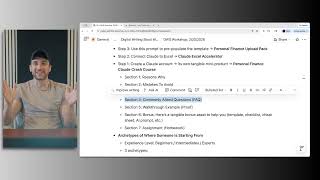
Nicolas Cole breaks down a seven-part structure for course modules: explain the why, surface objections, give micro-steps, add an FAQ, include a real-world case study, label bonuses like templates and checklists, and assign homework. Each section addresses why learners drop off or doubt the material will work for them.
Chapters
How do you build the perfect course module? This is the framework that I typically use over and over and over again. Okay, so inside of each action step, first we have reasons why. Why is this an important section? Because I can't just tell someone, go do this. Most people aren't gonna do it. They're not gonna believe me. They're not gonna believe you. So what do we have to do? We have to educate them on why they should take this action step, right? You have to sell them on the idea of taking action. So great, first I gotta educate you. What are the reasons why you should do this? The second is, okay, now I've educated you on why you should do this, but before we get started, What's everyone's biggest objection before they start anything? What if I do it the wrong way? What if I waste time? What if I put my foot in that direction instead? Does that mean everything's ruined? People have a lot of faulty beliefs and questions and uncertainties. And so you sell them on why they should take this action step. And then the next section is you go, and before you get started, I want to be helpful. I want to point out some mistakes to avoid. So what does that do? That gives them— that does two things. It helps them overcome that second layer of objections in themselves. And two, it gives them confidence moving forward. They're like, oh, and I know the right way of doing it. Right. Very powerful. Which leads to step 3. These are the micro steps. Right. So how do we create a Claude account? Micro step number 1, you go to this domain, you sign up for an account. Micro step number 2, you connect it to your Gmail. Step number 3, step number 4, step number 5. Congratulations, you accomplished Step number 1, right? Now, just to reinforce here, what's happening inside this one step with these microsteps is the same thing that's happening across all of these steps to the final outcome, right? So it's a little meta. It's the same. That's why once you understand these things, like, they just stack on each other over and over and over again. Okay, so we give the microsteps. Now, of course, after you explain to someone how to do something, what do they have? They have questions, right? Doesn't matter what I'm explaining, they have questions. It's true in fitness, health and wellness, technology, habit building. So I have to sell the person on the action step. I have to educate them on what to avoid so that they feel confident moving forward. I have to give them the microsteps that allow them to be successful at the action step. And then I have to answer, or proactively answer, all of, as many questions as I can. Right? Because usually what happens, especially with info, is someone buys into the idea and then they love, "Oh, and I know to avoid those mistakes." They feel smart. They are smart. They just learned. Then they understand the microsteps. And then why does everyone fall off here? They fall off because they have a question and they don't have an answer. And most people, when they are confronted with a question and they don't have an answer, they just stop. Right. So let's, let's use a really simple example. Let's say that— let's say there's a known bug in signing up for a Cloud account with a Gmail account. Like you've, you've done this a bunch of times. Let's just make this up. Let's say there's a known bug. And what happens is maybe the first time, if you're using a certain browser, maybe if you're using like Safari, you go to log in with Gmail and Claude like rejects it and gives you a 404. And all you need to do is just sign up for the account, not in Safari. You have to sign up for it in, in Google Chrome, and then you can use it in Safari. Let's just— I'm just making this problem up. Okay. What's going to happen is if your micro steps are sign up for an account, etc., and you don't you don't answer that question, then someone's going to run into that and then they're going to go, "Oh, Claude doesn't work for me," and then they throw their hands up and they go, "I give up." And by the way, your info product didn't work. So why did that happen? That happened because whenever you're explaining something, chances are there's 5, 7, 10 questions that pop up over and over and over again. And that's why this section is so important, because you need to answer those questions in order to make sure that the person actually doesn't get stuck and moves forward. Does that make sense? Yeah. Basically, in all of these, they're all tackling it in different ways. But every section in some way is, here's what to do, and I'm simultaneously like dismantling all the different objections that you might have to taking action, right? So whether it's— whether you're addressing that in the micro step or you're addressing it in the FAQ section, like all you're trying to accomplish is that by the end of the module, the person knows what to do, they know what not to do, and they don't have any more questions. If you've accomplished that, your product did its job and it's on them to then put it into action, right? Okay. So that makes sense, which leads to section 5. Now, why is, why is a walkthrough example so important? Because even when someone buys into the action and they know what to avoid, and they understand the micro steps to do it and you've answered all of their questions, what is their last objection? It's one of the most popular objections of, of selling anything in any industry. Anyone want to take a guess? Drop in the chat. It won't work for me. I think it works for you. I think it works for everybody else. I don't think that it works for me. The reason that people have that objection is because people like to believe that they are a special snowflake. You can't possibly understand that my situation is unique and different. Now, is it actually unique and different? No, it is the exact same as everybody else's, right? But people like to believe that their situation is different because it gives them an out. It's the easiest way to go, "Oh yeah, I understand, but I don't actually wanna take action. I don't actually wanna confront my faulty beliefs around this thing." So how do you get around that? You overcome that with some sort of tangible walkthrough example. So here, if you're first starting out, if this is your first info product, this might be you doing it. As time goes on, you want this to be a student doing it or a customer doing it, someone else doing it. You want, you want it to be a success story. You want it to be a case study, right? So for example, if my step 1 module for starting to write online is setting up a— this is a very common one in PGA. Let's say your step 1 is setting up your LinkedIn profile and positioning yourself as a ghostwriter. And I explain the reasons why you should do that. I explain the mistakes to avoid. I give all the micro steps. Here's how to set up your LinkedIn profile. I answer all of the questions. What's one final objection? I don't think this will work for me because— and your job is to basically come up with the 1 to 3. It could be one predominant one. Maybe it's 2 or 3 little subspecific ones. Your job is to come up with one or— what are the 1, 2, or 3 becauses? And I'll tell you, in PGA, a very common one is people say, I understand how to set up and position myself as a ghostwriter on LinkedIn. I understand, but this won't work for me because I have a full-time job and I'm afraid of my employer finding out. So how do I overcome that? In that section, I go, hey, and you might be sitting there thinking, Cole, I understand this, but I work a full-time job. I really want to ghostwrite. I understand the value of LinkedIn, but I'm afraid of my employer finding out, and so I don't want to do that. So how do I overcome that objection? In the next section, I go, and here is a case study, or here is a success story of a student inside PGA who is working a full-time job and didn't want their employer to find out about their ghostwriting, and here is what they did on LinkedIn. Does that make sense? So then what do they say, right? It's like, you just told me that your specific case is you're the special snowflake and no one could possibly understand you, and then I just said, actually, here's a different person in the exact same position who did it. Now what? And this is the game of, quote unquote, persuasion in info and education, is you literally have to persuade and educate people to take action because they are gonna come up with every possible reason why it won't work for them. So yeah, Sushil, that's what I said at the beginning. If you don't have that yet, then you use yourself as the example and you just speak to that problem or that uncertainty. So the first time, this is literally what we did when we started PGA and we didn't have people to point to for that specific objection. I said, hey, and you might be sitting there thinking, you know, I really want to ghostwrite, but I'm working a full-time job and I'm unsure if my employer is going to be supportive of it, so I don't want to do that. I know because I used to be in your position too. I actually started ghostwriting when I was working at an ad agency out of college. I had the same uncertainty. Here's what I did to get around it, right? So you're just using yourself as the example, and then over time you can upgrade this section with more and more compelling case studies, success stories, things like that. Does that make sense? Everyone, everyone see the thinking and how it stacks on top of each other? Like, you want to get to the point where, where when they get here, you've sort of backed them into a corner and you're like, none, none of your objections make sense. None of them hold water. You know everything you need to do. There's only one thing left for you to actually go do it. Right. And so then from here, there's two, there's two other sections that I think are really important. First of all, here's, here I'm going to share a little secret about info products with everyone. Info products are kind of like Pokémon cards in the sense that people who value info products want to catch them all. They love info products. They want to, they want to collect them. They want to save them. They want, they want everything. If I take the same product and I like— what's the best way to explain this? If, if this is the— let's say this is the mini course and I say the mini course, okay, this might be a little hard to follow, but I'm gonna try my best to explain this. If I say that the mini course is these 6 sections, but I don't call this a bonus, I just say in this mini course I'm gonna tell you reasons why, mistakes, the microsteps, I'm gonna answer all your questions, I'm gonna show you a case study example, and I'm gonna give you this template or checklist or whatever, okay? If I tell you that and then you go through that and I don't give you the template, you're literally gonna ignore all of this and go and email me really mad and be like, you promised me the template and you didn't give me the template. Okay. If I don't tell you that there's a template in there and then all of a sudden it appears as a bonus, you're going to email me and go, Cole, this was not only so helpful, but man, like, and the fact that you gave us that bonus template, that was so cool. That was so helpful. Thank you so much. And so people with info products are very funny in that, like, I see when we run webinars or we run like 3-day challenges and stuff, I see this all the time. It doesn't matter how much value I pack in there. It doesn't matter. I could give away $100,000 of value. But if I say, and we also give you this thing, this bonus, people ignore all of the other stuff and go, I want to make sure I get my template. I want to make sure I get my bonus, which is fine. Like, make sure you give them the things that you promised, right? But the reason I'm explaining this is that info is one of those funny things where it's, it's very dependent on how you present the information. And there's— and exactly, Sushil, it is all about underpromising and overdelivering. And the easiest way to overdeliver with info products is to take something that you were already gonna give them and just call it a bonus. So as you, as you were building the thing, it's like, oh, I was— I already wanted to build you a template to make this easier, but the perceived value goes up 10 times when you call that thing and you say, "Hey, and by the way, as a free bonus, I just wanted you to have this for free. I just thought it would be really helpful." If I don't call it a bonus, people don't value it. If I do call it a bonus and something that you weren't gonna get but I'm now giving to you, people are over the moon happy. Okay? So these are just rules to the game. It's like you gotta understand the psychology of how these products work. And so something that I like doing in every mini course or every module or each individual thing is I ask myself, what is a tangible object that I could give someone that would make their life better? Could I, could I give them a template? Could I give them a suite of templates? Could I make them a checklist? Should I build them a cheat sheet? And then instead of just making it part of the module, I break it out and go, and by the way, as a thank you, just to make your life easier, I wanted to give you this, this bonus template, this bonus checklist. And all of a sudden everybody values it. Okay, so it's, it's— we're pulling back the curtain a little bit. This is, this is something that took me a long time to understand. I promise if you do that, the perceived value goes up. And then lastly At the very end, yeah, MD, now that you know that, you should see us, we do that everywhere. We do bonuses everywhere, we do bonuses at the beginning of live sessions, hey, thanks so much for showing up live. We do bonuses at the end, thanks so much for staying to the end. We do bonuses for booking a call, we do bonuses for responding to an email, we do bonuses for responding to a survey. We have an internal mantra that is anytime you want anyone to do anything, Give them a bonus in exchange for doing it. You don't just ask someone to fill out a survey, you say, hey, you can unlock this bonus by filling out a survey, right? So bonuses are a really great mechanism, which leads to the very last thing. And you don't have to do this, I just like doing it. Okay. Because the reality is, even if you give someone an assignment or homework at the end of each mini course or module, unless this is a curriculum for like a high-ticket group coaching program or a mastermind, you don't really have a way of enforcing it. So what I mean by that is, uh, our, uh, Premium Ghostwriting Academy curriculum looks exactly like this. Like every single module follows this to a T. But at the end of each module, we have people do an assignment and then we hold them accountable when they submit that assignment into a Slack channel and then their coach follows up with them and reviews the assignment. Right. So there is an accountability mechanism there. When you're building $350 digital products or less, you don't have that accountability mechanism. Right? Like, you're not, you're not promising to review all their assignments and things like that. You're— this is just information. So the way to think about this section, assignments or homework, is it's really just a crystallized version of the, the main action step that you want them to take. You're like, great, I just explained to you A to Z how to do this. Your assignment: go do it. That's, that's really all it is, is like one final reminder. Here's what you need to do. You are successful when you have done X, Y, Z. And again, like, we have this in our products too. So you're welcome to go through and check this out. But we have like here, we call them exercises. It's like, here's what you should do. Go practice this thing. Go do this thing. Right, so don't overthink this. We could, we could go down the rabbit hole on like the advanced way to execute this if this was a curriculum for a high-ticket group coaching program or a mastermind, something with an accountability mechanism. But if you don't have that accountability mechanism, then it's really just a recap of what do you need to go do. Go do it. And then what happens? You take this And then you go, great, you did step 1. Time to move on to the Claude Excel Accelerator. And then we do it all over again. Real quick, if you want to write online but aren't sure where to start, click the link in the description of this video and check out startwritingonline.com.
This is a free masterclass I put together sharing all of our most helpful frameworks for beginners, like proven hooks to capture your target reader's attention, where to write online to get the most distribution on your work, and little growth hacking tips to build your social audience and email list faster. Over 100,000 writers have gone through this free masterclass, and many even send us emails afterwards thanking us for sharing such valuable information for free. So click the link below this video to check it out and make this year the year you start seeing success from your writing online.
More from Nicolas



What Every Writer Gets Wrong About Their Audience #writing #creator #writingtips




