Q&A on Digital Writing, Ghostwriting, and Self-Publishing
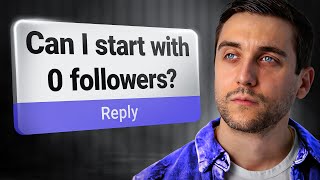
Nicolas Cole answers audience questions about starting to write online, building an audience, ghostwriting, and self-publishing. He covers consistency, understanding what your readers want, and the trade-offs between different paths to monetizing your writing.
Okay, little Q and A. Today I posted on Twitter if anyone had questions on digital writing, ghost writing and self publishing and got a handful of good ones back. So I wanted to rapid fire through a handful of these. So first Magda asked, how would you go about starting to write online? If today you started with zero audience, would you just go on Twitter or medium, be consistent and hope for the best? And then goes on to say, you know, that the big advantage that me and my co founder Dickie have is that we were ahead of the curve. And I think this is a big misunderstanding. Whenever you look at a creator that is much further along, you have to keep in mind that you are looking at Cole today. But Cole's been writing on the Internet for a very, very long time. I wrote the very first, you know, my first gaming article on the Internet when I was 17. This was back in 2007. And I started consistently writing online and really treating this passion of mine as a pursuit in 2014, right after I graduated from college, I graduated in 2013. Okay, so even just that 10 years, so you're looking at a 10 year journey. And it's not that I was ahead of the curve. When I was writing on Quora back in 2014, Quora already had 200 million users. It already had people on there with huge audiences. I wasn't ahead of the curve. I just started. And then when Dickie and I started gaining a lot of traction on Twitter in 2020, you have to keep in mind Twitter had already been around for over a decade, probably longer. I think it came out in 2006. Right. So that's like 15 years, 2007 maybe. So 15 years old. Okay, so we were not ahead of the curve. We just started. And I think one of the hardest things for new writers to really wrap their heads around is that everyone starts at zero, every single person. When you say, I'm going to start writing on the Internet, you don't log in and go, well, you won the lottery. We're giving you 3,000 followers to start with. Everyone starts at zero. And so a lot of the frameworks that I talk about, I'm telling you, are the same frameworks that I was using when I had zero followers on Quora. And I can tell you exactly how it went. I wrote one thing on quora, it got 27 views and I got no followers. And I sat there just like everybody else going, I guess this platform doesn't work. And then I tried again, then I tried again, and then I tried again. And eventually I started to see, like, I would get 100 views, or I would get one follower, or I'd get one like, or I'd get one comment and I'd go, wow, one is a whole lot better than zero. What did I do? Why did that resonate? Let me try and do that again. Right? 1 leads to 2, 2 leads to 4, 4 leads to 8. It is the same framework. The same way that a creator with, with a quarter million followers asks themselves, how do I grow from here? Is the exact same way someone with zero followers asks, how do I grow from here? It's based on what's working. And the only way that you can learn what's working is you have to start creating things. And the hardest part and, and it's one of those, like, you almost have to be a little, like, naive about the journey. The hardest part is when you start writing things and you don't see the numbers go up. And you have to not sit there and go, the platform must be broken. I promise you the platform's not broken. Platforms, if they were broken, wouldn't be making billions of dollars a year. Okay, so the platform is not broken and it is not saturated and you are not late to the party. The problem is that you haven't written long enough and you haven't figured out yet what resonates with people and who you're trying to reach and who you're trying to help. And that is the hardest part. When you're starting anything new, it's not just writing. Starting anything new is almost embracing the suck, embracing the fact that you don't know yet, and you have to go on the journey of discovering and figuring that out. So that's a long winded way of me saying, if I was starting over at zero, would I just start writing on a social platform, be consistent, and hope for the best? Yes, because to be perfectly honest, that's exactly what I did when I started on Quora. I didn't know what the outcome was going to be. I just figured, hey, if I write lots and I'm consistent with it, I'm probably going to get better and maybe something will happen. And then the rest is history. And yes, lots of things happened, so there really isn't much to overthink. Just start, get going, and don't stop. Second question Fotl asks, what makes a good story impactful and valuable? And this is both a simple question and a difficult question. The simple answer to me is, what makes a story impactful and valuable is if the reader can see themselves in it. If the reader can't see themselves in it, it's not a very good story. And a lot of times, you see, you know, I had teachers when I was studying fiction at Columbia College Chicago that would say if you can write fiction, you can write anything. And I didn't understand what that meant until I graduated. And then I got a job at an advertising agency and I started getting into business writing and nonfiction writing. And I realized how true that was because I had already written fiction. And so I understood a lot about story. And then I went into these other opportunities writing nonfiction and business content and people. I mean, the writing is just horrible. It's so like, it pales in comparison to great fiction. And one of the primary differences and one of the reasons why most, quote, unquote, business content tends to not be very good is, Is because there's all of this, like, there's this belief that circulates in the business world of, your story is important. You have to tell your story, your startup story, your founder story. And the reality is, nobody cares. Your story is not what matters. The only time your story matters is if you can tell it in a way that makes the reader be able to see themselves in it. And so whenever I explain this, writers go, well, how do you do that? I'll tell you exactly how you do it. You have to use your story as an example. Your story is not what's in the spotlight. Your story is an example. And so what you need to start with instead is what is the reader interested in? And how can I use my story as an example? So let's say, hypothetically, I built a recruiting company, and everyone around me saying, cole, you need to tell your story. Your story of how you built this recruiting company is amazing. Well, if I walk around and say, hey, everyone, listen to my story about how I built this recruiting company. Nobody cares. But if I change who's in the spotlight and I say, hey, reader, I'm going to put you in the spotlight. Are you interested in building a recruiting company? Do you work in recruiting? And do you want to know how to grow a really successful recruiting company? Well, I can tell you because, for example, I built a recruiting company. That is the only difference. And all you did was say, instead of putting the spotlight on me, I'm going to put the spotlight on the reader, and I'm going to put the spotlight on the reader's wants, needs, and interests and desires. And then I'm going to use my story as an example. Question number three. Tariq asks, have you and Dickie shared the gory details of how you grew your team bootstrapping. I'd like to understand how you added new people without financing or taking on debt. So whenever you're growing a business, doesn't matter if it's 0 to 1, 1 to 2, 2 to 10, 10 to a gazillion, you will always be faced with the trade off. Do I want this to cost me money, or do I want this to cost me time and effort? Those are the only options. You either pay for it with money, or you pay for it with time and energy and effort and your own blood, sweat, and tears. Okay. And I can tell you, in the beginning, when we started, when Dickie and I started working together, we didn't raise any money. Sort of the beauty of both education products and my first business, which was an agency. Both of those types of businesses don't really require very much upfront capital, doesn't cost very much to build an education product, and it doesn't cost anything to start an agency because you're essentially selling your time or you're creating, like, digital assets that don't really have any marginal cost. So we didn't need money. But I will tell you, in the beginning, before ship 30 was really making money, I was still ghostwriting. And because we didn't raise money and because we didn't want to go, well, let's, you know, give away 20% of this idea and let's, you know, have some Runway, and then let's hire a couple team members, we just bootstrapped it. And so at the time, I was still ghostwriting. I was still ghostwriting probably four or five hours a day, and Dickie was still working his hedge fund job on Wall Street. And then we just worked together in the other hours of the day, and that was it. And then that was all it took to get ship 30 up and running. And then once ship 30 started making some money, we slowly started to reinvest in building the team. And then as we got further along and ship 30 became more successful, then I shut down my ghostwriting agency, right? So I had one foot in, one foot out, and I sort of de. Risked the situation. And then I left my ghostwriting agency, and then I moved into building ship 30 full time. And then Dickie ended up doing the same thing. He left his job on Wall street and then was, quote, unquote, full time with ship 30. So that is always the trade. You're either buying it, you're paying for it with cash, or you're paying for it with Time, energy, and effort. And pretty much everything that we've built has come from just reinvesting in the business and paying for it with time, energy, and effort. Though those first two years building ship 30 and building all of the tangential products and everything, I mean, I worked probably every weekend, and I probably worked 10, 12 hours a day most days. And in many ways, I kind of still work that hard. I still work six days a week. And anytime you see a thumbnail of someone saying, here's how I make $28 million a month working two hours a day, it's just clickbait. It's wrong, it's a lie. Anyone who is building anything successful, unless you've gotten to a point where you have completely exited the business, you have hired a CEO and you sit as chairman, and you are out of the. Out of the business, none of that is true. Everyone is working very, very hard to build these things, and they're either incurring the cost and paying for it, whatever the next stages of growth with money, or they're paying for it with time, energy, and effort. Question number four, Clayton asks, should you start writing online and building a personal brand first, or should you start with ghostwriting? It just depends on what you want, in my opinion. A lot of times people ask these questions outside of the most important piece of context, which is what's going on in your life? You know, like, if you ask any question, should you do this or this? Well, the answer is completely subjective, A, depending on who you're talking to, and B, it's. It's dependent on what's going on in your life and what do you need to optimize for. So a very easy way of thinking about this sort of question is like, do you have a really cushy 9 to 5 job, you have a ton of spare time, and you've got 50 grand saved up in a savings account, okay, I'm going to give a different answer to that person than the person who goes, I lost my job. I haven't worked in two months. I have 30 more days of Runway, and if I don't find something soon, I'm going to have to go back to my parents and ask for a loan because I'm not going to be able to pay my rent or buy groceries. I'm going to give very different advice to each one of those people, Right? So oftentimes I notice when people ask these questions, they don't start from a place of, well, what is the context of my life and what am I trying to Optimize for. And in my opinion, if what you're trying to optimize for is how do I monetize my writing skills as quickly as possible and how do I power level my earnings so that I can sort of buy back some of my time? Like for example, if you were working a full time job that was really just exhausting and mentally consuming and you enjoy writing and you're looking for something that's equally or more lucrative but doesn't require you to work eight, 10 hours a day, ghostwriting is your fastest path to doing that. That is a very effective path. But if you're happy with the life that you have and you're like, I don't really need to optimize for money and I'm fine and that's not really what's driving me, but I'd like some long term upside and I actually care more about maybe some of the other tangential benefits like connecting with other people or you want to build an audience so that you can do XYZ other thing you want to launch a podcast, whatever it is, then yeah, I would encourage you to start writing online and investing in your in quote unquote, building a personal brand. But the easiest way to differentiate this decision is are you trying to power level your earnings as a writer as quickly as possible in the short term, then the answer is ghostwriting. Are you trying to unlock longer term upside and know that this will probably be a one to five year journey? Then you should start writing online and building your personal brand. My honest take though is you don't have to choose and in many ways you can and should do both. I think anyone who wants to build themselves and wants to build a personal brand and an audience should also be monetizing with ghostwriting because otherwise you're leaving a ton of money on the table. And if you're ghostwriting, you should be building yourself because it's only going to make it easier for you to attract clients. So you should be doing both. All right, question number five, Mike asks, what advice do you have for someone who loves to learn but can't figure out what their offer is? So this is why close listening is so important. Because even in this question there's a cognitive dissonance. So in this question it's how do I figure out what my offer is, AKA what to offer other people when I really love learning, AKA I love being selfish. To put it bluntly, I love focusing on what I like to focus on. And these are two completely different things. And what you have to recognize is that figuring out a compelling offer often has very little to do with what you care about. I'm not saying that you should go build an offer or build a product or build a service around something that you have zero interest in. That's not what I'm saying. What I'm saying is that when you start from a place of here's what I'm interested in, you immediately miss the point of offer creation. And the real art of offer creation is you taking the backseat and instead you starting from a place of, what do other people need? What do other people care about? And the mistake that I see people make here is they think that the way that you come up with that answer is you sit in a room by yourself and you stare off into the distance and you go, let me think about what people need. And that is not how you figure it out. It will. It will never fall into your brain. The way that you figure out what other people need is by going and talking to other people. So again, if you don't know what your niche is, you don't know what industry you want to be in, you don't know who you can help. The single easiest place to start is who do you know who's struggling with something that you know how to do? It could be, you have a friend that just bought a house and their yard is a mess and they don't know how to cut their lawn. If you know how to cut their lawn, congratulations, you have an offer. Because your offer is, hey, you don't know how to cut your lawn. Would you like me to cut your lawn for you? Yes, that is an offer, right? Or if you want to do something in the digital world and you want to help X person solve Y problem to unlock Z outcome, go find a bunch of those people online and DM them and email them and talk to them and be like, I'll do it for free. I just want to understand, like, how can I help you? I have ideas for how I can help you. You have to start from what the other person values, not from what you're interested in learning about. In an ideal world, there is an overlap, right? I'm not just saying, quote, unquote, chase the money and do something that's unfulfilling to you. There should be an overlap, but oftentimes that overlap reveals itself as you help other people. All right, question six. Sasan asks, how do you grow an audience for your fiction writing from zero? The feedback loop from book to book is way too slow. So there's a faulty belief buried in here. And I just want to point it out, which is the feedback loop from book to book is too slow. If you've studied genre fiction at all, then you know that the most read, most popular genre fiction writers are writing a book every two to four weeks. And every time I explain that to people, they go, well, there's no way that those books are high quality. They're just pumping out trash. Well, here's, here's the thing. If those books are selling millions of copies, then you sitting there saying those books are trash is really just you saying, I don't want to take the time to understand what's happening here because clearly they're not trash. Like, even if the writing isn't Pulitzer Prize winning level, the story is still compelling enough where millions of people or hundreds of thousands of people or tens of thousands of people are reading it and enjoying it. And that is the only metric that matters. And so if you're sitting there going, well, no, I need to spend two years on a book, then yes, the feedback loop for books takes too long. But there are a lot of ways around that problem. First of all, it has never been easier to write and self publish books ever in the history of everything. Second is you don't have to write 100,000 word books. You can write like there's entire categories on Amazon where you can publish short mini books that are, you know, 10,000 words. That's a book. And you can, you don't even have to do a print version. You could do just an ebook version. So oftentimes, I find even more than the nonfiction world, fiction writers have 10 times more faulty beliefs than all of the writers in the nonfiction world who have faulty beliefs. And they have a lot of them. And so if you're asking how to build an audience for fiction, the simplest answer is you need to write more fiction, write smaller fiction, so shorter fiction, and you need to hit publish more often. And trust me, I've spent a lot of hours going down this because I had a hard time wrapping my head around this as well. But one of the most fascinating data points I think is that some of the most read, most popular genre fiction authors actually have very small social audiences. Many of them are actually invisible on social. The only thing they do is rep out ebooks or series on Amazon. It's the only thing they do. And the reason that they're so successful is because they push volume and they don't have some giant email list and they don't have some giant social audience but they're consistent and they figure out what readers want, and they pump out books every two to four weeks. And then they learn and they read the comments and they iterate and they double down and they don't give up after two months. And that's. That's it. You know, that it's like, let's not overthink it. If that's what everybody does and that's how you become successful with genre fiction, then you should probably go do that. And that's the answer. All right, question seven, which actually leads nicely into the last one. Question eight, Sophie asks, and then on the back end, Charlene asks as well, who is in demand for ghostwriters? Which industries is ghostwriting best suited for? And then Charlene sort of backpacks on this and says, how do you get your first client as a ghostwriter? First of all, I get this question all the time. Everyone wants to know, what's the most lucrative industry? The easy answer? If you just want something super prescriptive, the easy answer is, look at the new and emerging industries where lots of money is floating around. And the tldr. Easy answer. There is technology, and now more specifically, anything with AI, like, there you go. But me giving that prescriptive answer isn't really the full picture. And so to just expand on this for a little bit, I truthfully believe that every single industry can work. I have seen every industry work. I have ghostwritten in very obscure industries. And what you have to recognize is that you have this bias as a writer, as a ghostwriter, where you look at someone else, you look at some other industry, and you think, oh, that's so successful. But I've run into friction with my thing, and I don't think my thing works. But if I showed you someone who was crushing it in that niche or in that category, the thing that you've tried, then all of a sudden you would be like, oh, I guess this works too. But then what's funny is that whenever I do that and I point out a success story, then the person sits there and goes, well, it's too saturated. Then I don't think there's any opportunity for me. And neither of these extremes are true. The reality is that every single person in every single industry who wants money, more customers needs a ghostwriter. It doesn't matter what the industry is. The only thing that matters is who is their customer and how can you help them reach or speak to more of those customers with writing? That's it. So every industry can work. And so my recommendation and A big framework we talk about in our premium ghost trading academy is starting with what industry do you have an information advantage in? AKA what is an industry where you already know the lingo, you already speak the language, you already understand all the industry terms. Ideally, this would be an industry that you've worked in, or this is an industry that you're a hobbyist in. You know, like, for example, it'd be very easy for me to ghostwrite for people in gaming because I was a pro gamer as a teenager and I really understand that space quite a bit. It would be very hard for me to ghostwrite in an industry that I know absolutely nothing about. Like, if someone was like, hey, Cole, I want you to ghostwrite for my mineral rock business. I don't know anything about mineral rocks. I could probably get myself up to speed, right? But the person who is obsessed with that and is like, oh, I've been collecting mineral rocks for 20 years, they're going to know how to ghostwrite that content better than I am, at least in the short to medium term. So you always want to start with some sort of industry where you have an information advantage and then backpacking on this. Charlene's question of so then how do you get that first client? Well, another framework that we really drill home in PGA is in the very beginning, your niche is your network. Okay? So your niche is not, let me go pick some hyper specific category and position myself as an authority. In the very beginning, your first client should be someone you know or someone you know who knows someone. That's it. Okay. It's the uncle that always complains at Thanksgiving about how no one reads his newsletter. It's the cousin you see posting on X or LinkedIn. And you can tell they're trying to like drive traffic to their startup, but they're not doing a very good job. It's the friend that is like, hey, I'm thinking about leaving my job and starting this thing, but I don't, I don't know how to do it. You're looking for people in your life that you can help. And sometimes that means being paid in cash, and sometimes that means being paid in a testimonial or being paid in, you getting experience or you building confidence. Right? You don't always have to get paid in cash. So that first ghostwriting client, chances are, is sitting right, right next to you somewhere in your life. But in your brain you think, no, my first client is going to be. And then you project this big fancy vision of what it means to land a client off in the future, and that's not what it is. Your first client should just be someone in your life that you know and you go help them, and then you ladder that work up to the next one, and to the next one, and to the next one. So in the very beginning, your niche is your network. Let me know if you enjoy this Q and A series. I really enjoy actually just having questions teed up. It's a lot. It's very easy for me to just speak to as well, and I always find myself going down different tangents and rabbit holes that I might not have thought to talk about had someone not asked the question. So if you enjoy this Q and A series, drop a comment on YouTube, let me know and I'll do more of them.
More from Nicolas



What Every Writer Gets Wrong About Their Audience #writing #creator #writingtips




