Summary: The Art & Business of Online Writing by Nicolas Cole (10 best ideas)
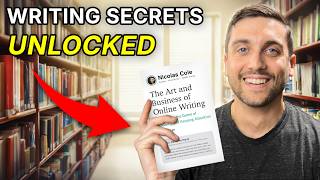
This is a YouTube video titled "Summary: The Art & Business of Online Writing by Nicolas Cole (10 best ideas)" created in June 2024. It features a detailed monologue by Nicolas Cole sharing key insights and strategies from his book on becoming a successful online writer. The content covers topics such as writing distribution, reader focus, building a writing habit, public practice, voice development, consistency, headline writing, reader behavior, niche targeting, and creating a unique category for writing success. The video serves as a comprehensive guide for writers aiming to grow their audience and monetize their work in the digital age.
In 2020, I published a book called the Art and Business of Online Writing, sharing everything I had learned, becoming the most read writer on quora out of 200 million users, becoming one of the top 10 contributing columnists for Inc. Magazine, bringing in millions of page views and becoming one of the most read writers on the Internet, racking up hundreds of millions of views on my work. And since then, the art and business of online writing has sold over 50. Blog should essentially be your last priority. The reason is because a blog has no distribution. Flywheel. It's just a page flo around in the ether that nobody knows about except your mom and your dog. And whenever I explain this, I know, I know SEO, blah blah blah. SEO is a completely different game. SEO is not writing. SEO is data science. And so this argument is a logical fallacy. Do you want to write? Okay, then you aren't playing the SEO game. And if you aren't playing the SEO game, which is a completely different skill, then having a blog isn't going to move the needle for you. So where should you be writing instead of social platforms? X Twitter, LinkedIn, Medium, Quora. You can even write on Facebook or Instagram and you can read your writing on TikTok or YouTube. And if you're writing fiction, you can write on Wattpad or Royal Road. Medium also has a big fiction audience as well. A lot of people don't know that. The point is, all these platforms have hundreds of millions of readers already consuming content there. So why would you hit publish on your own website where you have two readers, your mom and your dog? It makes no sense. And on top of that, when you publish on these social platforms, you still own the content. It's yours. Which means you can take that content and republish it on any of the other social platforms. I've been doing this for over a decade and this is how I've not only accumulated over a billion views on my writing at this point, but I've also directed that traffic to my various writing businesses, products, books, and made millions of dollars all without a blog. Big idea. Number two, you are not the main character. The reader is the main character. This is something that took me a long time to learn, but ended up having the biggest impact on my trajectory as a writer. Most people who say they want to become writers or want to unlock some sort of external outcome from their writing, whether it's to build an audience or establish themselves as a thought leader in their industry, or connect with like minded creators, or monetize in some way, think the process Goes like this. I'm going to write what I want to write about, and. And then I'm going to tell other people to read my writing. And that is false. They think they are the main character and they're not. The reader is the main character. Which means if you want to unlock any external outcomes from your writing, you have to start in the inverse. What does the reader want? What problem does the reader have? What question is the reader looking for an answer to? My years spent writing on Quora really taught me this lesson. On Quora, you don't start with a blank page. You start by answering a question. And so success on Quora, down to your ability to help someone else, could you still write what you wanted to write about? Of course. Could you still share your stories, your insights, your perspectives? Definitely. But you were sharing them in service of the reader as a way of answering their question. Which in turn is why readers would give you their attention. Because you're helping them. Whenever I explain this, one of the big objections people say is okay, but that only works for marketing or businessy nonfiction. No, it doesn't. This is true for all types of writing and just media in general. Why have so many people read read Harry Potter? Because they want to know what it's like to attend a school for wizards. The story is answering that question. Why do people love Marvel movies? Because they want to see whether or not the good guys defeat the bad guys. The story is answering that question. All great writing in some way answers a question the reader has. Which means if readers aren't reading your writing, you can summarize the problem in a very basic way. You aren't answering a valuable or interesting enough question. Big idea number three. You have to build an antifragile daily writing habit. One of the biggest faulty beliefs that is so deeply embedded in the writing world is people thinking that in order to do their best work, they need to quit their job and run away to a cabin in the woods. Then they need to wake up at 6am, light a candle and stare out the window. They need to put on a chapeau. They need to smoke a corn cob pipe, and they need to sit there and wait for inspiration. And then, once they've successfully opted out of being a participating member in society, their magnum opus will just drop down from the sky. A ray of sunshine will make it glow in the window pane, and the most beautif beautiful magical words will start falling out of their fingertips. And in reality, this completely unrealistic pipe dream leads to the exact opposite outcome. These writers never build resilience. They never build a daily writing routine that's antifragile. They don't figure out how to still get their writing done, even in a busy, distracted digital first world. And as a result, they spend their entire lives thinking about how one day they will escape to a cabin in the woods and finally start writing, but then never actually write anything. And I think that's a shame. The solution to writing in the digital age, where notifications and distractions are just part of everyday society, isn't to opt out of society. It's to create and protect your sacred hours, even when it feels uncomfortable. And it's to build the discipline of showing up, even when you don't want to. I've gotten to the point now where I can enter a flow state with my writing even while sitting on the concrete floor in a busy airport, or in a loud hotel bar, or even in the back of a cab. And the only reason I'm able to do that is because I've parked practiced getting my writing done in all of these environments for years, even when I didn't want to and even when it wasn't convenient. Which leads to big idea number four. You have to stop practicing in private, and you have to start practicing in public. So another faulty belief a lot of writers have is that back in Hemingway's era, writers wrote in private. They think the magic of these classic writers was that they didn't share their work with anyone and were geniuses all by themselves. And that is not true. If you've ever read Hemingway's memoir, A Moveable Feast, personal favorite, by the way, then you should know that the primary reason he moved to Paris in the 1920s was to be around other writers. He wanted to be inspired. He wanted to gather feedback from his peers. These writers weren't hiding away in their apartments, keeping their work to themselves. They were mingling in coffee shops and restaurants, and they were reading their work aloud in salons to see what other people thought of their drafts in progress. And today, every single writer has the ability to do the same in the digital world. Twitter X is a global coffeehouse. LinkedIn is a global networking event. Medium and Quora are global writers retreats. Except in the digital world, you don't have to wait for feedback. You don't have to get up in front of a small crowd and read your work and wait to see if anyone claps or comes up afterwards and says, I really enjoyed your story. Now you can hit publish from your laptop or even your phone from Anywhere in the world and get feedback within minutes, sometimes even seconds. If Hemingway was alive today, he would have loved this. Big idea. Number five. Five. You don't find your voice by yourself. You co create your voice with your readers. So this is another one that took me a really long time to learn. I have probably 10 entire handwritten journals in my home office from my years in college and the years after when I was working at an ad agency as a copywriter. And in those journals, I wrote and rewrote thousands of times what I wanted my writing voice to be, what I wanted it to sound like, who I was going to become. And guess what? All of it was wrong. Looking back, it was a huge waste of time because you don't find your voice. It's not something you think about for hours and hours. And then one day, aha, and you found it. What I ended up learning was that my voice was something I ended up co creating with my readers. Even this voice I'm using today, here with you, this is a voice I co created with readers, listeners, customers, students. I've learned what resonates with them, what's helpful, what's not helpful. And the only reason I am confident in the voice that I use today is because I have gone through the exercise of writing things and gathering feedback, writing things and gathering feedback. And then slowly over time, I have learned which qualities I want to keep in my voice and which qualities I don't want to keep or aren't helpful to readers. So if you're sitting in your apartment right now saying to yourself, I want to start writing, but I don't know what my voice is, okay, guess what? You aren't going to figure it out sitting there staring out the window. Your voice reveals itself as you go through the process of sharing with readers and then seeing what resonates. It is a co creation. Big idea. Number six. Write consistently for at least six months and then make a decision. A lot of writers don't give themselves enough time to learn what's working and what's not. In our beginner writing program, ship 30 for 30, we do our best to compress this learning experience down into 30 days. But to be honest, there's a reason so many writers complete ship 30 and then continue writing and exploring for another five or six months, sometimes even a year. Because after the first 30 days, if you're consistent, you start to realize how much more you have to write about and how writing online isn't something you do for a period of time and then stop. The real goal of building a daily writing habit and building yourself as a writer on the Internet is to write throughout the course of your entire life, because the longer the time horizon, the greater the outcomes. Unfortunately, a lot of people do the opposite. They write one thing, they hit publish, and then they get frustrated that the entire world didn't clap and give them approval for how brilliant they are. And then they stop. And that's like showing up to your first piano lesson expecting to play like Mozart. These people don't give themselves enough time to learn and grow and get better, or they don't put forth enough effort to really give it a real shot. So as a general rule of thumb, I tell writers if you want to see growth both externally but also within yourself and your own skills, you have to give it at least six months. Then after that, you can make a decision as to if you want to continue or where you want to go next. Big Idea Number seven It's only clickbait if you fail to keep your promise. So in my book, the Art and Business of Online Writing, I have an entire chapter dedicated to idea generation and headline writing. But a lot of the advice I share gets misunderstood. Just because I encourage writers to start by writing listicle titles doesn't mean I'm advocating for writing clickbait. Listicles are an amazing format for organizing your thinking and making your writing skimmable. The big idea here is that the format of the title isn't what makes something clickbait. Or Just because the title has a big number or dollar sign in it doesn't mean that it's clickbait. A title is only clickbait if you fail to keep your promise to the reader in the content of the piece. So, for example, if a piece has a title like 3 Ways to make an extra million dollars in your business this year, is that clickbait? Well, the answer is it depends. If you click that title and the writer gives you three really unique, really intelligent, really well articulated ways to make an extra million dollars in your business this year, with examples and actionable tips and links to extra resources, you aren't going to think that's clickbait. In fact, you're going to think the opposite. You're going to bookmark it, you're going to send it to five of your friends. You might even print it out and keep a copy on your desk. Whereas if you click a piece with that same same title. But the three ways to make an extra million dollars are you have to work hard, you have to focus, and you have to scale with no examples and nothing actionable for you to implement. Guess what? That's clickbait. Because the writer baited you with a promise they didn't end up keeping. It has nothing to do with the title itself and everything to do with the content. Big idea number eight. In the digital age, readers don't read, they skim. This is a really hard one for people to grok because every writer wants to believe that they are special and that when someone reads their writing that they are giving it their full attention in reality. And we all do it. The way we read in the digital age is like this. Oh, cool title. Let's see what this is about. Okay, a couple different sections here. Don't care about that. Don't need that. Oh, this is kind of interesting. Okay, I'm done. In the digital age, readers don't read. They skim first. And it's only after they've skimmed the title, the intro, the subheads, and maybe a section or two that they decide whether this piece is worth reading in detail. Which means sort of ironically, if you want more people to actually read your writing, then you have to make your writing skimmable first by using formatting techniques like bolding. Subheads use bolded lists, incorporate writing rhythms like 131-14-112521. I cover this extensively in the art and business of online writing. So if you want dozens of examples of how these different formatting techniques work, then I encourage you to get a print copy so you can refer back to them, highlight them, just keep it on your desk. Big idea Number nine. The size of the question dictates the size of the answer. So this is another huge lesson I learned from my years writing on Quora. The broader the question, the larger the potential audience, the more surface level the engagement. The more specific the question, the smaller the potential audience, but the more resonant the engagement. So here's an easy example. The question how do I make more money? Is significantly larger than the question how do I make more money as a traveling nurse? But the broader question doesn't necessarily mean that it's better if you write something, something that speaks to the question, how do I make more money? You are going to attract all sorts of different types of readers with different problems, each with their own specific wants, needs, and sub questions. Which, from a reach perspective, is great. You are reaching lots of different types of people. But from a resonance perspective, this is horrible because you're speaking to so many different types of people that you don't actually know which one of them you can help the most. So by narrowing the question, yes, your reach goes down, but your engagement and the quality of that engagement goes up. And now you know exactly who your target reader is, what they're struggling with, and how you can help them. I can tell you, after accumulating hundreds of millions of views on my writing, reach is incredibly overrated. Everybody loves sharing these vanity metrics, views and likes and followers. But views don't pay the bills. And all of my financial success as a writer and how I've made millions of dollars from writing came from niching down, getting more specific and caring more about engagement metrics rather than vanity reach metrics. Which leads to the last Big Idea big idea number 10. Your ultimate goal is to create a category of one for your writing. If you look at any successful writer, they didn't become successful writing all things for all people. They became successful because they dominated a niche. Ryan Holiday Stoicism. Mark Manson, Brutal life advice. James Clear habits. Brene Brown, Vulnerable leadership. But without fail. And I know because I struggled with this for years too. Beginner writers don't want to believe this is true. They say, I want to write about everything. And in the beginning, that's fine because you're exploring and you're figuring out what you enjoy most and where your strengths are. But eventually the goal and what what you're going to have to do is narrow down. Because the truth is, readers don't really care about you. They care about the category first, and then they care about you because of your ability to service their needs in that category. So if you love reading about stoicism and tomorrow Ryan Holiday decides he's going to become a dating coach, you aren't going to keep reading Ryan Holiday's work. You're going to stay with the category and find another writer in that category who can service your needs and answer your question. So sure, explore around and write about lots of different things. I've done that. But if you want to unlock external outcomes from your writing, at some point you're going to have to niche down. Because the goal isn't for you to become known. The goal is to become known for a niche you own. So if you're still watching this video, I hope this helped give you a crash course on some of the big mental shifts required to become a successful writer in the digital age. You can grab an ebook or print copy of the Art and Business of Online Writing on Amazon. Let me know in the comments if you've already read it or are planning on reading it. And if you have, then I encourage you to check out the next book in the series, the Art and Business of Ghostwriting, where I share how to get started as a premium ghostwriter and how I built my own ghostwriting agency to millions of dollars in revenue. See you in the next video.
More from Nicolas



What Every Writer Gets Wrong About Their Audience #writing #creator #writingtips




